Within Sharper Thinking
What Is the Best Case Against You?
Seeking the strongest case against your conclusion helps test whether your reasoning can survive serious challenge.
On this page
- Steelman the opposition
- Use objections constructively
- Decide after challenge
Page outline Jump by section
Introduction
Strong objections before you decide are not a sign that your thinking is weak. They are a way of finding out whether your conclusion can survive contact with its most serious alternatives. The practice is simple: before committing, deliberately ask for the strongest case against your preferred answer, not the easiest objection to dismiss. That can mean steelmanning an opponent’s view, running a pre-mortem, assigning a devil’s advocate, comparing rival hypotheses, or asking what evidence would make you change your mind. The point is not to become paralysed by doubt. It is to make the decision less dependent on first impressions, group confidence, status pressure, or evidence gathered only to support what you already wanted to do.
This matters because confirmation bias is not a rare flaw in unusually closed-minded people. Raymond Nickerson’s widely cited review defines it as seeking or interpreting evidence in ways that favour existing beliefs, expectations, or a current hypothesis, and documents it across many practical settings.[pages.ucsd.edu]pages.ucsd.eduConfirmation Bias: A Ubiquitous Phenomenon in ManyOctober 6, 2004 — by RS Nickerson · 1998 · Cited by 12455 — Confirmation bias, as the term is typically used in the psychological literat… Good analytical skill therefore requires more than “being rational” in the abstract. It needs a repeatable moment, before the decision hardens, when the best available objections are allowed to do real work.
Why the best objection is different from ordinary disagreement
Ordinary disagreement often comes too late, too vaguely, or too defensively. Someone says, “I’m not sure,” and the group treats that as a mood rather than a reason. Someone raises a risk, and the proposer answers it point by point without reconsidering the plan. Someone plays “devil’s advocate” by making a weak version of the opposing case, which only makes the original conclusion feel stronger.
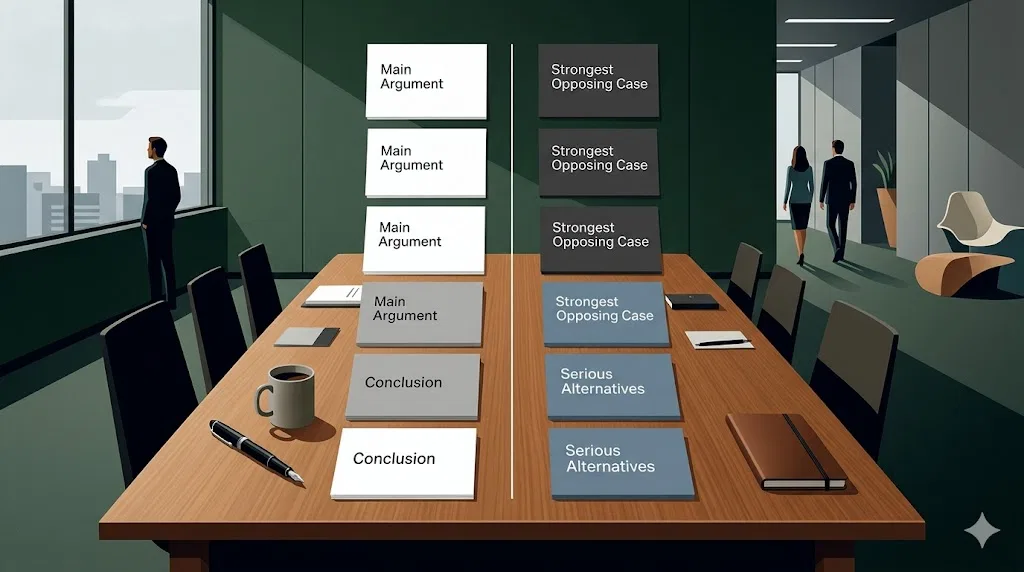
A strong-objection routine is more demanding. It asks: if an intelligent, well-informed critic thought our conclusion was wrong, what would their best argument be? What evidence would they emphasise? Which assumption would they attack first? What would they say we are underestimating?
That distinction is close to what people now call steelmanning: constructing the most persuasive version of the opposing case before responding to it. In analytical decision-making, the value is not politeness for its own sake. It is diagnostic. A weak objection tells you little; a strong objection reveals where your conclusion is load-bearing. If your decision depends on a market growing quickly, a team delivering on schedule, a source being reliable, or a policy working as intended, the strongest objection points to the assumption that needs testing first.
This is why “strong objections before you decide” belongs inside improving analytical skills rather than simply communication skills. It changes the sequence of thought. Instead of deciding first and defending afterwards, you expose the decision to organised challenge while revision is still cheap.
Steelman the opposition
Steelmanning is most useful when the issue is emotionally attractive, socially loaded, or already surrounded by a preferred story. The stronger your attachment to a conclusion, the more tempting it is to answer only the weakest critics. A steelman reverses that habit.
A practical steelman has three parts. First, state the opposing view in language its own supporters would recognise. Second, identify the evidence or values that make it plausible. Third, name the condition under which it might beat your current conclusion. For example, if you favour launching a product quickly, the steelman is not “some cautious people hate risk”. It might be: “The strongest case against launching now is that early failure would damage trust, support capacity is not ready, and a smaller private release would produce better evidence without creating public expectations.”
That kind of objection is harder to brush aside because it does not caricature the critic. It also separates two questions that are often blurred: whether the goal is desirable, and whether the chosen route is robust.
The same principle appears in structured analytic work. Analysis of Competing Hypotheses, associated with former CIA analyst Richards Heuer, asks analysts to compare multiple plausible explanations against the evidence rather than build a case for the hypothesis that first seems likely. A primer on the method describes it as evaluating plausible and mutually exclusive hypotheses, while Heuer’s own work stresses that alternative hypotheses should be carefully considered, especially those not easily disproved by available information.[Futuribles]futuribles.comAnalysis of Competing HypothesesAnalysis of Competing HypothesesSeptember 4, 2019 — Analysis of Competing Hypotheses (ACH) is an intelligence analysis method b… The practical lesson is simple: do not merely ask whether your conclusion has support. Ask whether another conclusion explains the same evidence as well or better.
Steelmanning is especially powerful when it produces a sentence like this: “The best case against us is not that we are stupid; it is that we are relying on an assumption we have not yet earned.” That sentence often marks the beginning of better thinking.
Use objections constructively
The main danger with objections is that they turn into theatre. A team appoints a critic, everyone waits for the ritual challenge, and then the original plan continues unchanged. Constructive objection has to be built into the decision process, not added as a decorative final step.
One well-known method is the pre-mortem. Gary Klein describes it as an exercise after a team has been briefed on a plan: members imagine the plan has failed and then generate the threats and hurdles that could explain the failure.[garyklein]gary-klein.comOpen source on gary-klein.com. In his Harvard Business Review account, the team is asked to assume the project has already failed and then write down every plausible reason, including concerns people might otherwise avoid mentioning because they seem impolitic.[Harvard Business Review]hbr.orgperforming a project premortemperforming a project premortem The psychological move is important: it gives permission to surface doubts without making the doubter seem disloyal.
A pre-mortem works because it changes the question. “Will this fail?” invites reassurance. “It has failed; what happened?” invites diagnosis. The second question often uncovers operational problems that ordinary optimism hides: dependence on one supplier, weak user adoption, unclear ownership, unrealistic timing, political resistance, missing data, or a hidden incentive that will push people away from the intended behaviour.
A second method is “consider the opposite”. In medical and investigative settings, debiasing literature describes this as deliberately seeking evidence that would support a decision opposite to the initial impression.[PMC]pmc.ncbi.nlm.nih.govOpen source on nih.gov. A 2021 study in criminal investigation examined “consider the opposite” as a cognitive support strategy for detectives’ professional judgement, grounding the method in the need to counter known shortcomings in investigative decision-making.[Sage Journals]journals.sagepub.comOpen source on sagepub.com. The method is modest but useful: before concluding, ask what you would look for if your current answer were false.
A third method is structured devil’s advocacy. In group decisions, devil’s advocacy and dialectical inquiry have been studied as ways to introduce cognitive conflict before commitment. A classic strategic decision-making study found that groups using dialectical inquiry and devil’s advocacy made higher-quality decisions than consensus groups, while later summaries note that these approaches can reduce process losses in face-to-face decision teams.[JSTOR]jstor.orgExperiential Effects of Dialectical Inquiry, Devil's Advocacy,Experiential Effects of Dialectical Inquiry, Devil's Advocacy, The key is structure. A devil’s advocate who merely irritates the room is not enough; the role must be authorised to test assumptions, request evidence, and force comparison with alternatives.
Constructive objections should therefore be specific enough to change the decision. A good objection does at least one of the following:
- identifies a hidden assumption;
- points to missing evidence;
- names a plausible failure path;
- reveals a stakeholder whose incentives have been ignored;
- compares the preferred option with a credible alternative;
- states what would make the current conclusion wrong.
The test is not whether the objection is negative. The test is whether it improves the next version of the decision.
When challenge prevents expensive confidence
The clearest value of strong objections appears in decisions where consensus feels comforting but is not evidence. Public inquiries, corporate post-mortems, intelligence failures and project failures often show the same pattern: a group had reasons to worry, but the process rewarded alignment more than challenge.
The UK Covid-19 Inquiry’s Module 1 report, published on 18 July 2024, examined the United Kingdom’s resilience and preparedness before the pandemic.[UK Covid-19 Inquiry]covid19.public-inquiry.ukOpen source on public-inquiry.uk. Reporting on the inquiry highlighted Baroness Hallett’s concern that groupthink and insufficient external challenge weakened preparedness, including a tendency to settle around conventional assumptions about pandemic risk.[The Guardian]theguardian.comOpen source on theguardian.com. One resulting recommendation was wider, more systematic use of red teams: groups designed to challenge official thinking rather than reinforce internal consensus.[UK Covid-19 Inquiry]covid19.public-inquiry.ukinquiry recommendationsinquiry recommendations
That example matters beyond pandemic policy because it shows the organisational version of a personal thinking problem. If everyone around a decision is rewarded for producing a single confident recommendation, the system may suppress exactly the information leaders need most: the best case that the recommendation is incomplete, over-optimistic, too narrow, or aimed at the wrong threat.
The same pattern appears in business decision guidance. Daniel Kahneman, Dan Lovallo and Olivier Sibony argued in Harvard Business Review that strategic decisions are vulnerable to judgement biases, and proposed a checklist for leaders to detect defects in recommendations before accepting them.[Harvard Business Review]hbr.orgHarvard Business Review The Big Idea: Before You Make That Big Decision…Harvard Business Review The Big Idea: Before You Make That Big Decision… Their checklist includes questions about whether credible alternatives have been considered, whether dissenting opinions were explored, and whether the team may have fallen in love with its proposal.[ResearchGate]researchgate.netResearch Gate(PDF) Before you make that big decisionResearch Gate(PDF) Before you make that big decision
The point is not that every decision needs a formal inquiry, red team, or consulting-style checklist. It is that confidence should be treated as a product of testing, not a substitute for it. A decision that has survived strong objections deserves more trust than one that has merely avoided them.
Decide after challenge
The purpose of strong objections is better commitment, not endless hesitation. After the challenge stage, the decision-maker still has to decide. The difference is that the decision should now be clearer about its risks, assumptions and triggers for revision.
A useful final decision statement has four parts:
- The conclusion: what you will do or believe for now.
- The strongest objection: the best case against that conclusion.
- The answer to the objection: why the conclusion still holds, or how the plan has changed.
- The tripwire: what evidence would cause you to pause, reverse or re-open the decision.
For example: “We will proceed with the launch, but the strongest objection is that support demand may exceed capacity and damage trust. We have reduced the launch audience, added support staffing, and set a tripwire: if response times exceed 24 hours for more than two days, we stop expanding access.”
This format prevents two common failures. The first is performative scepticism, where objections are heard but never connected to action. The second is brittle confidence, where a decision is made with no clear sign of what would count as disconfirming evidence.
The “tripwire” is especially important because people often become more committed after acting. Sunk costs, public promises and team identity can all make later revision harder. A pre-decision tripwire preserves intellectual honesty by deciding in advance what kind of evidence matters.

A practical routine for stronger decisions
For everyday analytical work, the practice can be short. The aim is to insert a disciplined challenge before the moment of commitment.
Start by writing your current conclusion in one sentence. Then write the strongest objection in a second sentence, using language that a serious critic would accept. Do not let yourself write a straw man. Next, list the two or three assumptions that must be true for your conclusion to hold. For each one, ask what evidence would weaken it. Finally, decide whether the objection changes the conclusion, changes the plan, or simply becomes a risk to monitor.
For group decisions, make the challenge visible and authorised. Give one person the role of finding the strongest objection, but do not make them the only person allowed to dissent. Ask participants to write risks privately before discussion, because private generation can surface concerns that hierarchy or politeness would otherwise suppress. Then require the final recommendation to include the best rejected alternative and the reason it was rejected.
For personal decisions, use a lighter version:
- Best critic: “What would the smartest person who disagrees say?”
- Opposite evidence: “What would I notice if my current answer were wrong?”
- Failure story: “Imagine this went badly. What caused it?”
- Revision point: “What would make me change course?”
These questions are small, but they create a valuable pause. They move thinking from defence to examination.
The limits of objection-seeking
Strong objections are powerful, but they can be misused. The first misuse is cynical obstruction: raising objections to avoid responsibility, delay action, or protect the status quo. A strong objection should clarify the decision, not make every option seem equally hopeless.
The second misuse is false balance. Some objections are weak, unsupported or irrelevant. Steelmanning does not mean pretending that every position has equal evidential weight. It means giving serious alternatives their strongest fair hearing, then judging them.
The third misuse is social punishment disguised as rigour. If the person raising objections is treated as negative, disloyal or difficult, the method will fail. Research and practice on devil’s advocacy repeatedly point to the need for an explicit role and a process that legitimises challenge rather than leaving dissenters exposed.[LSA Global]lsaglobal.comLSA Global How Teams Avoid Groupthink: 5 Research-Backed StepsLSA Global How Teams Avoid Groupthink: 5 Research-Backed Steps
The fourth misuse is overconfidence in debiasing itself. Reviews of debiasing research argue that some interventions can help, but also stress the difficulty of reducing confirmation bias reliably in real-world settings.[PubMed]pubmed.ncbi.nlm.nih.govOpen source on nih.gov. Knowing the name of a bias is not the same as correcting it. The value comes from procedures that change what people actually do before deciding.
What changes when objections come first
The habit of seeking strong objections changes the emotional feel of thinking. Instead of treating criticism as a threat to identity, it treats criticism as a stress test. Instead of asking, “Can I defend this?” it asks, “What would I learn if this were wrong?” That shift is small enough to use in ordinary decisions and strong enough to improve serious ones.
It also changes the quality of confidence. Untested confidence is often just fluency: the conclusion feels smooth because the mind has not met resistance. Tested confidence is different. It has encountered a credible rival, named the main uncertainty, and decided anyway.
For improving thinking and analytical skills, this is the central payoff. Strong objections before you decide do not guarantee the right answer. They make it harder to be wrong for the most avoidable reason: because you only listened to the case in your favour.
eBay marketplace picks
Marketplace Samples
Live-tested eBay searches with available results related to this page.

Endnotes
1.
Source: pages.ucsd.edu
Title: Confirmation Bias: A Ubiquitous Phenomenon in Many
Link:https://pages.ucsd.edu/~mckenzie/nickersonConfirmationBias.pdf
Source snippet
October 6, 2004 — by RS Nickerson · 1998 · Cited by 12455 — Confirmation bias, as the term is typically used in the psychological literat...
Published: October 6, 2004
2.
Source: futuribles.com
Title: Analysis of Competing Hypotheses
Link:https://www.futuribles.com/wp-content/uploads/related-documents/analysis-of-competing-hypotheses.pdf?postId=73706
Source snippet
Analysis of Competing HypothesesSeptember 4, 2019 — Analysis of Competing Hypotheses (ACH) is an intelligence analysis method b...
Published: September 4, 2019
3.
Source: gary-klein.com
Link:https://www.gary-klein.com/premortem
4.
Source: researchgate.net
Link:https://www.researchgate.net/publication/3229642_Performing_a_Project_Premortem
5.
Source: pmc.ncbi.nlm.nih.gov
Link:https://pmc.ncbi.nlm.nih.gov/articles/PMC3786644/
6.
Source: jstor.org
Title: Experiential Effects of Dialectical Inquiry, Devil’s Advocacy,
Link:https://www.jstor.org/stable/256567
7.
Source: researchgate.net
Title: Research Gate(PDF) Before you make that big decision
Link:https://www.researchgate.net/publication/51453002_Before_you_make_that_big_decision
8.
Source: open.edu
Link:https://www.open.edu/openlearn/money-business/leadership-management/difference-and-challenge-teams/content-section-5
9.
Source: consensus.app
Link:https://consensus.app/search/dialectical-inquiry-and-devils-advocate-techniques/sT0kOX82Tk–2qRgXR0Auw/
10.
Source: researchgate.net
Link:https://www.researchgate.net/publication/328432468_From_Devil%27s_Advocate_to_Crime_Fighter_Confirmation_Bias_and_Debiasing_Techniques_in_Prosecutorial_Decision_Making
11.
Source: researchgate.net
Link:https://www.researchgate.net/publication/355070855_Project_Pre-mortem_using_Prospective_Hindsight_An_Unexplored_Tool_to_address_Healthcare_Projects_Implementation_barriers
12.
Source: researchgate.net
Link:https://www.researchgate.net/publication/339074064%27Consider_the_Opposite%27-Effects_of_Elaborative[Feedback
13.
Source: researchgate.net
Link:https://www.researchgate.net/publication/245586859_Giving_Debiasing_Away_Can_Psychological_Research_on_Correcting_Cognitive_Errors_Promote_Human_Welfare
14.
Source: researchgate.net
Link:https://www.researchgate.net/publication/387476306_Confirmation_Bias_in_Decision-making_Implications_in_Finance_Business_and_Digital_Media
15.
Source: researchgate.net
Link:https://www.researchgate.net/profile/Colin-Macdougall-2/publication/240698190_The_Devil%27s_Advocate_A_Strategy_to_Avoid_Groupthink_and_Stimulate_Discussion_in_Focus_Groups/links/54e26a1e0cf2c3e7d2d3a1ca/The-Devils-Advocate-A-Strategy-to-Avoid-Groupthink-and-Stimulate-Discussion-in-Focus-Groups.pdf
16.
Source: avesis.medipol.edu.tr
Link:https://avesis.medipol.edu.tr/file?id=893d9005-2c62-4a44-8d5b-707771c1f18b
17.
Source: hbsp.harvard.edu
Title: R1106B PDF ENG
Link:https://www.hbsp.harvard.edu/product/R1106B-PDF-ENG
18.
Source: journals.sagepub.com
Link:https://journals.sagepub.com/doi/abs/10.1037/1089-2680.2.2.175
Source snippet
Sage JournalsConfirmation Bias: A Ubiquitous Phenomenon in Many...by RS Nickerson · 1998 · Cited by 12455 — The author reviews evidence...
19.
Source: hbr.org
Title: performing a project premortem
Link:https://hbr.org/2007/09/performing-a-project-premortem
20.
Source: journals.sagepub.com
Link:https://journals.sagepub.com/doi/10.1177/0032258X211038888
21.
Source: covid19.public-inquiry.uk
Link:https://covid19.public-inquiry.uk/reports/module-1-report-the-resilience-and-preparedness-of-the-united-kingdom/
22.
Source: GOV.UK
Title: uk covid 19 inquiry resilience and preparedness module 1 report
Link:https://www.gov.uk/government/publications/uk-covid-19-inquiry-resilience-and-preparedness-module-1-report
23.
Source: theguardian.com
Link:https://www.theguardian.com/uk-news/article/2024/jul/18/covid-inquiry-hallett-prescribes-red-teams-as-antidote-to-flawed-thinking
24.
Source: theguardian.com
Link:https://www.theguardian.com/uk-news/article/2024/jul/18/hancock-and-hunt-failed-to-prepare-uk-for-pandemic-covid-inquiry-finds
25.
Source: covid19.public-inquiry.uk
Title: inquiry recommendations
Link:https://covid19.public-inquiry.uk/inquiry-recommendations/
26.
Source: gov.scot
Title: Scottish Government9. Red teams
Link:https://www.gov.scot/publications/uk-covid-19-inquiry-module-1-report-scottish-government-response/pages/10/
27.
Source: hbr.org
Title: Harvard Business Review The Big Idea: Before You Make That Big Decision…
Link:https://hbr.org/2011/06/the-big-idea-before-you-make-that-big-decision
28.
Source: lsaglobal.com
Title: LSA Global How Teams Avoid Groupthink: 5 Research-Backed Steps
Link:https://lsaglobal.com/how-teams-avoid-groupthink/
29.
Source: pubmed.ncbi.nlm.nih.gov
Link:https://pubmed.ncbi.nlm.nih.gov/26158987/
30.
Source: journals.sagepub.com
Title: j.1745 6924.2009.01144.x
Link:https://journals.sagepub.com/doi/abs/10.1111/j.1745-6924.2009.01144.x
31.
Source: dictionary.cambridge.org
Link:https://dictionary.cambridge.org/dictionary/english/consider
32.
Source: dictionary.cambridge.org
Link:https://dictionary.cambridge.org/dictionary/english/pre
33.
Source: GOV.UK
Title: uk government response to the covid 19 inquiry module 1 report html
Link:https://www.gov.uk/government/publications/uk-government-response-to-the-covid-19-inquiry-module-1-report/uk-government-response-to-the-covid-19-inquiry-module-1-report-html
34.
Source: journals.sagepub.com
Link:https://journals.sagepub.com/doi/abs/10.1177/0032258X211038888
35.
Source: journals.sagepub.com
Title: j.1745 6924.2009.01144.x
Link:https://journals.sagepub.com/doi/10.1111/j.1745-6924.2009.01144.x
36.
Source: journals.sagepub.com
Link:https://journals.sagepub.com/doi/10.1080/17470218.2014.914547
37.
Source: journals.sagepub.com
Link:https://journals.sagepub.com/doi/10.1177/105960119101600207
38.
Source: pmc.ncbi.nlm.nih.gov
Link:https://pmc.ncbi.nlm.nih.gov/articles/PMC8659691/
39.
Source: pmc.ncbi.nlm.nih.gov
Link:https://pmc.ncbi.nlm.nih.gov/articles/PMC10219317/
40.
Source: hbr.org
Title: before you make that big decision
Link:https://hbr.org/2013/06/before-you-make-that-big-decision
41.
Source: hbr.org
Link:https://hbr.org/2026/06/our-favorite-management-tips-on-decision-making
42.
Source: youtube.com
Title: Consider the Opposite
Link:https://www.youtube.com/watch?v=ieVaeYVaOrc
43.
Source: youtube.com
Link:https://www.youtube.com/watch?v=sbVmos5dkJ0
44.
Source: Wikipedia
Title: Analysis of competing hypotheses
Link:https://en.wikipedia.org/wiki/Analysis_of_competing_hypotheses
45.
Source: inquirytracker.uk
Link:https://www.inquirytracker.uk/inquiries/14/
46.
Source: theguardian.com
Title: hindsight in advance premortem this column change life
Link:https://www.theguardian.com/lifeandstyle/2014/may/10/hindsight-in-advance-premortem-this-column-change-life
47.
Source: edemocracy.northyorks.gov.uk
Title: northyorks.gov.uk COVI D-19 Inquiry: Module 1
Link:https://edemocracy.northyorks.gov.uk/documents/s43409/COVID-19%2BInquiry%2BModule%2B1%2BOutcomes%2B2024-12-18.pdf
48.
Source: ldoceonline.com
Link:https://www.ldoceonline.com/dictionary/consider
Additional References
49.
Source: youtube.com
Link:https://www.youtube.com/watch?v=G-m6dKMS3kc
Source snippet
How Run a Premortem Before Your Next Team Project...
50.
Source: youtube.com
Title: Sources of Power: How People Make Decisions
Link:https://www.youtube.com/watch?v=n5qs-kJBIwU
Source snippet
The Confirmation Bias: Think Logically And Remove Bias With Examples...
51.
Source: greydynamics.com
Link:https://greydynamics.com/a-guide-to-structured-analytic-techniques-sats-for-intelligence/
52.
Source: linkedin.com
Link:https://www.linkedin.com/posts/damiancranney_the-big-idea-before-you-make-that-big-decision-activity-7469668812460724224-z0-j
53.
Source: merriam-webster.com
Link:https://www.merriam-webster.com/dictionary/consider
54.
Source: dictionary.com
Link:https://www.dictionary.com/browse/consider
55.
Source: collinsdictionary.com
Link:https://www.collinsdictionary.com/dictionary/english/consider
56.
Source: thedecisionlab.com
Link:https://thedecisionlab.com/biases/confirmation-bias
57.
Source: copernicanrevolution.org
Link:https://copernicanrevolution.org/cognitive-psychology/confirmation-bias
58.
Source: explorable.com
Link:https://explorable.com/confirmation-bias
Topic Tree