Within Pressure
When anger turns blame into proof
Anger can reveal injustice, but it can also make responsibility feel proven before the evidence has been tested.
On this page
- How anger raises certainty and action readiness
- Why blame can outrun evidence in disputes and crises
- Cooling off rules for high stakes judgments
Page outline Jump by section
Introduction
Anger is often treated as the enemy of good judgement, but that is too simple. Anger can be an accurate response to injustice, deception or genuine harm. It can focus attention on problems that would otherwise be ignored and motivate people to challenge abuse or defend others. The danger arises when anger changes not only what feels important, but also what feels already proven. Instead of encouraging investigation, it can create a powerful sense that responsibility has already been established and that further evidence is merely confirmation. This shift matters because many of the most consequential decisions—disciplinary actions, legal disputes, political conflicts, workplace investigations and personal confrontations—require separating justified moral concern from justified factual certainty. Research on emotion and judgement shows that anger is associated with unusually high feelings of certainty, personal control and readiness for action, making it distinct from many other negative emotions.[Frank Baumgartner]unc.eduLerner 2001 FearAngerRiskS. Lerner & D. Keltner, 2000), the authors predicted and found that fear and anger have opposite effects on risk

How anger raises certainty and action readiness
Not all negative emotions influence thinking in the same way. Fear tends to highlight uncertainty and encourage caution. Anger, by contrast, is commonly associated with appraisals that someone is responsible, the situation is understandable and action is both possible and justified. This combination makes anger especially influential in shaping confidence rather than merely increasing emotional intensity.[Frank Baumgartner]unc.eduLerner 2001 FearAngerRiskS. Lerner & D. Keltner, 2000), the authors predicted and found that fear and anger have opposite effects on risk
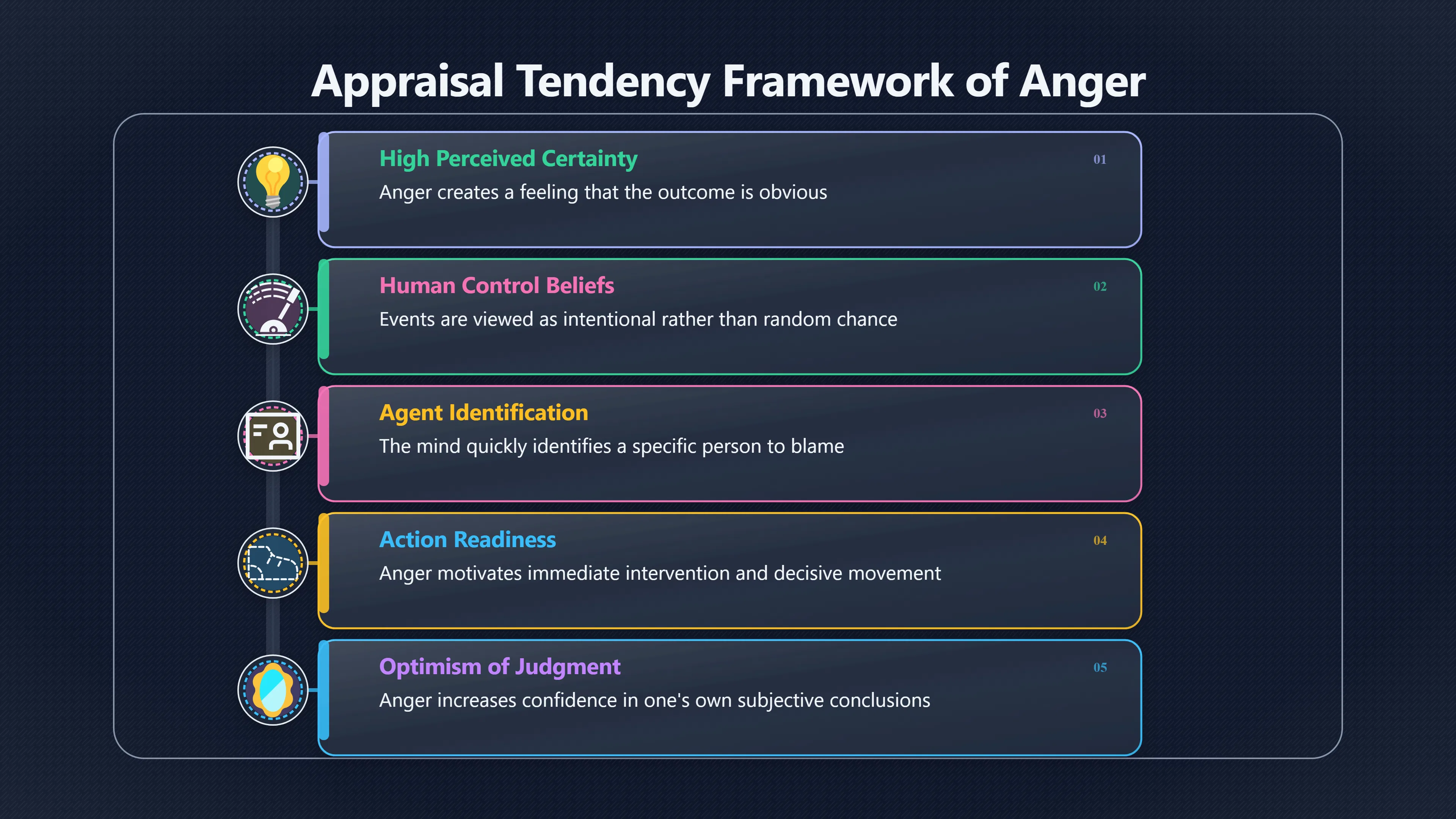
The appraisal-tendency framework, developed by psychologists Jennifer Lerner and colleagues, explains why. Rather than treating emotions as simply positive or negative, the framework argues that each emotion carries characteristic patterns of appraisal. Anger is linked with:
- high perceived certainty about what happened;
- strong beliefs that events are under human control rather than due to chance;
- a tendency to identify responsible agents;
- increased confidence that decisive action is appropriate.
These appraisals often persist even when the anger originated elsewhere. Someone angered by one event may unconsciously carry that mindset into judging an unrelated dispute or risk.[jenniferlerner.com]jenniferlerner.comThe appraisal-tendency frameworkJennifer Lernerby S Han · Cited by 1101 — Lerner and Keltner (2000, 2001) proposed the Appraisal-Tendency. Framework (ATF) as a basis for…
This helps explain why angry people often express unusually high confidence despite possessing no more information than calmer observers. The feeling of certainty is itself part of the emotional state rather than independent evidence that the conclusion is correct.[Wiley Online Library]onlinelibrary.wiley.comWiley Online LibraryAppraisal Tendencies Shape Anger's Influence on Cognitionby JS Lerner · 2006 · Cited by 1571 — Lerner and Keltner (20…
Why blame can outrun evidence in disputes and crises
When people become angry, they often shift from asking “What happened?” to asking “Who caused this?” That transition can be useful if responsibility is genuinely clear, but it also creates predictable reasoning risks.
One well-studied pattern is a stronger tendency to explain behaviour by stable personal character rather than circumstances. Instead of asking whether stress, confusion, poor information or organisational failures contributed, the angry observer becomes more likely to conclude that the person involved is dishonest, malicious or incompetent.[Frank Baumgartner]unc.eduLerner 2001 FearAngerRiskS. Lerner & D. Keltner, 2000), the authors predicted and found that fear and anger have opposite effects on risk
Several mechanisms reinforce this process.
Ambiguity feels smaller than it really is. When evidence is incomplete, anger can make uncertainty feel temporary rather than fundamental. Missing information is interpreted as a gap that will eventually support the initial judgement instead of a reason to suspend judgement.[jenniferlerner.com]jenniferlerner.comThe appraisal-tendency frameworkJennifer Lernerby S Han · Cited by 1101 — Lerner and Keltner (2000, 2001) proposed the Appraisal-Tendency. Framework (ATF) as a basis for…
Contradictory evidence receives greater suspicion. Information inconsistent with the emerging blame narrative may be dismissed as excuses, manipulation or bias before it has been evaluated on its merits. This does not require deliberate bad faith; the emotional state changes how credibility is assessed.[Wiley Online Library]onlinelibrary.wiley.comWiley Online LibraryAppraisal Tendencies Shape Anger's Influence on Cognitionby JS Lerner · 2006 · Cited by 1571 — Lerner and Keltner (20…
Action begins to feel morally urgent. Anger naturally prepares people to intervene rather than observe. That urgency can reduce willingness to tolerate the delays needed for careful investigation, creating pressure to act before the factual picture has stabilised.[jenniferlerner.com]jenniferlerner.comThe appraisal-tendency frameworkJennifer Lernerby S Han · Cited by 1101 — Lerner and Keltner (2000, 2001) proposed the Appraisal-Tendency. Framework (ATF) as a basis for…
These tendencies help explain why public controversies often escalate rapidly after emotionally charged events. Early narratives may become psychologically compelling long before investigators have reconstructed timelines or verified competing accounts.
Why confidence is not the same as evidence
One of the most misleading features of anger is that it changes subjective certainty. People frequently experience the feeling that “it is obvious” who is responsible.
Subjective certainty, however, is not a reliable indicator of evidential strength.
In psychology, confidence and accuracy are related only imperfectly. Emotional states can increase confidence without improving the underlying quality of reasoning. Anger is particularly important because, unlike fear or sadness, it tends to increase optimism about one’s own judgement and willingness to accept risk. Studies comparing anger and fear found that angry participants judged uncertain situations differently despite having identical information.[Frank Baumgartner]unc.eduLerner 2001 FearAngerRiskS. Lerner & D. Keltner, 2000), the authors predicted and found that fear and anger have opposite effects on risk
This distinction is practically important because investigations frequently begin under emotionally charged conditions:
- allegations after accidents;
- workplace misconduct claims;
- political scandals;
- social media controversies;
- emergency response failures.
In each case, anger may correctly signal that something serious deserves attention while simultaneously overstating how much is already known.

How anger interacts with group conflict
Anger rarely remains confined to judging individuals. In conflicts between groups, it can reshape perceptions of entire categories of people.
Once an out-group becomes associated with blame, observers often generalise beyond the specific individuals involved. New information is filtered through existing expectations, making ambiguous behaviour appear intentionally hostile while benevolent behaviour receives less attention or greater scepticism. These effects contribute to stereotyping, reduced trust and escalating cycles of mutual accusation.[Frank Baumgartner]unc.eduLerner 2001 FearAngerRiskS. Lerner & D. Keltner, 2000), the authors predicted and found that fear and anger have opposite effects on risk
This helps explain why prolonged conflicts often become increasingly resistant to factual correction. Each new incident is interpreted through an already established blame framework rather than evaluated independently.
When anger improves judgement
Recognising these risks does not require treating anger as irrational.
Anger often identifies genuine moral problems before detached analysis does. Many historical reforms began because people refused to remain emotionally neutral about injustice, corruption or abuse. In everyday life, anger can motivate reporting misconduct, defending vulnerable people or refusing unfair treatment.
The key distinction is between:
- anger as a signal that something deserves investigation; and
- anger as proof that the investigation has already reached its conclusion.
The first supports good reasoning. The second bypasses it.
Cooling-off rules for high-stakes judgments
When important decisions carry legal, professional or personal consequences, delaying final conclusions can improve reasoning without suppressing legitimate moral concern.
Useful safeguards include:
- Separate observations from conclusions. Write down exactly what is known before listing interpretations or suspected motives.
- Ask what evidence would change your mind. If no imaginable evidence could alter the judgement, certainty may have become detached from investigation.
- Generate at least one plausible alternative explanation. This does not mean treating every explanation as equally likely; it simply prevents the first narrative from becoming invisible.
- Delay irreversible actions where possible. Temporary restraint is often less costly than acting on an incorrect attribution of responsibility.
- Seek independent review. Someone who was not emotionally involved may notice missing evidence, overlooked assumptions or inconsistencies.
These practices do not eliminate bias, but they slow the transition from emotional reaction to factual certainty.

The practical lesson for analytical thinking
Anger deserves attention because it often reflects values worth defending. The analytical challenge is not to eliminate anger but to prevent it from becoming an unconscious substitute for evidence.
A useful mental distinction is simple:
- “I am angry” describes an emotional state.
- “Someone is responsible” is a factual claim.
- “The evidence establishes responsibility” is an evidential judgement.
Those three statements frequently occur together, but they are not logically identical. Strong anger may make responsibility feel obvious, yet good reasoning still requires the same standards of evidence that would be expected if the emotional intensity were absent. Research consistently suggests that anger increases feelings of certainty and readiness to act; recognising that influence is one of the most practical ways to reduce premature conclusions while preserving justified moral concern.[Frank Baumgartner+2Wiley Online Library]unc.eduLerner 2001 FearAngerRiskS. Lerner & D. Keltner, 2000), the authors predicted and found that fear and anger have opposite effects on risk
Amazon book picks
Further Reading
Books and field guides related to When anger turns blame into proof. Use these as the next step if you want deeper reading beyond the article.
Mistakes Were Made (but Not by Me)
Shows how blame and self-justification distort evidence.
eBay marketplace picks
Marketplace Samples
Example marketplace items related to this page. Use the search link to explore similar finds on eBay.




Endnotes
1.
Source: onlinelibrary.wiley.com
Link:https://onlinelibrary.wiley.com/doi/pdf/10.1002/bdm.515
Source snippet
Wiley Online LibraryAppraisal Tendencies Shape Anger's Influence on Cognitionby JS Lerner · 2006 · Cited by 1571 — Lerner and Keltner (20...
2.
Source: jenniferlerner.com
Title: The appraisal-tendency framework
Link:https://jenniferlerner.com/wp-content/uploads/2017/08/20.Feelings-and-Consumer-Decision-Making.pdf
Source snippet
Jennifer Lernerby S Han · Cited by 1101 — Lerner and Keltner (2000, 2001) proposed the Appraisal-Tendency. Framework (ATF) as a basis for...
3.
Source: fbaum.unc.edu
Title: Lerner 2001 FearAngerRisk
Link:https://fbaum.unc.edu/[teaching
Source snippet
S. Lerner & D. Keltner, 2000), the authors predicted and found that fear and anger have opposite effects on risk...
Additional References
4.
Source: psychologytoday.com
Link:https://www.psychologytoday.com/us/blog/psychologys-credibility-revolution/202409/the-associations-between-emotions-evaluations-and
Source snippet
The Associations Between Emotions, Evaluations, and RiskSep 28, 2024 — The appraisal-tendency framework suggested that emotions are assoc...
5.
Source: gruberpeplab.com
Title: Lecture13 Han2007 AppraisalTendencyFramework
Link:https://www.gruberpeplab.com/teaching/psych131_summer2013/documents/Lecture13_Han2007_AppraisalTendencyFramework.pdf
Source snippet
The Appraisal-Tendency Frameworkby S Han · 2007 · Cited by 1101 — This article presents the Appraisal-Tendency Framework (ATF; Lerner & K...
6.
Source: youtube.com
Title: Experts in Emotion 13.1 – Jennifer Lerner on Emotion and Judgment
Link:https://www.youtube.com/watch?v=hfAZbUDLTS8
Source snippet
How Anger Affects Thinking | Anger Management...
7.
Source: ideas.repec.org
Link:https://ideas.repec.org/p/hrv/hksfac/37143006.html
Source snippet
IDEAS/RePEcFeelings and Consumer Decision Making: Extending the...by J Lerner · 2007 · Cited by 227 — This article presents the Appraisa...
8.
Source: youtube.com
Title: How Anger Affects Thinking | Anger Management
Link:https://www.youtube.com/watch?v=qdI3fUB81K4
Source snippet
Jennifer Lerner on Emotions and Decision Making...
9.
Source: msbfile03.usc.edu
Title: appraising the atf final 1
Link:https://msbfile03.usc.edu/digitalmeasures/lisacava/intellcont/appraising%20the%20atf%20final-1.pdf
Source snippet
(ATF; Han, Lerner, & Keltner, 2007).Read more...
10.
Source: youtube.com
Title: Jennifer Lerner on Emotions and Decision Making
Link:https://www.youtube.com/watch?v=bxLgOQnBtjI
Source snippet
Brené Brown on Blame...
11.
Source: youtube.com
Title: Brené Brown on Blame
Link:https://www.youtube.com/watch?v=RZWf2_2L2v8
Source snippet
The Strange Psychology of Anger...
Topic Tree