Within Fluency Trap
Can the Idea Survive a New Example?
Near and far transfer show whether you can use a principle when the surface story, numbers or context changes.
On this page
- Near transfer with small changes
- Far transfer across different contexts
- How to design one new example yourself
Page outline Jump by section
Introduction
Knowing an idea only in the setting where you first learned it is not the same as understanding it. A reliable way to tell the difference is to ask whether the idea still works when the story, numbers, or context change. This is known as a transfer test: instead of repeating the original example, you apply the same underlying principle somewhere new. If your reasoning survives those changes, you probably understand the concept. If it falls apart, you may have memorised the example rather than the idea.
 Research on learning consistently treats transfer as one of the strongest indicators of meaningful understanding. Rather than asking, “Can you repeat what you saw?”, transfer asks, “Can you recognise the same structure when the surface details are different?” [nationalacademies.org]nationalacademies.orgChapter: 3 Learning and TransferProcesses of learning and the transfer of learning are central to understanding how people develop import…
Why a new example is a better test than the original
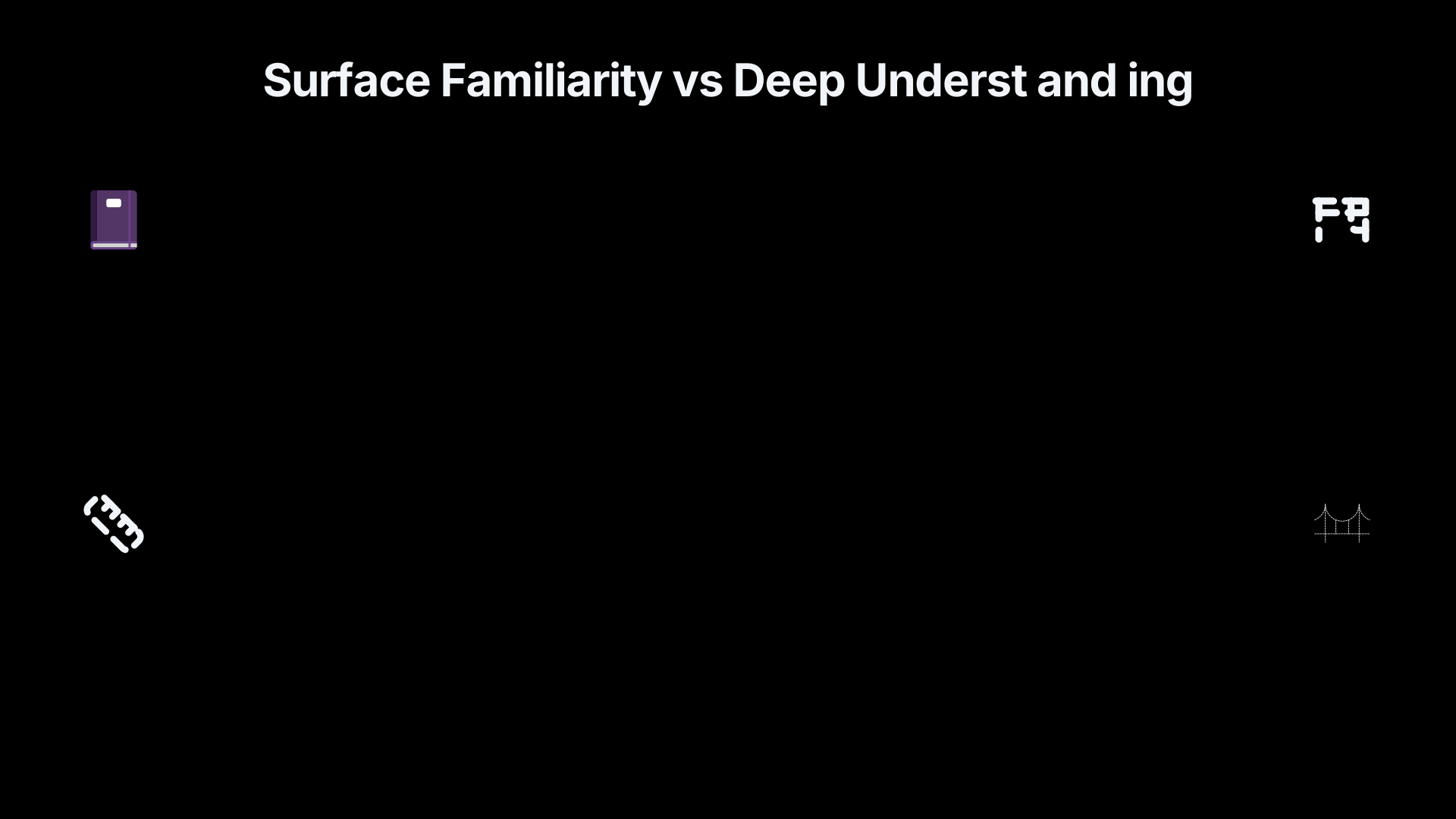
Worked examples are valuable because they reduce confusion while you are first learning. However, they can also create an illusion of mastery. The original numbers, wording and sequence become familiar, making it difficult to tell whether you have learned the underlying principle or simply remembered the example.
A transfer test deliberately removes those familiar cues. It changes details that should not matter while preserving the principle that does matter. Success therefore depends on recognising the structure of the problem rather than recalling its appearance.
For example:
- Memorising: “Compound interest works for this savings account example.”
- Understanding: “Compound growth follows the same mathematical principle whether the context is savings, population growth, debt or investment returns.”
The National Academies describe transfer as extending what has been learned in one setting to new situations, making it a central goal of effective learning rather than an optional extra. [nationalacademies.org]nationalacademies.orgChapter: 3 Learning and TransferProcesses of learning and the transfer of learning are central to understanding how people develop import…
Near transfer: can the idea survive small changes?
Near transfer keeps the underlying problem almost identical while altering surface features. These are often the first tests you should try because they isolate whether you understand the principle without making the task unnecessarily difficult.
Typical changes include:
- Different numbers.
- Different names or objects.
- A different order of information.
- Slightly altered wording.
- A new but closely related scenario.
Suppose you learn how to calculate percentages using a shop discount. A near-transfer question might instead ask about exam marks or tax rates. The arithmetic principle stays the same even though the story changes.
Near transfer matters because it separates genuine understanding from dependence on one memorised template. Students who can solve only the exact version they practised often struggle once superficial details change, even though the required reasoning is identical. [The Learning Scientists]learningscientists.orgThe Learning Scientists What's Transfer, and Why is it so Hard to Achieve?Part 1)June 2, 2016 — 2 Jun 2016 — A helpful distinction can be made between near and far transfer. Transfer can be conceptualized as a…
Far transfer: can the principle travel to a different world?
Far transfer is more demanding. Here the surface similarities become much weaker, and recognising the shared principle requires abstraction.
For instance, consider the idea of feedback loops.
A learner who truly understands the mechanism should recognise it in many different settings:
- A thermostat regulating room temperature.
- Predator and prey populations.
- Business inventory management.
- Social media recommendation systems.
- Personal habits that reinforce themselves.
The stories have little in common, but the causal structure is similar: outputs influence future inputs.
Researchers often describe transfer as existing on a continuum rather than as a simple near-versus-far distinction. Distance can arise from changes in subject matter, physical setting, time, purpose or the people involved. The farther those dimensions move from the original learning situation, the stronger the evidence that the learner has grasped an underlying principle rather than a single example. [rapunselshair.pbworks.com+2The Learning Scientists]rapunselshair.pbworks.comWhen and Where Do We Apply What We Learn?SM Barnett · 2002 · Cited by 3474 — 614 BARNETT AND CECI a school lesson, and the transfer test were to be conducted in a distant…
Importantly, far transfer is substantially harder than near transfer. Many teaching methods produce excellent performance on similar problems but much weaker performance when learners must recognise the same idea in unfamiliar contexts. [Carolina Digital Repository]cdr.lib.unc.eduCarolina Digital Repository Effects of Worked Examples on Far TransferCarolina Digital RepositoryEffects of Worked Examples on Far TransferJuly 16, 2013 — by YR Kim · 2013 · Cited by 1 — This study demonstra…

How to design your own transfer test
One of the most effective ways to check your understanding is to invent a new example before looking for one in a textbook.
A useful sequence is:
- Identify the core principle in one sentence.
- Remove every detail that is specific to the original example.
- Place the principle inside a different context.
- Predict what should happen.
- Explain why using the same reasoning as before.
For example:
Original example: Supply falls while demand stays constant, so prices rise.
Transfer version: A popular concert has fewer available tickets than expected.
The correct reasoning should emerge without relying on the original market example. If your explanation changes only because the story changed, your understanding may still be tied to the first example.
Another useful variation is to ask, “What details can I change without changing the answer?” That question forces you to separate essential features from incidental ones.
Common signs that an idea is still stuck to one example
Several patterns suggest that familiarity has been mistaken for understanding.
You may find yourself:
- Recognising the answer only after seeing familiar wording.
- Feeling lost when numbers are replaced.
- Believing two problems are different because they use different stories.
- Copying solution steps without knowing why each step works.
- Explaining an example correctly but failing to invent another one.
These failures usually reflect difficulty identifying the deep structure of the problem rather than a lack of effort. Transfer tests expose this weakness because they remove the cues that supported recognition.

Why transfer tests improve analytical thinking
Analytical thinking depends on recognising recurring patterns beneath changing appearances. Real decisions rarely arrive in the tidy form used during learning.
Business decisions rarely look exactly like textbook case studies. Medical diagnoses rarely match textbook examples perfectly. Historical events never repeat with identical actors or circumstances. Everyday reasoning requires deciding whether an old principle genuinely applies to a new situation.
Transfer testing therefore develops two valuable habits:
- Abstraction: identifying what is essential rather than what is merely present.
- Generalisation: applying principles cautiously across different contexts while recognising where important differences remain.
Research also suggests that learning activities encouraging learners to explain ideas to themselves, rather than simply following worked solutions, improve later transfer because they strengthen understanding of underlying relationships rather than isolated procedures. [mr barton maths]mrbartonmaths.commr barton mathsPromoting Transfer: Effects of Self-Explanation and Direct…February 2, 2006 — by B Rittle-Johnson · 2006 · Cited by 628…
A practical rule
Whenever you think you understand an idea, resist checking it with another example from the same chapter.
Instead, ask three questions:
- Can I solve the same problem after changing the numbers?
- Can I recognise the same principle inside a completely different story?
- Can I invent a fresh example that obeys the same rule?
If the answer to all three is yes, the idea has probably moved beyond familiarity. It is no longer attached to one example but has become knowledge that can travel into new situations—the strongest practical evidence of genuine understanding.
eBay marketplace picks
Marketplace Samples
Topic-anchored marketplace searches for visual, collectible, or second-hand items related to this page.



Endnotes
-
Source: nationalacademies.org
Link: https://www.nationalacademies.org/read/9853/chapter/6Source snippet
Chapter: 3 Learning and TransferProcesses of learning and the transfer of learning are central to understanding how people develop import...
-
Source: rapunselshair.pbworks.com
Title: When and Where Do We Apply What We Learn?
Link: https://rapunselshair.pbworks.com/f/barnett_2002.pdfSource snippet
SM Barnett · 2002 · Cited by 3474 — 614 BARNETT AND CECI a school lesson, and the transfer test were to be conducted in a distant...
-
Source: nationalacademies.org
Link: https://www.nationalacademies.org/read/9853/chapter/3Source snippet
How People Learn: Brain, Mind, Experience, and SchoolResearch on learning and transfer has uncovered important principles for structuring...
-
Source: nationalacademies.org
Link: https://www.nationalacademies.org/read/10067/chapter/7 -
Source: nationalacademies.org
Link: https://www.nationalacademies.org/read/24783/chapter/2Source snippet
Summary: There are many reasons to be curious about the way people learn, and the past several decades have seen an explosion of research...
-
Source: nationalacademies.org
Title: The National Academies.Read more
Link: https://www.nationalacademies.org/projects/DBASSE-BBCSS-13-06/publication/24783Source snippet
How People Learn II: Learners, Contexts, and Cultures 2018Driving progress for the benefit of society by providing independent, objective...
-
Source: nationalacademies.org
Title: The National
Link: https://www.nationalacademies.org/publications/9853Source snippet
How People Learn: Brain, Mind, Experience, and Schoolby National Research Council · 1999 · Cited by 6044 — Driving progress for the benef...
-
Source: learningscientists.org
Title: The Learning Scientists What’s Transfer, and Why is it so Hard to Achieve?
Link: https://www.learningscientists.org/blog/2016/6/2-1Source snippet
(Part 1)June 2, 2016 — 2 Jun 2016 — A helpful distinction can be made between near and far transfer. Transfer can be conceptualized as a...
Published: June 2, 2016
-
Source: cdr.lib.unc.edu
Title: Carolina Digital Repository Effects of Worked Examples on Far Transfer
Link: https://cdr.lib.unc.edu/downloads/np193b25tSource snippet
Carolina Digital RepositoryEffects of Worked Examples on Far TransferJuly 16, 2013 — by YR Kim · 2013 · Cited by 1 — This study demonstra...
Published: July 16, 2013
-
Source: mrbartonmaths.com
Link: https://mrbartonmaths.com/resourcesnew/8.%20Research/Self%20explanations/Self%20explanation%20-%20Rittle%20Johnson.pdfSource snippet
mr barton mathsPromoting Transfer: Effects of Self-Explanation and Direct...February 2, 2006 — by B Rittle-Johnson · 2006 · Cited by 628...
Published: February 2, 2006
-
Source: open.metu.edu.tr
Link: https://open.metu.edu.tr/bitstream/handle/11511/22891/index.pdfSource snippet
AND FAR TRANSFER LEARNING IN...by BG Tüker · 2013 · Cited by 4 — The purpose of the study is to explore the contributions of learning ta...
Additional References
-
Source: sdcoe.net
Link: https://www.sdcoe.net/ngss/evidence-based-practices/key-findings-from-how-people-learnSource snippet
Key Findings from How People LearnA fundamental insight about learning is that new understandings are constructed on a foundation of exis...
-
Source: nifdi.org
Link: https://www.nifdi.org/resources/88-news/kerry-hempenstall/758-near-and-far-transfer-in-cognitive-training.htmlSource snippet
Near and far transfer in cognitive trainingNear transfer occurs when skills learned in one context are applied to similar contexts, while...
-
Source: smu.edu
Link: https://www.smu.edu/provost/cte/resources/-/media/site/provost/cte/teachingresources/how-people-learn.pdfSource snippet
how people learn.pdfCurrent knowledge on learning and transfer (Chapter 3) and develop- ment (Chapter 4) provide important guidelines for...
-
Source: researchgate.net
Title: 331179824 How People Learn II Learners Contexts and Cultures
Link: https://www.researchgate.net/publication/331179824_How_People_Learn_II_Learners_Contexts_and_CulturesSource snippet
How People Learn II: Learners, Contexts, and Cultures2 May 2026 — The report summarized insights on the nature of learning in school-aged...
Published: May 2026
-
Source: m.cradall.org
Link: https://m.cradall.org/sites/default/files/How%20People%20Learn%20II.pdfSource snippet
People Learn II: Learners, Contexts, and CulturesLearn more about the National Academies of Sciences, Engineering, and Medicine...
-
Source: nifdi.org
Title: 758 near and far transfer in cognitive training
Link: https://www.nifdi.org/resources/hempenstall-blog/758-near-and-far-transfer-in-cognitive-training.htmlSource snippet
Near and far transfer in cognitive training25 Sept 2019 — Near transfer occurs when skills learned in one context are applied to similar...
-
Source: researchgate.net
Title: When and where do we apply what we learn?
Link: https://www.researchgate.net/publication/299037708_When_and_where_do_we_apply_what_we_learn_A_taxonomy_for_far_transferSource snippet
A taxonomy...Barnett and Ceci (2002) provide a comprehensive taxonomy distinguishing near transfer, where knowledge and skills apply acr...
-
Source: structural-learning.com
Title: transfer learning complete guide teachers
Link: https://www.structural-learning.com/post/transfer-learning-complete-guide-teachersSource snippet
Transfer of Learning: A Complete Guide6 days ago — Research from Barnett and Ceci (2002) shows near transfer works better than far transf...
-
Source: pmc.ncbi.nlm.nih.gov
Title: This metacognitive
Link: https://pmc.ncbi.nlm.nih.gov/articles/PMC9902256/Source snippet
Erring Improves Far Transfer of Learning More...by SSH Wong · 2023 · Cited by 28 — Barnett and Ceci's (2022) taxonomy, transfer can be v...
-
Source: peoplealchemy.com
Title: models of learning transfer
Link: https://peoplealchemy.com/blog/models-of-learning-transfer/Source snippet
11 Oct 2023 — Near and far transfer. In effect, the theory predicts that while near transfer takes place often, far transfer is much less...
Topic Tree