Within Online Claims
When Headlines Outrun the Evidence
Misleading headlines can turn limited findings into stronger conclusions than the article or study can honestly support.
On this page
- How headlines compress or exaggerate claims
- Signs that caveats are buried below the headline
- How to rewrite a claim in narrower terms
Page outline Jump by section
Introduction
Headlines are designed to compress complex information into a few words. That compression is useful, but it also creates a recurring problem: a headline can sound far more certain than the evidence underneath it actually is. Readers often remember the headline long after they have forgotten the details, meaning an exaggerated framing can shape beliefs even if the article itself later adds qualifications.
 This matters because evidence comes in different strengths. A small observational study, an experiment in mice, or a single statistical association cannot support the same level of certainty as a large, well-conducted randomised trial or a body of replicated research. Improving your analytical skills therefore means learning to distinguish what the headline claims from what the evidence genuinely demonstrates.
How headlines compress or exaggerate claims
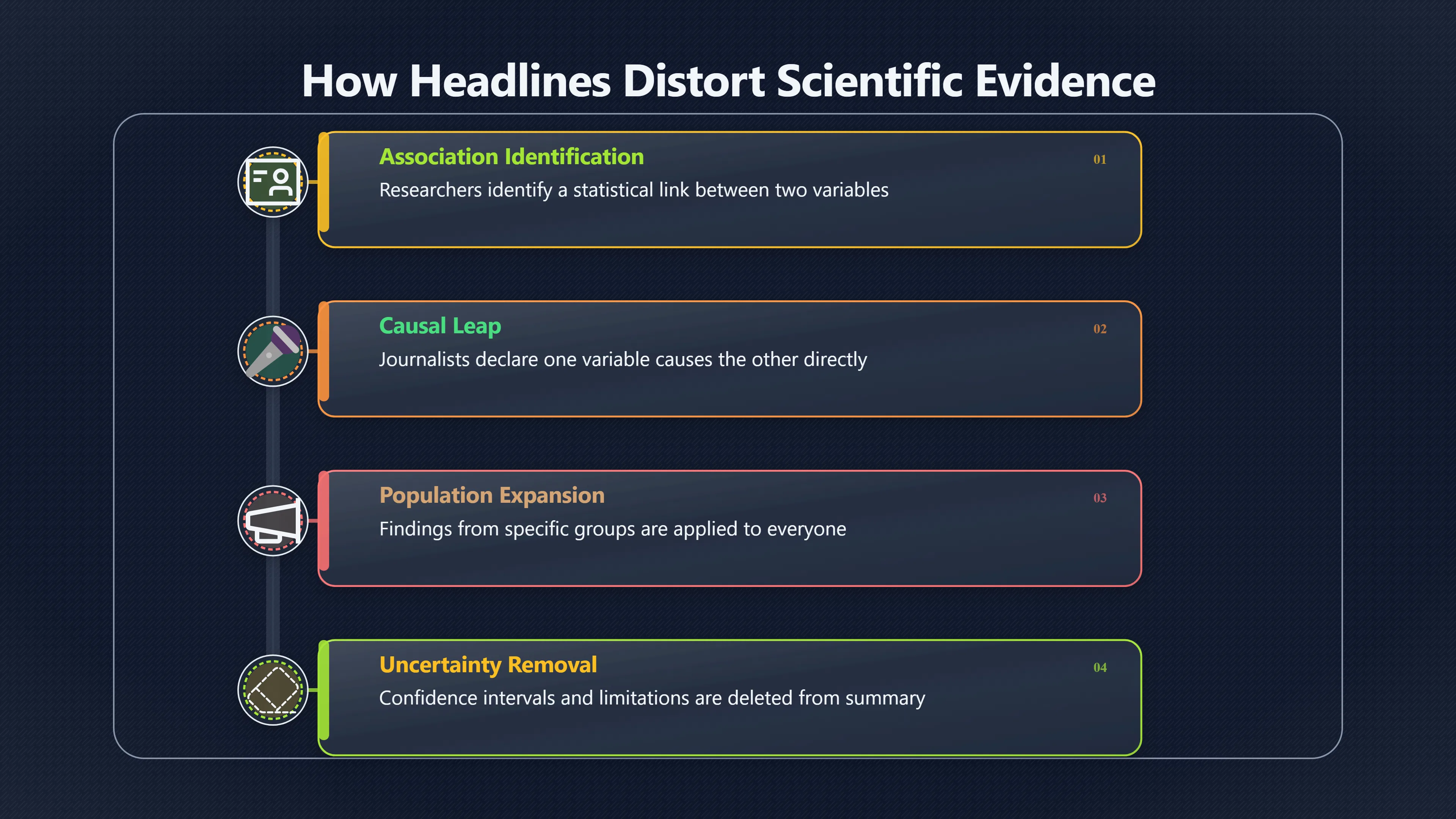
Most overstated headlines do not invent facts outright. Instead, they strengthen the relationship between the evidence and the conclusion.
Common forms of exaggeration include:
- Turning association into causation. A study finds that two variables are linked, but the headline declares that one causes the other.
- Treating preliminary findings as settled knowledge. Early research becomes “scientists prove”.
- Generalising beyond the study population. Results from one age group, country, or medical condition become claims about everyone.
- Extending animal or laboratory findings to humans. Research in mice or cell cultures becomes advice for people.
- Ignoring uncertainty. Confidence intervals, limitations, and competing explanations disappear from the summary.
Each step may seem small, yet together they can substantially change what readers believe the evidence shows.
Why the article is often more cautious than the headline
Journalists and editors face pressure to make stories concise and engaging. Headlines also have severe space limits. Unfortunately, the shortest wording is not always the most accurate.
A typical pattern looks like this:
Evidence in the studyHeadline version”People who reported eating more nuts had lower rates of disease.”“Eating nuts prevents disease.”“Researchers observed an association.”“Researchers discover the cause.”“This finding requires further study.”“Scientists have the answer.”
The article itself may explain that the study was observational, that alternative explanations exist, or that the effect was modest. Readers who stop at the headline never encounter those important qualifications.
Research into health and science reporting has repeatedly found that exaggeration often appears before journalists even write their stories. Studies comparing peer-reviewed papers, university press releases and subsequent news reports found that stronger claims in press releases were strongly associated with stronger claims in news coverage. Importantly, there was little evidence that exaggeration increased news uptake.[BMJ+2PMC]bmj.comexaggerated causal claims were associated with 2.7 news…
Signs that caveats are buried below the headline
A useful habit is to compare the certainty of the headline with the certainty of the evidence described later.
Warning signs include:
- The headline uses words such as “proves”, “shows”, “reveals”, “causes” while the article later says “may”, “is associated with”, “suggests”, or “researchers caution”.
- The headline gives behavioural advice that the researchers themselves never offered.
- The first paragraph is definitive, but the study limitations appear only near the end.
- Important methodological details—small sample size, observational design, or lack of replication—are mentioned only after several paragraphs.
- The article quotes independent experts expressing caution that the headline does not reflect.
The placement of caveats matters because many readers never reach the later paragraphs where the uncertainties are explained.
A concrete example: correlation becomes causation
One of the most common headline errors occurs when observational studies are reported as if they established cause and effect.
Imagine researchers find that people who sleep less than six hours are more likely to develop a particular illness.
The evidence could support statements such as:
- People with shorter sleep tended to have higher rates of the illness.
- The study found an association between sleep duration and illness.
- More research is needed to determine whether poor sleep contributes directly.
An overstated headline would instead read:
“Lack of sleep causes the illness.”
That stronger wording ignores other possibilities. Poor health may reduce sleep rather than the reverse. A third factor, such as stress or socioeconomic circumstances, could influence both. Without an experimental design or other strong causal evidence, the study cannot distinguish between these explanations.
Why overstatement can begin before publication
Many readers assume exaggeration is introduced only by journalists. The evidence suggests the picture is more complicated.
Research comparing scientific papers with university and journal press releases found that stronger causal claims, more direct health advice and broader inferences often appeared in the press releases themselves. Those stronger claims then tended to appear in subsequent news coverage.[BMJ+2PMC]bmj.comexaggerated causal claims were associated with 2.7 news…
Follow-up research also challenged a common assumption within science communication: making headlines and summaries more cautious did not appear to reduce media interest. Trials in which press releases used more accurate causal language and included explicit caveats found that news coverage was not significantly reduced, while the resulting reporting better reflected the underlying evidence.[Springer Nature Link]link.springer.comWe aimed to improve the alignment between causal claims and evidence,Springer Nature LinkClaims of causality in health news: a randomised trialby RC Adams · 2019 · Cited by 70 — Misleading news claims can b…
This suggests that accuracy and readability are not necessarily in conflict.
How to rewrite a claim in narrower, evidence-based terms
One of the best ways to test a headline is to rewrite it so that it matches the evidence as closely as possible.
Instead of:
- “Coffee prevents dementia.”
Write:
- “Study finds an association between coffee consumption and lower dementia rates.”
Instead of:
- “Scientists prove screen time damages children’s brains.”
Write:
- “Researchers report evidence linking higher screen time with certain developmental measures, but the study cannot establish causation.”
Instead of:
- “New drug cures cancer.”
Write:
- “Early clinical trial reports promising results for a new treatment in a limited group of patients.”
Notice that the rewritten versions are less dramatic, but they communicate more accurately what the evidence actually supports.
Practical questions to ask before accepting a headline
When you encounter a strong claim, ask yourself:
- What exactly did the study measure?
- Does the evidence demonstrate causation or only association?
- Who was studied, and can the findings reasonably be generalised?
- Are important limitations missing from the headline?
- Would replacing “causes” with “is associated with” better match the evidence?
These questions take only a few moments but often reveal whether a headline has outrun the underlying research.
Why this matters for analytical thinking
Headlines are powerful because they provide the first—and often only—mental frame through which people interpret a story. When that frame overstates what the evidence proves, readers can come away with more confidence than the underlying research justifies.
Developing the habit of separating the headline from the evidence is therefore not merely a media-literacy skill. It is a broader thinking skill: recognising the difference between what has been observed, what has been inferred, and what has actually been demonstrated. That distinction helps readers evaluate claims more accurately, avoid being persuaded by unwarranted certainty, and make decisions that better reflect the quality of the available evidence.
Amazon book picks
Further Reading
Books and field guides related to When Headlines Outrun the Evidence. Use these as the next step if you want deeper reading beyond the article.
Bad Science
Explains exaggerated health and science reporting with accessible examples.
The Skeptics' Guide to the Universe
Teaches readers to distinguish evidence from persuasive framing.
The Data Detective
Helps readers interpret claims, statistics and uncertainty carefully.
eBay marketplace picks
Marketplace Samples
Live-tested eBay searches with available results related to this page.

Top pick
critical thinking card game
Open a targeted eBay search for items related to this topic.
Browse eBay
Related search
critical thinking game
Open a targeted eBay search for items related to this topic.
Browse eBay

Related search
when memorabilia
Open a targeted eBay search for items related to this topic.
Browse eBayEndnotes
1.
Source: bmj.com
Link:https://www.bmj.com/content/349/bmj.g7015
Source snippet
exaggerated causal claims were associated with 2.7 news...
2.
Source: pmc.ncbi.nlm.nih.gov
Link:https://pmc.ncbi.nlm.nih.gov/articles/PMC6833989/
Source snippet
association between exaggeration in health-related...by L Bratton · 2019 · Cited by 35 — For press releases with exaggerated causal stat...
3.
Source: link.springer.com
Title: We aimed to improve the alignment between causal claims and evidence,
Link:https://link.springer.com/article/10.1186/s12916
Source snippet
Springer Nature LinkClaims of causality in health news: a randomised trialby RC Adams · 2019 · Cited by 70 — Misleading news claims can b...
Additional References
4.
Source: researchgate.net
Link:https://www.researchgate.net/publication/337355829_The_association_between_exaggeration_in_health-related_science_news_and_academic_press_releases_a_replication_study
Source snippet
(PDF) The association between exaggeration in health...18 Nov 2019 — Background: Exaggerations in health news were previously found to s...
5.
Source: stempra.org.uk
Link:https://stempra.org.uk/resources/news-and-blogs/cautious-headlines-claims-and-explicit-limitations-in-press-releases-the-evidence-so-far/
Source snippet
Cautious headlines, claims and explicit limitations in press...by P Sumner — In our new study, we report on a collaboration with press o...
6.
Source: scispace.com
Title: The association between exaggeration in health related
Link:https://scispace.com/papers/the-association-between-exaggeration-in-health-related-2xmudgcdfq
Source snippet
Abstract: Objective To identify the source (press releases or news) of distortions, exaggerations, or changes to the main conclusions dra...
7.
Source: isrctn.com
Link:https://www.isrctn.com/ISRCTN10492618
Source snippet
effect of news coverage for health-related research.Read more...
8.
Source: youtube.com
Title: Correlation Doesn’t Equal Causation: Crash Course Statistics #8
Link:https://www.youtube.com/watch?v=GtV-VYdNt_g
Source snippet
Correlation vs. Causation: Don't Confuse Relationship with Cause...
9.
Source: youtube.com
Title: Why Nutrition Headlines Mislead You (Even When They’re True)
Link:https://www.youtube.com/watch?v=0owRwlk-iRk
Source snippet
Correlation Doesn't Equal Causation: Crash Course Statistics #8...
10.
Source: youtube.com
Title: Correlation vs. Causation: Don’t Confuse Relationship with Cause!
Link:https://www.youtube.com/watch?v=QuafiIpGqPU
Source snippet
What the Ketone Heart Risk Headlines Got Wrong...
11.
Source: sciencedaily.com
Link:https://www.sciencedaily.com/releases/2014/12/141210081011.htm
Source snippet
Most exaggeration in health news is already present...12 Dec 2014 — They found that 40% of press releases contained exaggerated advice...
12.
Source: committees.parliament.uk
Link:https://committees.parliament.uk/writtenevidence/67269/html/
Source snippet
UK Parliament CommitteesCOM0067 - Evidence on Science communicationIn two major studies we found a strong association between exaggeratio...
13.
Source: youtube.com
Title: How To Spot Bad Science Reporting
Link:https://www.youtube.com/watch?v=ZZYSBlLRxfs
Source snippet
Why Nutrition Headlines Mislead You (Even When They're True)...
Topic Tree