Within Fluency Trap
Why Wrong Answers Teach the Boundaries
Explaining why a wrong answer is wrong tests the boundaries of a method more sharply than repeating the right answer.
On this page
- Why correct patterns are not enough
- How to diagnose a plausible mistake
- Using errors to map when a rule fails
Page outline Jump by section
Introduction
A reliable way to distinguish genuine understanding from mere familiarity is to ask not only, “What is the right answer?” but also, “Why is this wrong?” Explaining an error forces you to identify the rule, the conditions under which it applies, and the point at which it fails. Someone who has only memorised a correct pattern can often reproduce it when the situation looks familiar. Someone who truly understands it can recognise plausible mistakes, explain why they seem convincing, and identify exactly where the reasoning goes off track.
 This makes error diagnosis one of the strongest tests of analytical thinking. In science, mathematics, engineering, medicine, software development and everyday decision-making, expertise depends not only on producing correct answers but also on detecting incorrect ones before they become costly. Research on self-explanation, metacognition and the illusion of explanatory depth consistently shows that analysing mistakes exposes hidden gaps in understanding far more effectively than repeatedly rehearsing successful examples. [PMC+2Journal of Cognition]pmc.ncbi.nlm.nih.govPMCUnderstanding Is a ProcessIt depends on learning, interpreting, generalizing, and acting upon information. No…Read more…
Why correct patterns are not enough
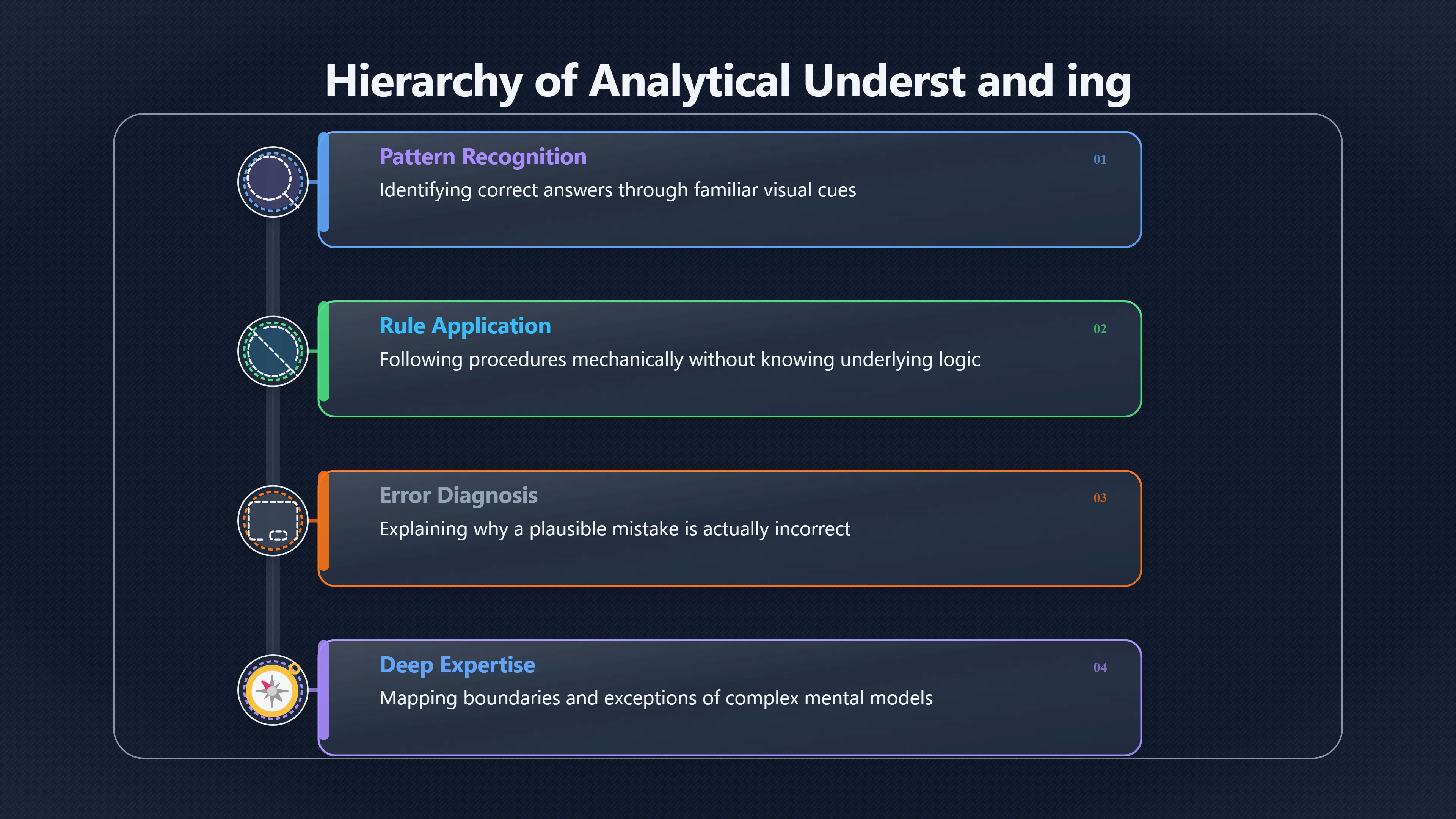
Getting the right answer can happen for several reasons that have little to do with deep understanding. A person may remember an example, recognise a familiar pattern, or follow a procedure mechanically without understanding why it works.
Error diagnosis demands something different. To explain why an answer is wrong, you must identify:
- the underlying principle;
- the assumptions required for that principle;
- which assumption has been violated;
- why the incorrect reasoning appears attractive;
- what evidence would reveal the mistake.
This process tests the boundaries of knowledge rather than its centre. Instead of asking whether a rule works in ideal conditions, it asks where it stops working.
Researchers studying understanding increasingly describe it as an active process of constructing, testing and revising mental models rather than simply storing correct facts. An explanation that survives scrutiny across both successful and failed cases reflects a more complete understanding than one that only fits successful examples. [PMC]pmc.ncbi.nlm.nih.govPMCUnderstanding Is a ProcessIt depends on learning, interpreting, generalizing, and acting upon information. No…Read more…
How diagnosing a plausible mistake reveals deeper understanding
Many mistakes are not random. They arise because people apply a generally useful rule outside the conditions where it remains valid.
Consider a few familiar examples:
- Statistics: believing that correlation automatically proves causation.
- Medicine: assuming that improvement after treatment proves the treatment caused recovery.
- Programming: believing code is correct because it succeeds on one test case.
- Business: assuming last year’s successful strategy will work unchanged despite different market conditions.
In every case, repeating the correct principle (“correlation does not imply causation”) demonstrates recognition. Explaining exactly why the mistaken conclusion fails requires tracing the mechanism, identifying missing evidence, and showing which alternative explanations remain possible.
This distinction matters because analytical work rarely involves obviously incorrect answers. Instead, it involves choosing between several explanations that all appear plausible until their weaknesses are examined.
Errors expose the edges of a mental model
A useful mental model is defined as much by its limits as by its successes.
Experts usually possess richer knowledge of exceptions, edge cases and failure modes than novices. This does not mean they memorise more special cases. Rather, they understand why those exceptions arise.
For example:
- A mathematician knows when a theorem’s assumptions no longer hold.
- An engineer anticipates the operating conditions under which a design becomes unreliable.
- A scientist asks which observations would falsify a proposed explanation.
- A financial analyst identifies circumstances in which a normally reliable indicator becomes misleading.
Knowing where a rule breaks demonstrates that it has been organised around underlying principles instead of isolated examples.
This explains why experienced practitioners often spend considerable time examining failures rather than celebrating successes. Successful cases confirm that something worked once. Failures reveal the structure of the system itself.
Why wrong answers often feel convincing
Many incorrect answers survive because they preserve enough of the correct pattern to appear reasonable.
Common characteristics include:
- applying the correct rule too broadly;
- overlooking a hidden assumption;
- confusing necessary conditions with sufficient ones;
- focusing on surface similarity instead of underlying structure;
- ignoring evidence that contradicts the preferred explanation.
These errors are valuable because they reveal precisely which distinction has not yet become part of the learner’s internal model.
Research on the illusion of explanatory depth shows that people frequently believe they understand complex systems until they must explain them in detail. Similarly, explaining why an attractive mistake fails often exposes knowledge gaps that remain invisible while simply producing correct answers. [Journal of Cognition]journalofcognition.orgJournal of CognitionSubjective Understanding is Reduced by Mechanistic…by JC Zemla · 2024 · Cited by 1 — In two experiments, we found…
Using errors to map when a rule fails
One practical way to strengthen analytical thinking is to treat every error as information about the limits of a rule.
Rather than asking only:
“What is the correct answer?”
also ask:
- Why would someone reasonably choose the incorrect answer?
- Which assumption did they make?
- Under what conditions would their reasoning actually become correct?
- What observation would distinguish the two explanations?
- What minimal change would turn the incorrect answer into the correct one?
These questions transform mistakes from failures into boundary markers.
Instead of memorising isolated corrections, you gradually build a map showing where concepts apply, where they become unreliable, and how neighbouring ideas differ.
Error diagnosis improves transfer to new problems
One weakness of familiarity is that it depends heavily on context. A learner may solve problems that closely resemble examples but struggle when the presentation changes.
Error diagnosis helps overcome this limitation because it focuses attention on causal structure rather than appearance.
For example, two problems may use different terminology while sharing the same logical mistake. Conversely, two problems may look almost identical while requiring different reasoning because one hidden assumption has changed.
People who habitually explain errors become better at recognising these structural similarities and differences. This improves transfer: the ability to apply knowledge in situations that differ from the original learning context.
Research on self-explanation shows that actively generating explanations helps learners reorganise and refine their knowledge instead of merely accumulating examples. [Frontiers]frontiersin.orgerror conditions, wrong answers, or bad decisions? Explicit Self-explanation has been shown to improve learning and understanding. This…
Turning mistakes into a routine analytical habit
Error diagnosis becomes more valuable when it is systematic rather than occasional.
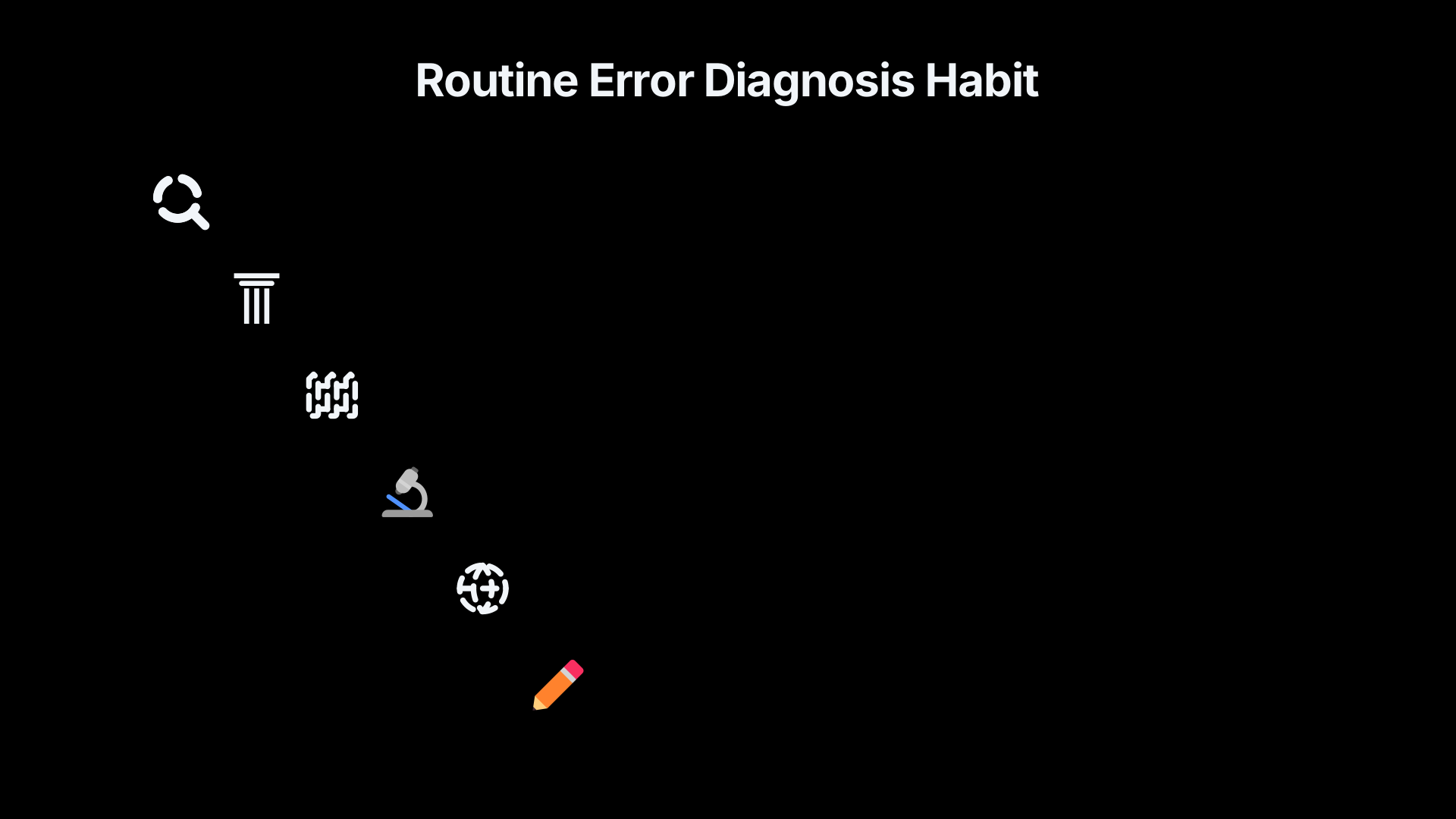
After solving any significant analytical problem, it is useful to ask:
- Which incorrect answer would have seemed most plausible?
- Why is it attractive?
- Which assumption makes it fail?
- What evidence would expose the mistake?
- How could the same error appear in a different context?
This approach works equally well after successes. Even when you reach the correct conclusion, analysing nearby mistakes tests whether you understand the underlying reasoning or simply arrived at the answer by luck or familiarity.
A related finding from learning research is the hypercorrection effect: confidently held errors that receive clear corrective feedback are often remembered better than uncertain mistakes because the contradiction captures attention and prompts revision of existing knowledge. The benefit comes not from making errors alone but from diagnosing and correcting them accurately. [Wikipedia]WikipediaHypercorrection (psychologyHypercorrection (psychology
Why error checking is a stronger test than repetition
Repeating a correct answer demonstrates that a pattern has been recognised. Explaining a wrong answer demonstrates that the pattern has been understood.
The difference is subtle but important. Recognition asks whether you know the destination. Error diagnosis asks whether you understand the landscape well enough to recognise every road that leads away from it.
In analytical thinking, that distinction is often what separates dependable judgement from confident imitation. A person who can identify exactly why a plausible argument fails has usually developed a mental model that is both deeper and more adaptable than someone who can merely reproduce the correct conclusion.
Amazon book picks
Further Reading
Books and field guides related to Why Wrong Answers Teach the Boundaries. Use these as the next step if you want deeper reading beyond the article.
Why Don't Students Like School?
Encourages understanding rather than pattern memorisation.
eBay marketplace picks
Marketplace Samples
Topic-anchored marketplace searches for visual, collectible, or second-hand items related to this page.



Endnotes
-
Source: pmc.ncbi.nlm.nih.gov
Title: PMCUnderstanding Is a Process
Link: https://pmc.ncbi.nlm.nih.gov/articles/PMC9008134/Source snippet
It depends on learning, interpreting, generalizing, and acting upon information. No...Read more...
-
Source: Wikipedia
Title: Illusion of explanatory depth
Link: https://en.wikipedia.org/wiki/Illusion_of_explanatory_depth -
Source: Wikipedia
Title: Hypercorrection (psychology)
Link: https://en.wikipedia.org/wiki/Hypercorrection_%28psychology%29 -
Source: journalofcognition.org
Link: https://journalofcognition.org/articles/10.5334/joc.393Source snippet
Journal of CognitionSubjective Understanding is Reduced by Mechanistic...by JC Zemla · 2024 · Cited by 1 — In two experiments, we found...
-
Source: frontiersin.org
Link: https://www.frontiersin.org/journals/computer-science/articles/10.3389/fcomp.2023.1096257/fullSource snippet
error conditions, wrong answers, or bad decisions? Explicit Self-explanation has been shown to improve learning and understanding. This...
Additional References
-
Source: researchgate.net
Link: https://www.researchgate.net/publication/398269382_Learning_Science_and_the_Illusion_of_Understanding_Exploring_the_Effects_of_Integrating_Learning_Tasks_after_Explainer_VideosSource snippet
(PDF) Learning Science and the Illusion of UnderstandingThis paper reports two experimental studies examining the immediate and long-term...
-
Source: arxiv.org
Title: Why Do Explanations Fail?
Link: https://arxiv.org/html/2405.13474v2Source snippet
A Typology and Discussion on...16 Oct 2025 — The typology decomposes system-specific explanation failures into two categories: (1) misle...
-
Source: link.springer.com
Link: https://link.springer.com/article/10.1007/s42113-026-00271-1Source snippet
Illusions of Understanding in the Sciences - Springer Natureby R Shiffrin · 2026 · Cited by 15 — Most often scientists believe th...
-
Source: youtube.com
Title: From [Hindsight Bias]({{ ‘hindsight-bias/’ | relative_url }}) to Machine Bias: Dr. Laura Zwaan on Learning from Mistakes
Link: https://www.youtube.com/watch?v=_Ob_PgYRz7ESource snippet
How to Get the Most Out of Studying: Part 5, "I Blew the Exam, Now What?"...
-
Source: gallerix.org
Link: https://gallerix.org/tribune/psy–illyuziya-ponimaniya/Source snippet
The Illusion of Understanding: Why We Think We Know...The brain mistakenly interprets a sense of familiarity with an object as an unders...
-
Source: youtube.com
Title: How to Think About Thinking — The Metacognition Explained
Link: https://www.youtube.com/watch?v=tn2jyKgwHMgSource snippet
From Hindsight Bias to Machine Bias: Dr. Laura Zwaan on Learning from Mistakes...
-
Source: youtube.com
Title: Error Analysis: Deepen Understanding by Exploring Mistakes
Link: https://www.youtube.com/watch?v=p78mrRRShuUSource snippet
How to Think About Thinking — The Metacognition Explained...
-
Source: mdpi.com
Link: https://www.mdpi.com/2078-2489/17/3/299Source snippet
Fluency Illusion: A Review on Influence of ChatGPT in...by S Kumar · 2026 · Cited by 3 — Drawing on research from cognitive psychology a...
-
Source: youtube.com
Title: Falling Forward: The Science of Learning from Mistakes w/ Amy Edmondson
Link: https://www.youtube.com/watch?v=l1WJbiA3cGI -
Source: dl.acm.org
Link: https://dl.acm.org/doi/10.1145/3785022.3785061Source snippet
This study conducted an in vivo experiment...Read more...
Topic Tree