Within Three Parts
Can smart people reason themselves into error?
Intellectual humility helps prevent reasoning skill from becoming a tool for defending whatever you already wanted to believe.
On this page
- How skill can serve rationalisation
- What intellectual humility changes in practice
- Ways to make belief revision less threatening
Page outline Jump by section
Introduction
Reasoning ability is often treated as a safeguard against error. In practice, it can become a remarkably effective tool for defending beliefs we already hold. The better someone is at constructing arguments, spotting weaknesses and generating explanations, the more capable they may be of rationalising a preferred conclusion rather than impartially testing it. This phenomenon is known as motivated reasoning: reasoning directed towards protecting a desired belief, identity or outcome rather than discovering what is true.[Wikipedia]WikipediaMotivated reasoningMotivated reasoning
 Intellectual humility is one of the most important counterweights to this tendency. It is not about lacking confidence or refusing to form opinions. Instead, it is the willingness to recognise that one’s beliefs may be incomplete or mistaken, and that changing one’s mind in response to better evidence is a sign of good judgement rather than personal failure. Within metacognition, intellectual humility acts as a protective disposition that keeps analytical skill aligned with truth-seeking instead of self-defence.
Can smart people reason themselves into error?
One of the most counterintuitive findings in psychology is that greater reasoning ability does not automatically reduce bias. In situations where beliefs are tied to personal identity, politics or group membership, highly capable reasoners can become especially effective at constructing sophisticated justifications for conclusions they already favour. Rather than eliminating motivated reasoning, intelligence sometimes supplies it with better tools.[ndg.asc.upenn.edu]ndg.asc.upenn.eduIdeology motivated reasoningIdeology, motivated reasoning, and cognitive reflectionby DM Kahan · 2013 · Cited by 2098 — When in- dividuals display identity-protectiv…
This helps explain why intelligent people can passionately disagree over questions where they have access to much the same evidence. The disagreement is not always caused by differences in logical ability. Instead, people may unconsciously search for evidence selectively, interpret ambiguous findings differently, or apply stricter standards to information that threatens their existing commitments than to information that supports them.[Wikipedia]WikipediaMotivated reasoningMotivated reasoning
The result is not deliberate dishonesty. Most people genuinely experience their reasoning as objective because the filtering occurs largely outside conscious awareness.
How skill can serve rationalisation
Motivated reasoning does not usually involve inventing facts from nothing. It operates through ordinary cognitive processes that become systematically biased when important beliefs are at stake.
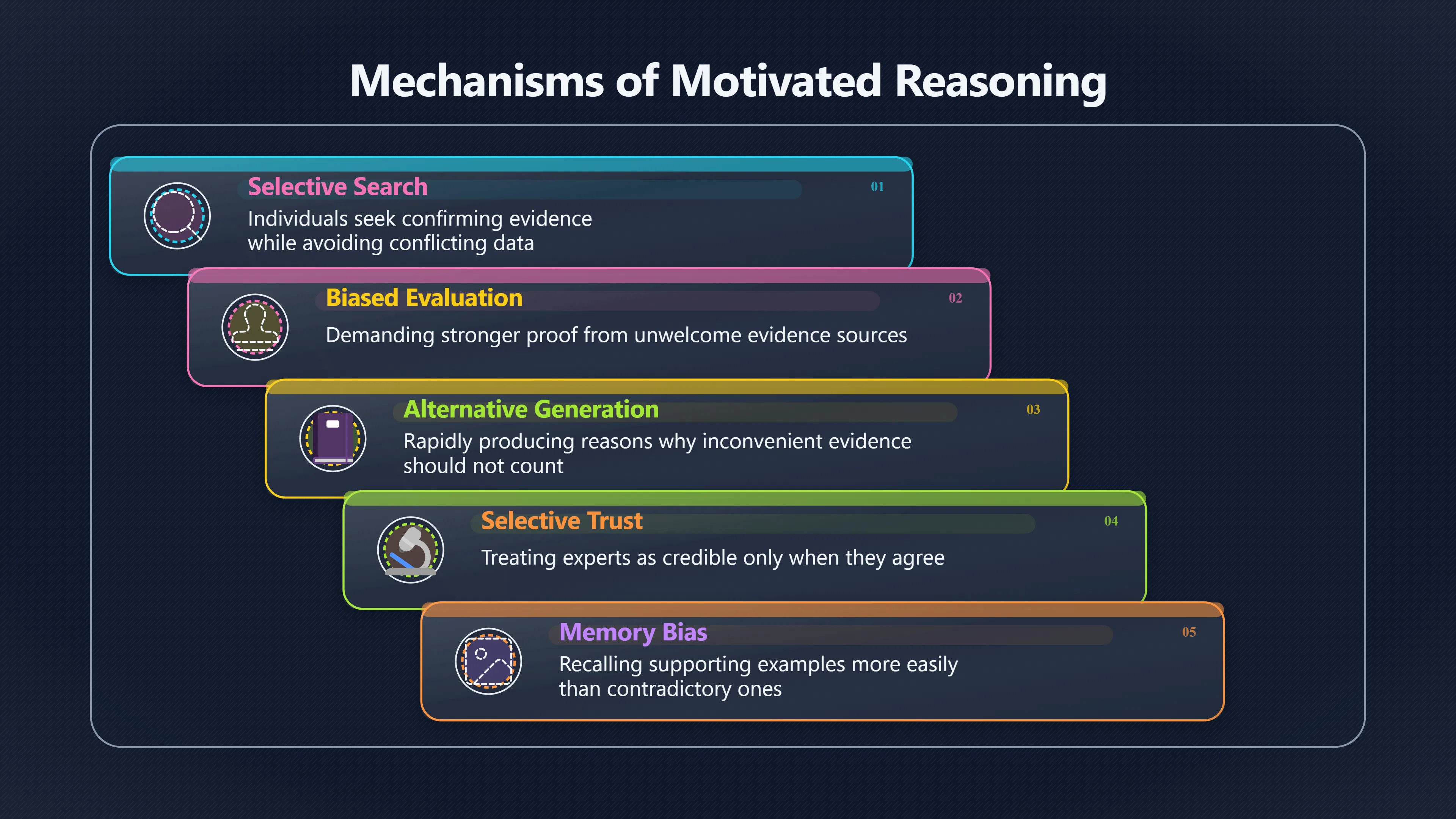
Common mechanisms include:
- Selective information search: seeking confirming evidence while avoiding conflicting information.
- Biased evaluation: demanding stronger proof from unwelcome evidence than from supportive evidence.
- Alternative explanation generation: rapidly producing reasons why inconvenient evidence should not count.
- Selective trust: treating experts as credible when they agree and unreliable when they disagree.
- Memory bias: recalling supporting examples more easily than contradictory ones.
These mechanisms often reinforce one another. Because each step appears individually reasonable, people rarely notice that the overall process consistently favours one conclusion.[The Cultural Cognition Project+2Wikipedia]culturalcognition.netThe Cultural Cognition Project Motivated reasoning & its cognatesThe Cultural Cognition ProjectMotivated reasoning & its cognates - Cultural Cognition of…15 May 2013 — Identity-protective cognition…
Research on identity-protective cognition illustrates this pattern clearly. When factual questions become associated with social identities, people are motivated to preserve their standing within valued groups. Evidence is then evaluated partly according to its implications for belonging, reputation or loyalty rather than solely for its accuracy.[ndg.asc.upenn.edu+2informalscience.org]ndg.asc.upenn.eduIdeology motivated reasoningIdeology, motivated reasoning, and cognitive reflectionby DM Kahan · 2013 · Cited by 2098 — When in- dividuals display identity-protectiv…
What intellectual humility changes in practice
Intellectual humility interrupts motivated reasoning at several points rather than attempting to eliminate bias completely.
First, it changes a person’s relationship with certainty. Instead of treating confidence as proof of correctness, intellectually humble thinkers recognise that confidence and accuracy are only loosely connected.
Second, it changes the goal of reasoning. Rather than asking, “How can I defend my position?” the guiding question becomes, “What evidence would genuinely change my view?”
Third, it separates personal identity from individual beliefs. If being wrong is no longer experienced as a threat to one’s competence or character, evidence becomes easier to evaluate fairly.
In practice, intellectually humble people are more likely to:
- distinguish confidence from certainty;
- acknowledge uncertainty explicitly;
- revise conclusions when evidence changes;
- recognise the limits of their own expertise;
- treat disagreement as potentially informative rather than automatically hostile.
These habits do not guarantee correct conclusions. Instead, they reduce the chance that analytical ability becomes a servant of prior commitments.

Ways to make belief revision less threatening
Changing one’s mind is psychologically difficult because beliefs often become connected to reputation, relationships and self-image. Intellectual humility helps by reducing the emotional cost of revision.
Several practical habits make this easier.
Treat beliefs as working hypotheses. Instead of viewing opinions as permanent possessions, regard them as models that improve through testing. Scientists routinely replace successful theories with better ones without treating revision as failure.
Separate identity from conclusions. It is safer to think “I currently believe this” than “This belief defines who I am.” The weaker the identity attachment, the easier honest evaluation becomes.
Actively search for disconfirming evidence. Looking only for supporting arguments feels objective but usually strengthens confirmation bias. Deliberately asking what could prove a favourite idea wrong creates a more balanced evidence search.
Keep a record of changed views. Many people remember being correct more vividly than remembering occasions when they learned something important by changing their minds. Recording belief revisions reframes them as intellectual successes rather than embarrassments.
Reward good updating, not just being right. In organisations and discussions, recognising careful revision encourages truth-seeking more effectively than rewarding consistency alone.
These practices shift the emotional incentives surrounding reasoning. Instead of protecting existing beliefs at all costs, they make accuracy itself the valued outcome.
Intellectual humility is not endless self-doubt
Humility is sometimes confused with indecisiveness or excessive scepticism. That is a mistake.
An intellectually humble person can hold strong views while recognising that any conclusion remains open to revision if sufficiently strong evidence emerges. The defining feature is not low confidence but appropriately calibrated confidence.
Likewise, humility does not require treating every opinion as equally credible. Evidence still matters. Experts remain more reliable than uninformed speculation. Intellectual humility simply recognises that expertise, including one’s own, is never infallible.
Recent research also suggests that intellectual humility is associated with better discrimination between reliable and unreliable information rather than indiscriminate scepticism. People higher in intellectual humility appear better able to distinguish true from false claims while maintaining greater awareness of the possibility of error in their own judgements.[Wikipedia]WikipediaIntellectual humilityIntellectual humility
Why this disposition matters for better thinking
Reasoning skill is indispensable, but by itself it cannot guarantee good judgement. The same analytical abilities that uncover errors can also construct persuasive defences of mistaken beliefs when identity, emotion or social belonging become involved.
Intellectual humility provides the motivational correction. It reminds us that the purpose of reasoning is not to preserve consistency with yesterday’s opinions but to improve our understanding today. When analytical ability is combined with the willingness to recognise fallibility, evidence becomes something to investigate rather than something to defeat. That combination makes reasoning more likely to serve truth instead of rationalisation.

Amazon book picks
Further Reading
Books and field guides related to Can smart people reason themselves into error?. Use these as the next step if you want deeper reading beyond the article.
The Demon-Haunted World
Rating: 4.5/5 from 43 Google Books ratings
Encourages intellectual humility through scepticism.
eBay marketplace picks
Marketplace Samples
Example marketplace items related to this page. Use the search link to explore similar finds on eBay.




Endnotes
1.
Source: Wikipedia
Title: Motivated reasoning
Link:https://en.wikipedia.org/wiki/Motivated_reasoning
2.
Source: ndg.asc.upenn.edu
Title: Ideology motivated reasoning
Link:https://ndg.asc.upenn.edu/wp-content/uploads/2017/08/Ideology-motivated-reasoning.pdf
Source snippet
Ideology, motivated reasoning, and cognitive reflectionby DM Kahan · 2013 · Cited by 2098 — When in- dividuals display identity-protectiv...
3.
Source: informalscience.org
Link:https://informalscience.org/identity/dan-kahan/
Source snippet
Identity | Dan KahanDan Kahan's identity-related work has focused on “identity protective cognition”, which refers to the tendency of ind...
4.
Source: Wikipedia
Title: Intellectual humility
Link:https://en.wikipedia.org/wiki/Intellectual_humility
5.
Source: culturalcognition.net
Title: The Cultural Cognition Project Motivated reasoning & its cognates
Link:https://www.culturalcognition.net/blog/2013/5/15/motivated-reasoning-its-cognates.html
Source snippet
The Cultural Cognition ProjectMotivated reasoning & its cognates - Cultural Cognition of...15 May 2013 — Identity-protective cognition...
Published: May 2013
Additional References
6.
Source: duepublico2.uni-due.de
Link:https://duepublico2.uni-due.de/servlets/MCRFileNodeServlet/duepublico_derivate_00075899/Wischnewski_et_al_2021_Role_of_Emotions.pdf
Source snippet
Role of Emotions and Identity-Protection Cognition...In this study, we investigate the role of emotions in identity-protection cognition...
7.
Source: scispace.com
Link:https://scispace.com/pdf/misconceptions-misinformation-and-the-logic-of-identity-mpc3ka7t6o.pdf
Source snippet
individuals to selectively credit and dismiss evi- dence in patterns that reflect the...Read more...
8.
Source: srbluemle.wordpress.com
Title: motivated reasoning and identity protective cognition
Link:https://srbluemle.wordpress.com/2020/10/05/motivated-reasoning-and-identity-protective-cognition/
Source snippet
reasoning and identity protective cognition5 Oct 2020 — Kahan, by contrast, emphasizes that identity protective cognition is, when practi...
9.
Source: rcgd.isr.umich.edu
Title: motivated numeracy and enlightened selfgovernment
Link:https://rcgd.isr.umich.edu/wp-content/uploads/2018/07/motivated_numeracy_and_enlightened_selfgovernment.pdf
Source snippet
Motivated numeracy and enlightened self-governmentby DANM KAHAN · Cited by 1290 — 'Cultural cognition', in this work, is simply the term...
10.
Source: tandfonline.com
Link:https://www.tandfonline.com/doi/full/10.1080/13546783.2023.2276975
Source snippet
Taylor & Francis OnlineThe skeptical import of motivated reasoning: a closer look...by M van Doorn · 2024 · Cited by 15 — A growing body...
11.
Source: youtube.com
Link:https://www.youtube.com/watch?v=DDM4TNWxkx8
Source snippet
Reason and scientific method | Hugo Mercier | Reason with Science | Psychology...
12.
Source: cambridge.org
Link:https://www.cambridge.org/core/journals/episteme/article/identityprotective-reasoning-an-epistemic-and-political-defense/5C62B4A3FC3F564ADE86BA5B7C5EF2BE
Source snippet
Cambridge University Press & AssessmentIdentity-protective reasoning: an epistemic and political...by C Flores · 2025 · Cited by 3 — In...
13.
Source: youtube.com
Title: Why Most People’s Opinions Are Worthless — Arthur Schopenhauer
Link:https://www.youtube.com/watch?v=WVHii535zb4
Source snippet
Can You Be a Good Person in 2026? 'Most Influential Living Philosopher' Peter Singer explains...
14.
Source: youtube.com
Title: Reason and scientific method | Hugo Mercier | Reason with Science | Psychology
Link:https://www.youtube.com/watch?v=SJUoyZKGPIc
Source snippet
Why Smart People Believe the Most Ridiculous Things...
15.
Source: eprints.gla.ac.uk
Link:https://eprints.gla.ac.uk/211649/7/211649.pdf
Source snippet
Enlighten Publicationson the skeptical import of motivated reasoningby JA Carter · 2020 · Cited by 51 — Empirical work on motivated reaso...
Topic Tree