Within Sharper Thinking
How to Notice Your Own Thinking
Metacognition helps you catch overconfidence, hidden assumptions, and gaps between what you know and what you think you know.
On this page
- What metacognition adds to reasoning
- Questions that reveal hidden assumptions
- How to check confidence before acting
Page outline Jump by section
Introduction
Metacognition is the habit of noticing how your own mind is reaching a conclusion before you treat that conclusion as reliable. Within analytical thinking, its special value is not that it makes you cleverer in a general sense; it gives you a way to catch hidden assumptions, inflated confidence and gaps between “I know this” and “I have not actually checked this”. Researchers often describe metacognition as planning, monitoring and evaluating your own thinking, and educational evidence links these skills with better learning and self-regulation when they are taught explicitly rather than left as vague advice. [tll.mit.edu]tll.mit.eduMetacognitionMetacognition is the process by which learners use knowledge of the task at hand, knowledge of learning strategies, and know…
The practical point is simple: many reasoning errors happen before the visible argument begins. A person assumes the problem is framed correctly, assumes the first explanation is the main one, assumes their memory is complete, or assumes confidence is evidence. Metacognition turns those assumptions into objects you can inspect. It asks: What am I taking for granted? How would I know if I were wrong? What evidence would reduce my confidence? That small pause can change the quality of decisions in study, work, debate and everyday judgement.
What metacognition adds to reasoning
Reasoning often focuses on the outside world: facts, evidence, logic, causes and consequences. Metacognition adds a second layer: it looks at the reliability of the person doing the reasoning. This matters because even a well-structured argument can be built on a hidden premise. “This project will work” may rest on “the team has enough time”; “this article is persuasive” may rest on “the quoted expert is representative”; “I understand this topic” may rest on “I recognised the vocabulary”.
A useful distinction is between accuracy and calibration. Accuracy asks whether your answer is right. Calibration asks whether your confidence matches your accuracy. Someone who is right 70% of the time when they say “I’m 70% sure” is well calibrated; someone who feels certain while often being wrong is not. Research on metacognition commonly uses confidence ratings, judgements of learning and related measures to study how well people monitor their own knowledge and performance. [Wikipedia]WikipediaOpen source on wikipedia.org.
This is why metacognition is especially important when you are improving analytical skills. A person can learn more facts without learning when their own confidence is unreliable. They can become fluent in an explanation while missing the assumptions beneath it. Metacognition closes that gap by making the thinker ask not only “What is my conclusion?” but “What made this conclusion feel obvious?”
A concrete example: imagine you are deciding whether a new work process is failing because “people are resisting change”. That may be true, but it may also be a convenient assumption. A metacognitive check would separate the observation from the interpretation:
- Observation: uptake is low after three weeks.
- Assumption: low uptake means resistance.
- Alternative assumptions: the tool is confusing, incentives are misaligned, training was insufficient, or the old process is still faster.
- Confidence check: what evidence would distinguish resistance from usability problems?
The thinking improves not because the first idea is rejected automatically, but because it stops being invisible.
The assumption you do not notice is the one that controls the conclusion
Hidden assumptions are powerful because they often sit upstream of evidence. Once a frame is accepted, the mind starts collecting details inside it. If the frame is wrong, even careful analysis can become careful analysis of the wrong problem.
Metacognition helps by slowing the transition from impression to conclusion. Instead of asking only “Do I have reasons?”, it asks “What must be true for these reasons to work?” That question is more precise than the generic instruction to “be objective”. It directs attention to the load-bearing parts of the argument.
For example, the claim “this candidate is not suitable for the role” may depend on several assumptions: that the interview measured the skills the job requires, that quietness signals low leadership potential, that the interviewer’s first impression was fair, and that the strongest alternative candidate was judged by the same standard. The obvious debate may be about the candidate; the better metacognitive question is about the assessment method.
A useful way to expose assumptions is to rewrite a conclusion as an “if” statement:
- “This plan will save money” becomes “This plan will save money if implementation costs stay below the forecast, staff actually use the new system, and the old system can be retired.”
- “I understand this topic” becomes “I understand this topic if I can explain it without notes, answer objections, and apply it to a new example.”
- “That source is unreliable” becomes “That source is unreliable if its evidence is weak, its claims conflict with stronger sources, or it has a reason to mislead.”
The word “if” is a metacognitive tool. It makes the hidden bridge between evidence and conclusion visible.

Why confidence can outrun knowledge
Overconfidence is not just a personality flaw. It is often a monitoring problem: people may lack the skill needed to recognise the limits of their skill. The well-known Kruger and Dunning study found that low performers in humour, grammar and logic tasks substantially overestimated their performance, and the authors linked this to difficulty recognising competence and error. [PubMed]pubmed.ncbi.nlm.nih.govUnskilled and unaware of it: how difficulties in recognizing…by J Kruger · 1999 · Cited by 13007 — Unskilled and unaware of it…
That finding is useful, but it is often oversimplified. The broader lesson is not “incompetent people are always the most confident”. Later debates have questioned how much of the pattern is explained by metacognitive deficits, statistical effects, task difficulty and measurement design. A 2022 Royal Society Open Science paper, for example, directly challenged the “dual burden” interpretation that low skill necessarily causes poor self-knowledge. [Royal Society Publishing]royalsocietypublishing.orgOpen source on royalsocietypublishing.org.
For practical thinking, the dispute strengthens rather than weakens the case for metacognition. It shows that self-assessment is difficult, context-sensitive and easy to misread. Confidence may be distorted by lack of skill, by task difficulty, by limited feedback, by social comparison, or by a run of lucky outcomes. The safe habit is therefore not to diagnose yourself or others with a slogan, but to treat strong confidence as a signal that deserves checking.
One especially important failure mode is partial knowledge. A little knowledge can make a pattern feel familiar before you have enough depth to judge it well. Recent work on diagnostic decision-making found that partial knowledge can inflate confidence and reduce further information seeking, creating a practical danger: the person stops looking precisely when they most need to keep checking. [PMC]pmc.ncbi.nlm.nih.govOpen source on nih.gov.
In analytical work, this can appear as premature closure. You see enough to form a story, then the story starts filtering what you notice. Metacognition interrupts that closure by asking, “Am I confident because the evidence is strong, or because the explanation now feels fluent?”
Questions that reveal hidden assumptions
The best metacognitive questions are specific enough to change behaviour. “Am I biased?” is usually too broad. Most people can answer “probably not” and move on. Better questions force the assumption into the open.
Use these when a decision, judgement or explanation matters:
- What would have to be true for my conclusion to be right?
This identifies the premises doing the real work. If one of them is weak, the whole conclusion may be weaker than it feels.
- What am I treating as a fact that is really an interpretation?
“The meeting went badly” may be an interpretation. The facts might be that two people objected, three said little, and one deadline was questioned.
- What evidence would make me lower my confidence?
If no possible evidence would move you, you may be defending an identity, preference or prior commitment rather than analysing a claim.
- What is the strongest alternative explanation?
A weak opposing view is easy to dismiss. A strong alternative tests whether your explanation is genuinely robust.
- Where did this belief come from?
Some assumptions come from direct evidence. Others come from habit, authority, group norms, old experience or a memorable anecdote.
- Am I using the same standard for each option?
People often scrutinise disliked options and excuse favoured ones. Metacognition checks whether the burden of proof is being applied evenly.
The “consider the opposite” strategy is one researched way to do this. In classic experiments, Lord, Lepper and Preston found that prompting people to consider possibilities opposite to their initial beliefs reduced bias in social judgement more effectively than simply telling them to be fair and unbiased. [PubMed]pubmed.ncbi.nlm.nih.govOpen source on nih.gov.
The lesson is practical: do not merely command yourself to be neutral. Give your mind a task that produces counter-evidence. Ask, “Suppose my first interpretation is wrong. What would I notice?”

How to check confidence before acting
Metacognition becomes most useful when it changes what you do before a decision. The aim is not to become paralysed by doubt, but to match your confidence to the strength of your evidence and the cost of being wrong.
A quick confidence check has three parts:
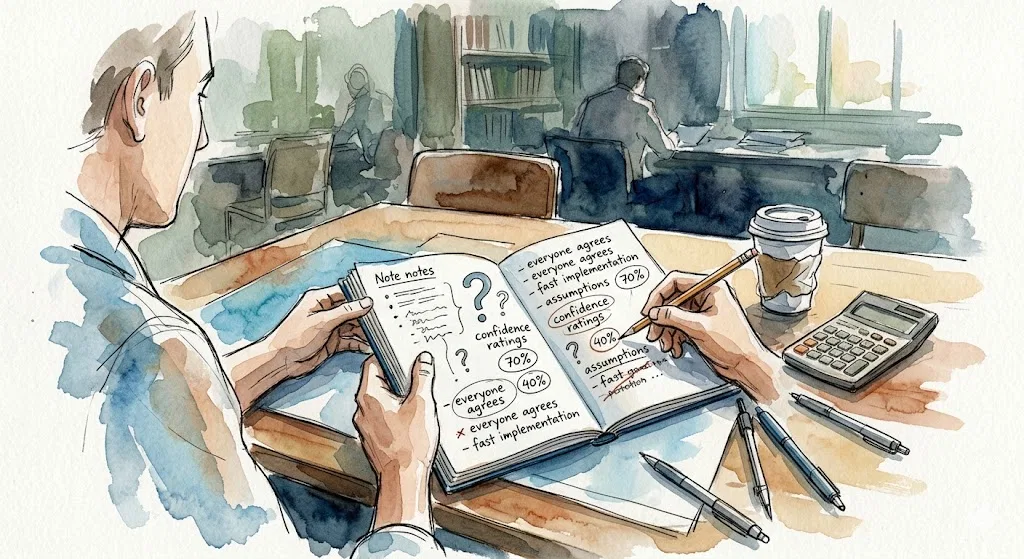
- State the confidence level. Instead of “I’m sure”, try “I’m about 70% confident.” Numbers are imperfect, but they make confidence easier to inspect.
- Name the confidence source. Is confidence coming from direct evidence, expert feedback, repeated experience, a clear model, social agreement, or simple familiarity?
- Choose the next check by risk. If the decision is low-stakes, a light check may be enough. If it affects money, safety, relationships or reputation, require stronger evidence.
Calibration can be trained, at least in some contexts. A 2024 study of intelligence analysts found that commercial calibration training improved overall calibration and bias, with especially clear improvement for interval estimation tasks, although effects varied by task type. [Wiley Online Library]onlinelibrary.wiley.comOpen source on wiley.com. This matters because confidence is not merely a private feeling; it guides whether people seek more information, defer, act, warn others or stop investigating.
For everyday analytical work, a simple calibration routine is to keep a small prediction log. Write down the claim, your confidence, the reason for that confidence, and what happened. Over time, patterns become visible: perhaps your 90% claims are closer to 65%, or perhaps you are underconfident in one domain and overconfident in another. The point is not self-criticism. It is feedback.
A second routine is to use confidence bands rather than single-point guesses. Instead of “the project will take six weeks”, try “I think it will take six to ten weeks, and I would be surprised if it takes less than five.” This forces the mind to think about uncertainty, not just the most convenient estimate.
Premortems make assumptions easier to challenge
Some assumptions are hard to notice because challenging them feels socially awkward. In a team, people may not want to sound negative, obstructive or disloyal. A premortem changes the social task: instead of asking “What could go wrong?”, it asks people to imagine that a plan has already failed and then explain why.
Gary Klein’s Harvard Business Review account of the project premortem describes this as a prospective hindsight method: the team assumes failure has occurred and generates plausible causes before the plan is finalised. [Harvard Business Review]hbr.orgHarvard Business Review Performing a Project PremortemHarvard Business Review Performing a Project Premortem The value is metacognitive as much as managerial. It gives people permission to surface doubts that were previously suppressed or unformed.
A premortem is especially good at exposing assumptions such as:
- “The deadline is realistic.”
- “The handover will be smooth.”
- “The client understands the trade-offs.”
- “The data will be available.”
- “The people responsible will have the authority to act.”
- “No one outside the room needs to be consulted.”
The technique does not prove that the plan will fail. Its purpose is to reveal what the plan is quietly depending on. Once the assumptions are visible, the team can revise the plan, gather evidence or add safeguards.
For individual thinking, a smaller version works well: “It is three months from now and this decision turned out badly. What did I ignore?” The question is useful because it changes the angle of attention. Instead of defending the current plan, you search for missing conditions.
The difference between useful doubt and endless second-guessing
Metacognition is not the same as rumination. Rumination circles around worry without improving the evidence. Useful metacognition produces a clearer question, a better test, a revised confidence level or a concrete next step.
The difference is visible in the output:
- Rumination asks, “What if I’m wrong?” again and again.
- Metacognition asks, “What specific assumption could be wrong, and how would I check it?”
- Rumination treats uncertainty as a threat.
- Metacognition treats uncertainty as information.
- Rumination delays action indefinitely.
- Metacognition changes the action threshold: act, pause, ask, test or monitor.
This distinction matters because improving thinking does not mean doubting every thought equally. Some assumptions are harmless, some are unavoidable, and some are too costly to check. The skill is to identify the assumptions that carry the most risk.
A practical rule is to spend the most metacognitive effort where three conditions overlap: your confidence is high, the evidence is incomplete, and the cost of error is meaningful. That is where hidden assumptions do the most damage.
A simple working routine
Metacognition works best when it is short enough to use under real conditions. Before acting on an important conclusion, use a five-minute assumption check:
- Write the conclusion in one sentence.
“We should choose supplier A.” “This argument is weak.” “I am ready for the exam.”
- List three assumptions behind it.
Include at least one assumption about evidence quality, one about alternatives, and one about your own knowledge.
- Mark the weakest assumption.
Ask which one would most damage the conclusion if false. [4. Consider the opposite.]pubmed.ncbi.nlm.nih.govSource details in endnotes.
Write the strongest reason the conclusion might be wrong, not the easiest reason to dismiss.
- Set a confidence level and an action threshold.
Decide whether the current confidence is enough to act, enough to test, or only enough to keep exploring.
For example, “I am ready for the exam” might rest on the assumptions that recognition equals recall, practice questions match the exam format, and weak topics will not be heavily tested. A metacognitive check might reveal that the student feels fluent because rereading is familiar, not because retrieval is strong. That changes the next action: self-testing becomes more useful than more highlighting.
The same routine applies outside study. A manager can use it before approving a plan. A voter can use it before sharing a claim. A researcher can use it before trusting a model. A friend can use it before interpreting a difficult conversation.
Why this pillar matters for better thinking
Metacognition for noticing assumptions is a pillar of analytical skill because it protects the point where reasoning is most vulnerable: the moment before a claim feels settled. It does not replace evidence, expertise or logic. It improves the way you use them by asking whether your confidence, framing and standards are justified.
The core habit is to make the invisible visible. Turn conclusions into conditional claims. Separate observations from interpretations. Ask what would lower your confidence. Consider the strongest alternative. Check whether confidence is coming from evidence or from familiarity. In high-stakes situations, use structured tools such as premortems, prediction logs and calibration checks.
Better thinking is not a permanent state of scepticism. It is a disciplined relationship with your own mind: trusting it enough to reason, but not so much that you stop inspecting the assumptions it quietly supplies.
Amazon book picks
Further Reading
Books and field guides related to How to Notice Your Own Thinking. Use these as the next step if you want deeper reading beyond the article.
The Scout Mindset
Focuses on recognizing assumptions, updating beliefs, and monitoring your own thinking.
Super Thinking
Provides mental models that complement metacognitive reflection and reasoning.
Mistakes Were Made (but Not by Me)
Shows why people overlook errors in their own thinking and how to recognize them.
The Art of Thinking Clearly
Helps readers identify recurring thinking traps and become more reflective decision-makers.
eBay marketplace picks
Marketplace Samples
Live-tested eBay searches with available results related to this page.


Endnotes
-
Source: tll.mit.edu
Link: https://tll.mit.edu/teaching-resources/how-people-learn/metacognition/Source snippet
MetacognitionMetacognition is the process by which learners use knowledge of the task at hand, knowledge of learning strategies, and know...
-
Source: Wikipedia
Link: https://en.wikipedia.org/wiki/Metacognition -
Source: pmc.ncbi.nlm.nih.gov
Link: https://pmc.ncbi.nlm.nih.gov/articles/PMC4451238/Source snippet
Metacognition and confidence: comparing math to other...by S Erickson · 2015 · Cited by 73 — Rather, we focus on calibration of metac...
-
Source: pmc.ncbi.nlm.nih.gov
Link: https://pmc.ncbi.nlm.nih.gov/articles/PMC12988131/ -
Source: onlinelibrary.wiley.com
Link: https://onlinelibrary.wiley.com/doi/10.1002/acp.4236 -
Source: Wikipedia
Title: Dunning–Kruger effect
Link: https://en.wikipedia.org/wiki/Dunning%E2%80%93Kruger_effect -
Source: Wikipedia
Title: Pre mortem
Link: https://en.wikipedia.org/wiki/Pre-mortem -
Source: onlinelibrary.wiley.com
Link: https://onlinelibrary.wiley.com/doi/10.1111/jpr.12409 -
Source: educationendowmentfoundation.org.uk
Link: https://educationendowmentfoundation.org.uk/education-evidence/guidance-reports/metacognitionSource snippet
EEFMetacognition and Self-Regulated Learning13 Nov 2025 — There is a strong body of research from psychology and education demonstrating...
-
Source: pubmed.ncbi.nlm.nih.gov
Link: https://pubmed.ncbi.nlm.nih.gov/10626367/Source snippet
Unskilled and unaware of it: how difficulties in recognizing...by J Kruger · 1999 · Cited by 13007 — Unskilled and unaware of it...
-
Source: royalsocietypublishing.org
Link: https://royalsocietypublishing.org/rsos/article/9/12/191727/96372/Skill-and-self-knowledge-empirical-refutation-of -
Source: pubmed.ncbi.nlm.nih.gov
Link: https://pubmed.ncbi.nlm.nih.gov/6527215/ -
Source: hbr.org
Title: Harvard Business Review Performing a Project Premortem
Link: https://hbr.org/2007/09/performing-a-project-premortem -
Source: pmc.ncbi.nlm.nih.gov
Link: https://pmc.ncbi.nlm.nih.gov/articles/PMC12730000/ -
Source: pubmed.ncbi.nlm.nih.gov
Link: https://pubmed.ncbi.nlm.nih.gov/35981722/ -
Source: pmc.ncbi.nlm.nih.gov
Link: https://pmc.ncbi.nlm.nih.gov/articles/PMC10912288/ -
Source: pmc.ncbi.nlm.nih.gov
Link: https://pmc.ncbi.nlm.nih.gov/articles/PMC9242397/ -
Source: pmc.ncbi.nlm.nih.gov
Link: https://pmc.ncbi.nlm.nih.gov/articles/PMC8187395/ -
Source: pmc.ncbi.nlm.nih.gov
Link: https://pmc.ncbi.nlm.nih.gov/articles/PMC12103939/ -
Source: ejpbl.org
Link: https://www.ejpbl.org/journal/view.php?number=78
Additional References
-
Source: youtube.com
Title: Behaviors That Reveal You Have “Metacognitive IQ” (Only 1% Possess It)
Link: https://www.youtube.com/watch?v=8ev8RLr_kGoSource snippet
How to Use "Step In, Step Out, Step Back" | Harvard Project Zero...
-
Source: youtube.com
Title: How to Use “Step In, Step Out, Step Back” | Harvard Project Zero
Link: https://www.youtube.com/watch?v=HV7LCYGxkHcSource snippet
How Zen Philosophy Trains Real [Critical Thinking]({{ 'critical-skills/' | relative_url }})...
-
Source: youtube.com
Title: 5 Signs You Have Metacognitive Intelligence
Link: https://www.youtube.com/watch?v=QfK3PwI1OUwSource snippet
Behaviors That Reveal You Have "Metacognitive IQ" (Only 1% Possess It)...
-
Source: academia.edu
Link: https://www.academia.edu/16749881/Is_an_Unskilled_Really_Unaware_of_it -
Source: researchgate.net
Link: https://www.researchgate.net/publication/3229642_Performing_a_Project_Premortem -
Source: researchgate.net
Link: https://www.researchgate.net/publication/12688660_Unskilled_and_Unaware_of_It_How_Difficulties_in_Recognizing_One%27s_Own_Incompetence_Lead_to_Inflated_Self-Assessments -
Source: researchgate.net
Link: https://www.researchgate.net/publication/380873905_Young_Children%27s_Self-Regulated_Learning_Benefited_from_a_Metacognition-Driven_Science_Education_Intervention_for_Early_Childhood_Teachers -
Source: academia.edu
Link: https://www.academia.edu/3723863/Considering_the_opposite_A_corrective_strategy_for_social_judgment -
Source: facebook.com
Link: https://www.facebook.com/groups/775801081313358/posts/1235198688706926/ -
Source: thedecisionlab.com
Link: https://thedecisionlab.com/biases/dunning-kruger-effect
Topic Tree