Within Alternatives
Put Your Explanations in Competition
Listing hypotheses side by side helps reveal which explanation has the least serious evidence against it.
On this page
- How side by side comparison changes the question
- Why disconfirming evidence gets special weight
- A simple matrix for everyday judgment calls
Page outline Jump by section
Introduction
Everyday decisions often feel as though they require choosing between a “right” explanation and a “wrong” one. In practice, the better question is: which explanation survives comparison with the least serious evidence against it? Putting plausible explanations into direct competition changes the way we think. Instead of asking, “Can I find evidence for my preferred story?”, we ask, “Which explanation best accounts for all the evidence, especially the awkward facts?” This approach reduces the risk that the first convincing narrative becomes the default simply because it appeared first. Research in decision-making, intelligence analysis and cognitive psychology consistently shows that explicitly comparing rival hypotheses helps counter confirmation bias, although structured techniques are most effective when used thoughtfully rather than mechanically.[PMC+2Strathprints]pmc.ncbi.nlm.nih.govEffects of task structure and confirmation bias in alternative…by MK Dhami · 2024 · Cited by 2 — We empirically examined the effect…
How side-by-side comparison changes the question
Most people evaluate one explanation at a time. Suppose a friend cancels dinner at short notice. A first reaction might be, “They no longer value the friendship.” Once that story forms, new information is unconsciously interpreted through it.
A competing-hypotheses approach reframes the problem by placing several plausible explanations side by side:
ObservationLost interestGenuine emergencyWork overloadMiscommunicationCancelled at the last minute✓✓✓✓Suggested another date✗✓✓✓Similar pattern over months✓✗✓✗Apologised promptlyWeakensFitsFitsFits
The important shift is that each new piece of evidence is compared across every explanation, rather than being added only to the favourite one. Richards Heuer’s Analysis of Competing Hypotheses (ACH), originally developed for intelligence analysis, deliberately encourages analysts to work across a matrix in this way because it makes alternative explanations harder to ignore.[Pherson]pherson.orgThis paper identifies three different approaches to Analysis of Competing Hypotheses (ACH) and four major steps in the intelligence analy…
For everyday decisions, the same principle applies whether deciding why sales have fallen, why a household appliance stopped working, or why someone behaved unexpectedly. The aim is not exhaustive analysis but disciplined comparison.
Why disconfirming evidence gets special weight
Supporting evidence is often less informative than people assume because several explanations can usually accommodate it.
Imagine receiving only one observation:
“The customer has stopped ordering.”
This observation could fit many stories:
- the customer found a cheaper supplier;
- the customer is temporarily reducing spending;
- an administrative error prevented orders;
- the customer has changed business priorities.
By itself, the observation discriminates poorly between explanations.
Now consider a different observation:
“The customer continues buying the same products from competitors.”
That single fact strongly weakens some explanations while strengthening others. It is therefore more diagnostic.
One of the central ideas behind competing-hypothesis analysis is that evidence capable of ruling explanations out deserves more attention than evidence that merely confirms what several explanations already predict. The process therefore asks analysts to look first for inconsistencies rather than accumulating supporting examples.[Pherson]pherson.orgThis paper identifies three different approaches to Analysis of Competing Hypotheses (ACH) and four major steps in the intelligence analy…
This is psychologically difficult because people naturally search for confirming information. Experimental research examining ACH has found that structured comparison can influence how people organise evidence and reduce some aspects of confirmation bias, although improvements are not uniform and depend on how carefully the method is applied.[PMC]pmc.ncbi.nlm.nih.govEffects of task structure and confirmation bias in alternative…by MK Dhami · 2024 · Cited by 2 — We empirically examined the effect…
A simple matrix for everyday judgment calls
A full intelligence-style ACH exercise is unnecessary for most personal decisions. A lightweight comparison matrix usually captures most of the benefit.
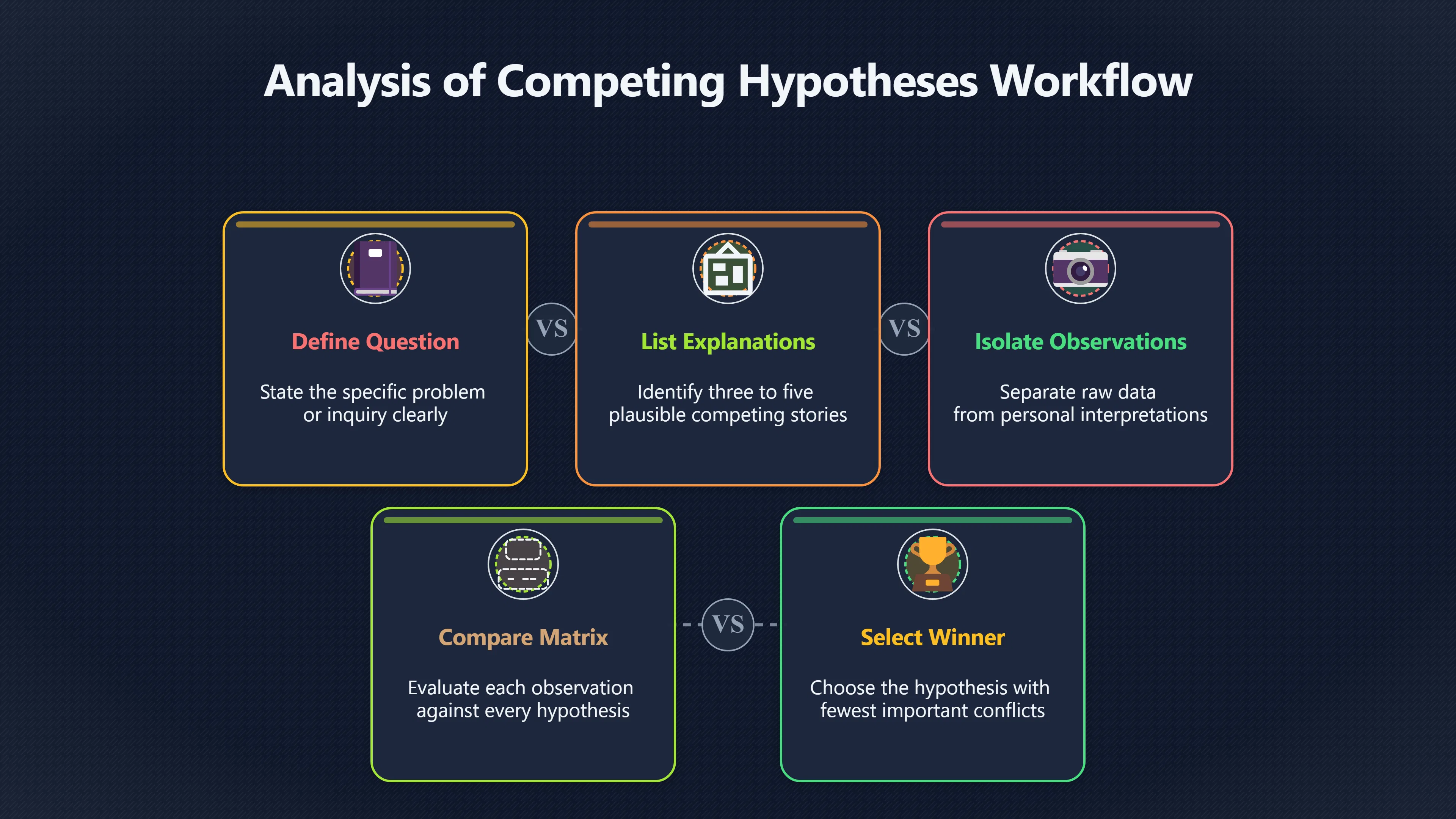
- State the question clearly. “Why did website traffic fall this week?” “Why am I feeling unusually tired?” “Why was my proposal rejected?”
- List three to five plausible explanations.
Avoid creating one favourite explanation and several implausible alternatives.
- List observations separately from interpretations.
For example: traffic fell by 30%; advertising budget was unchanged; competitors launched promotions; website response times increased.
- Compare each observation against every explanation.
Ask: Does this fit? Does it contradict? Is it irrelevant?
- Focus on the explanation with the fewest important conflicts.
A hypothesis should survive because competing explanations fit the evidence less well—not because it accumulated the largest pile of confirming facts.
This process usually takes only a few minutes but forces slower, more deliberate reasoning.

Common mistakes when comparing explanations
Several habits weaken the value of competing-hypothesis analysis.[Wikipedia]WikipediaAnalysis of competing hypothesesAnalysis of competing hypothesesThe analysis of competing hypotheses (ACH) is a methodology for evaluating multiple competing hypothes…
Treating every imaginable possibility as equally plausible. The goal is not unlimited scepticism. Implausible explanations need not occupy equal attention simply because they are conceivable.
Counting evidence instead of weighing it. Ten weak observations rarely outweigh one highly diagnostic fact.
Ignoring assumptions. Many explanations depend on hidden assumptions such as “the measurements are accurate” or “people acted rationally”. Listing these assumptions often reveals where uncertainty actually lies.
Stopping too early. Once one explanation looks promising, it is tempting to stop searching. Maintaining at least one credible rival prevents premature closure.
Failing to update. Competing hypotheses are provisional. New evidence should change relative confidence rather than forcing an all-or-nothing reversal.
Everyday examples where competition improves judgement
The approach is particularly useful whenever several ordinary explanations fit the same observation.
- Health decisions. Before attributing fatigue to stress, compare sleep quality, illness, medication, nutrition and workload. A structured comparison encourages gathering information that distinguishes between these possibilities rather than reinforcing an initial assumption.
- Workplace problems. If a project is behind schedule, compare inadequate planning, changing client requirements, staffing shortages and technical failures instead of blaming the first visible cause.
- Personal relationships. Delayed replies, changed behaviour or cancelled plans usually admit multiple reasonable explanations. Explicit comparison reduces unnecessary conflict driven by overconfident interpretation.
- Financial decisions. Before assuming an investment performed well because of personal skill, compare broader market movements, sector trends and chance. Rival explanations help avoid overconfidence after successful outcomes.
In each case, the practical benefit is less about finding certainty than about making the most defensible judgement from incomplete information.
Using the method without becoming indecisive
A common concern is that considering alternatives will delay decisions indefinitely. In practice, competing-hypothesis analysis works best when bounded.
Useful stopping rules include:
- compare only the strongest three to five explanations;
- seek evidence that would genuinely distinguish between them;
- decide once additional evidence is unlikely to change the ranking substantially;
- identify future observations that would justify revisiting the decision.
This keeps analysis proportional to the importance of the choice. Heuer’s original framework similarly emphasises identifying future indicators that would signal whether an alternative explanation is becoming more likely, allowing decisions to remain adaptable rather than fixed.[Pherson]pherson.orgThis paper identifies three different approaches to Analysis of Competing Hypotheses (ACH) and four major steps in the intelligence analy…
By putting explanations into direct competition, everyday reasoning becomes less about defending an attractive story and more about discovering which explanation withstands critical comparison. That simple shift—from proving a favourite explanation to testing several plausible ones—helps produce decisions that are more resilient, more transparent and less vulnerable to confirmation bias.

Amazon book picks
Further Reading
Books and field guides related to Put Your Explanations in Competition. Use these as the next step if you want deeper reading beyond the article.
The Scout Mindset
Focuses on comparing competing explanations, updating beliefs, and avoiding confirmation bias.
Psychology of Intelligence Analysis
Introduces Analysis of Competing Hypotheses (ACH), the exact method discussed on the page.
Superforecasting
Demonstrates evidence-based forecasting through continual testing of rival hypotheses.
How to Think About Weird Things: Critical Thinking for a New Age
Teaches systematic evaluation of competing claims using evidence and logical reasoning.
eBay marketplace picks
Marketplace Samples
Example marketplace items related to this page. Use the search link to explore similar finds on eBay.


Endnotes
1.
Source: pmc.ncbi.nlm.nih.gov
Link:https://pmc.ncbi.nlm.nih.gov/articles/PMC11169332/
Source snippet
Effects of task structure and confirmation bias in alternative...by MK Dhami · 2024 · Cited by 2 — We empirically examined the effect...
2.
Source: pherson.org
Link:https://pherson.org/wp-content/uploads/2013/06/06.-How-Does-ACH-Improve-Analysis_FINAL.pdf
Source snippet
This paper identifies three different approaches to Analysis of Competing Hypotheses (ACH) and four major steps in the intelligence analy...
3.
Source: strathprints.strath.ac.uk
Title: Dhami etal ACP 2019 The analysis of competing hypotheses in intelligence
Link:https://strathprints.strath.ac.uk/69049/1/Dhami_etal_ACP_2019_The_analysis_of_competing_hypotheses_in_intelligence.pdf
Source snippet
The “analysis of competing hypotheses” in intelligence analysisby MK Dhami · 2019 · Cited by 81 — We examined the use of the...
4.
Source: Wikipedia
Title: Analysis of competing hypotheses
Link:https://en.wikipedia.org/wiki/Analysis_of_competing_hypotheses
Source snippet
Analysis of competing hypothesesThe analysis of competing hypotheses (ACH) is a methodology for evaluating multiple competing hypothes...
Additional References
5.
Source: futuribles.com
Link:https://www.futuribles.com/wp-content/uploads/related-documents/analysis-of-competing-hypotheses.pdf?postId=73706
Source snippet
Analysis of Competing HypothesesAnalysis of Competing Hypotheses (ACH) is an intelligence analysis method based on evaluating plausible a...
6.
Source: sosintel.co.uk
Link:https://sosintel.co.uk/mastering-the-analysis-of-competing-hypotheses-ach-a-practical-framework-for-clear-thinking/
Source snippet
SOS IntelligenceMastering the Analysis of Competing Hypotheses (ACH)20 Jun 2025 — At its core, ACH shifts the analytical focus from provi...
7.
Source: youtube.com
Title: There Is MOAR To Structured Analytic Techniques Than Just ACH!
Link:https://www.youtube.com/watch?v=PtYWVzY2Ves
Source snippet
Analysis of Competing Hypotheses (ACH): Finding Plausible Answers - YouTube Analysis of Competing Hypotheses (ACH): Finding Plausible Ans...
8.
Source: youtube.com
Title: Analysis of Competing Hypotheses (ACH): Finding Plausible Answers
Link:https://www.youtube.com/watch?v=xt4EnzvGA4w
Source snippet
Analysis of Competing Hypotheses (ACH): A Structured Analytic Technique (SAT) for FinCrime...
9.
Source: youtube.com
Link:https://www.youtube.com/watch?v=Y-J0FYOQRMY
Source snippet
An Example of the Analysis of Competing Hypotheses...
10.
Source: youtube.com
Title: This CIA Manual Trains the World’s Sharpest Analytical Minds
Link:https://www.youtube.com/watch?v=NMElghTG_kI
Source snippet
There Is MOAR To Structured Analytic Techniques Than Just ACH...
11.
Source: youtube.com
Title: An Example of the Analysis of Competing Hypotheses
Link:https://www.youtube.com/watch?v=KTSF4HEKBj0
Source snippet
This CIA Manual Trains the World's Sharpest Analytical Minds...
12.
Source: isc.sans.edu
Link:https://isc.sans.edu/diary/22460
Source snippet
SANS Internet Storm CenterAnalysis of Competing Hypotheses (ACH part 1)28 May 2017 — ACH is an analytic process that identifies a set of...
Published: May 2017
13.
Source: ptgmedia.pearsoncmg.com
Link:https://ptgmedia.pearsoncmg.com/imprint_downloads/ftpress/bookreg/9780131873667/Ch28.pdf
Source snippet
pearsoncmg.comCh. 28 Analysis of Competing HypothesisACH is a process for refuting hypotheses. • Typical: analysts choose what they intui...
Topic Tree