Within Confirmation Bias
Why the First Answer Starts Winning
A promising first answer can turn into a protected story when relief, identity, or social cost makes contrary evidence feel threatening.
On this page
- The emotional pull of an early answer
- How identity raises the cost of changing course
- Questions that loosen a protected conclusion
Page outline Jump by section
Introduction
A first impression is often only a starting point, yet it can quickly become the default explanation that shapes everything that follows. In personal decisions, the problem is rarely that the first answer is always wrong. The problem is that once an early explanation provides relief, confidence or a sense of direction, the mind begins treating it as something to protect rather than something to test. New information is no longer evaluated on equal terms. Instead, it is filtered through the original judgement, making contradictory evidence feel less convincing than it would have been before the first conclusion formed. This mechanism helps explain why confirmation bias is so persistent in everyday choices, from relationships and careers to investments and health decisions. Research on confirmation bias, motivated reasoning and first-impression effects shows that emotional rewards, identity concerns and selective information processing work together to make early conclusions unusually resistant to change. UC San Diego Pages+2The Decision Lab[pages.ucsd.edu]pages.ucsd.eduAs already noted, this is not to.Read moreUC San Diego PagesConfirmation Bias: A Ubiquitous Phenomenon in Many…by RS Nickerson · 1998 · Cited by 12272 — People may treat eviden…
Why the First Answer Starts Winning
The first plausible answer offers more than information. It reduces uncertainty.
When people face an ambiguous decision, uncertainty is mentally demanding. A convincing early explanation provides immediate psychological benefits: it simplifies a complex situation, creates a feeling of understanding and allows action to begin. Once these benefits are experienced, abandoning the first answer means giving up certainty and returning to ambiguity.
This helps explain why confirmation bias often begins before anyone deliberately searches for supporting evidence. The preferred explanation becomes the reference point against which later information is judged. Rather than asking, “Which explanation best fits all the evidence?”, people increasingly ask, often without noticing, “Does this new evidence fit what I already think?”
Research on confirmation bias consistently finds that people selectively seek, interpret and remember information that supports existing beliefs or decisions. This tendency becomes stronger when the issue is emotionally important or connected to desired outcomes.[UC San Diego Pages]pages.ucsd.eduAs already noted, this is not to.Read moreUC San Diego PagesConfirmation Bias: A Ubiquitous Phenomenon in Many…by RS Nickerson · 1998 · Cited by 12272 — People may treat eviden…
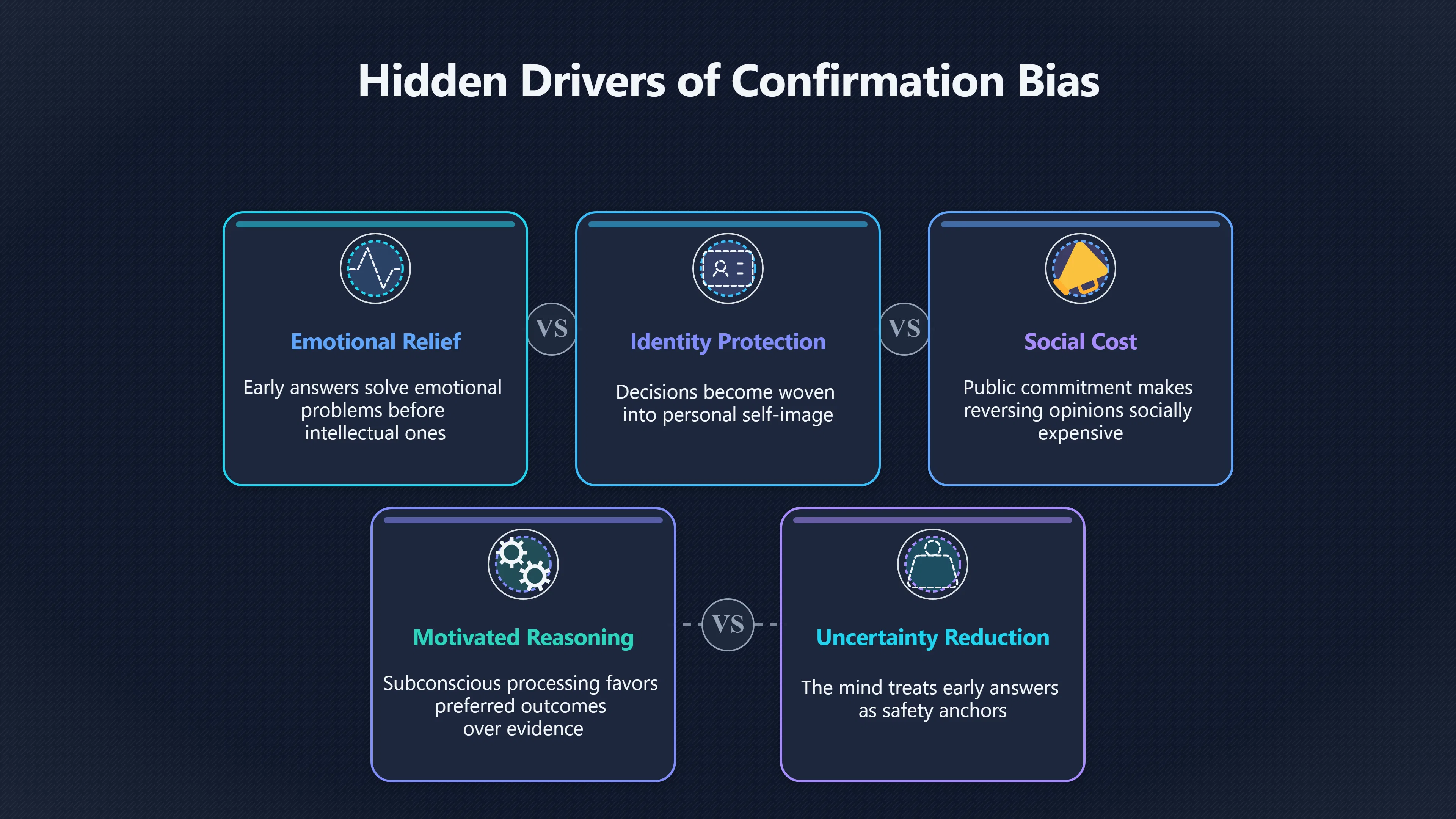
The emotional pull of an early answer
Early conclusions often become attractive because they solve an emotional problem before they solve an intellectual one.
For example:
- A promising job offer reduces anxiety about an uncertain future.
- A new relationship satisfies hopes for companionship.
- An investment idea promises financial success.
- A medical explanation reduces fear by providing certainty.
In each case, the first answer delivers emotional relief alongside factual interpretation. Later contradictory information therefore threatens not only the conclusion itself but also the emotional comfort attached to it.
Psychologists describe part of this process as motivated reasoning: reasoning influenced by preferred outcomes rather than purely by evidence. Importantly, this usually happens outside conscious awareness. People rarely decide to ignore evidence. Instead, supporting evidence simply feels more reasonable, while opposing evidence feels unusually weak, unfair or exceptional.[UC San Diego Pages+2Psychology Today]pages.ucsd.eduAs already noted, this is not to.Read moreUC San Diego PagesConfirmation Bias: A Ubiquitous Phenomenon in Many…by RS Nickerson · 1998 · Cited by 12272 — People may treat eviden…
How Identity Raises the Cost of Changing Course
As time passes, an early judgement often becomes woven into how people see themselves.
A decision may begin as a practical choice but gradually acquire social and personal meaning:
- “I chose this career because I’m independent.”
- “I’m good at spotting talented people.”
- “I’m someone who trusts my instincts.”
- “People already know I’ve committed to this.”
At this stage, evidence no longer threatens only the decision. It threatens competence, consistency or reputation.
This increases the psychological cost of changing one’s mind. Admitting the original judgement was incomplete can feel like admitting personal failure, even when changing course would objectively improve the outcome.
Researchers studying motivated reasoning argue that people often evaluate evidence differently depending on whether it supports or threatens valued beliefs or identities. Information inconsistent with those identities tends to receive closer scrutiny, while supportive information is accepted more readily. The result is not necessarily stronger reasoning but asymmetric reasoning.[UC San Diego Pages+2Psychology Today]pages.ucsd.eduAs already noted, this is not to.Read moreUC San Diego PagesConfirmation Bias: A Ubiquitous Phenomenon in Many…by RS Nickerson · 1998 · Cited by 12272 — People may treat eviden…
A practical example is someone who buys a house after quickly becoming convinced it is perfect. Once family and friends have heard enthusiastic descriptions, changing their mind becomes socially expensive. Problems discovered during inspections may be dismissed as minor because abandoning the purchase now also means explaining the reversal.
Why Contradictory Evidence Often Fails
People sometimes assume that stronger evidence naturally changes minds. In reality, later evidence must compete with an interpretation that has already been organised around the first answer.
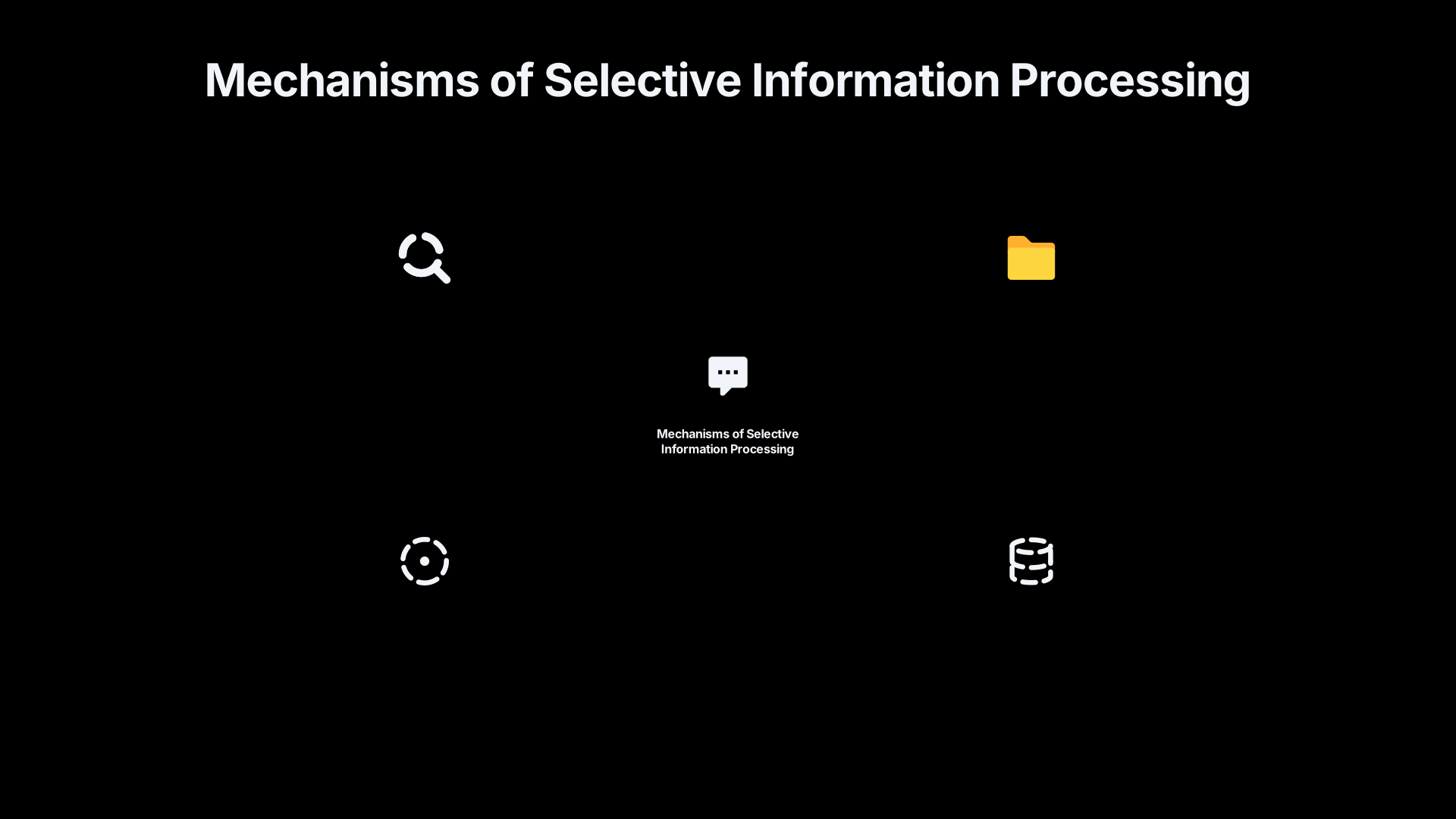
Several mechanisms reinforce this pattern:
- Selective attention: supporting facts attract more notice than conflicting ones.
- Selective interpretation: ambiguous information is interpreted in ways that preserve the existing story.
- Selective memory: confirming experiences become easier to remember.
- Unequal standards of proof: evidence against the preferred conclusion is expected to meet a much higher standard before being accepted.
These processes interact. A person who already believes a business opportunity is excellent may notice encouraging customer reviews, discount warnings as isolated complaints, remember successful examples and demand overwhelming proof before reconsidering.
This creates the impression that the conclusion has survived rigorous testing when, in reality, much of the testing has been uneven. Research on first-impression bias similarly shows that initial information often receives disproportionate weight, influencing how subsequent information is interpreted rather than simply being combined with it.[The Decision Lab]thedecisionlab.comThe Decision LabThe First Impression BiasThe first impression bias describes how we make quick judgements about others that are often sub…
Questions That Loosen a Protected Conclusion
The goal is not to distrust every first impression. Many first impressions are accurate enough to serve as useful starting points. The challenge is preventing them from becoming protected conclusions.
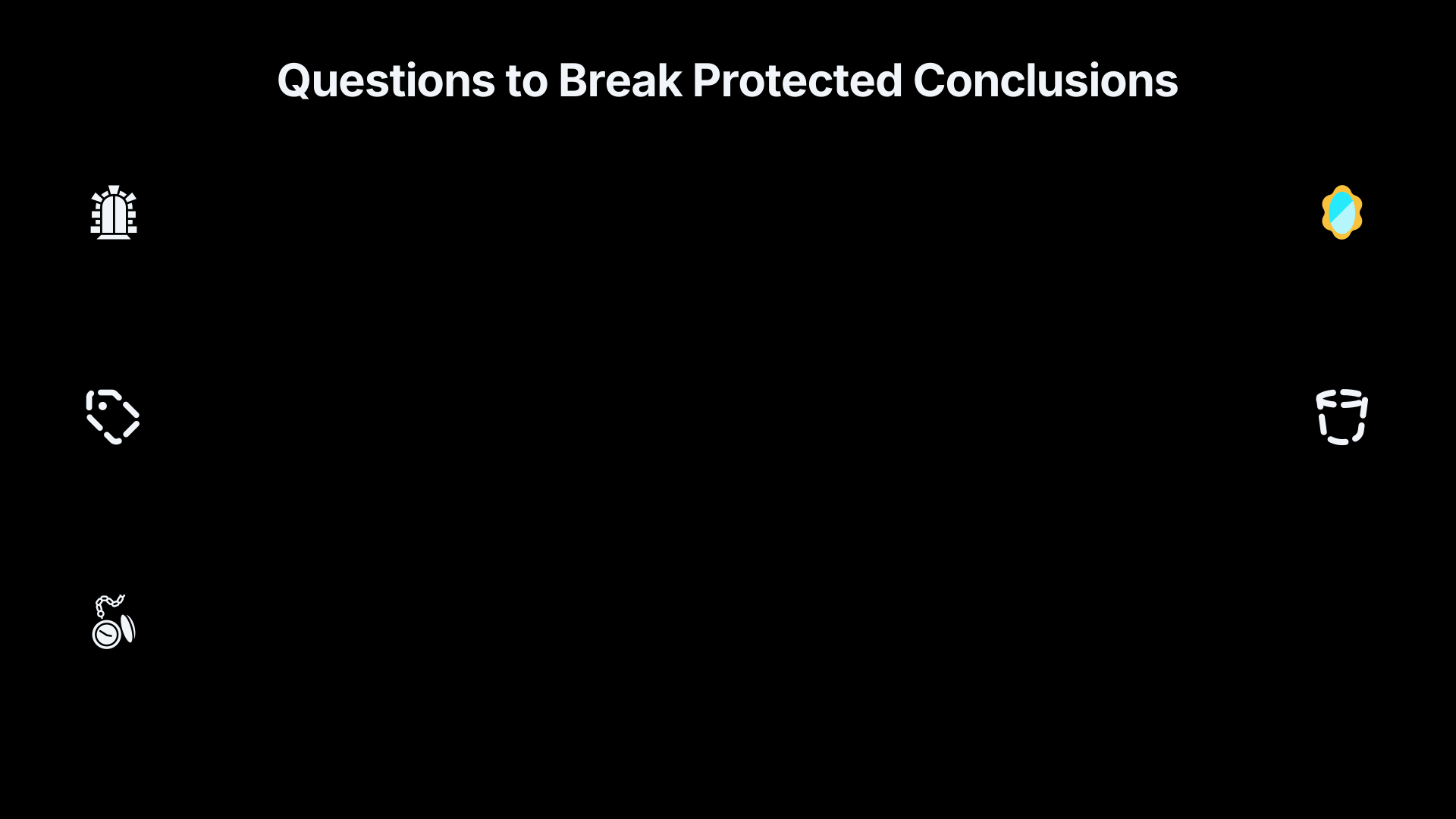
Several questions can interrupt this process:
- What evidence would genuinely change my mind? If no realistic evidence qualifies, the belief may already be insulated from testing.
- Would I judge the same evidence differently if it supported the opposite conclusion? This exposes unequal standards of proof.
- Am I defending the decision or defending my identity? Distinguishing the two reduces unnecessary commitment.
- What information did I avoid because I expected it to be uncomfortable? The answer often reveals missing evidence.
- If I had not already committed time, money or reputation, would I still make the same choice today? This helps separate current evidence from past investment.
These questions work because they redirect attention away from defending the original answer and back towards comparing competing explanations.
Recognising the Mechanism Before It Hardens
The earliest stage of confirmation bias is often the most important. Once an initial impression becomes emotionally rewarding, socially visible and tied to personal identity, it grows increasingly difficult to abandon even when new evidence appears.
Improving analytical thinking therefore depends less on avoiding first impressions altogether than on treating them as provisional hypotheses rather than conclusions. The most reliable decision-makers do not assume their first answer is wrong. They deliberately keep it easy to revise until it has survived serious attempts to disprove it. That shift—from protecting an attractive story to testing it against realistic alternatives—is what weakens the grip of confirmation bias in personal decisions.
Amazon book picks
Further Reading
Books and field guides related to Why the First Answer Starts Winning. Use these as the next step if you want deeper reading beyond the article.
Mistakes Were Made (but Not by Me)
Explores self-justification, identity protection, and why people cling to early conclusions.
The Scout Mindset
Focuses on reducing motivated reasoning and becoming more willing to update beliefs.
Decisive
Provides practical techniques for avoiding narrow framing and testing initial assumptions before deciding.
The Art of Thinking Clearly
Covers confirmation bias and related thinking errors that make first answers feel increasingly correct.
eBay marketplace picks
Marketplace Samples
Example marketplace items related to this page. Use the search link to explore similar finds on eBay.



Endnotes
1.
Source: pages.ucsd.edu
Title: (As already noted, this is not to.Read more
Link:https://pages.ucsd.edu/~mckenzie/nickersonConfirmationBias.pdf
Source snippet
UC San Diego PagesConfirmation Bias: A Ubiquitous Phenomenon in Many...by RS Nickerson · 1998 · Cited by 12272 — People may treat eviden...
2.
Source: thedecisionlab.com
Link:https://thedecisionlab.com/reference-guide/psychology/the-first-impression-bias
Source snippet
The Decision LabThe First Impression BiasThe first impression bias describes how we make quick judgements about others that are often sub...
3.
Source: Wikipedia
Title: Confirmation bias
Link:https://en.wikipedia.org/wiki/Confirmation_bias
Source snippet
Confirmation biasConfirmation bias is the tendency to search for, interpret, favor and [recall]({{ 'recall/' | relative_url }}) information in a way that confirms or su...
4.
Source: psychologytoday.com
Title: motivated reasoning
Link:https://www.psychologytoday.com/us/basics/motivated-reasoning
Source snippet
Nov 13, 2025 — Motivated reasoning, when biased reasoning leads to a particular conclusion or decision, a process that often occurs outsi...
Additional References
5.
Source: newslit.org
Title: in brief confirmation bias motivated reasoning
Link:https://newslit.org/news-and-research/in-brief-confirmation-bias-motivated-reasoning/
Source snippet
News Literacy ProjectIn brief: Confirmation bias and motivated reasoningJul 20, 2022 — Confirmation bias is an innate, unconscious tenden...
6.
Source: animal-ethics.org
Link:https://www.animal-ethics.org/motivated-reasoning-and-confirmation-bias/
Source snippet
Motivated reasoning and confirmation biasThus, motivated reasoning leads to denying, or avoiding the examination of unwelcome information...
7.
Source: youtube.com
Title: The Halo Effect: Unmasking Hidden Bias & How to Break Free
Link:https://www.youtube.com/watch?v=-aEMeqTDff4
Source snippet
Why first impressions stick cognitive psychology decision making confirmation bias Why First Impressions Are Almost Impossible to Erase C...
8.
Source: youtube.com
Link:https://www.youtube.com/watch?v=tZvDaPBqAyg
Source snippet
Anchoring Bias: How The Mind Is Biased By First Impressions (Cognitive Biases In A Nutshell)...
9.
Source: alignmentforum.org
Title: Motivated reasoning is one cause of that effect.Read more
Link:https://www.alignmentforum.org/posts/QpgmEhBvJQxAfFMP2/motivated-reasoning-confirmation-bias-and-ai-risk-theory
Source snippet
Motivated reasoning, confirmation bias, and AI risk theoryMay 5, 2026 — Confirmation bias is an effect in which we are irrational in favo...
Published: May 5, 2026
10.
Source: pmc.ncbi.nlm.nih.gov
Link:https://pmc.ncbi.nlm.nih.gov/articles/PMC4090078/
Source snippet
Dynamics with Confirmation Bias - PMC - NIHby AE Allahverdyan · 2014 · Cited by 186 — Confirmation bias is the tendency to acquire or pro...
11.
Source: youtube.com
Title: Anchoring Bias – Why First Impressions Stick (Even When They’re Wrong)
Link:https://www.youtube.com/watch?v=p21Yd-a9r-M
Source snippet
The Halo Effect: Unmasking Hidden Bias & How to Break Free...
12.
Source: aivy.app
Title: primacy effect
Link:https://www.aivy.app/en/lexicon/primacy-effect
Source snippet
The First Impression MistakeJan 6, 2026 — The “Primacy Effect” therefore means that the first information is more important to your brain...
13.
Source: youtube.com
Link:https://www.youtube.com/watch?v=5k6U4roEnbE
Source snippet
The Confirmation Bias...
14.
Source: youtube.com
Title: The Confirmation Bias
Link:https://www.youtube.com/watch?v=Kho5KvPBDSw
Source snippet
Anchoring Bias – Why First Impressions Stick (Even When They’re Wrong)...
Topic Tree