Within Decision Stakes
Which Decisions Deserve Slower Thinking?
Some choices deserve extra friction because the damage is serious, hard to undo, or likely to reshape later options.
On this page
- What makes a decision hard to reverse
- Realistic costs beyond money
- A slower process checklist before acting
Page outline Jump by section
Introduction
Some decisions deserve deliberate, slower thinking because they function like one-way doors: once you pass through them, reversing course is difficult, expensive, or impossible. The challenge is not simply that they are important, but that a mistake can permanently reshape your future options. Choosing to sign a long-term contract, relocate for a job, publicly commit to a position, or enter a business partnership can create consequences that persist long after the initial decision.
 Improving your thinking means learning to distinguish these high-commitment choices from the many everyday decisions that are easily corrected. Rather than applying maximum analysis to everything, reserve your deepest judgement for decisions where recovery is slow, costly, or incomplete. This approach improves both decision quality and decision speed by concentrating effort where it matters most.[Amazon News]aboutamazon.com2016 letter to shareholdersMany decisions are reversible, two-way doors. Those decisions can use a light- …Read more
What Makes a Decision Hard to Reverse?
A decision becomes a one-way door not because it is emotionally significant, but because reversing it requires substantial cost or leaves lasting consequences even after reversal.
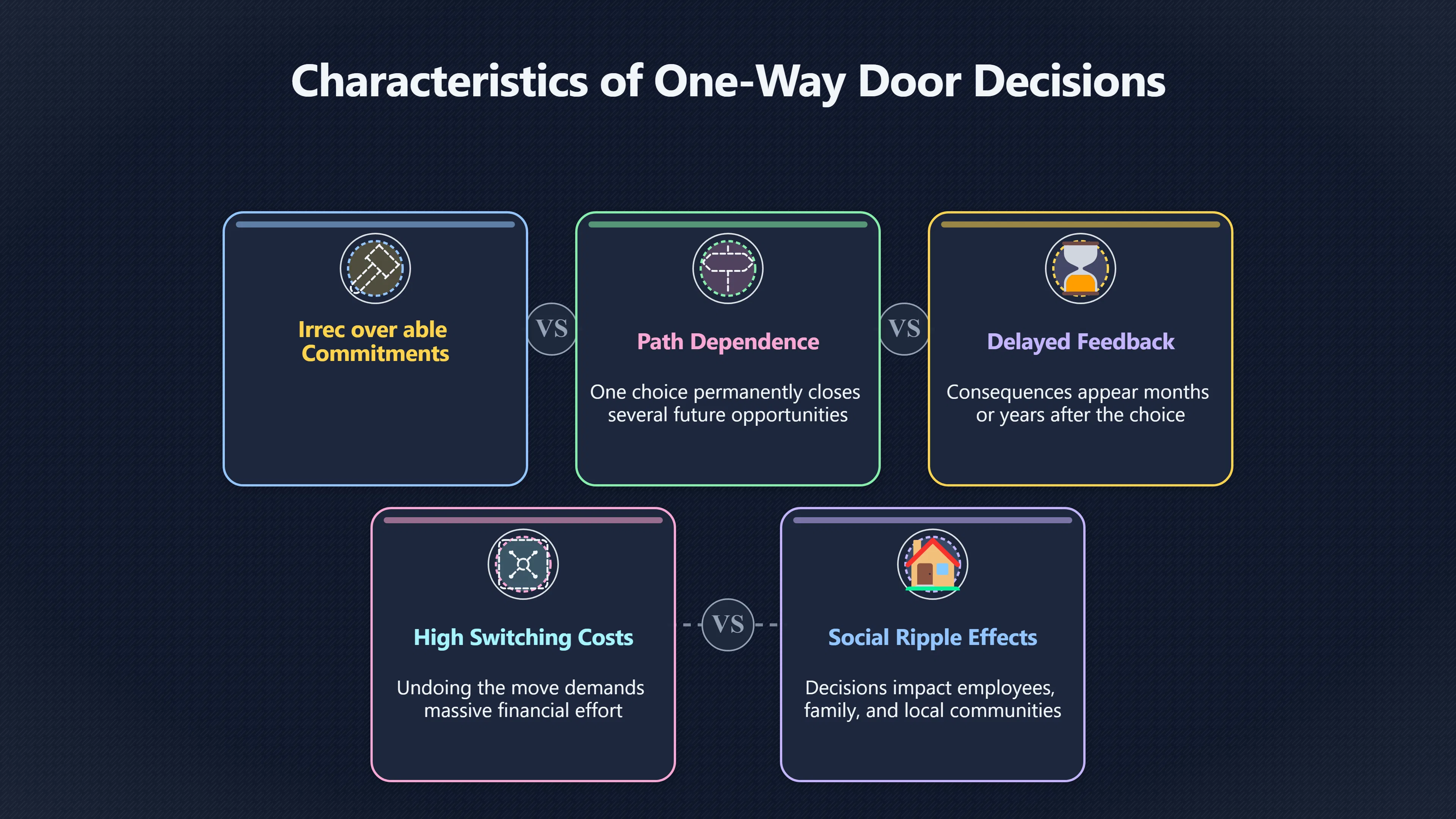
Several features make a decision genuinely difficult to undo:
- Irrecoverable commitments. Time, money, reputation, legal obligations or relationships become locked in.
- Path dependence. One choice changes the set of future choices available. Accepting one opportunity may permanently close several others.
- Delayed feedback. You may not discover whether the decision was good until months or years later, making rapid correction impossible.
- High switching costs. Undoing the decision demands major financial, emotional or organisational effort.
- Effects on other people. Decisions affecting employees, family members, customers or communities become harder to reverse because they create wider commitments.
Amazon popularised the distinction between “Type 1” (one-way) and “Type 2” (two-way) decisions for precisely this reason. One-way decisions require careful deliberation because mistakes cannot simply be corrected through quick iteration, while two-way decisions benefit from experimentation and rapid learning.[Amazon News]aboutamazon.com2016 letter to shareholdersMany decisions are reversible, two-way doors. Those decisions can use a light- …Read more
Importantly, reversibility is rarely absolute. Many decisions can technically be undone, but only after significant losses. Leaving an unsuitable job is possible; recovering the years spent building specialised experience may not be. Ending a business partnership is possible; repairing damaged trust or recovering legal costs may not be.
The Real Costs Extend Beyond Money
People often evaluate irreversible decisions primarily through financial cost. In practice, the most important losses are frequently less visible.
Opportunity costs
Every major commitment crowds out alternatives. Committing to one university, one career path or one market strategy means giving up other possibilities that cannot all be explored simultaneously.
The cost is not simply what you spend, but what you never get the chance to pursue.
Reputation
Public actions create expectations that are difficult to erase. Publishing incorrect information, making public accusations or repeatedly breaking commitments can leave reputational effects long after the original event.
Unlike financial losses, reputation often recovers slowly and unevenly.
Relationships
Marriage, business partnerships, hiring senior executives or dismissing trusted colleagues reshape social systems rather than isolated transactions.
Even when relationships formally end, the practical consequences often continue through networks, trust and future collaboration.
Time
Perhaps the least appreciated irreversible resource is time.
Money can sometimes be earned again. Years invested in the wrong direction cannot be recovered, especially when the decision delays acquiring experience elsewhere.
Why Instinct Alone Is Often Not Enough
Human intuition performs well in familiar environments with rapid feedback. It performs less reliably when decisions involve uncertainty, delayed consequences and rare events.
One-way door decisions frequently combine exactly these conditions:
- little previous experience
- incomplete information
- emotional pressure
- delayed outcomes
- large consequences.
This creates fertile conditions for common thinking errors.
People may:
- overweight recent experiences;
- become overly confident in their predictions;
- underestimate future regret;
- confuse commitment with certainty;
- mistake urgency for importance.
Because feedback arrives slowly, these mistakes often remain hidden until reversing course becomes extremely expensive.
Slowing down introduces deliberate checks that compensate for these predictable weaknesses rather than attempting to eliminate uncertainty altogether.
A Slower-Process Checklist Before Acting
Slower judgement does not mean endless analysis. It means introducing structured friction before crossing a one-way door.
A practical checklist includes the following questions.
1. What exactly becomes difficult to undo?
Be specific.
Rather than asking whether the decision is “important”, ask:
- What commitment becomes permanent?
- What future options disappear?
- What obligations begin immediately?
Writing these answers often reveals hidden commitments that emotions overlook.
2. What is the worst realistic outcome?
Avoid imagining either catastrophe or perfection.
Instead ask:
- What would failure actually look like?
- Could I recover?
- How long would recovery take?
- Who else would bear the consequences?
Thinking in concrete scenarios produces more reliable judgement than relying on vague feelings.
3. Which assumptions must be true?
List the few assumptions on which the decision depends.
For example:
- the new employer remains financially stable;
- projected demand actually exists;
- the partnership remains cooperative;
- the legal environment does not materially change.
Identifying assumptions makes it easier to test them before committing.
4. Can I reduce the irreversibility?
Many apparently one-way decisions can be redesigned into smaller, reversible steps.
Examples include:
- accepting a short trial before signing a long contract;
- piloting a product with limited customers before a national launch;
- renting before buying property;
- testing a collaboration before forming a permanent partnership.
Reducing commitment often preserves valuable learning while limiting downside.

5. Have I sought disagreement?
For one-way door decisions, consultation is valuable not because groups are always wiser, but because independent perspectives expose assumptions you cannot easily see yourself.
The goal is not unanimous agreement but stronger reasoning.
Amazon’s guidance emphasises deliberate consultation for Type 1 decisions precisely because the cost of unnoticed errors is unusually high.[Amazon News]aboutamazon.com2016 letter to shareholdersMany decisions are reversible, two-way doors. Those decisions can use a light- …Read more
Practical Examples of One-Way Door Decisions
The concept applies across personal and professional life.
DecisionWhy slower judgement helpsAccepting a role requiring international relocationChanges career path, relationships and living arrangements simultaneously.Choosing a business co-founderCreates long-term legal, financial and interpersonal commitments.Selling a family businessOwnership, customer relationships and strategic control may never return.Publicly adopting an irreversible organisational strategyEmployees, investors and customers begin adapting immediately.Undergoing major irreversible medical treatmentBenefits and risks may extend throughout the remainder of life.
By contrast, changing meeting formats, testing pricing, trying new software or experimenting with a study routine are often much closer to two-way doors because they can usually be adjusted quickly after learning from experience.[Amazon News]aboutamazon.com2016 letter to shareholdersMany decisions are reversible, two-way doors. Those decisions can use a light- …Read more
Avoid Two Common Mistakes
The one-way door framework helps prevent two opposite errors.
The first is acting too quickly on genuinely irreversible decisions. Enthusiasm, deadlines or social pressure can encourage commitment before important uncertainties have been examined.
The second is treating reversible decisions as irreversible. Large organisations often slow themselves by applying heavyweight approval processes to choices that could easily be tested and revised. Jeff Bezos argued that this tendency leads to excessive caution, reduced experimentation and slower innovation.[Amazon News]aboutamazon.com2016 letter to shareholdersMany decisions are reversible, two-way doors. Those decisions can use a light- …Read more
Good judgement lies between these extremes: careful where recovery is difficult, fast where learning comes from action.
The Goal Is Better Commitment, Not Perfect Certainty
One-way door decisions can never become risk-free. Waiting indefinitely rarely removes uncertainty because many important facts only become visible after commitment.
The objective is therefore not perfect prediction but high-quality commitment. By identifying what is truly hard to reverse, examining realistic consequences beyond financial cost, testing critical assumptions and reducing irreversibility where possible, you greatly improve the odds that your most consequential decisions are guided by careful reasoning rather than impulse or unnecessary haste.
Amazon book picks
Further Reading
Books and field guides related to Which Decisions Deserve Slower Thinking?. Use these as the next step if you want deeper reading beyond the article.
Thinking, Fast and Slow
Explains why important decisions deserve slower, more careful reasoning.
Superforecasting
Supports better judgment when outcomes are uncertain and hard to reverse.
eBay marketplace picks
Marketplace Samples
Live-tested eBay searches with available results related to this page.

Top pick
critical thinking card game
Open a targeted eBay search for items related to this topic.
Browse eBay
Related search
which poster
Open a targeted eBay search for items related to this topic.
Browse eBay
Related search
which memorabilia
Open a targeted eBay search for items related to this topic.
Browse eBay
Endnotes
1.
Source: aboutamazon.com
Title: 2016 letter to shareholders
Link:https://www.aboutamazon.com/news/company-news/2016-letter-to-shareholders?tag=searcht-20
Source snippet
Many decisions are reversible, two-way doors. Those decisions can use a light-...Read more...
Additional References
2.
Source: linkedin.com
Link:https://www.linkedin.com/top-content/business-strategy/intelligent-business-decisions/amazon-two-way-door-decision-making-model/
Source snippet
Amazon Two-Way Door Decision-Making ModelOne-way doors: Irreversible decisions (be careful) Two-way doors: Reversible decisions (move fas...
3.
Source: theuncertaintyproject.org
Link:https://www.theuncertaintyproject.org/tools/decision-types
Source snippet
Decision TypesThe system is called "Decision Types" and it involves identifying two types of decisions: Type 1 and Type 2. Type 1: Also k...
4.
Source: fs.blog
Link:https://fs.blog/reversible-irreversible-decisions/
Source snippet
Farnam StreetReversible and Irreversible DecisionsSome decisions are consequential and irreversible or nearly irreversible – one-way door...
5.
Source: medium.com
Link:https://medium.com/%40dannywen/on-decision-making-3e045c09b173
Source snippet
Most Decisions Are Two-Way DoorsSome decisions are consequential and irreversible or nearly irreversible — one-way doors — and these deci...
6.
Source: nironirmalan.com
Title: decision making using one and two way doors
Link:https://nironirmalan.com/2023/07/09/decision-making-using-one-and-two-way-doors/
Source snippet
Decision Making using One and Two-Way Doors9 Jul 2023 — Jeff Bezos' one-way and two-way doors concept is a pretty nifty way to navigate d...
7.
Source: blueprints.guide
Title: Jeff Bezos’s 1-Way vs 2-Way Doors
Link:https://blueprints.guide/posts/one-way-vs-two-way-doors
Source snippet
In Amazon's 2016 letter to shareholders, Jeff Bezos encourages us to allocate decisions into one of two buckets: Reversible '2...
8.
Source: youtube.com
Link:https://www.youtube.com/watch?v=rxsdOQa_QkM
Source snippet
Reminds of the decision model of asking yourself is it a hat, haircut or...
9.
Source: youtube.com
Title: Jeff Bezos’s [explain]({{ ‘explain/’ | relative_url }}) his famous one-way door and two-way door decision making
Link:https://www.youtube.com/watch?v=XjShSJkffzI
Source snippet
Why Decision-Making Is Becoming Harder for C-Suite Leaders—and How You Can Overcome It...
10.
Source: youtube.com
Title: The Framework Jeff Bezos’ Used To Make Me a Millionaire
Link:https://www.youtube.com/watch?v=AvH3VgOIg9U
Source snippet
Why the Best Startup Founders Prioritize Action Over Certainty...
11.
Source: youtube.com
Link:https://www.youtube.com/watch?v=eF5ceq1_grM
Source snippet
How to Stop Overthinking Your Decisions...
Topic Tree