Within Change Mind
Why Contradictory Evidence Is More Useful Than More Proof
The strongest test of a belief often comes from evidence that could prove it wrong.
On this page
- Types of disconfirming evidence
- Finding rival explanations
- Updating confidence without overreacting
Page outline Jump by section
Introduction
Asking “What would change my mind?” is only useful if you genuinely look for evidence that could reduce your confidence rather than simply collecting more reasons to believe you are already correct. Once a belief has enough supporting evidence to be plausible, additional confirming examples often add surprisingly little information. By contrast, a single piece of reliable contradictory evidence can reveal that an assumption is incomplete, a causal explanation is wrong, or the belief only holds under limited conditions. This does not mean treating every objection as decisive. It means deliberately searching for evidence that has the power to prove your current explanation wrong, because such evidence is usually more informative than another example that merely fits what you already expected.[Wikipedia]WikipediaConfirmation biasConfirmation bias

Why contradictory evidence is more useful than more proof
One of the most common reasoning mistakes is assuming that confidence should grow simply because more supporting evidence has been collected. In reality, evidence has unequal value.
Suppose you believe that a new training programme improves employee performance. Ten managers who already favour the programme may report positive experiences. Those reports increase confidence only slightly because they are exactly what your hypothesis predicted. However, discovering that comparable teams using the programme consistently perform worse under carefully measured conditions would force a much deeper rethink. The contradictory finding tests the belief in a way that repeated agreement cannot.
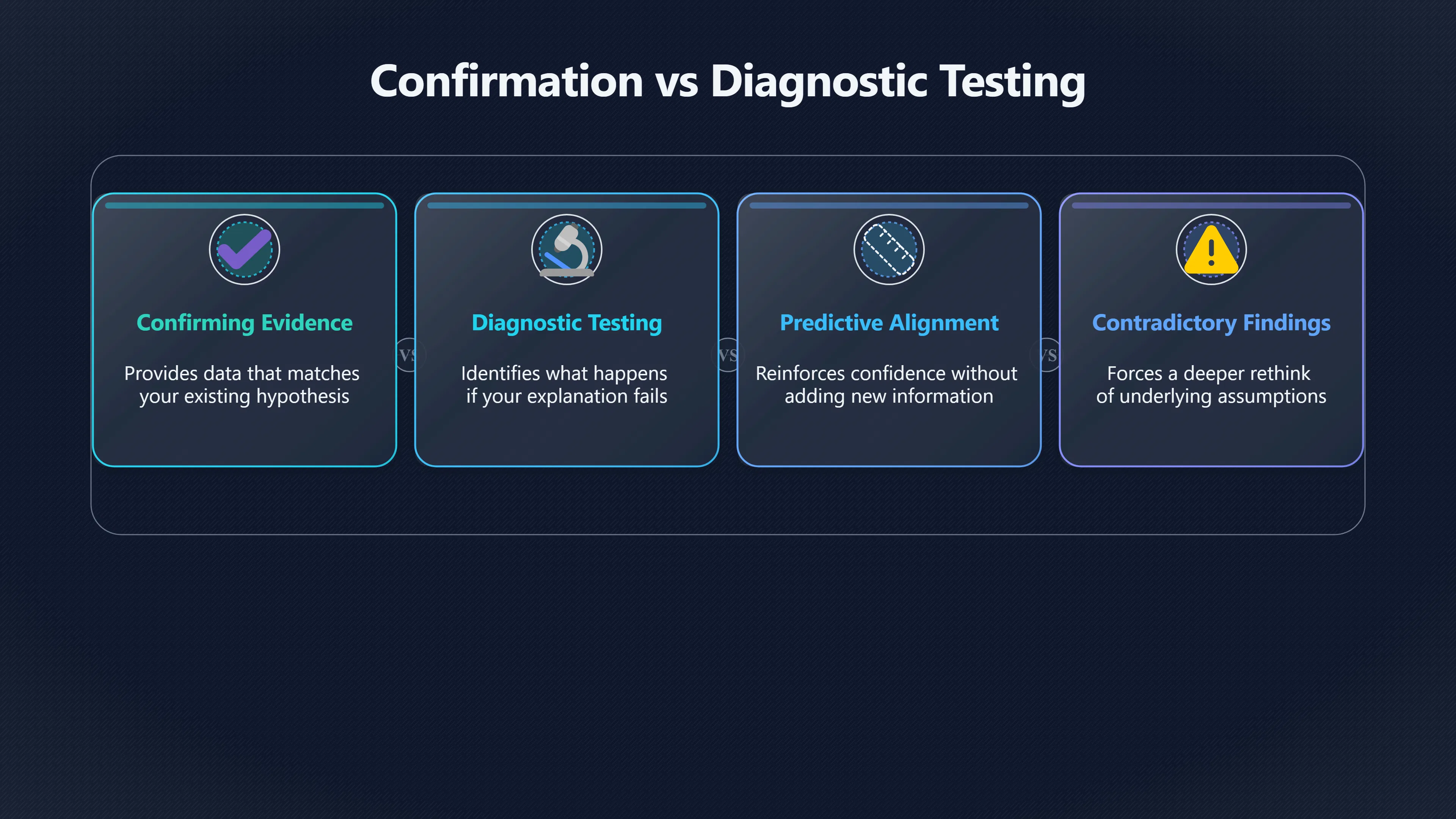
This principle explains why psychologists distinguish between confirmation and diagnostic testing. Confirming evidence often tells you what you already expected to observe. Disconfirming evidence asks a different question: what would I see if my explanation were mistaken? Evidence that can answer that question carries much greater informational value.[Wikipedia+2lakens.github.io]WikipediaConfirmation biasConfirmation bias
Types of disconfirming evidence
Not every disagreement counts as meaningful contradictory evidence. The most useful forms directly challenge the assumptions on which the belief depends.
Common examples include:
- Failed predictions. A belief predicts that a specific outcome should occur, but it repeatedly does not.
- Reliable counterexamples. Even one well-established case can show that a supposedly universal claim is false.
- Competing explanations. Another hypothesis explains the same observations equally well or better.
- Boundary cases. The belief works only under narrow conditions rather than generally.
- Independent replication failures. Other investigators cannot reproduce the expected results despite following comparable methods.
The key question is whether the evidence would genuinely lower your confidence if it turned out to be true. If the answer is no, then the evidence is not functioning as a real test.
Finding rival explanations instead of defending one explanation
People naturally explain new information in ways that preserve existing beliefs. This tendency, often called confirmation bias or myside bias, affects what information we search for, how we interpret ambiguous evidence, and even what we remember later.[Wikipedia]WikipediaConfirmation biasConfirmation bias
A stronger approach is to generate competing explanations before collecting more evidence.
Instead of asking:
“What evidence shows my conclusion is correct?”
ask questions such as:
- What else could explain these observations?
- What prediction differs between the two explanations?
- What observation would favour the alternative instead?
- If I had to argue against my own position, what would be my strongest point?
For example, if customer satisfaction rises after launching a new website, the obvious explanation is that the redesign worked. A rival explanation might be seasonal demand, a pricing change, or improved customer support. The next step is not to defend either explanation but to identify evidence capable of distinguishing between them.
This shifts reasoning away from advocacy and towards discrimination between competing hypotheses.
Lessons from the classic Wason experiments
Psychologist Peter Wason demonstrated this problem in his famous rule-discovery experiments.
Participants were shown the sequence 2, 4, 6 and asked to discover the underlying rule by proposing additional number triples. Most quickly guessed a specific rule—for example, “numbers increasing by two”—and then tested more examples that fit that idea, such as 8, 10, 12. Those examples almost always received confirmation, reinforcing the incorrect hypothesis.
Far fewer participants proposed triples designed to prove themselves wrong, such as 3, 5, 4 or 8, 6, 4. Those disconfirming tests would have revealed much sooner that the actual rule was simply any ascending sequence.[Wikipedia+2Wikipedia]WikipediaPeter Cathcart WasonPeter Cathcart Wason
The lesson extends well beyond laboratory puzzles. People often design “tests” that can only produce supporting evidence. A better test deliberately creates the possibility of discovering that the current explanation is mistaken.
Updating confidence without overreacting
Seeking contradictory evidence does not mean abandoning a belief whenever criticism appears.
Instead, think of confidence as something that moves gradually.
Useful questions include:
- Is the contradictory evidence reliable?
- Does it directly challenge a core assumption or only a minor detail?
- Could measurement error explain the apparent contradiction?
- Does the evidence repeat across independent observations?
- Does the alternative explanation now account for more of the facts?
This approach avoids two opposite mistakes:
- Ignoring contradictory evidence, which leads to unwarranted certainty.
- Overreacting to isolated anomalies, which creates instability and constant opinion changes.
Good judgement means allowing confidence to increase or decrease in proportion to the quality of the evidence, not simply the quantity.
Practical ways to search for disconfirming evidence
The habit becomes easier if it is built into decision-making before a conclusion feels psychologically committed.
Useful practices include:
- Write down one observation that would genuinely change your mind before gathering additional evidence.
- Assign someone to argue for the strongest competing explanation rather than simply criticising details.
- Search specifically for studies, examples or datasets that contradict your preferred conclusion.
- Compare predictions from multiple explanations before deciding which evidence to collect.
- Periodically ask whether new evidence would still count if it supported the opposite conclusion.
These habits make it less likely that evidence collection becomes an exercise in self-validation.

A useful shift in mindset
Collecting more supporting evidence often increases confidence without substantially increasing understanding. Looking for evidence that could prove a belief wrong does the opposite: it exposes hidden assumptions, distinguishes between competing explanations, and reveals where confidence is genuinely deserved.
Within the broader practice of asking “What would change my mind?”, this is the central mechanism. The goal is not to become sceptical of everything, but to make beliefs answerable to evidence capable of changing them. That is what turns a belief from something merely defended into something genuinely tested.[Wikipedia+2PMC]WikipediaConfirmation biasConfirmation bias
Amazon book picks
Further Reading
Books and field guides related to Why Contradictory Evidence Is More Useful Than More Proof. Use these as the next step if you want deeper reading beyond the article.
Mistakes Were Made (but Not by Me)
Explores self-justification and resistance to contradictory evidence.
eBay marketplace picks
Marketplace Samples
Live-tested eBay searches with available results related to this page.


Endnotes
1.
Source: Wikipedia
Title: Confirmation bias
Link:https://en.wikipedia.org/wiki/Confirmation_bias
2.
Source: lakens.github.io
Title: 16 confirmationbias
Link:https://lakens.github.io/statistical_inferences/16-confirmationbias.html
Source snippet
16 Confirmation Bias and Organized SkepticismIn a classic paper on confirmation bias, Nickerson (1998) defines confirmation bias as the s...
3.
Source: Wikipedia
Title: Peter Cathcart Wason
Link:https://en.wikipedia.org/wiki/Peter_Cathcart_Wason
4.
Source: Wikipedia
Title: Wason selection task
Link:https://en.wikipedia.org/wiki/Wason_selection_task
Additional References
5.
Source: fs.blog
Link:https://fs.blog/confirmation-bias/
Source snippet
Confirmation Bias And the Power of Disconfirming EvidenceConfirmation bias is our tendency to cherry-pick information that confirms our e...
6.
Source: pmc.ncbi.nlm.nih.gov
Link:https://pmc.ncbi.nlm.nih.gov/articles/PMC11561113/
Source snippet
by V Berthet · 2024 · Cited by 25 — When they are asked to test a given hypothesis, individuals tend to be biased towards confirming e...
7.
Source: reasoningforthedigitalage.com
Link:https://reasoningforthedigitalage.com/table-of-contents/confirmation-bias-total-evidence-requirement-and-falsificationism/
Source snippet
Confirmation Bias, Total Evidence Requirement, and...Confirmation bias is when only confirming evidence and reasons are cited, and falsi...
8.
Source: youtube.com
Title: The Black Swan
Link:https://www.youtube.com/watch?v=YDiy6tZL5KQ
Source snippet
this is how to improve your critical thinking according to neuroscience | THE ONLY VIDEO THAT WORKS...
9.
Source: statmodeling.stat.columbia.edu
Title: How do these two forms of reasoning differ?Read more
Link:https://statmodeling.stat.columbia.edu/2014/09/05/confirmationist-falsificationist-paradigms-science/
Source snippet
and falsificationist paradigms of science5 Sept 2014 — In falsificationist reasoning, it is the researcher's actual hypothesis A that is...
10.
Source: drinknumin.com
Title: Confirmation Bias vs
Link:https://drinknumin.com/blogs/news/confirmation-bias-vs-falsification-the-two-scientist-test-for-better-decision-making?srsltid=AfmBOoq9eTiOjSmV-bEZf1zYudRnuwbABJENE2Gz6MKxRUBmbA4Ll-F5
Source snippet
Falsification: The Two-Scientist Test...9 Feb 2026 — Learn how confirmation bias inflates confidence without accuracy, and how falsifica...
11.
Source: youtube.com
Title: Confirmation Bias: The Reason Smart People Are Usually the Most Wrong
Link:https://www.youtube.com/watch?v=ld0sTjTFL50
Source snippet
Confirmation Bias Explained: Why Smart People Miss Evidence...
12.
Source: youtube.com
Title: Confirmation Bias Explained: Why Smart People Miss Evidence
Link:https://www.youtube.com/watch?v=72PnUjoSNKY
Source snippet
The Black Swan - Video 3: "Why Your Brain Lies: The Narrative Fallacy"...
13.
Source: youtube.com
Link:https://www.youtube.com/watch?v=mHkOk3W48gk
Source snippet
How to overcome the Judge's prejudice?...
14.
Source: youtube.com
Title: How to overcome the Judge’s prejudice?
Link:https://www.youtube.com/watch?v=runKCTt0hUM
Topic Tree
Follow this branch
Parent topic
Change Mind What Evidence Would Change Your Mind?Related pages 5
- Confidence Updates Why Changing Your Mind Can Mean Changing Your Confidence
- Premortems Can a Premortem Reveal When You Should Reconsider?
- Review Triggers How Review Triggers Make Changing Course Easier
- Revision Rules What Would Actually Make You Change Your Mind?
- Wason 2 4 6 What the 2 4 6 Experiment Teaches About Better Decisions