Within Decision Stakes
Imagine Failure Before It Happens
A premortem helps people notice plausible reasons a decision could fail before commitment makes them harder to discuss.
On this page
- How prospective hindsight works
- Questions that reveal hidden risks
- When a premortem is worth the time
Page outline Jump by section
Introduction
A premortem is a structured way to imagine that an important decision or project has already failed and then work backwards to explain why. Unlike a postmortem, which analyses failure after the damage has been done, a premortem aims to uncover weak assumptions, overlooked risks and hidden dependencies before commitment makes them harder to question. It is particularly valuable for high-stakes or difficult-to-reverse decisions, where discovering a critical flaw early is far cheaper than correcting it later.
 Within a broader approach to decision stakes and reversibility, a premortem provides deliberate friction at exactly the point where optimism and momentum are most likely to distort judgement. Rather than asking, “What could go wrong?”, it asks a more psychologically powerful question: “It is one year from now and this decision has failed badly. What happened?” Research on this form of “prospective hindsight” suggests that it improves people’s ability to identify plausible causes of future outcomes by roughly 30%, making it a practical tool for spotting costly failure modes before they become reality.[ResearchGate]researchgate.netResearch Gate(PDF) Performing a Project Premortemidentify reasons for future outcomes. by 30%. We have used prospective hind-. sight to devise a method called a premortem. which helps p…
How prospective hindsight works
Most planning begins from an assumption of success. Teams naturally defend their preferred option, discount contrary evidence and become attached to the effort already invested. These tendencies contribute to well-known thinking errors such as optimism bias, overconfidence and the planning fallacy.
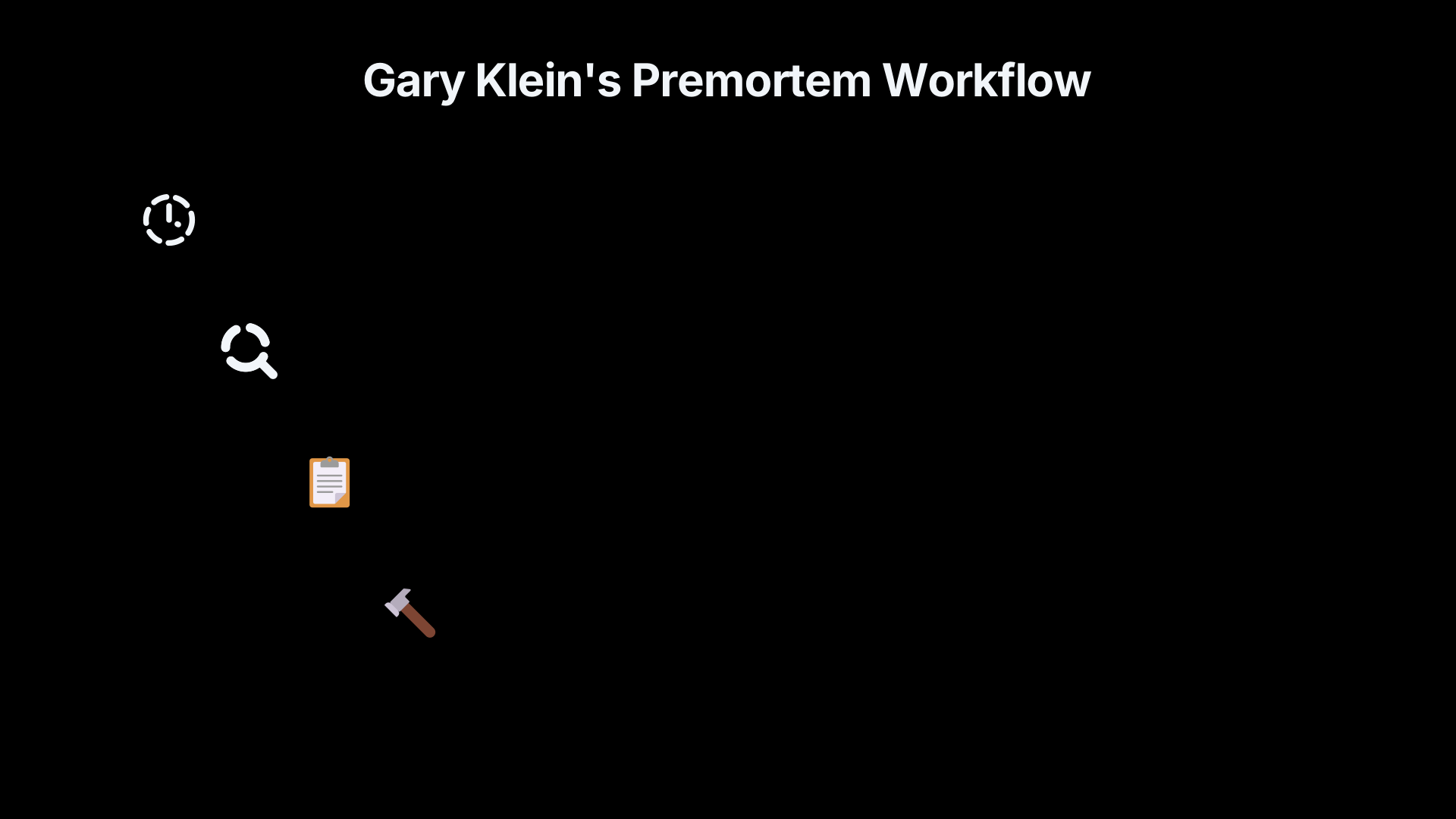
A premortem changes the mental task. Instead of predicting whether a project will succeed, participants accept—temporarily—that it has already failed. Their job is no longer to criticise colleagues or argue against the proposal but to explain an established outcome. This subtle change reduces the social cost of expressing doubts because people are not challenging the project itself; they are diagnosing an imagined failure. Gary Klein introduced the technique specifically to encourage knowledgeable dissent that would otherwise remain unspoken.[Harvard Business Review]hbr.orgperforming a project premortemHarvard Business ReviewPerforming a Project PremortemReprint: F0709A In a premortem, team members assume that the project they are planni…
The psychological mechanism is known as prospective hindsight. Rather than reasoning forwards through uncertain possibilities, participants mentally “look back” from a future failure. This tends to generate richer explanations, surface uncomfortable possibilities and reveal interactions between small risks that ordinary planning often overlooks.[homepages.se.edu]homepages.se.eduincreases the ability to correctly identify reasons for future.Read more…
Importantly, the exercise is not an attempt to predict the future with certainty. Instead, it broadens the range of plausible futures that decision-makers actively consider before committing resources.
Questions that reveal hidden risks
The quality of a premortem depends less on imagination than on asking questions that expose fragile assumptions. Useful prompts include:
- What assumption proved false? Which belief looked obvious today but turned out to be wrong?
- What warning signs did we ignore? Were there early indicators that everyone discounted?
- What dependency failed? Did success rely on a supplier, regulator, technology or partner behaving exactly as expected?
- What changed externally? Could market conditions, legislation, competitors or public opinion have shifted?
- Where were estimates too optimistic? Were costs, timelines or adoption rates unrealistic?
- Who had information that never reached the decision-maker? Did organisational hierarchy or group pressure suppress concerns?
- Which small problem cascaded? Many expensive failures arise from several manageable issues combining rather than one catastrophic mistake.
These questions help distinguish superficial risks (“the schedule slipped”) from underlying mechanisms (“the schedule assumed specialist staff would remain available, but competing priorities removed them”).
A particularly valuable follow-up asks which imagined failures would have been visible before commitment if only someone had looked. Those are often the highest-value risks because they are still preventable.
Turning imagined failures into better decisions
A premortem is valuable only if it changes the decision rather than merely producing a list of worries.
After generating possible failure modes, they should be grouped according to both likelihood and consequence. Some require redesigning the plan entirely, while others simply justify contingency measures or additional monitoring.
Typical responses include:
- strengthening assumptions with additional evidence;
- running a small pilot before committing fully;
- adding checkpoints where the decision can be revisited;
- assigning explicit ownership for major risks;
- identifying objective indicators that would trigger a change of course;
- abandoning options whose downside remains unacceptable even after mitigation.
This approach preserves one of the central ideas of good decision-making: analysis should improve choices rather than merely increase confidence.
Common failure modes that premortems expose
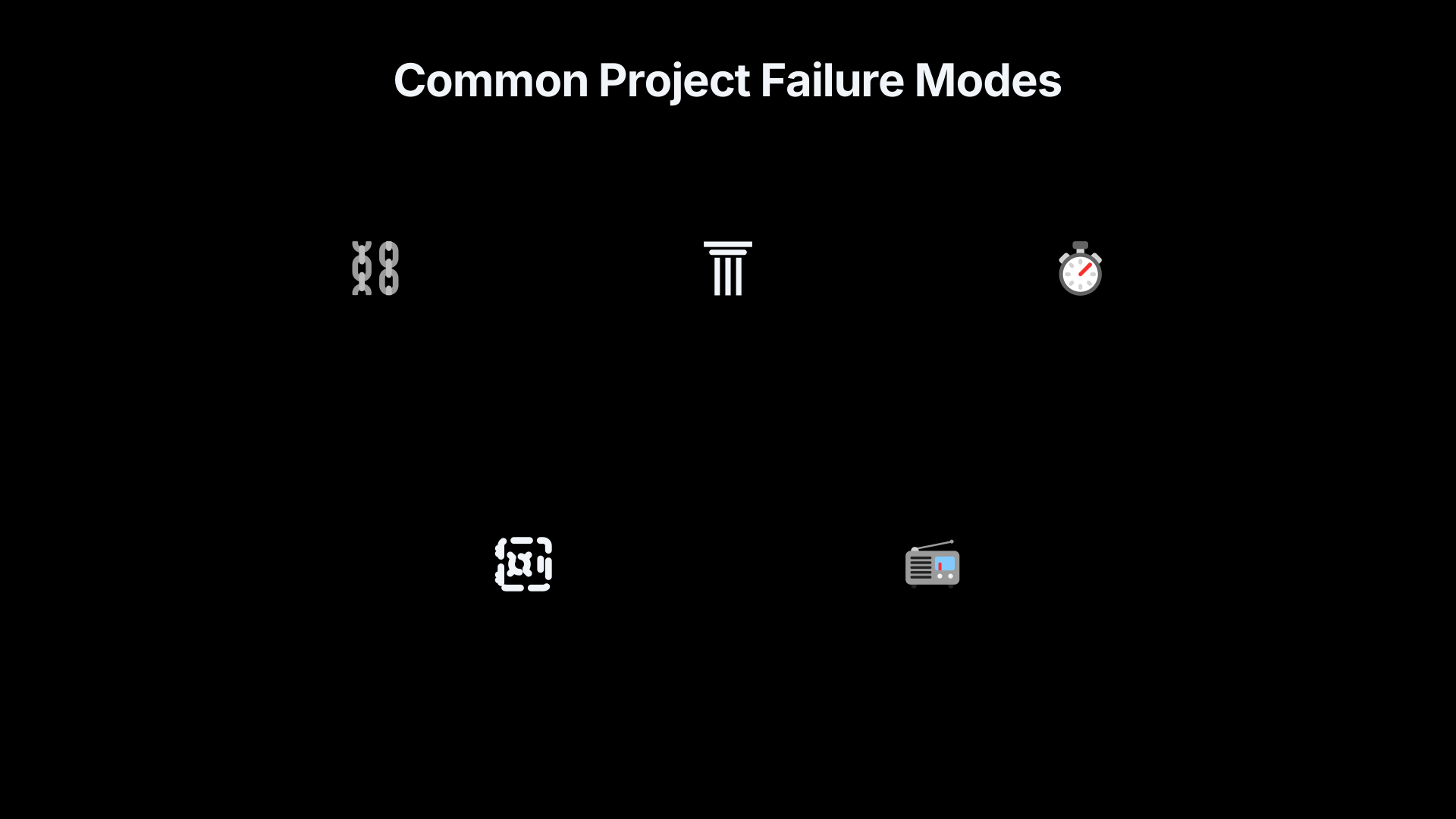
Although every important decision has unique risks, premortems frequently uncover recurring patterns.
Hidden dependency chains. Success depends on several independent events all occurring together, yet planning assumes each will happen without examining their combined fragility.
Single points of failure. One individual, supplier, approval or technology quietly becomes indispensable.
Planning fallacy. Teams systematically underestimate time, complexity and coordination costs despite experience suggesting otherwise.
Escalation of commitment. Early investments make people reluctant to reconsider even when evidence deteriorates. Behavioural research identifies escalation of commitment as one of the major biases affecting project outcomes.[arXiv]arxiv.orgarXiv Top Ten Behavioral Biases in Project Management: An OverviewTop Ten Behavioral Biases in Project Management: An OverviewJanuary 24, 2022…
Communication breakdowns. Critical information exists somewhere in the organisation but never reaches those making the decision.
Unclear ownership. Everyone assumes someone else is responsible for monitoring an important risk.
Recognising these recurring failure modes makes future premortems faster because participants begin with patterns that have repeatedly caused expensive mistakes elsewhere.
When a premortem is worth the time
Not every decision deserves a formal premortem. Running one before choosing a restaurant or drafting an email simply adds unnecessary friction.
A premortem becomes worthwhile when several of the following conditions apply:
- the decision is expensive or difficult to reverse;
- failure would significantly affect other people;
- uncertainty is high despite available information;
- success depends on multiple interacting assumptions;
- organisational pressure encourages agreement;
- reputational, legal or safety consequences could be substantial.
Examples include launching a major product, relocating a business, making a significant investment, introducing organisational change or adopting critical new technology.
For low-cost, reversible decisions, rapid experimentation usually provides better learning than extensive hypothetical analysis.

Pitfalls and limitations
A premortem is not immune to misuse.
One common mistake is treating every imagined problem as equally likely. The objective is to improve judgement, not accumulate endless speculative risks. Once obvious hazards have been identified, further brainstorming often produces diminishing returns.
Another mistake is confusing pessimism with realism. Effective premortems identify plausible failure mechanisms supported by evidence or experience rather than dramatic worst-case scenarios.
The exercise can also fail if organisational culture discourages honesty. If participants fear appearing negative or disloyal, they may still withhold their strongest concerns despite the hypothetical framing. Skilled facilitation is therefore important: the discussion should reward thoughtful criticism without turning into blame or cynicism.[Harvard Business Review]hbr.orgperforming a project premortemHarvard Business ReviewPerforming a Project PremortemReprint: F0709A In a premortem, team members assume that the project they are planni…
Finally, a premortem should not replace empirical evidence. If important uncertainties can be resolved through testing, expert advice or a limited pilot, those sources of information remain more valuable than imagination alone.
Why premortems improve thinking
Premortems strengthen analytical thinking because they counter a predictable weakness of human judgement: once people become invested in a preferred course of action, it becomes increasingly difficult to notice evidence that points in another direction.
By deliberately imagining failure before commitment, decision-makers become better at recognising fragile assumptions, encouraging constructive disagreement and identifying risks while they are still inexpensive to address. For decisions with meaningful consequences or limited reversibility, that small investment in prospective hindsight can substantially improve the quality of reasoning without requiring complex analytical tools.[ResearchGate+2brookings.edu]researchgate.netResearch Gate(PDF) Performing a Project Premortemidentify reasons for future outcomes. by 30%. We have used prospective hind-. sight to devise a method called a premortem. which helps p…
Amazon book picks
Further Reading
Books and field guides related to Imagine Failure Before It Happens. Use these as the next step if you want deeper reading beyond the article.
The Black Swan
Rating: 4.0/5 from 25 Google Books ratings
Highlights overlooked risks and unexpected failure modes.
eBay marketplace picks
Marketplace Samples
Example marketplace items related to this page. Use the search link to explore similar finds on eBay.
Endnotes
1.
Source: researchgate.net
Title: Research Gate(PDF) Performing a Project Premortem
Link:https://www.researchgate.net/publication/3229642_Performing_a_Project_Premortem
Source snippet
identify reasons for future outcomes. by 30%. We have used prospective hind-. sight to devise a method called a premortem. which helps p...
2.
Source: homepages.se.edu
Link:https://homepages.se.edu/cvonbergen/files/2013/01/Performing-a-Project-Premortem.pdf
Source snippet
increases the ability to correctly identify reasons for future.Read more...
3.
Source: arxiv.org
Title: arXiv Top Ten Behavioral Biases in Project Management: An Overview
Link:https://arxiv.org/abs/2202.00125
Source snippet
Top Ten Behavioral Biases in Project Management: An OverviewJanuary 24, 2022...
Published: January 24, 2022
4.
Source: brookings.edu
Link:https://www.brookings.edu/articles/the-art-and-science-of-[pre-mortems
Source snippet
Imagining failure to attain success: The art and science of...6 Feb 2025 — When seen as an opportunity for learning, failure becomes a r...
5.
Source: researchgate.net
Link:https://www.researchgate.net/publication/355070855_Project_Pre-mortem_using_Prospective_Hindsight_An_Unexplored_Tool_to_address_Healthcare_Projects_Implementation_barriers
Source snippet
project failure and address the... Klein's Premortem Technique, which uses prospective hindsight to proactively identify failures.Read more...
6.
Source: hbr.org
Title: performing a project premortem
Link:https://hbr.org/2007/09/performing-a-project-premortem
Source snippet
Harvard Business ReviewPerforming a Project PremortemReprint: F0709A In a premortem, team members assume that the project they are planni...
7.
Source: asana.com
Link:https://asana.com/resources/premortem
Source snippet
How to Run a Project Pre-Mortem Meeting [2025]Jul 3, 2025 — A premortem helps your team find risks early. Get practical tips by assuming...
8.
Source: linkedin.com
Title: Prospective Hindsight
Link:https://www.linkedin.com/pulse/prospective-hindsight-critical-leadership-life-[practice
Source snippet
A Critical Leadership and Life...Prospective hindsight, or imagining that an event has already occurred, increases the ability to correc...
Additional References
9.
Source: nasa.gov
Link:https://www.nasa.gov/
Source snippet
NASA explores the unknown in air and space, innovates for the benefit of humanity, and inspires the world through discovery. About NA...
10.
Source: theuncertaintyproject.org
Link:https://www.theuncertaintyproject.org/tools/pre-mortem
Source snippet
Pre-MortemDeveloped by Gary Klein, the pre-mortem analysis is a tool intended to increase the probability of a project's success. It is b...
11.
Source: corporate.jasoncollins.blog
Link:https://corporate.jasoncollins.blog/premortem
Source snippet
jasoncollins.blog30 The premortemUnlike a postmortem, which analyses failures after they've occurred, a premortem works on the assumption...
12.
Source: pmc.ncbi.nlm.nih.gov
Link:https://pmc.ncbi.nlm.nih.gov/articles/PMC12330140/
Source snippet
NIHby GM Wippold · 2025 · Cited by 4 — Prospective hindsight has been found to increase the ability to correctly identify potential...
13.
Source: youtube.com
Link:https://www.youtube.com/NASA
14.
Source: linkedin.com
Title: pre mortem might save your project from failure vivek gambhir
Link:https://www.linkedin.com/pulse/pre-mortem-might-save-your-project-from-failure-vivek-gambhir
15.
Source: mountaingoatsoftware.com
Title: use a pre mortem to identify project risks before they occur
Link:https://www.mountaingoatsoftware.com/blog/use-a-pre-mortem-to-identify-project-risks-before-they-occur
Source snippet
Use a Pre-Mortem to Identify Project Risks Before They Occur11 Jul 2024 — A pre-mortem attempts to shift this learning to the start of a...
16.
Source: rochester.edu
Link:https://www.rochester.edu/college/learningcenter/studying/blog/2026-02-25-the-premortem-technique.html
Source snippet
The Premortem Technique: Planning for Success Before...Feb 25, 2026 — The 5-Step Premortem in Action · Step 1: Define and identify the Goal...
17.
Source: successodysseyhub.com
Title: Learn how Gary Klein’s prospective hindsight method lets
Link:https://successodysseyhub.com/blog/pre-mortem-technique
Source snippet
The Pre-Mortem Technique: How to Prevent Failure Before It...9 May 2026 — The pre-mortem technique is the most powerful decision tool mo...
Published: May 2026
18.
Source: get-alfred.ai
Link:https://get-alfred.ai/blog/pre-mortem-technique
Source snippet
The Pre-Mortem Technique: Gary Klein's 30% Risk-Spotting...19 Feb 2026 — Gary Klein's 2007 HBR pre-mortem improves failure prediction by...
Topic Tree