Within Critical Thinking
What Question Are You Really Answering?
A clear question keeps critical thinking from becoming endless commentary and makes evidence easier to test.
On this page
- Why purpose comes before critique
- How vague questions distort evidence
- Turning broad doubts into testable questions
Page outline Jump by section
Introduction
Critical thinking begins before evidence is collected or judged. The first task is to identify the precise question that needs answering. Without a clear question, even excellent evidence can be misused because it may answer a different problem from the one actually under consideration. This is why influential definitions of critical thinking describe it as purposeful judgement: thinking is directed towards deciding what to believe or what to do about a specific issue, not simply accumulating facts or criticising ideas in general.[Insight Assessment]insightassessment.comInsight Assessment The Delphi ReportInsight AssessmentThe Delphi Report - Insight AssessmentIt defines critical thinking to be purposeful, self-regulatory judgment – the cog…
 A well-defined question gives inquiry a destination. It determines what counts as relevant evidence, what standards should be used to evaluate that evidence, and what kind of conclusion would genuinely answer the problem. Conversely, a vague or shifting question encourages endless debate, selective use of evidence, and arguments in which participants appear to disagree even though they are answering different questions.
Why purpose comes before critique
Purposeful judgement is impossible without knowing the object of the judgement. Before asking whether evidence is convincing, a critical thinker asks: What exactly am I trying to decide?
This may seem obvious, yet many reasoning failures arise because people move directly to supporting or attacking claims without agreeing on the question. The Delphi Report’s description of critical thinking includes interpretation as one of its core skills precisely because understanding the issue precedes evaluating it. Interpretation involves clarifying meaning, identifying the problem, and recognising what is actually being asked before analysing reasons or drawing conclusions.[Insight Assessment]insightassessment.comInsight Assessment The Delphi ReportInsight AssessmentThe Delphi Report - Insight AssessmentIt defines critical thinking to be purposeful, self-regulatory judgment – the cog…
Consider the statement:
“Artificial intelligence is changing education.”
Before looking for evidence, several different questions could be hidden inside it:
- Is AI improving examination results?
- Is it making cheating easier?
- Is it changing how teachers work?
- Should schools encourage or restrict its use?
- Is the change beneficial overall?
Each question demands different evidence. Statistics about plagiarism cannot answer whether AI improves learning. Teacher surveys cannot settle whether students’ understanding has improved. Without clarification, people often present perfectly accurate evidence that nevertheless fails to answer the question under discussion.
Purpose therefore acts as a filter. It prevents inquiry from expanding into every related issue and keeps judgement proportional to the decision being made.
How vague questions distort evidence
Evidence does not possess meaning independently of a question. The same information may support one conclusion, weaken another, or be entirely irrelevant depending on what is being asked.
Several common reasoning errors arise from poorly defined questions.
Answering an easier question. Psychologists have observed that people often substitute a difficult question with one that feels easier to answer. Instead of asking, “Is this policy effective?”, they unconsciously answer, “Do I like the people proposing it?” The evidence collected then reflects the substitute question rather than the original decision.
Mixing descriptive and evaluative questions. A discussion may begin by asking whether something happened but gradually become an argument about whether it was morally acceptable. Historical evidence can establish events, but it cannot alone determine ethical judgement. Confusing these different questions produces unnecessary disagreement.
Changing the question during debate. Someone challenged to support a broad claim may quietly retreat to a narrower version once evidence becomes difficult. For example:
- Original question: “Does this treatment cure depression?”
- Revised question: “Can this treatment help some people under certain conditions?”
The second question may have a positive answer while the first does not. Unless the shift is recognised, participants may believe a claim has been supported when, in reality, the claim itself has changed.
Collecting evidence without stopping criteria. If the question remains vague, there is no obvious point at which enough evidence has been gathered. Inquiry becomes an endless search because success has never been defined.
These distortions explain why careful thinkers spend time refining questions before evaluating sources.

Turning broad doubts into testable questions
Many everyday problems begin as broad feelings of uncertainty rather than clear questions.
Instead of asking:
- “Is social media bad?”
- “Can you trust the news?”
- “Is remote working better?”
critical thinkers transform them into questions that evidence can realistically answer.
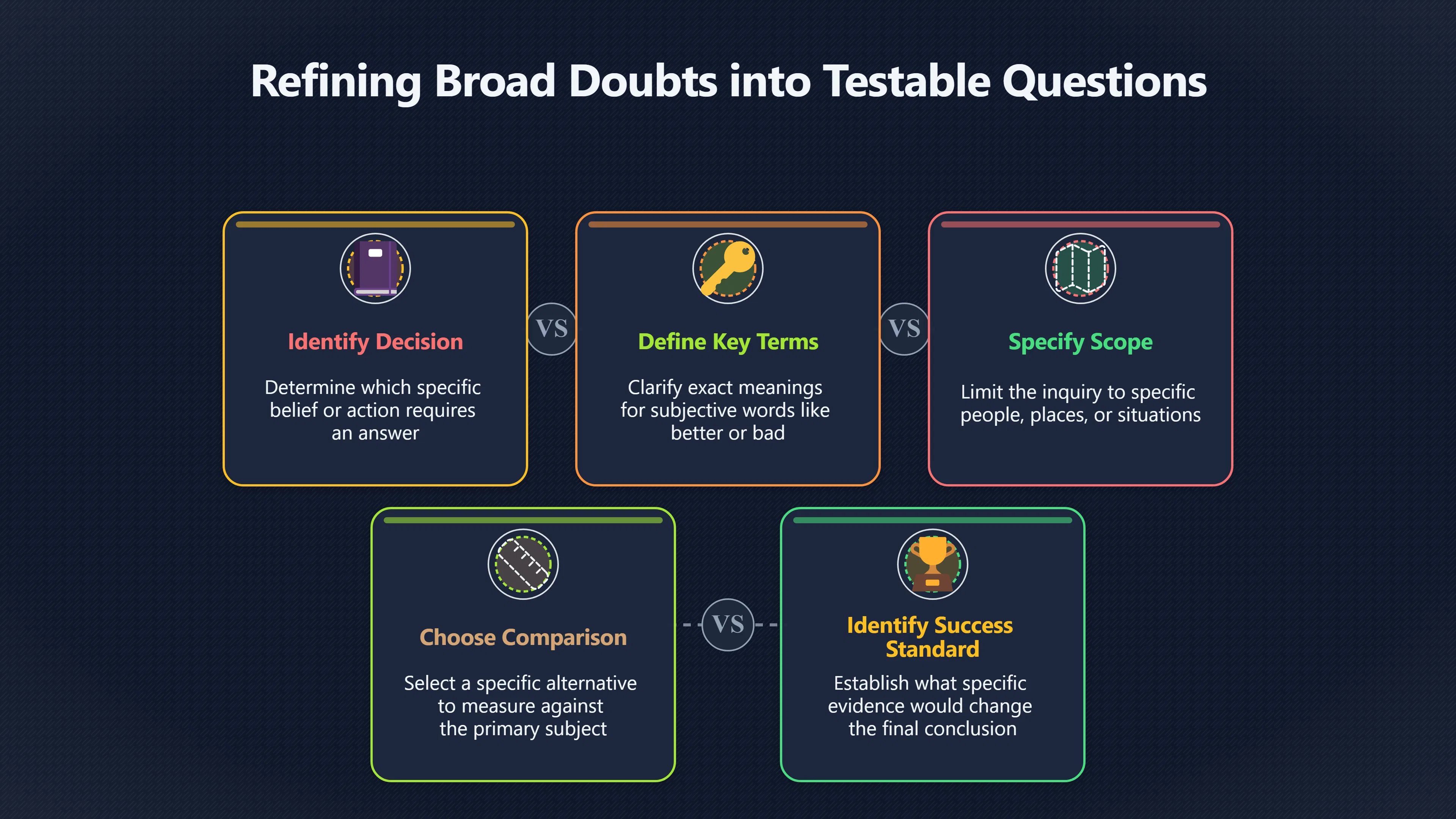
A useful sequence is:
- Identify the decision. What belief or action depends on the answer?
- Define the key terms. What exactly counts as “bad”, “trust”, or “better”?
- Specify the scope. Which people, places, or situations are being discussed?
- Choose the comparison. Better than what alternative?
- Identify the standard of success. What evidence would genuinely change the conclusion?
For example, “Is remote working better?” might become:
“For software developers working full-time, does remote working improve productivity over a six-month period compared with office-based work?”
Although narrower, this question is far easier to investigate. Relevant evidence becomes clearer, competing explanations can be examined, and conclusions can be appropriately limited.
The goal is not to make questions artificially complicated but to make them answerable.
Questions that improve evidence quality
Experienced critical thinkers often use clarification questions before reading studies, reports, or arguments. These questions reduce the risk of evaluating evidence against the wrong standard.
Useful examples include:
- What decision depends on this answer?
- What is the precise claim being made?
- Which part of the claim is uncertain?
- How would I recognise a satisfactory answer?
- What evidence would count against my current view?
- Am I trying to explain, predict, compare, or decide?
These questions shape the investigation before evidence begins to accumulate. They also reveal hidden assumptions that might otherwise remain unnoticed.
For instance, asking whether a medicine “works” assumes agreement about what counts as success. Is the aim complete recovery, symptom reduction, longer survival, improved quality of life, or fewer side effects? Each standard points towards different evidence.
A practical example
Imagine reading the headline:
“Coffee reduces the risk of heart disease.”
A rapid reaction might be either acceptance or scepticism. A more disciplined approach begins by clarifying the question.
Possible interpretations include:
- Does coffee directly reduce heart disease?
- Is coffee associated with lower rates in observational studies?
- Does the effect apply to everyone or only certain groups?
- Compared with drinking no coffee or with sugary drinks?
- How large is the reduction in risk?
Only after these questions are clarified does it become possible to judge whether the evidence is appropriate. A randomised clinical trial, a long-term observational study, or laboratory research each answers different kinds of questions and carries different strengths and limitations.
The clarification stage therefore protects against both overconfidence and unnecessary scepticism.
Clear questions lead to better judgement
Purposeful judgement is not simply about evaluating evidence carefully; it is about evaluating evidence for the right question. A clearly defined question narrows the inquiry, identifies relevant standards, exposes hidden assumptions, and prevents discussions from drifting into unrelated issues.
This discipline also makes critical thinking more efficient. Rather than collecting every available fact, the thinker searches for evidence capable of resolving a specific uncertainty. When the question is clear, stronger evidence becomes easier to recognise, weaker evidence is easier to discard, and conclusions can be stated with confidence that matches the quality of the available information.[Insight Assessment]insightassessment.comInsight Assessment The Delphi ReportInsight AssessmentThe Delphi Report - Insight AssessmentIt defines critical thinking to be purposeful, self-regulatory judgment – the cog…
eBay marketplace picks
Marketplace Samples
Example marketplace items related to this page. Use the search link to explore similar finds on eBay.




Endnotes
1.
Source: insightassessment.com
Title: Insight Assessment The Delphi Report
Link:https://insightassessment.com/iaresource/the-delphi-report-a-statement-of-expert-consensus-on-the-definition-of-critical-thinking/
Source snippet
Insight AssessmentThe Delphi Report - Insight AssessmentIt defines critical thinking to be purposeful, self-regulatory judgment – the cog...
Additional References
2.
Source: researchgate.net
Link:https://www.researchgate.net/publication/242279575_Critical_Thinking_A_Statement_of_Expert_Consensus_for_Purposes_of_Educational_Assessment_and_Instruction
Source snippet
(PDF) Critical Thinking: A Statement of Expert Consensus...8 Dec 2016 — Critical thinking involves the ability to evaluate evidence, ide...
3.
Source: coffeeandtheory.com
Title: educating minds to question understanding and [teaching]({{ ‘teaching/’ | relative_url }}) critical thinking
Link:https://www.coffeeandtheory.com/educating-minds-to-question-understanding-and-teaching-critical-thinking/
Source snippet
Understanding and Teaching Critical Thinking8 Aug 2025 — Use open-ended questions: “What evidence supports that?” or “What might someone...
4.
Source: ecampusontario.pressbooks.pub
Title: investigating and assessing multiple choice critical thinking tests
Link:https://ecampusontario.pressbooks.pub/popsterscrrar2019/chapter/investigating-and-assessing-multiple-choice-critical-thinking-tests/
Source snippet
and Assessing Multiple-Choice Critical...by RH Ennis · 2022 · Cited by 19 — I shall suggest a structure for appraising a claim regarding...
5.
Source: windsor.scholarsportal.info
Title: range of criteria for effective test questions, the “question frame”.Read more
Link:https://windsor.scholarsportal.info/omp/index.php/wsia/catalog/download/219/435/2493
Source snippet
Critical Thinking Education and Assessment, 2nd ed.by J Sobocan · 2022 · Cited by 34 — "Delphi" report (Critical Thinking: A Statement of...
6.
Source: academia.edu
Link:https://www.academia.edu/5903873/Critical_Thinking_A_Statement_of_Expert_Consensus_for_Purposes_of_Educational_Assessment_and_Instruction
Source snippet
Critical Thinking: A Statement of Expert Consensus for...The Delphi Report defines critical thinking as purposeful, self-regulatory judg...
7.
Source: youtube.com
Title: How To Identify The Problem In Case Study
Link:https://www.youtube.com/watch?v=pQjLQhCjFio
Source snippet
How to Master Problem-Solving Skills: 5 Steps & Root Cause Analysis...
8.
Source: files.eric.ed.gov
Link:https://files.eric.ed.gov/fulltext/ED315423.pdf
Source snippet
CT is) can be validly and reliably tested at some educational level or levels. If the...Read more...
9.
Source: youtube.com
Title: Problem Solving and Decision Making
Link:https://www.youtube.com/watch?v=iQtnggDMfqE
Source snippet
How To Identify The Problem In Case Study...
10.
Source: youtube.com
Title: How to Master Problem-Solving Skills: 5 Steps & Root Cause Analysis
Link:https://www.youtube.com/watch?v=fhZyfZMdc3o
11.
Source: philarchive.org
Title: DAVASC 2
Link:https://philarchive.org/archive/DAVASC-2
Source snippet
(Facione 1990, 3). This report drew upon the...Read more...
Topic Tree