Within Change Mind
What Would Actually Make You Change Your Mind?
Clear revision conditions make it harder to ignore evidence that challenges your current view.
On this page
- Turn beliefs into testable claims
- Write specific revision conditions
- Avoid vague escape clauses
Page outline Jump by section
Introduction
The question “What would actually make me change my mind?” only improves decisions if the answer is specific enough to force a genuine revision. A vague promise to “follow the evidence” leaves plenty of room to reinterpret disappointing results, postpone action, or invent exceptions after the fact. By contrast, writing explicit revision conditions before new evidence arrives makes beliefs testable, reduces confirmation bias, and creates a clear standard for when to update your judgement rather than defend it. Research on confirmation bias and actively open-minded thinking consistently shows that people are better at finding evidence for what they already believe than at recognising when they should revise those beliefs.[PMC]pmc.ncbi.nlm.nih.govPMCActively Open-Minded Thinking and Its Measurementby KE Stanovich · 2023 · Cited by 133 — Actively open-minded thinking (AOT) is measured by items that tap the willingness to consider…
 The goal is not to make yourself change your mind easily. It is to decide in advance what evidence would be strong enough to justify doing so.
Turn beliefs into claims that can succeed or fail
A revision condition only works if it is attached to a concrete claim. Broad opinions such as “this project is a good idea” or “this investment will work out” cannot be meaningfully tested because they do not predict anything specific.
Instead, identify the assumption that matters most and express it as an observable claim.
For example:
- “This marketing campaign will increase qualified leads by at least 20% within three months.”
- “The new onboarding process will reduce customer drop-off without increasing support requests.”
- “Hiring another engineer will shorten release cycles by at least one week.”
Each statement creates the possibility of being wrong. That is essential. A claim that cannot fail cannot guide better decisions.
This reflects the broader idea that useful reasoning depends on exposing beliefs to potential contradiction rather than continually finding confirming examples.[The Decision Lab]thedecisionlab.comThe Decision LabConfirmation BiasConfirmation bias describes our underlying tendency to notice, focus on, and provide greater credence to…
What makes a revision condition strong?
A useful revision condition answers a simple question:
“If this happened, would I genuinely change my decision?”
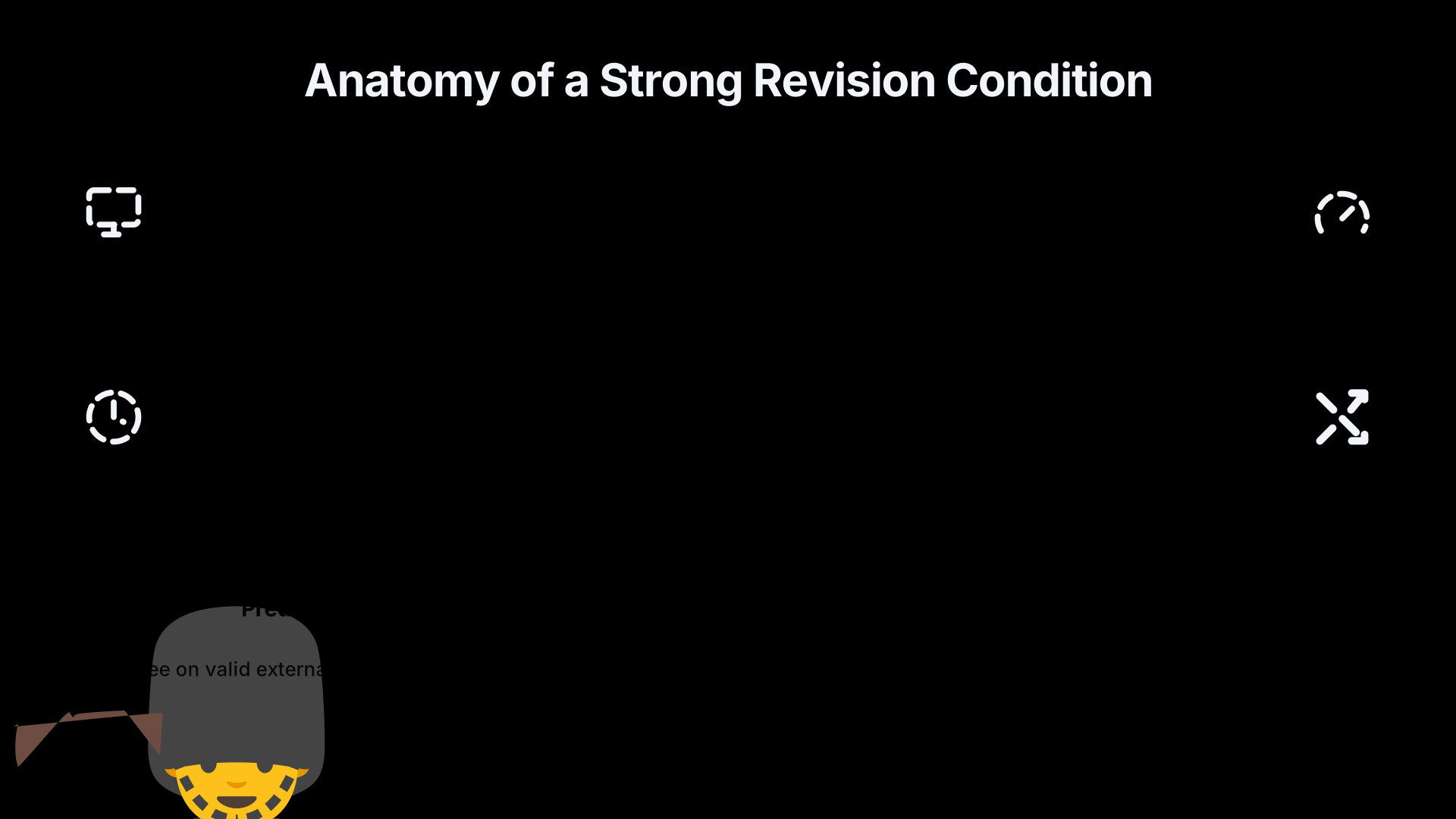
Strong revision conditions usually contain four elements:
- A measurable indicator. Define exactly what will be observed, such as revenue, error rates, customer retention, completion times or test results.
- A threshold. Specify how much evidence is required. “Sales fall below forecast by 15%” is stronger than “sales disappoint.”
- A timeframe. Decide when the evidence will be assessed. Without a deadline, disappointing evidence can always be dismissed as temporary.
- A predetermined response. State what revision means. You might reduce confidence, run another experiment, delay a launch, abandon a proposal or adopt an alternative explanation.
Notice that the revision condition is separate from the evidence itself. The evidence arrives later; the standard for interpreting it is set beforehand.
Write specific revision conditions
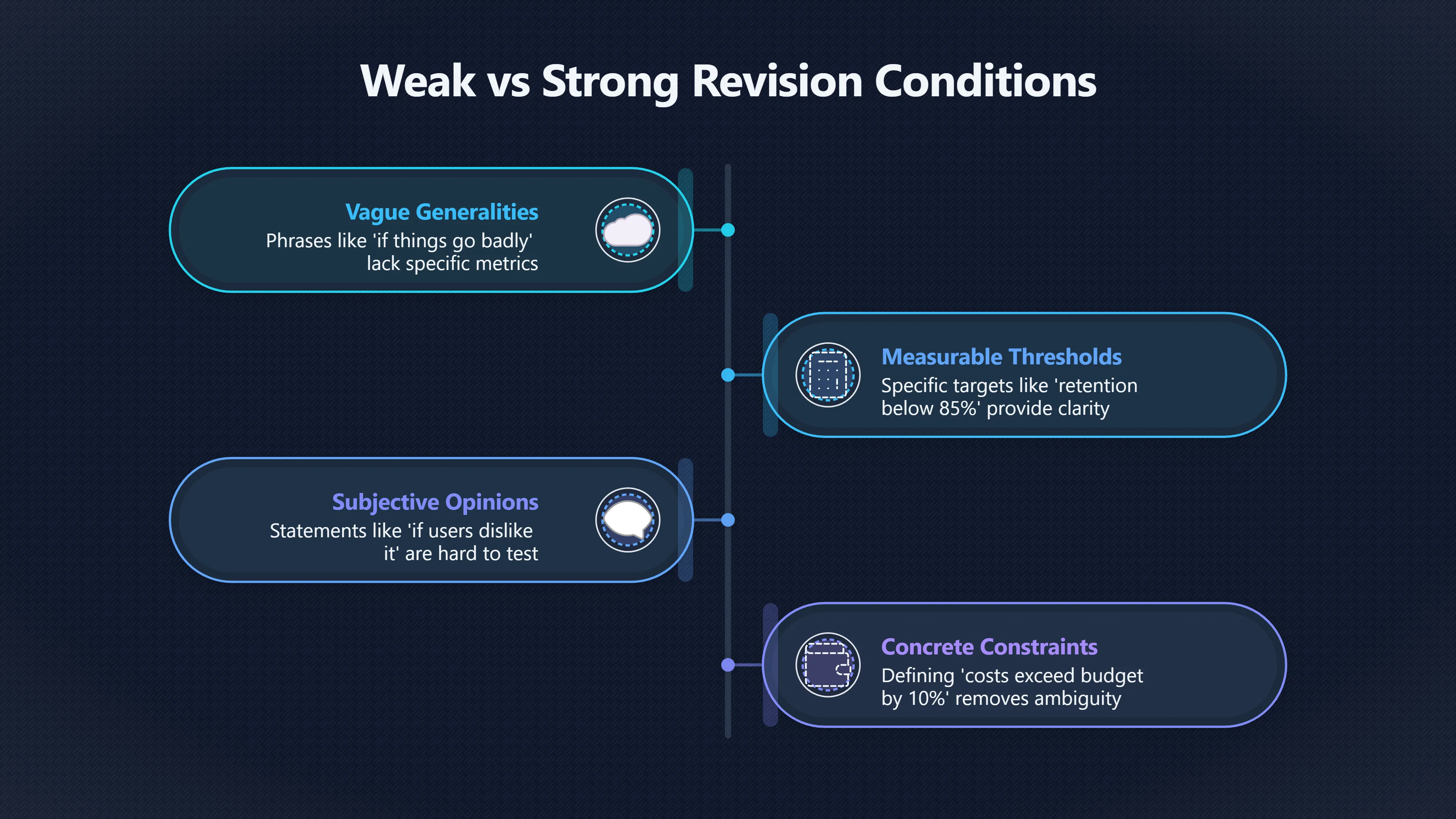
Weak revision rules usually sound reasonable but provide unlimited room for escape.
Weak conditionStrong condition”If things go badly.”“If customer retention drops below 85% after eight weeks.”“If experts disagree.”“If two independent systematic reviews conclude the treatment has no meaningful effect.”“If users dislike it.”“If fewer than 70% of test users complete the task unaided.”“If costs become too high.”“If total implementation costs exceed the approved budget by more than 10%.”
The stronger version removes ambiguity. When the evidence arrives, the question is no longer “How do I feel about these results?” but “Did the agreed condition occur?”
This approach also reduces the temptation to reinterpret evidence after becoming emotionally invested in a decision.
Avoid vague escape clauses
Many revision conditions fail because they quietly include loopholes that allow the original belief to survive almost any outcome.
Common escape clauses include:
- “Unless the situation is unusually complicated.”
- “The evidence wasn’t representative.”
- “We just need more time.”
- “The timing was unfortunate.”
- “The data collection was imperfect.”
Sometimes these objections are valid. The problem is introducing them only after unfavourable evidence appears.
A better approach is to specify acceptable exceptions beforehand.
For example:
- Define which data sources will count.
- Agree which external events would invalidate the test.
- Decide in advance how much uncertainty is acceptable.
- State how many independent observations are required before changing course.
This prevents standards from shifting every time evidence becomes uncomfortable.
Separate confidence from commitment
Changing your mind is not an all-or-nothing event. Many decisions improve when revision conditions change confidence rather than immediately reversing a conclusion.
For example:
- One failed experiment may reduce confidence from 80% to 60%.
- Repeated failures across independent tests may justify abandoning the idea altogether.
- Strong supporting evidence may increase confidence without eliminating uncertainty.
Thinking in terms of confidence encourages gradual belief updating instead of treating every decision as either complete victory or total defeat. Research on belief revision shows that people naturally tend to update too conservatively, giving insufficient weight to genuinely informative new evidence. Explicit revision rules help counter that tendency.[Wikipedia]WikipediaConservatism (belief revisionConservatism (belief revision
Use implementation rather than intention
Simply intending to be open-minded is often ineffective because confirmation bias influences how evidence is searched for, interpreted and remembered. People frequently believe they are evaluating information fairly while unconsciously favouring evidence consistent with existing views.[The Decision Lab]thedecisionlab.comThe Decision LabConfirmation BiasConfirmation bias describes our underlying tendency to notice, focus on, and provide greater credence to…
Writing revision conditions transforms an abstract value into a behavioural commitment.
Instead of saying:
“I’ll reconsider if convincing evidence appears.”
Write:
“If the next two quarterly reviews both miss the target by more than 10%, despite normal market conditions, I will pause further investment until an alternative explanation has been evaluated.”
The second statement creates accountability because it specifies both the trigger and the response.
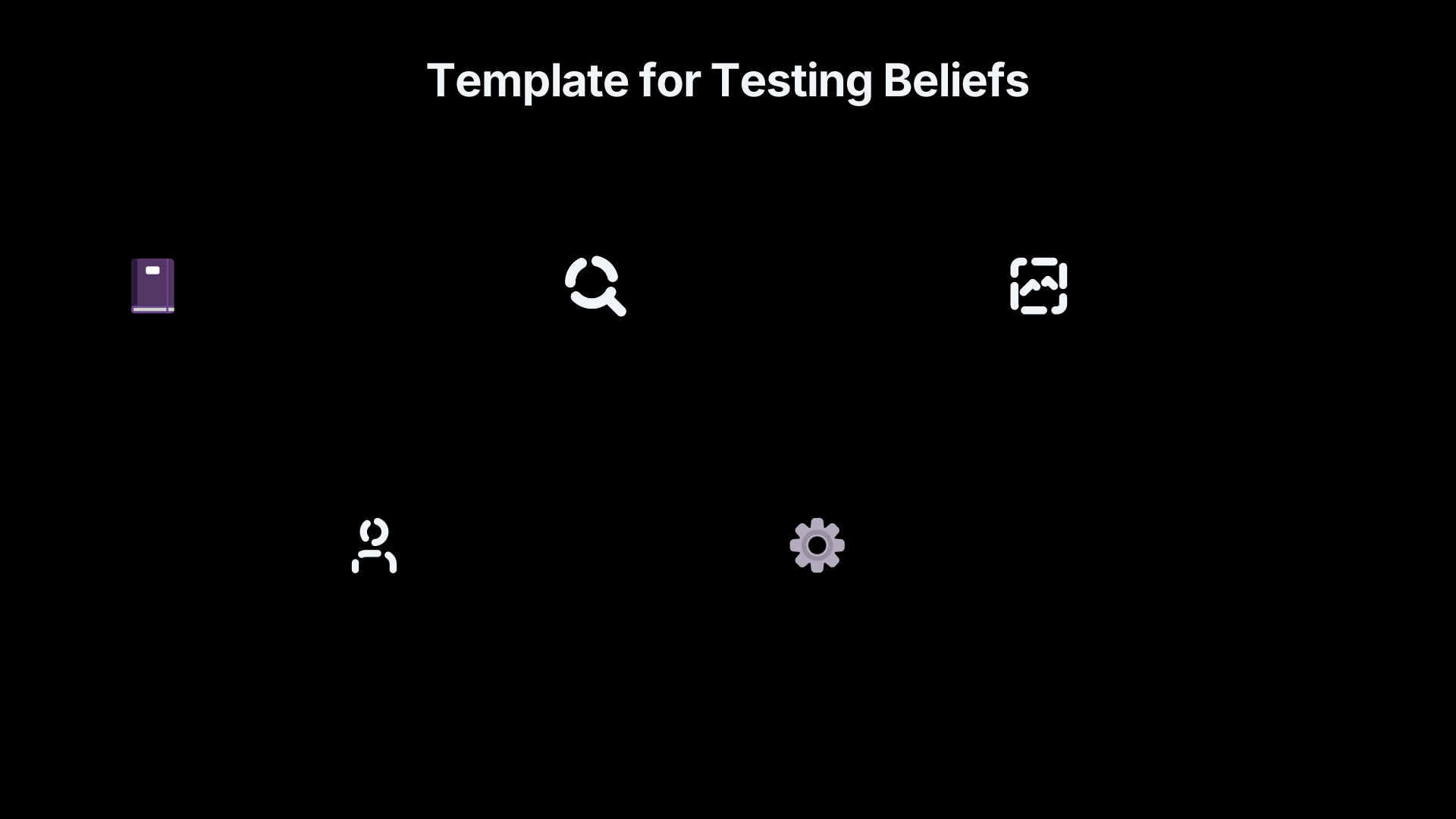
A practical template
For important decisions, a simple template is often sufficient:
Current belief: What do I currently think is true?
Critical assumption: What has to be true for this belief to hold?
Evidence that would reduce my confidence: What specific observation would count against it?
Revision threshold: How much contrary evidence is enough?
Decision change: What action will I take if that threshold is reached?
Completing these questions before the outcome is known makes it substantially harder to ignore evidence simply because it is inconvenient.
Why this improves thinking
Well-written revision conditions change the structure of decision-making. Instead of debating every new piece of information from scratch, they establish a fair standard before personal preferences, sunk costs and identity become entangled with the outcome.
The result is not perfect objectivity. It is a practical safeguard against moving the goalposts after evidence arrives. By turning beliefs into testable claims, defining explicit revision thresholds and eliminating vague escape clauses, you make changing your mind a disciplined response to evidence rather than an emotional concession. Research on actively open-minded thinking suggests that this willingness to seek, consider and act on contradictory evidence is a measurable thinking disposition associated with better judgement across many domains.[PMC]pmc.ncbi.nlm.nih.govPMCActively Open-Minded Thinking and Its Measurementby KE Stanovich · 2023 · Cited by 133 — Actively open-minded thinking (AOT) is measured by items that tap the willingness to consider…
eBay marketplace picks
Marketplace Samples
Live-tested eBay searches with available results related to this page.


Endnotes
1.
Source: pmc.ncbi.nlm.nih.gov
Title: PMCActively Open-Minded Thinking and Its Measurement
Link:https://pmc.ncbi.nlm.nih.gov/articles/PMC9966223/
Source snippet
by KE Stanovich · 2023 · Cited by 133 — Actively open-minded thinking (AOT) is measured by items that tap the willingness to consider...
2.
Source: Wikipedia
Title: Conservatism (belief revision)
Link:https://en.wikipedia.org/wiki/Conservatism_%28belief_revision%29
3.
Source: Wikipedia
Title: Belief revision
Link:https://en.wikipedia.org/wiki/Belief_revision
4.
Source: Wikipedia
Title: Confirmation bias
Link:https://en.wikipedia.org/wiki/Confirmation_bias
Source snippet
Confirmation biasConfirmation bias is the tendency to search for, interpret, favor and [recall]({{ 'recall/' | relative_url }}) information in a way that confirms or su...
5.
Source: youtube.com
Title: Why Your Brain Lies About Evidence
Link:https://www.youtube.com/watch?v=NXgW92pWrV0
Source snippet
Confirmation Bias - Definition & Examples (3 Minute Explanation)...
6.
Source: youtube.com
Title: Confirmation Bias
Link:https://www.youtube.com/watch?v=7gOQ2cbywn4
Source snippet
Cognitive Bias: The Invisible Decision-Maker...
7.
Source: thedecisionlab.com
Link:https://thedecisionlab.com/biases/confirmation-bias
Source snippet
The Decision LabConfirmation BiasConfirmation bias describes our underlying tendency to notice, focus on, and provide greater credence to...
Additional References
8.
Source: betterhumans.pub
Title: the falsification mindset how to change your own mind db4a0a9ae7f2
Link:https://betterhumans.pub/the-falsification-mindset-how-to-change-your-own-mind-db4a0a9ae7f2
Source snippet
How to Overcome Confirmation Bias by Adopting a...17 Oct 2017 — Here's a simple [practice]({{ 'practice/' | relative_url }}) that can boost your intelligence, help you avoi...
9.
Source: sjdm.org
Link:https://sjdm.org/dmidi/Actively_Open-Minded_Thinking_Beliefs.html
Source snippet
your mind is a sign of weakness. (5R); People should search...Read more...
10.
Source: researchgate.net
Title: Why Is It So Hard to Change Our Minds?
Link:https://www.researchgate.net/publication/399856432_Why_Is_It_So_Hard_to_Change_Our_Minds_Confirmation_Bias_and_the_Competencies_of_Belief_Revision
Source snippet
Confirmation Bias...18 Jan 2026 — Confirmation bias, motivated reasoning, and biased assimilation enable individuals to interpret the sa...
11.
Source: verywellmind.com
Title: what is a confirmation bias 2795024
Link:https://www.verywellmind.com/what-is-a-confirmation-bias-2795024
Source snippet
Confirmation Bias: How to Identify and Overcome It30 Apr 2026 — Confirmation bias is a cognitive tendency to prioritize information that...
12.
Source: medium.com
Title: Overcoming confirmation bias
Link:https://medium.com/data-science/overcoming-confirmation-bias-during-covid-19-51a64205eceb
Source snippet
by Cassie KozyrkovConfirmation bias is the tendency to search for, interpret, favor, and recall information in a way that confirms or str...
13.
Source: youtube.com
Title: The Tool That Stops You From Holding Losers Too Long | Annie Duke
Link:https://www.youtube.com/watch?v=Nu9qgbRm6bs
Source snippet
A Gambler's Guide To Investing & Life w/ Annie Duke (RWH015)...
14.
Source: youtube.com
Title: A Gambler’s Guide To Investing & Life w/ Annie Duke (RWH015)
Link:https://www.youtube.com/watch?v=lIrAtIZcH5o
Source snippet
Why Your Brain Lies About Evidence...
15.
Source: youtube.com
Title: Cognitive Bias: The Invisible Decision-Maker
Link:https://www.youtube.com/watch?v=yTXqypSxBh0
Topic Tree
Follow this branch
Parent topic
Change Mind What Evidence Would Change Your Mind?Related pages 5
- Confidence Updates Why Changing Your Mind Can Mean Changing Your Confidence
- Disconfirming Evidence Why Contradictory Evidence Is More Useful Than More Proof
- Premortems Can a Premortem Reveal When You Should Reconsider?
- Review Triggers How Review Triggers Make Changing Course Easier
- Wason 2 4 6 What the 2 4 6 Experiment Teaches About Better Decisions