Within Project Failure
What Crossrail Reveals About Hidden Complexity
Crossrail shows how large projects can fall behind when sponsors underestimate the difficulty of joining many working parts into one service.
On this page
- What the programme thought was complete
- Why trains, stations and signalling had to work together
- Lessons for judging complex project progress
Page outline Jump by section
Introduction
Crossrail, now operating as the central section of the Elizabeth line, is often described as a project that was delayed and over budget. That description is accurate but incomplete. The more important lesson is that the programme demonstrated how easily decision-makers can mistake visible construction progress for genuine readiness. By the time tunnels, stations and track looked largely complete, the most difficult work still lay ahead: proving that hundreds of interconnected systems could operate safely and reliably as a single railway.
 For anyone interested in improving analytical thinking, Crossrail is a powerful reminder that complex systems should be judged by successful integration rather than by the completion of individual components. The programme’s difficulties were not primarily about digging tunnels or building stations. They arose from underestimating the effort required to combine trains, signalling, software, communications, safety systems, operations and multiple organisations into one functioning service.[National Audit Office (NAO)]nao.org.ukNational Audit Office (NAO)Completing CrossrailNAO report3 May 2019 — This report examines the causes of the cost increases and delays to the Crossrail programme…
What the programme thought was complete
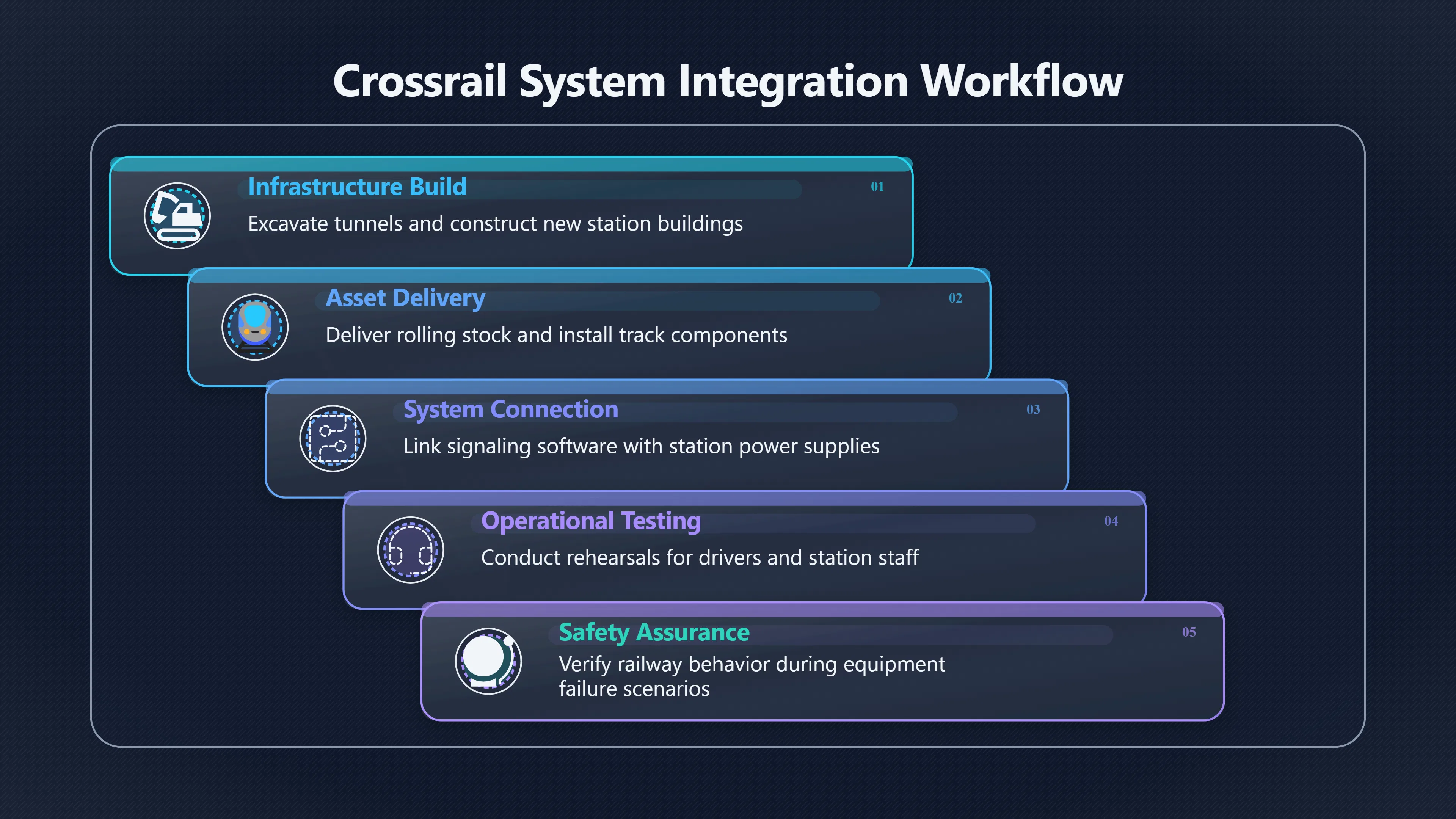
By 2018, much of Crossrail’s physical infrastructure appeared finished. New stations stood in central London, tunnels had been excavated, track had been installed and trains had been delivered. From a traditional construction perspective, the programme looked close to completion.
However, infrastructure projects reach a critical point where progress changes from building individual assets to making every asset work together. The National Audit Office (NAO) concluded that Crossrail’s leadership, together with its sponsors, underestimated how much work remained once construction was largely complete. Rather than approaching the finish line, the programme still faced an enormous volume of testing, commissioning, assurance and defect resolution before passengers could be carried safely.[National Audit Office (NAO)]nao.org.ukNational Audit Office (NAO)Crossraila progress update - NAO reportJul 9, 2021 — Despite efforts to control costs and schedule in 2019, the programme was further from complet…
This distinction matters because different kinds of work produce different signals. Construction creates visible progress that politicians, journalists and the public can easily observe. Integration work is largely invisible. Software interfaces, signalling validation, operational rehearsals and safety assurance generate little visible evidence even though they often determine whether a railway can actually open.
The consequence was an optimism gap. Decision-makers could point to completed stations and installed equipment while the underlying operational readiness remained far less advanced than appearances suggested. The NAO later concluded that when the programme was reset in 2019 it was “further from completion and more complicated” than Crossrail Ltd or its sponsors understood.[National Audit Office (NAO)]nao.org.ukNational Audit Office (NAO)Crossraila progress update - NAO reportJul 9, 2021 — Despite efforts to control costs and schedule in 2019, the programme was further from complet…
Why trains, stations and signalling had to work together
Crossrail was never simply a civil engineering project. It was a system-of-systems in which each part depended on many others behaving correctly at the same time.
Several different categories of integration had to succeed simultaneously:
- Rolling stock and signalling: Trains needed to operate under multiple signalling environments, including conventional Network Rail signalling, the European Train Control System and Communications-Based Train Control within the central tunnels.
- Stations and railway systems: Fire alarms, platform equipment, ventilation, lifts, power supplies, communications and control rooms all had to exchange information correctly during both normal operation and emergencies.
- Operational procedures: Drivers, controllers, station staff, maintenance teams and emergency services needed validated procedures supported by working technology.
- Safety assurance: Regulators required evidence that the railway behaved safely not only when every component worked, but also when equipment failed or unexpected situations occurred.[Crossrail Learning Legacy+2Crossrail Learning Legacy]learninglegacy.crossrail.co.ukCrossrail Learning LegacyCrossrail System Integration – The Practicalities of Integrating…Successful system integration (SI) on Crossr…
None of these challenges could be solved independently. A software change affecting signalling could require further train testing. Station modifications might alter safety certification. Operational procedures could change because of engineering findings. Every completed task potentially created new dependencies elsewhere.
This is characteristic of complex systems: progress is not additive. Completing 90% of individual tasks does not imply that 90% of the integrated system is ready.
Hidden complexity grows at interfaces
One reason Crossrail became difficult to predict is that complexity accumulated at interfaces rather than inside individual contracts.
Many contractors successfully delivered their own assets. The greater challenge was ensuring that separately designed and separately delivered components interacted correctly after installation. Every interface between organisations represented a potential point where assumptions, technical standards or schedules could diverge.
The NAO identified several structural contributors to this problem, including the very large number of contracts, bespoke designs and limited standardisation across the programme. These factors increased the amount of coordination required during final delivery, making completion substantially harder than straightforward construction metrics suggested.[National Audit Office (NAO)]nao.org.ukCrossrail a progress update 2National Audit Office (NAO)Crossrail – a progress updateJul 9, 2021 — The work to bring the railway into service was made more complex by…
Crossrail’s own later technical publications similarly describe successful system integration as encompassing technical compatibility, operational readiness and organisational coordination. The lesson is significant because engineering success depended not only on whether equipment functioned individually but also on whether organisations could jointly manage testing, assurance and operational acceptance.[Crossrail Learning Legacy]learninglegacy.crossrail.co.ukCrossrail Learning LegacyCrossrail System Integration – The Practicalities of Integrating…Successful system integration (SI) on Crossr…
Why schedules became unreliable
Large projects usually estimate how long construction activities will take. Integration work is much harder to estimate because new problems often emerge only when previously separate systems are connected.
Testing frequently uncovers unexpected interactions:
- Software behaves differently under operational loads.
- Equipment supplied by different contractors may interpret standards differently.
- Safety evidence reveals additional verification work.
- Operational exercises expose issues that design reviews never identified.
Each discovery creates further work, which then requires additional testing before confidence can be restored.
The NAO’s investigation into Crossrail concluded that the programme suffered from compressed schedules, unrealistic assumptions about completion and an absence of a realistic delivery plan as pressures increased. Rather than recognising integration uncertainty early, the programme continued to work towards dates that became progressively less achievable.[National Audit Office (NAO)]nao.org.ukNational Audit Office (NAO)Completing CrossrailNAO report3 May 2019 — This report examines the causes of the cost increases and delays to the Crossrail programme…
Importantly, this was not simply poor scheduling. It reflected a misunderstanding of the nature of integration itself. Construction tasks often have predictable durations; system integration contains feedback loops in which solving one issue can expose several more.

Recovery required changing how progress was measured
After the programme reset, Crossrail’s recovery placed much greater emphasis on measurable operational readiness rather than construction milestones.
Later technical accounts from engineers involved in completing the railway describe a stronger focus on:
- structured systems integration;[learninglegacy.crossrail.co.uk]learninglegacy.crossrail.co.ukCrossrail Learning LegacySystems Integration and Technical AssuranceThis Technical Paper sets out the details of the System Safety approa…
- staged operational testing;
- realistic assessment of remaining work;
- governance centred on evidence rather than optimistic forecasts;
- clearer coordination between sponsors, operators and delivery teams.[Crossrail Learning Legacy+2Crossrail Learning Legacy]learninglegacy.crossrail.co.ukgrasping the nettle integrating the uks first digital railwayCrossrail Learning LegacyGrasping the nettle: Integrating the UK's first digital railway5 Apr 2023 — This paper outlines some of the prom…
This shift reflects an important analytical principle. When uncertainty is high, useful indicators change. Instead of asking whether infrastructure has been built, leaders need to ask whether the complete service has demonstrated reliable behaviour under realistic operating conditions.
That change in measurement does not eliminate complexity, but it makes complexity more visible before it becomes a crisis.
Lessons for judging complex project progress
Crossrail offers several practical lessons for evaluating any major programme.
Visible progress is not the same as operational readiness. Buildings, equipment and completed contracts may conceal substantial unfinished integration work.
Interfaces deserve more attention than components. Projects often fail where organisations, technologies or responsibilities meet rather than within individual teams.
Testing creates knowledge rather than merely confirming expectations. If testing never changes schedules or plans, it may not be examining the hardest problems.
Late-stage work can be the most uncertain. Projects often become harder—not easier—as they approach completion because interactions multiply while tolerance for failure decreases.
Confidence should follow evidence, not construction percentages. Claims that a programme is “95% complete” are meaningful only if the remaining 5% does not contain most of the integration risk.
These lessons extend beyond railways. Digital transformations, hospital systems, aircraft programmes and large software platforms all share the same analytical pattern: success depends less on completing individual pieces than on demonstrating that every essential piece functions together under real operating conditions. Crossrail illustrates the cost of forgetting that distinction. Crossrail Learning Legacy+2National Audit Office (NAO)[learninglegacy.crossrail.co.uk]learninglegacy.crossrail.co.ukCrossrail Learning LegacyCrossrail System Integration – The Practicalities of Integrating…Successful system integration (SI) on Crossr…
eBay marketplace picks
Marketplace Samples
Example marketplace items related to this page. Use the search link to explore similar finds on eBay.

Endnotes
1.
Source: nao.org.uk
Title: National Audit Office (NAO)Completing Crossrail
Link:https://www.nao.org.uk/reports/crossrail/
Source snippet
NAO report3 May 2019 — This report examines the causes of the cost increases and delays to the Crossrail programme...
Published: May 2019
2.
Source: nao.org.uk
Title: National Audit Office (NAO)Crossrail
Link:https://www.nao.org.uk/reports/crossrail-progress-update/
Source snippet
a progress update - NAO reportJul 9, 2021 — Despite efforts to control costs and schedule in 2019, the programme was further from complet...
3.
Source: learninglegacy.crossrail.co.uk
Link:https://learninglegacy.crossrail.co.uk/documents/crossrail-system-integration-the-practicalities-of-integrating-europes-most-complex-rail-project/
Source snippet
Crossrail Learning LegacyCrossrail System Integration – The Practicalities of Integrating...Successful system integration (SI) on Crossr...
4.
Source: learninglegacy.crossrail.co.uk
Link:https://learninglegacy.crossrail.co.uk/learning-legacy-themes/engineering/integration/
Source snippet
Crossrail Learning LegacySystems Integration and Technical AssuranceThis Technical Paper sets out the details of the System Safety approa...
5.
Source: learninglegacy.crossrail.co.uk
Title: grasping the nettle integrating the uks first digital railway
Link:https://learninglegacy.crossrail.co.uk/documents/grasping-the-nettle-integrating-the-uks-first-digital-railway/
Source snippet
Crossrail Learning LegacyGrasping the nettle: Integrating the UK's first digital railway5 Apr 2023 — This paper outlines some of the prom...
6.
Source: nao.org.uk
Title: Crossrail a progress update 2
Link:https://www.nao.org.uk/wp-content/uploads/2021/07/Crossrail-a-progress-update-2.pdf
Source snippet
National Audit Office (NAO)Crossrail – a progress updateJul 9, 2021 — The work to bring the railway into service was made more complex by...
7.
Source: learninglegacy.crossrail.co.uk
Title: crossrail cost to complete cost and commercial management
Link:https://learninglegacy.crossrail.co.uk/documents/crossrail-cost-to-complete-cost-and-commercial-management/
Source snippet
Crossrail Learning LegacyCrossrail cost to complete: Cost and commercial management5 Apr 2023 — This paper explains the methodology used...
8.
Source: learninglegacy.crossrail.co.uk
Title: governance arrangements to complete the crossrail project
Link:https://learninglegacy.crossrail.co.uk/documents/governance-arrangements-to-complete-the-crossrail-project/
Source snippet
Crossrail Learning LegacyGovernance arrangements to complete the Crossrail project5 Apr 2023 — We reflect on the changes made to the gove...
9.
Source: publications.parliament.uk
Title: uk Completing Crossrail
Link:https://publications.parliament.uk/pa/cm201719/cmselect/cmpubacc/2127/212706.htm
Source snippet
Crossrail - Committee on Public Accounts19 Jul 2019 — Opening the new Elizabeth line 13.Crossrail ・ non-critical digital systems ・ to red...
10.
Source: nao.org.uk
Link:https://www.nao.org.uk/press-releases/crossrail-progress-update/
Source snippet
a progress update - NAO press release9 Jul 2021 — The latest cost estimate of £18.9 billion at May 2021 exceeds the available funding pac...
Published: May 2021
Additional References
11.
Source: majorprojects.org
Link:https://majorprojects.org/resources/crossrail-a-progress-update/
Source snippet
Crossrail: a Progress UpdateWhen complete, the railway will be around 73 miles long, stopping at 41 stations, including 10 new stations a...
12.
Source: linkedin.com
Link:https://www.linkedin.com/pulse/uk-crossrail-elizabeth-line-recovery-case-governing-complexity-sg1rc
Source snippet
UK Crossrail (Elizabeth Line): A Recovery Case in...The UK Parliament and National Audit Office later concluded that the complexity of f...
13.
Source: railjournal.com
Title: Crossrail “past the point of no return” says National Audit
Link:https://www.railjournal.com/passenger/metros/crossrail-past-the-point-of-no-return-says-national-audit-office/
Source snippet
May 3, 2019 — Britian's National Audit Office has released a report from an investigation into Crossrail, outlining why and how the proje...
Published: May 3, 2019
14.
Source: content.tfl.gov.uk
Link:https://content.tfl.gov.uk/elc-20210715-supplementary-agenda-item12-nao-report.pdf
Source snippet
Line Committee Date: Thursday 15 July 2021 TimeJul 15, 2021 — 12 National Audit Office Report - Crossrail - A Progress Review...
Published: July 2021
15.
Source: researchgate.net
Link:https://www.researchgate.net/publication/374869767_Lessons_learnt_from_Crossrail_project_regarding_System_integration_and_System_Safety_Challenges_1
Source snippet
August 2023. Conference: International Safety Society ISSS...Read more...
Published: August 2023
16.
Source: wired-gov.net
Link:https://www.wired-gov.net/wg/news.nsf/articles/Crossrail%2B%2Ba%2Bprogress%2Bupdate%2B09072021112500?open=
Source snippet
Crossrail – a progress update | National Audit Office Press...Jul 9, 2021 — Although cost increases and schedule delays are in line with...
17.
Source: apm.org.uk
Title: apm responds to nao report on crossrail
Link:https://www.apm.org.uk/news/apm-responds-to-nao-report-on-crossrail/
Source snippet
9 Jul 2021 — I'm not sure Agile is the right genre of approach, but the systems integration aspect of Crossrail does appear to have been...
18.
Source: publications.parliament.uk
Title: uk Crossrail: A progress update
Link:https://publications.parliament.uk/pa/cm5802/cmselect/cmpubacc/184/report.html
Source snippet
parliament.ukCrossrail: A progress update - Committee of Public AccountsOct 29, 2021 — The Department told us the £390 million increase i...
19.
Source: youtube.com
Link:https://www.youtube.com/watch?v=XsXEAfIFn2k
20.
Source: youtube.com
Link:https://www.youtube.com/watch?v=h70bQ5FGgTo
Topic Tree