Within Intuition
The Diagnosis Trap of Deciding Too Soon
Early diagnostic certainty can narrow attention too soon, causing later evidence to be fitted around the wrong story.
On this page
- How early impressions become diagnostic anchors
- Confirmation bias after the first label
- Second pass questions that keep alternatives alive
Page outline Jump by section
Introduction
Premature closure is one of the clearest examples of why fast intuition sometimes needs a second pass. In medicine, it occurs when a clinician settles on a diagnosis before the available evidence justifies that level of certainty. Once an early explanation feels convincing, attention can narrow, alternative possibilities receive less scrutiny, and new information may be interpreted as support for the original idea rather than as a reason to reconsider it. Researchers and patient-safety organisations consistently identify premature closure as a common contributor to diagnostic error, delayed diagnosis, and missed diagnosis.[PubMed+2MSD Manuals]pubmed.ncbi.nlm.nih.govPremature diagnostic closure: an avoidable type of errorby M Vázquez-Costa · 2013 · Cited by 18 — The main cause of failures in cli…
 The importance of the phenomenon extends beyond medicine. Clinical diagnosis provides a vivid real-world example of a broader thinking problem: the tendency to stop searching once a plausible answer appears. Because patients often present with incomplete, ambiguous, or evolving evidence, diagnosis is a setting where the costs of deciding too soon can be unusually high.[Springer]link.springer.comThe challenge of cognitive science for medical diagnosisby P Croskerry · 2023 · Cited by 54 — A common cause of diagnostic error…
How Early Impressions Become Diagnostic Anchors
Many diagnoses begin with pattern recognition. An experienced clinician may rapidly recognise a familiar cluster of symptoms and generate a likely explanation within seconds. Most of the time, this ability is useful and efficient. Problems arise when the initial impression becomes an anchor rather than a hypothesis.[MSD Manuals]msdmanuals.comThis is one of the most common errors; clinicians make an initial diagnosis (often…Read more…
Premature closure is often described as accepting a diagnosis before alternative explanations have been adequately explored. Rather than continuing to gather evidence and test competing possibilities, the diagnostic process effectively stops. Subsequent questions, examinations, and tests may then focus on confirming the preferred explanation rather than challenging it.[PSNet+2MSD Manuals]psnet.ahrq.govThe fallacy of a single diagnosis. | PSNetPremature closure occurs when clinicians accept a diagnosis before it has been confirmed a…
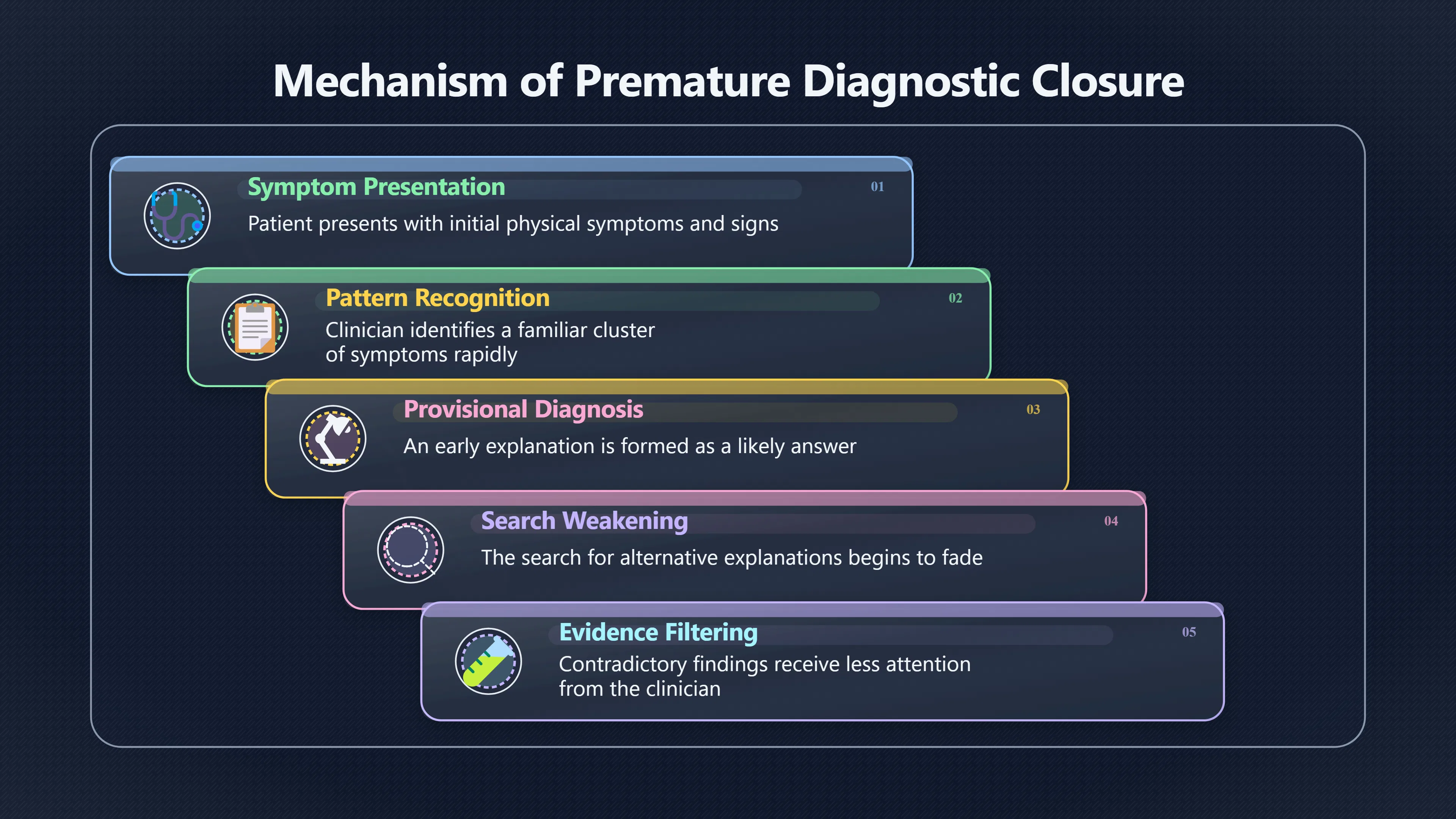
A common mechanism is deceptively simple:
- A patient presents with symptoms.
- An early pattern seems familiar.
- A provisional diagnosis is formed.
- The clinician’s search for alternatives weakens.
- Contradictory evidence receives less attention.
This progression can happen even among highly experienced professionals. Research on clinical reasoning shows that expertise does not eliminate vulnerability to cognitive bias. In some situations, extensive experience may actually strengthen confidence in an early pattern match, increasing the risk of overlooking exceptions or atypical presentations.[PubMed]pubmed.ncbi.nlm.nih.govAvoiding premature closure and reaching diagnostic…by E Krupat · 2017 · Cited by 50 — However, more recent studies indicate that…
A frequently cited illustration involves serious conditions that initially resemble common ones. Aortic dissection, for example, can present as chest pain that resembles more familiar cardiac problems. In a published case analysis, avoiding premature closure required persistent attention to the differential diagnosis—the list of plausible alternatives—rather than accepting the first explanation that appeared to fit.[PMC]pmc.ncbi.nlm.nih.govPMCclinical decision-making in a case of aortic dissectionby B Kumar · 2011 · Cited by 41 — Premature closure is a type of cognitive error in which the physician fails to consider reasonable a…
Why the First Label Changes What We Notice
The danger of premature closure is not merely that the first diagnosis might be wrong. The deeper problem is that the first diagnosis changes how later evidence is interpreted.
Psychologists and patient-safety researchers often describe this interaction through anchoring and confirmation bias. Anchoring occurs when the initial impression exerts disproportionate influence. Confirmation bias occurs when people preferentially seek, notice, or remember information that supports their current belief. Together, they can create a self-reinforcing cycle.[PSNet+2PMC]psnet.ahrq.govPSNet Diagnostic Errors | PSNetDiagnostic Errors | PSNet - AHRQAnchoring heuristic (premature closure), Relying on initial diagnostic impression, despite subsequen…
Once a patient has been labelled as having a particular condition, several things can happen:
- Supporting findings are treated as highly significant.
- Ambiguous findings are interpreted in favour of the diagnosis.
- Contradictory findings are discounted as exceptions.
- Alternative explanations receive less active consideration.
The result is not usually reckless decision-making. More often, it is a gradual narrowing of attention. Clinicians may sincerely believe they are following the evidence while unconsciously giving greater weight to information that preserves the original diagnosis.[ResearchGate]researchgate.netIt has been suggested that confirmation bias can arise from an attempt to avoid…Read more…
Evidence from analyses of diagnostic failures repeatedly identifies premature closure, anchoring, and confirmation bias among the most common cognitive contributors to error. During reviews of clinical cases, these biases frequently appear together rather than in isolation. A study examining cognitive biases in hospital care found premature closure among the most commonly implicated reasoning failures, often alongside anchoring and confirmation bias.[PMC+2Lippincott Journals]pmc.ncbi.nlm.nih.govPMCClinical reasoning in dire timesAnalysis of cognitive biases in…by M Coen · 2022 · Cited by 24 — They concluded that premature closure (72.2%), anchoring (61.1%), and…

When Confidence Becomes the Warning Sign
One of the most counterintuitive findings from the literature is that diagnostic mistakes are not always concentrated in the most confusing cases. Some occur precisely because the clinician feels unusually certain.
When uncertainty is obvious, people tend to slow down, seek additional information, and consult alternatives. Premature closure is more likely when a diagnosis feels straightforward. Confidence can signal that the mind has successfully recognised a pattern—but it can also signal that the search process has ended too early.[ResearchGate]researchgate.net19179531 Premature conclusions in diagnostic reasoningResearchGate(PDF) Premature conclusions in diagnostic reasoning8 Feb 2026 — Among them, overconfidence is manifested as cognitive biases…
This distinction matters because many diagnostic errors are not caused by ignorance. Reviews of clinical reasoning suggest that errors frequently arise from the way information is processed rather than from a complete lack of medical knowledge. In other words, the clinician may know the correct diagnosis but fail to consider it because the reasoning process has already converged on another explanation.[Fitzgerald Health Education Associates+2Delta Psychology]fhea.comcognitive errors in clinical diagnosis availability bias and premature closureFitzgerald Health Education AssociatesCognitive Errors in Clinical Diagnosis: Availability Bias and…24 Sept 2021 — Errors in diagnosti…
For thinking more broadly, this highlights an important lesson: certainty is not always evidence of correctness. Sometimes it is evidence that the search for alternatives has stopped.
Second-Pass Questions That Keep Alternatives Alive
Research on diagnostic excellence increasingly focuses not only on recognising bias but also on creating habits that interrupt it. The goal is not to eliminate intuition. Fast pattern recognition remains essential in medicine. The goal is to ensure that an initial judgement remains provisional until it survives further scrutiny.[codex.ucsf.edu]codex.ucsf.eduprimer 3 role clinical reasoning diagnostic excellencePrimer 3: The Role of Clinical Reasoning in Diagnostic…25 Jun 2025 — This primer focuses on the role of cognition in diagnostic excell…
Several second-pass questions are particularly useful:
What Else Could This Be?
The simplest safeguard is deliberately generating at least one or two plausible alternatives before committing to a diagnosis. This keeps the differential diagnosis active and prevents the first explanation from becoming the only explanation.[AAMC]aamc.orgwe all make diagnostic errorsWe all make diagnostic errors3 Sept 2019 — Premature closure occurs when a clinician thinks that they see a pattern for a specific il…
Which Finding Does Not Fit?
A strong diagnosis should explain the important facts. When a symptom, examination finding, or test result remains unexplained, it deserves attention rather than dismissal. Discordant evidence is often the clue that reveals a mistaken early conclusion.[Quality & Safety in Health Care]qualitysafety.bmj.comThe principle ones areQuality & Safety in Health CareCognitive debiasing 1: origins of bias and theory of debiasingby P Croskerry · 2013 · Cited by 782 — The p…
What Evidence Would Change My Mind?
This question reverses the usual search process. Instead of asking what supports the diagnosis, it asks what would falsify it. The shift encourages active testing rather than passive confirmation.[Frontiers]frontiersin.orgFrontiersDistinguishing anchoring from confirmation bias in…by J A Martínez — Reviews of cognitive diagnostic error underscore that pr…

Am I Stopping Because I Am Certain or Because the Evidence Is Sufficient?
These are not the same thing. Confidence is a psychological state; evidence is an external standard. Separating the two helps prevent subjective certainty from masquerading as proof.[Springer]link.springer.comThe challenge of cognitive science for medical diagnosisby P Croskerry · 2023 · Cited by 54 — A common cause of diagnostic error…
What Premature Closure Teaches About Thinking
Premature closure in medical diagnosis illustrates a broader principle of good reasoning: the first plausible answer is often the beginning of analysis, not the end of it.
Fast intuition can generate valuable hypotheses, especially in environments where experience has built reliable pattern recognition. Yet diagnosis demonstrates that an early answer becomes dangerous when it suppresses further inquiry. The most effective thinkers are not those who never form quick impressions; they are those who know when to revisit them. In medicine, that second look can prevent a missed diagnosis. In other domains, it can prevent a mistaken belief, a flawed decision, or a confident conclusion built on incomplete evidence.[PSNet+2Swiss Medical Weekly]psnet.ahrq.govPremature closure? Not so fast. | PSNetAnalyzing clinician decision making is increasingly suggested as a strategy to reduce diagnos…
Amazon book picks
Further Reading
Books and field guides related to The Diagnosis Trap of Deciding Too Soon. Use these as the next step if you want deeper reading beyond the article.
How Doctors Think
Focused specifically on clinical reasoning, diagnostic error, premature closure, and ways to challenge initial diagnostic impressions.
Thinking, Fast and Slow
Explains anchoring, confirmation bias, overconfidence, and the tendency to accept early explanations without sufficient scrutiny.
The Checklist Manifesto
Demonstrates structured methods that reduce avoidable errors caused by incomplete evaluation and rushed conclusions.
Decisive
Provides practical techniques for widening options and avoiding narrow framing that can lead to premature closure.
eBay marketplace picks
Marketplace Samples
Example marketplace items related to this page. Use the search link to explore similar finds on eBay.



Endnotes
1.
Source: link.springer.com
Link:https://link.springer.com/article/10.1186/s41235-022-00460-z
Source snippet
The challenge of cognitive science for medical diagnosisby P Croskerry · 2023 · Cited by 54 — A common cause of diagnostic error...
2.
Source: aamc.org
Title: we all make diagnostic errors
Link:https://www.aamc.org/news/we-all-make-diagnostic-errors
Source snippet
We all make diagnostic errors3 Sept 2019 — Premature closure occurs when a clinician thinks that they see a pattern for a specific il...
3.
Source: researchgate.net
Title: 19179531 Premature conclusions in diagnostic reasoning
Link:https://www.researchgate.net/publication/19179531_Premature_conclusions_in_diagnostic_reasoning
Source snippet
ResearchGate(PDF) Premature conclusions in diagnostic reasoning8 Feb 2026 — Among them, [overconfidence]({{ 'overconfidence/' | relative_url }}) is manifested as cognitive biases...
4.
Source: pmc.ncbi.nlm.nih.gov
Link:https://pmc.ncbi.nlm.nih.gov/articles/PMC8520040/
Source snippet
biases in diagnosis and decision making during...by CS Webster · 2021 · Cited by 80 — Cognitive bias is typically defined as flaws or di...
5.
Source: researchgate.net
Link:https://www.researchgate.net/publication/326361230_To_err_is_human_A_case-based_review_of_cognitive_bias_and_its_role_in_clinical_decision_making
Source snippet
It has been suggested that confirmation bias can arise from an attempt to avoid...Read more...
6.
Source: pmc.ncbi.nlm.nih.gov
Title: PMCClinical reasoning in dire times
Link:https://pmc.ncbi.nlm.nih.gov/articles/PMC8742156/
Source snippet
Analysis of cognitive biases in...by M Coen · 2022 · Cited by 24 — They concluded that premature closure (72.2%), anchoring (61.1%), and...
7.
Source: link.springer.com
Link:https://link.springer.com/article/10.1186/s13049-025-01415-1
Source snippet
biases in clinical decision-making in prehospital...by A Awanzo · 2025 · Cited by 12 — This scoping review has identified several cognit...
8.
Source: codex.ucsf.edu
Title: primer 3 role clinical reasoning diagnostic excellence
Link:https://codex.ucsf.edu/primer-3-role-clinical-reasoning-diagnostic-excellence
Source snippet
Primer 3: The Role of Clinical Reasoning in Diagnostic...25 Jun 2025 — This primer focuses on the role of cognition in diagnostic excell...
9.
Source: researchgate.net
Title: 393006843 Clinical reasoning and diagnostic error
Link:https://www.researchgate.net/publication/393006843_Clinical_reasoning_and_diagnostic_error
Source snippet
more...
10.
Source: youtube.com
Title: Diagnostic Errors
Link:https://www.youtube.com/watch?v=nBlAfdCE-2s
Source snippet
CODE RED: 10 Fatal ER Mistakes That Kill Patients (And How to Fix Them FAST!) | Emergency Medicine...
11.
Source: pubmed.ncbi.nlm.nih.gov
Link:https://pubmed.ncbi.nlm.nih.gov/22818221/
Source snippet
Premature diagnostic closure: an avoidable type of errorby M Vázquez-Costa · 2013 · Cited by 18 — The main cause of failures in cli...
12.
Source: msdmanuals.com
Link:https://www.msdmanuals.com/professional/special-subjects/clinical-decision-making/cognitive-errors-in-clinical-decision-making
Source snippet
This is one of the most common errors; clinicians make an initial diagnosis (often...Read more...
13.
Source: psnet.ahrq.gov
Title: PSNet Diagnostic Errors | PSNet
Link:https://psnet.ahrq.gov/primer/diagnostic-errors
Source snippet
Diagnostic Errors | PSNet - AHRQAnchoring heuristic (premature closure), Relying on initial diagnostic impression, despite subsequen...
14.
Source: smw.ch
Link:https://smw.ch/index.php/smw/article/download/1609/2103?inline=1
Source snippet
Swiss Medical WeeklyDiagnostic errors and flaws in clinical reasoningby M Nendaz · Cited by 140 — Premature closure may be the consequenc...
15.
Source: psnet.ahrq.gov
Link:https://psnet.ahrq.gov/issue/premature-closure-not-so-fast
Source snippet
Premature closure? Not so fast. | PSNetAnalyzing clinician decision making is increasingly suggested as a strategy to reduce diagnos...
16.
Source: psnet.ahrq.gov
Link:https://psnet.ahrq.gov/issue/fallacy-single-diagnosis
Source snippet
The fallacy of a single diagnosis. | PSNetPremature closure occurs when clinicians accept a diagnosis before it has been confirmed a...
17.
Source: pubmed.ncbi.nlm.nih.gov
Link:https://pubmed.ncbi.nlm.nih.gov/28857266/
Source snippet
Avoiding premature closure and reaching diagnostic...by E Krupat · 2017 · Cited by 50 — However, more recent studies indicate that...
18.
Source: pmc.ncbi.nlm.nih.gov
Title: PMCclinical decision-making in a case of aortic dissection
Link:https://pmc.ncbi.nlm.nih.gov/articles/PMC3189641/
Source snippet
by B Kumar · 2011 · Cited by 41 — Premature closure is a type of cognitive error in which the physician fails to consider reasonable a...
19.
Source: frontiersin.org
Link:https://www.frontiersin.org/journals/public-health/articles/10.3389/fpubh.2026.1770198/full
Source snippet
FrontiersDistinguishing anchoring from confirmation bias in...by J A Martínez — Reviews of cognitive diagnostic error underscore that pr...
20.
Source: journals.lww.com
Link:https://journals.lww.com/anesthesia-analgesia/fulltext/2024/07000/identifying%2C_understanding%2C_and_minimizing.11.aspx
Source snippet
Lippincott JournalsIdentifying, Understanding, and Minimizing Unconscious...The most commonly observed cognitive errors were anchoring, a...
21.
Source: fhea.com
Title: cognitive errors in clinical diagnosis [availability]({{ ‘availability/’ | relative_url }}) bias and premature closure
Link:https://www.fhea.com/resource-center/cognitive-errors-in-clinical-diagnosis-availability-bias-and-premature-closure/
Source snippet
Fitzgerald Health Education AssociatesCognitive Errors in Clinical Diagnosis: Availability Bias and...24 Sept 2021 — Errors in diagnosti...
22.
Source: deltapsychology.com
Title: clinical decision cognitive biases
Link:https://www.deltapsychology.com/articles-for-doctors/clinical-decision-cognitive-biases
Source snippet
Cognitive Biases in Clinical Decision-Making20 Mar 2025 — The most frequent problem was “premature closure,” meaning the physician stoppe...
23.
Source: qualitysafety.bmj.com
Title: The principle ones are
Link:https://qualitysafety.bmj.com/content/22/Suppl_2/ii58
Source snippet
Quality & Safety in Health CareCognitive debiasing 1: origins of bias and theory of debiasingby P Croskerry · 2013 · Cited by 782 — The p...
24.
Source: ahrq.gov
Link:https://www.ahrq.gov/patient-safety/reports/dxsafety-issuebriefs.html
Source snippet
AHRQ Papers on Diagnostic Safety TopicsAHRQ is currently developing a series of papers on different diagnostic safety issues. Some of the...
25.
Source: psnet.ahrq.gov
Title: possible probable sure wrong premature closure and anchoring complicated case
Link:https://psnet.ahrq.gov/web-mm/possible-probable-sure-wrong-premature-closure-and-anchoring-complicated-case
Source snippet
Possible to Probable to Sure to Wrong—Premature...by DE Newman-Toker · Cited by 4 — Typical estimates place the overall diagnostic error...
26.
Source: psnet.ahrq.gov
Title: patient safety strategies targeted diagnostic errors systematic review
Link:https://psnet.ahrq.gov/issue/patient-safety-strategies-targeted-diagnostic-errors-systematic-review
Source snippet
safety strategies targeted at diagnostic errorsConducted as part of the AHRQ Making Health Care Safer II report, this article reviews the...
27.
Source: psnet.ahrq.gov
Title: premature closure was it just syncope
Link:https://psnet.ahrq.gov/web-mm/premature-closure-was-it-just-syncope
Source snippet
PSNetby D Maurier — Inaccurate framing and premature closure are two common cognitive biases that can contribute to diagnostic error. E...
28.
Source: pmc.ncbi.nlm.nih.gov
Link:https://pmc.ncbi.nlm.nih.gov/articles/PMC10121120/
Source snippet
Critical Appraisal of AHRQ's “Diagnostic Errors” Report - PMCby CR Carpenter · 2023 · Cited by 12 — Nonetheless, patient safety experts i...
29.
Source: pmc.ncbi.nlm.nih.gov
Link:https://pmc.ncbi.nlm.nih.gov/articles/PMC10467407/
Source snippet
in clinical diagnosis: a narrative review - PMCby ZI Vally · 2023 · Cited by 46 — to terminate the decision-making process of a diagnosis...
30.
Source: pmc.ncbi.nlm.nih.gov
Link:https://pmc.ncbi.nlm.nih.gov/articles/PMC8195035/
Source snippet
A qualitative...by D Amelia Barwise · 2021 — This study was part of a mixed methods approach to understand the organizational, clinician...
31.
Source: ncbi.nlm.nih.gov
Link:https://www.ncbi.nlm.nih.gov/books/NBK555525/
Source snippet
Errors - Making Healthcare Safer III - NCBIby KK Hall · 2020 · Cited by 14 — In this chapter we discuss four patient safety practices (PS...
32.
Source: pmc.ncbi.nlm.nih.gov
Link:https://pmc.ncbi.nlm.nih.gov/articles/PMC12531978/
Source snippet
decades of diagnostic safety research - PMCby S Khan · 2025 · Cited by 3 — Any mistake or failure in the diagnostic process leading to a...
33.
Source: bmjopenquality.bmj.com
Link:https://bmjopenquality.bmj.com/content/14/3/e003389
Source snippet
diagnostic errors in the emergency department...by M Khalili · 2025 · Cited by 2 — In error-negative cases, the most common diagnoses we...
Additional References
34.
Source: timeofcare.com
Link:https://www.timeofcare.com/anchoring-bias/
Source snippet
Anchoring biasAnchoring bias, also known as premature closure, is defined by the Agency for Healthcare Research and Quality as relying on...
35.
Source: merckmanuals.com
Link:https://www.merckmanuals.com/professional/special-subjects/clinical-decision-making/cognitive-errors-in-clinical-decision-making
Source snippet
Cognitive Errors in Clinical Decision MakingPremature closure is jumping to and holding on to a presumptive diagnosis. This is one of the...
36.
Source: ovid.com
Title: medu.13382~avoiding premature closure and reaching diagnostic accuracy
Link:https://www.ovid.com/journals/meduca/fulltext/10.1111/medu.13382~avoiding-premature-closure-and-reaching-diagnostic-accuracy
Source snippet
Avoiding premature closure and reaching diagnostic...by E Krupat · 2017 · Cited by 50 — we also collected data on their differential dia...
37.
Source: aneskey.com
Title: cognitive biases and mitigation strategies in emergency diagnosis
Link:https://aneskey.com/cognitive-biases-and-mitigation-strategies-in-emergency-diagnosis/
Source snippet
Anesthesia KeyCognitive Biases and Mitigation Strategies in Emergency...14 May 2023 — Premature closure occurs when the information obta...
Published: May 2023
38.
Source: youtube.com
Title: Diagnostic Excellence: Creating a pool of Top Diagnosticians!
Link:https://www.youtube.com/watch?v=8ZFV1xtlQB8
Source snippet
This comprehensive breakdown of diagnostic errors explains the cognitive mechanics behind diagnostic failure modes, highlighting how intu...
39.
Source: linkedin.com
Link:https://www.linkedin.com/posts/peggy-maguire-554192249_did-you-know-that-diagnostic-errors-missed-activity-7474066869684101120-xVSx
Source snippet
iagnostic timeout” moments — brief pause to...Read more...
40.
Source: youtube.com
Link:https://www.youtube.com/watch?v=m9a2VpqM2eU
Source snippet
Diagnostic Excellence: Creating a pool of Top Diagnosticians...
41.
Source: youtube.com
Link:https://www.youtube.com/watch?v=LGa80di3DnE
Source snippet
Podcast # 481: Medical Errors and Cognitive Bias...
42.
Source: asmepublications.onlinelibrary.wiley.com
Link:https://asmepublications.onlinelibrary.wiley.com/doi/full/10.1111/medu.70229
Source snippet
closure underlies bias in medical diagnosis in...by A Al Essa — In this study, we have demonstrated that premature closure can mediate b...
43.
Source: youtube.com
Title: Podcast # 481: Medical Errors and Cognitive Bias
Link:https://www.youtube.com/watch?v=jQKoauEVPf0
Source snippet
McGraw Hill Masterclass Webinar: [Teaching]({{ 'teaching/' | relative_url }}) Clinical Reasoning & Reducing Diagnostic Error...
Topic Tree