Within Decision Stakes
Why Small Choices Can Steal Big Attention
Overthinking small reversible choices can waste attention that would be better saved for decisions with real downside.
On this page
- When more comparison stops helping
- Decision fatigue and attention costs
- Simple stopping rules for low risk choices
Page outline Jump by section
Introduction
Analysis paralysis in low-stakes decisions occurs when people devote disproportionate time and mental effort to choices that are inexpensive to reverse and carry little real downside. Rather than improving outcomes, this extra analysis often consumes attention that would be more valuable when facing genuinely consequential decisions. A central idea in improving thinking is therefore to match the depth of analysis to the stakes: if a choice is easy to undo, it is usually better to make a reasonable decision quickly, learn from the result, and move on.
 Research on choice overload, decision-making and cognitive effort supports this principle. While careful thinking is valuable for irreversible or high-risk choices, the evidence suggests that endlessly comparing options in low-risk situations can reduce satisfaction, delay action and contribute to mental fatigue without producing meaningfully better results.[UW Faculty]faculty.washington.eduUW FacultyWhen Choice is Demotivating: Can One Desire Too Much…by SS Iyengar · 2000 · Cited by 6813 — Current psychological theory and…
When More Comparison Stops Helping
People often assume that additional comparison always leads to better decisions. In reality, the value of gathering more information falls rapidly once the remaining options are all “good enough”. At that point, each additional review, comparison or search is increasingly likely to produce diminishing returns.
This pattern appears in many everyday decisions:
- Choosing between several highly rated restaurants.
- Comparing dozens of nearly identical headphones within the same price range.
- Spending hours selecting a notebook, study app or desk lamp.
- Rewriting an email subject line repeatedly before sending it.
In each case, the opportunity cost may exceed the expected benefit. The extra hour spent comparing products or refining a minor decision is an hour unavailable for work, learning, relationships or higher-value planning.
Psychologists distinguish between maximisers, who seek the objectively best option through extensive comparison, and satisficers, who choose the first option that adequately meets their criteria. Although maximising can improve outcomes when differences between options are substantial, research consistently finds that satisficing often produces similar objective results while reducing stress, regret and decision fatigue for routine choices.[Wikipedia+2meinpodcast.de]WikipediaThe Paradox of ChoiceThe Paradox of Choice
Why Small Decisions Consume So Much Attention
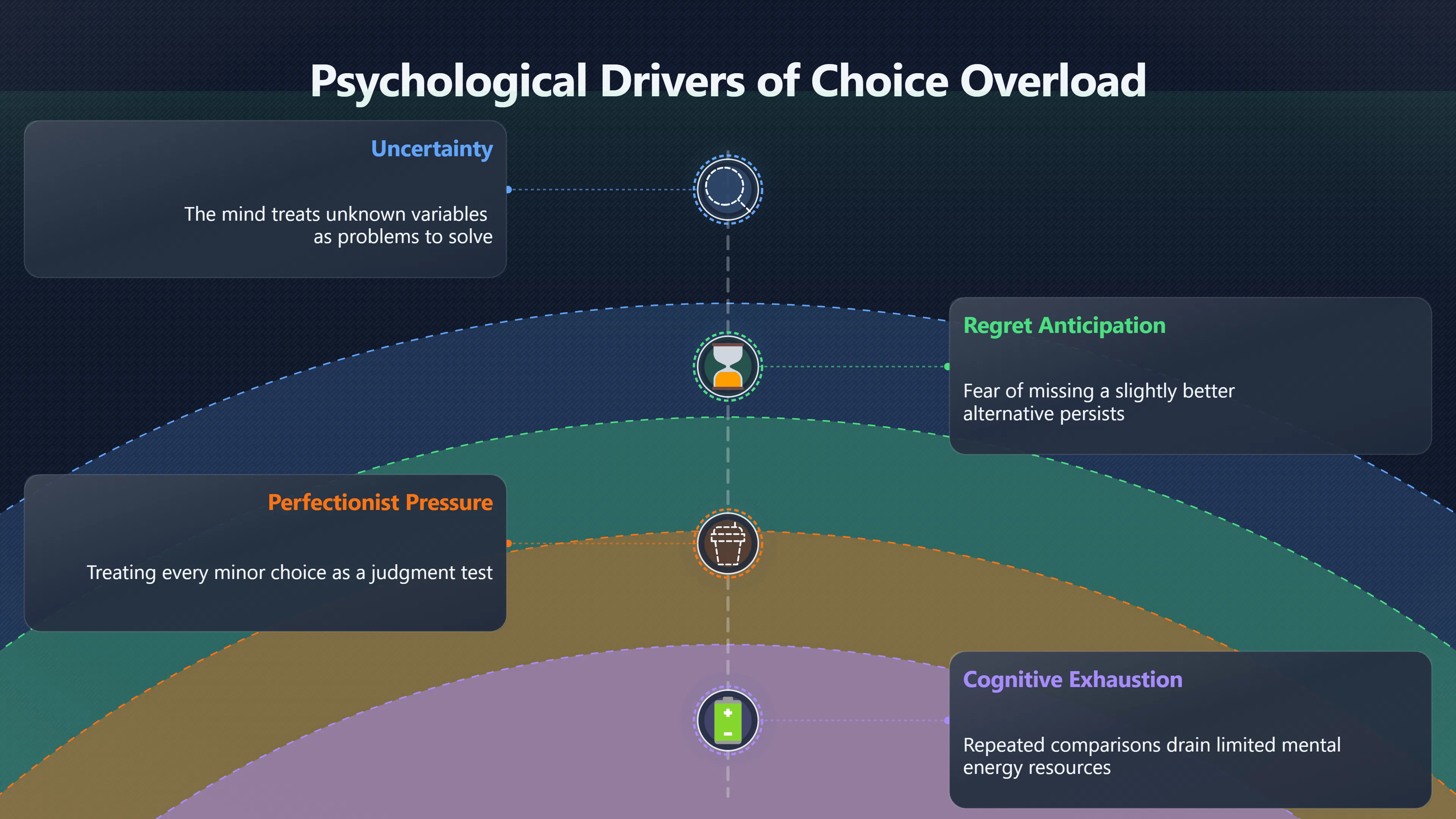
Low-stakes choices can feel surprisingly difficult because the mind often treats uncertainty itself as a problem to eliminate. Several psychological mechanisms reinforce this tendency.
Choice overload. When many acceptable alternatives exist, comparing them becomes mentally demanding. Rather than feeling liberated by more options, people may delay deciding altogether or abandon the decision. The well-known jam experiment by psychologists Sheena Iyengar and Mark Lepper illustrated this effect: shoppers were more attracted to a larger display but were substantially less likely to make a purchase than shoppers offered a smaller selection. Although later research has shown that choice overload depends on context rather than occurring universally, the broader finding—that excessive options can impair decision-making under certain conditions—has been replicated across many settings.[UW Faculty+2PMC]faculty.washington.eduUW FacultyWhen Choice is Demotivating: Can One Desire Too Much…by SS Iyengar · 2000 · Cited by 6813 — Current psychological theory and…
Fear of regret. With many similar options, people imagine the possibility that another alternative might have been slightly better. This anticipated regret encourages further searching, even when additional information is unlikely to change the practical outcome.[The Decision Lab]thedecisionlab.comThe Decision LabChoice Overload BiasChoice overload, or "overchoice", is a phenomena stating our tendency to have difficulty making a cho…
Perfectionism. Some individuals implicitly treat every decision as a test of judgement. The desire to avoid even tiny mistakes makes reversible choices feel far more consequential than they really are.
These mechanisms are especially powerful in modern environments where online reviews, rankings and comparison tools make it possible to continue searching almost indefinitely.
Decision Fatigue and the Hidden Cost of Tiny Choices
The cost of overthinking a small decision is not limited to the time spent making it. Every prolonged comparison consumes working memory, attention and self-control that could otherwise support more valuable thinking later in the day.
Researchers describe decision-making as drawing on limited cognitive resources. Although the precise mechanisms behind decision fatigue remain debated, there is broad agreement that repeated, effortful choices increase subjective mental fatigue and can reduce people’s willingness to engage in subsequent demanding decisions.[The Decision Lab]thedecisionlab.comThe Decision LabChoice Overload BiasChoice overload, or "overchoice", is a phenomena stating our tendency to have difficulty making a cho…
For example, imagine someone spending forty minutes comparing different coffee machines before work. Even if they eventually identify the objectively “best” model, they may begin the rest of the day with reduced mental energy for tasks that genuinely require careful reasoning, such as planning a project, negotiating with colleagues or reviewing important financial information.
The hidden cost therefore lies not merely in the minutes spent deciding, but in the attention that those minutes permanently consume.
Why Reversible Decisions Benefit From Action
A reversible decision creates an opportunity that prolonged analysis cannot: learning from experience.
Consider several examples:
- Trying a new note-taking application for one week.
- Ordering from a different café.
- Testing a revised meeting agenda.
- Rearranging a workspace.
In each case, direct experience quickly generates information that speculation cannot provide. If the experiment fails, the decision can usually be reversed at modest cost.
This highlights an important distinction between prediction and feedback. Endless comparison relies on increasingly uncertain predictions about which option will prove best. Acting instead creates real evidence about what actually works in practice.
For low-risk decisions, fast feedback often has greater value than increasingly detailed prediction.
Simple Stopping Rules for Low-Risk Choices
The goal is not to become careless. Instead, it is to stop analysing once additional effort is unlikely to improve the outcome.
Useful stopping rules include:
- Define success before comparing. Decide on two or three essential requirements in advance, then stop searching once an option satisfies them.
- Limit comparison time. Allocate a fixed period—perhaps ten or fifteen minutes—for decisions with little downside.
- Ignore tiny differences. If competing options differ only marginally in price, ratings or features, treat them as effectively equivalent.
- Choose, then evaluate later. Instead of asking whether this is the perfect option, ask whether it is good enough to test.
- Review reversibility explicitly. Before continuing to research, ask: “If this turns out to be the wrong choice, how difficult would it be to change?”
These rules deliberately shift attention from finding certainty to managing risk.

A Common Misunderstanding
Advice to avoid analysis paralysis is sometimes interpreted as encouragement to think less. That is not the lesson.
The evidence does not suggest that quick decisions are universally better. Rather, it suggests that the value of additional analysis depends on the structure of the decision itself. Some decisions genuinely deserve extended deliberation because they involve irreversible commitments, substantial uncertainty or serious consequences. Others do not.
The challenge is calibration. Treating every decision as equally important wastes cognitive resources, while treating every decision as trivial invites preventable mistakes. The most effective thinkers reserve their deepest analysis for choices where careful reasoning can meaningfully change the outcome, and deliberately simplify the many small, reversible decisions that fill everyday life.
Amazon book picks
Further Reading
Books and field guides related to Why Small Choices Can Steal Big Attention. Use these as the next step if you want deeper reading beyond the article.
The Art of Thinking Clearly
Covers many thinking errors that contribute to analysis paralysis.
eBay marketplace picks
Marketplace Samples
Example marketplace items related to this page. Use the search link to explore similar finds on eBay.



Endnotes
1.
Source: Wikipedia
Title: The Paradox of Choice
Link:https://en.wikipedia.org/wiki/The_Paradox_of_Choice
2.
Source: meinpodcast.de
Title: Chapter 1
Link:https://meinpodcast.de/bookey-book-summary-and-review/the-paradox-of-choice-how-an-abundance-of-options-impacts-our-decisions-and-happiness/
Source snippet
Summary of The Paradox Of ChoiceSchwartz argues that satisficers tend to be happier and experience less decision fatigue than maximizers...
3.
Source: Wikipedia
Link:https://en.wikipedia.org/wiki/Research
Source snippet
ResearchResearch is "creative and systematic work undertaken to increase the stock of knowledge". [1] It involves the collection, orga...
4.
Source: faculty.washington.edu
Link:https://faculty.washington.edu/jdb/345/345%20Articles/Iyengar%20%26%20Lepper%20%282000%29.pdf
Source snippet
UW FacultyWhen Choice is Demotivating: Can One Desire Too Much...by SS Iyengar · 2000 · Cited by 6813 — Current psychological theory and...
5.
Source: thedecisionlab.com
Link:https://thedecisionlab.com/reference-guide/economics/the-paradox-of-choice
Source snippet
The Paradox of ChoiceThe paradox of choice suggests that having too many choices actually limits our freedom. “ Learning to choose is har...
6.
Source: thedecisionlab.com
Link:https://thedecisionlab.com/biases/choice-overload-bias
Source snippet
The Decision LabChoice Overload BiasChoice overload, or "overchoice", is a phenomena stating our tendency to have difficulty making a cho...
7.
Source: reachlink.com
Title: choice overload
Link:https://reachlink.com/advice/anxiety/choice-overload/
Source snippet
How to Overcome Decision ParalysisMar 26, 2026 — Too many options can lead to stress and indecision. Learn practical strategies to simpli...
9.
Source: researchgate.net
Link:https://www.researchgate.net/publication/357474734_EXPRESS_Choice_Deprivation_Choice_Overload_and_Satisfaction_With_Choices_Across_Six_Nations
Source snippet
(PDF) EXPRESS: Choice Deprivation, Choice Overload...Jan 18, 2022 — The present research explores patterns of choice deprivation (havin...
10.
Source: hbr.org
Link:https://hbr.org/2006/06/more-isnt-always-better
Source snippet
More Isn't Always BetterResearch now shows that there can be too much choice; when there is, consumers are less likely to buy anything at...
11.
Source: modelthinkers.com
Link:https://modelthinkers.com/mental-model/paradox-of-choice
12.
Source: learningloop.io
Link:https://learningloop.io/plays/psychology/analysis-paralysis
Source snippet
Analysis Paralysis: Cut choices to drive action - Learning LoopA seminal study on Analysis Paralysis was conducted by Iyengar and Lepper...
13.
Source: stanforddaily.com
Title: choice paralysis and the fear of growing up
Link:https://stanforddaily.com/2020/02/03/choice-paralysis-and-the-fear-of-growing-up/
Source snippet
3 Feb 2020 — In 2000, psychologists Sheena Iyengar from Columbia and Mark Lepper from Stanford published a study called, “When Choice is...
14.
Source: zoovu.com
Title: why choice overload will hurt your sales
Link:https://zoovu.com/blog/why-choice-overload-will-hurt-your-sales
Source snippet
Why choice overload hurts your sales and what you can do...Apr 1, 2019 — Iyengar proved that when we've got too many options to consider...
15.
Source: philosopheasy.com
Title: the paradox of choice why having
Link:https://www.philosopheasy.com/p/the-paradox-of-choice-why-having
Source snippet
The Paradox of Choice: Why Having More Options Makes...5 Oct 2025 — Analysis paralysis refers to the inability to make a decision when f...
16.
Source: srivatssan.medium.com
Title: paradox of choices be8ee036dd6c
Link:https://srivatssan.medium.com/paradox-of-choices-be8ee036dd6c
Source snippet
of Choices - Insightful Savant - MediumToo many options create analysis paralysis, leaving talented people stuck in decision limbo. A qua...
17.
Source: oge.mit.edu
Title: the paradox of choice
Link:https://oge.mit.edu/the-paradox-of-choice/
Source snippet
Paradox of Choice: | Office of Graduate EducationThe paradox is that even though having more choices seems better, it is only better up t...
18.
Source: pmc.ncbi.nlm.nih.gov
Link:https://pmc.ncbi.nlm.nih.gov/articles/PMC11111947/
Source snippet
research directions in choice overload and its moderatorsby R Misuraca · 2024 · Cited by 38 — A famous field study conducted by Iyengar a...
Topic Tree