Within Health Claims
When Better Numbers Do Not Mean Better Health
A number moving in the right direction is not the same as fewer illnesses, longer life, better function, or less suffering.
On this page
- What surrogate markers are meant to do
- When markers mislead health decisions
- How to ask for patient important outcomes
Page outline Jump by section
Introduction
Many health claims rely on improvements in numbers rather than improvements in lives. A supplement may lower a blood test result, a drug may shrink a tumour on a scan, or a wearable device may report a better score. These changes can be meaningful, but they do not automatically mean people live longer, avoid illness, function better, or feel better.
 This distinction lies at the heart of analytical scepticism in health. A surrogate health marker is an indirect measure that is expected to predict a real health outcome. Sometimes surrogate markers are excellent predictors and allow treatments to be evaluated much faster. In other cases they have proved misleading, leading to treatments that improved laboratory values while producing little real-world benefit or even causing harm. Learning to distinguish between a change in a marker and a change in patient-important outcomes is one of the most valuable skills for evaluating health claims.[U.S. Food and Drug Administration]fda.govfacts biomarkers and surrogate endpointsFood and Drug AdministrationFDA Facts: Biomarkers and Surrogate Endpoints21 Dec 2017 — Surrogate endpoints are used when the clinical out…
What surrogate markers are meant to do
A surrogate marker (or surrogate endpoint in clinical trials) is a measurement that stands in for an outcome that really matters to patients. Instead of waiting years to see whether a treatment prevents strokes or extends life, researchers may measure something that changes sooner and is believed to lie on the pathway to that outcome.
Examples include:
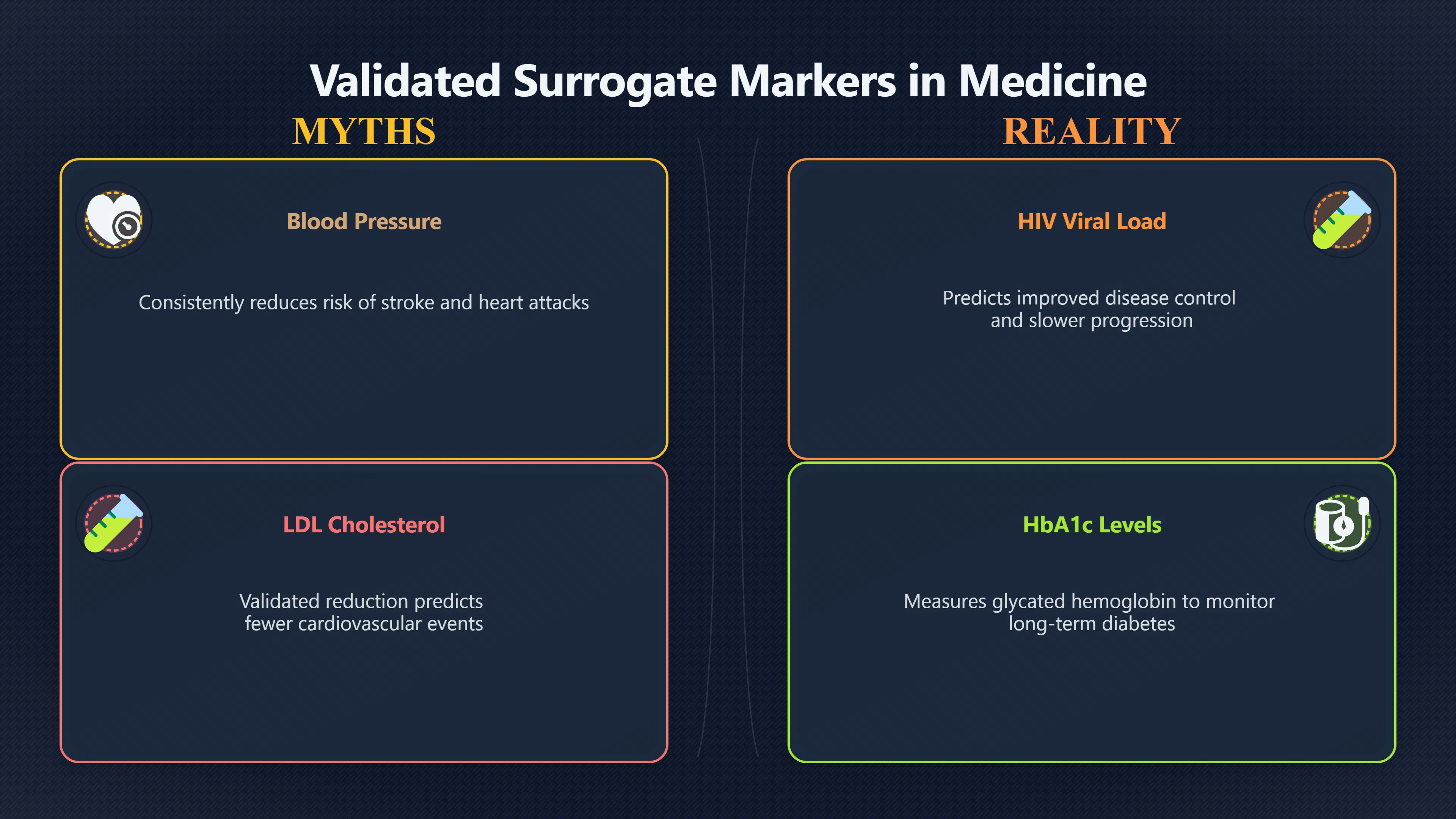
- Blood pressure instead of future strokes or heart attacks.
- LDL cholesterol instead of cardiovascular events.[ncbi.nlm.nih.gov]ncbi.nlm.nih.govNCBIValidated Surrogate EndpointNIH25 Sept 2017 — Low-density lipoprotein (LDL) cholesterol reduction is a validated surrogate endpoint for reduction of cardiovas…
- HbA1c (glycated haemoglobin) instead of long-term diabetic complications.
- HIV viral load instead of progression to AIDS.
- Tumour shrinkage instead of longer survival or improved quality of life. NCBI+2U.S. Food and Drug Administration[ncbi.nlm.nih.gov]ncbi.nlm.nih.govNCBIValidated Surrogate EndpointNIH25 Sept 2017 — Low-density lipoprotein (LDL) cholesterol reduction is a validated surrogate endpoint for reduction of cardiovas…
Surrogate markers exist for practical reasons. Waiting decades to measure heart attacks or dementia may make clinical trials prohibitively slow or expensive. For rapidly fatal diseases, waiting for final outcomes may also delay access to promising treatments. Regulators therefore sometimes accept validated surrogate endpoints when there is strong evidence that changes in the marker reliably predict meaningful clinical benefit. U.S. Food and Drug Administration+2U.S. Food and Drug Administration[fda.gov]fda.govtable surrogate endpoints were basis drug approval or licensureFood and Drug AdministrationTable of Surrogate Endpoints That Were the Basis of Drug…29 Apr 2026 — This surrogate endpoint table inclu…
The crucial word is validated. Not every biological marker deserves equal confidence.
When better numbers do not translate into better health
The central mistake is assuming that every biomarker is a faithful substitute for what patients actually care about.
Several things can go wrong.
First, a marker may capture only one part of a disease. Heart disease, for example, involves inflammation, clotting, blood pressure, metabolism and many other processes. Improving one laboratory value does not guarantee that the overall disease process improves.
Second, a treatment may affect both the surrogate marker and other biological pathways. Those unintended effects can offset or even outweigh the apparent benefit suggested by the marker.
Third, researchers may correctly identify a risk factor without proving that altering it in a particular way improves outcomes. A factor can be associated with disease while still failing as a treatment target.
These possibilities explain why regulators, evidence reviewers and clinical guideline developers distinguish between a reasonable biological theory and evidence that patients actually experience better outcomes.[The Lancet+2National Academies]thelancet.comThe LancetA framework for the definition and interpretation of the use…by O Ciani · 2023 · Cited by 67 — Surrogate endpoints are used…
Examples that sharpen analytical thinking
Some surrogate markers have proved highly reliable.[fas.org]fas.orgvalidating surrogate endpointsSurrogate markers…Read more…
Blood pressure reduction is one of the strongest examples. Across many different drug classes, lowering elevated blood pressure consistently reduces stroke risk, heart attacks and cardiovascular mortality. Similarly, lowering HIV viral load predicts improved disease control, and reducing LDL cholesterol through established treatments such as statins has repeatedly translated into fewer cardiovascular events. These markers became trusted because numerous trials confirmed that changing the marker reliably changed the clinical outcomes.[NCBI+2National Academies]ncbi.nlm.nih.govNCBIValidated Surrogate EndpointNIH25 Sept 2017 — Low-density lipoprotein (LDL) cholesterol reduction is a validated surrogate endpoint for reduction of cardiovas…
Other examples have been far less successful.
For many years, raising HDL (“good”) cholesterol appeared promising because people with naturally higher HDL levels tended to have lower rates of heart disease. However, several drugs that substantially increased HDL cholesterol failed to reduce heart attacks or deaths in large randomised trials. The biological association was real, but manipulating the marker did not produce the expected clinical benefit.[White Rose Research Online]eprints.whiterose.ac.ukWhite Rose Research OnlineTime to review the role of surrogate endpoints in health policyby O Ciani · 2017 · Cited by 178 — For example…
Cancer research provides another cautionary example. Some treatments shrink tumours or delay tumour growth, yet produce little improvement in overall survival or quality of life. Tumour response can be valuable, particularly in aggressive disease, but it is not automatically equivalent to helping patients live longer or live better. This is why oncology increasingly debates how much confidence should be placed in surrogate endpoints when approving new medicines. Cancer Therapy Advisor+2rama.mahidol.ac.th[cancertherapyadvisor.com]cancertherapyadvisor.comCancer Therapy AdvisorSurrogate Endpoints in Oncology & Use for Cancer Drug…by B Furlow — Surrogate endpoints increasingly are used fo…
These contrasting cases illustrate an important reasoning principle: the usefulness of one surrogate marker says little about another. Each must earn trust through evidence rather than analogy.
Why marketing often emphasises markers
Commercial health claims frequently focus on measurements that improve quickly because they are easier to demonstrate.
Advertisements may highlight that a product:
- “Reduces inflammation markers.”
- “Balances hormone levels.”
- “Optimises blood sugar.”
- “Boosts antioxidant status.”
- “Improves gut microbiome diversity.”
These statements may describe genuine changes in laboratory measurements. The analytical question is whether those changes have been shown to produce outcomes that matter to patients.
Many supplements and wellness products stop at the surrogate marker. They rarely demonstrate reductions in disease, disability, pain, hospital admissions or mortality because those studies are much larger, longer and more expensive.
A sophisticated reader therefore distinguishes between:
- The marker changed.
- People became healthier because the marker changed.
Those are different claims requiring different levels of evidence.

How to ask for patient-important outcomes
When reading a study or health advertisement, a few questions can quickly reveal whether the evidence rests mainly on surrogate markers.
Ask:
- What outcome was actually measured? Was it a laboratory value, scan or symptom score, or was it heart attacks, fractures, survival or quality of life?
- Has this surrogate been validated? Has changing this marker consistently predicted better patient outcomes across multiple high-quality studies?
- How certain is the relationship? Some surrogate markers have decades of supporting evidence; others remain speculative.
- Were harms measured alongside benefits? A treatment could improve one marker while increasing other risks.
- Would patients notice the difference? If the laboratory result improved but everyday function, symptoms and longevity did not, the practical value may be limited.
These questions redirect attention from impressive numbers to meaningful health.
Thinking more clearly about health claims
Surrogate markers are neither inherently trustworthy nor inherently misleading. They are tools whose value depends on how well they predict outcomes that matter to patients.
Good analytical thinking avoids two opposite errors. One is accepting every biomarker as proof that a treatment works. The other is dismissing all surrogate markers as useless. The evidence shows that some—such as blood pressure, HIV viral load and certain uses of LDL cholesterol—have earned confidence through repeated confirmation. Others have disappointed despite persuasive biological theories.
The key lesson is simple but powerful: better numbers are evidence only when they have been shown to lead to better lives. Whenever a health claim celebrates changes in a measurement, the next question should be whether those changes have actually reduced illness, improved function, lessened suffering or extended healthy life. That shift in focus helps separate scientifically meaningful progress from improvements that are merely numerical.
Amazon book picks
Further Reading
Books and field guides related to When Better Numbers Do Not Mean Better Health. Use these as the next step if you want deeper reading beyond the article.
Less Medicine, More Health
Encourages judging medicine by meaningful health outcomes rather than more findings or interventions.
Overdiagnosed
Shows why better-looking numbers do not always translate into better patient outcomes.
Ending Medical Reversal
Explains why surrogate endpoints and intermediate results can mislead medical decisions.
Bad Science
Builds general scepticism about impressive-sounding biomedical claims and weak evidence.
eBay marketplace picks
Marketplace Samples
Live-tested eBay searches with available results related to this page.

Top pick
critical thinking card game
Open a targeted eBay search for items related to this topic.
Browse eBay

Related search
when memorabilia
Open a targeted eBay search for items related to this topic.
Browse eBay
Endnotes
1.
Source: fda.gov
Title: facts biomarkers and surrogate endpoints
Link:https://www.fda.gov/about-fda/innovation-fda/fda-facts-biomarkers-and-surrogate-endpoints
Source snippet
Food and Drug AdministrationFDA Facts: Biomarkers and Surrogate Endpoints21 Dec 2017 — Surrogate endpoints are used when the clinical out...
2.
Source: ncbi.nlm.nih.gov
Title: NCBIValidated Surrogate Endpoint
Link:https://www.ncbi.nlm.nih.gov/books/NBK453484/
Source snippet
NIH25 Sept 2017 — Low-density lipoprotein (LDL) cholesterol reduction is a validated surrogate endpoint for reduction of cardiovas...
3.
Source: fda.gov
Title: table surrogate endpoints were basis drug approval or licensure
Link:https://www.fda.gov/drugs/development-resources/table-surrogate-endpoints-were-basis-drug-approval-or-licensure
Source snippet
Food and Drug AdministrationTable of Surrogate Endpoints That Were the Basis of Drug...29 Apr 2026 — This surrogate endpoint table inclu...
4.
Source: ncbi.nlm.nih.gov
Link:https://www.ncbi.nlm.nih.gov/books/NBK338448/
Source snippet
BEST (Biomarkers, EndpointS, and other Tools...28 Jan 2016 — A validated surrogate endpoint can be used to support marketing approval of...
5.
Source: rama.mahidol.ac.th
Link:https://www.rama.mahidol.ac.th/ceb/sites/default/files/public/pdf/Repository/bmj.n2191.full.pdf
Source snippet
Raising the bar for using surrogate endpoints in drug...by D Dawoud · 2021 · Cited by 48 — Evaluating the evidence behind the surrogate...
6.
Source: thelancet.com
Link:https://www.thelancet.com/journals/eclinm/article/PIIS2589-5370%2823%2900460-1/fulltext
Source snippet
The LancetA framework for the definition and interpretation of the use...by O Ciani · 2023 · Cited by 67 — Surrogate endpoints are used...
7.
Source: pmc.ncbi.nlm.nih.gov
Link:https://pmc.ncbi.nlm.nih.gov/articles/PMC8894669/
Source snippet
FDA established a table of acceptable surrogate endpoints (SEs) to support... Common examples include blood pressure, hemoglobin A1c, an...
8.
Source: nationalacademies.org
Link:https://www.nationalacademies.org/read/12869/chapter/4
Source snippet
Within CFSAN, blood pressure is recognized as a surrogate endpoint for hypertension...Read more...
9.
Source: eprints.whiterose.ac.uk
Link:https://eprints.whiterose.ac.uk/id/eprint/110099/1/OC_MB_MD_etc_rev_role_Surrogates_ViH_acceptd_201016.pdf
Source snippet
White Rose Research OnlineTime to review the role of surrogate endpoints in health policyby O Ciani · 2017 · Cited by 178 — For example...
10.
Source: cancertherapyadvisor.com
Link:https://www.cancertherapyadvisor.com/features/surrogate-endpoints-in-oncology-approvals/
Source snippet
Cancer Therapy AdvisorSurrogate Endpoints in Oncology & Use for Cancer Drug...by B Furlow — Surrogate endpoints increasingly are used fo...
Additional References
11.
Source: definitivehc.com
Link:https://www.definitivehc.com/resources/glossary/surrogate-endpoint
12.
Source: healthjournalism.org
Link:https://healthjournalism.org/glossary-terms/surrogate-endpoints/
13.
Source: appliedclinicaltrialsonline.com
Link:https://www.appliedclinicaltrialsonline.com/view/biomarkers-and-surrogate-endpoints-clinical-drug-development
Source snippet
en accepted as surrogate endpoints is much shorter, of course, and includes such characteristics as blood...Read more...
14.
Source: gao.gov
Link:https://www.gao.gov/assets/a295766.html
Source snippet
Surrogate endpoint(s) used to approve [application]({{ 'application/' | relative_url }}): LDL cholesterol levels.... Although FDA routinely uses blood pressure as a validated...
15.
Source: cda-amc.ca
Link:https://www.cda-amc.ca/sites/default/files/MG%20Methods/surrogate-endpoints-report.pdf
Source snippet
The topic of surrogate.Read more...
16.
Source: youtube.com
Title: Understanding Surrogate Endpoints and Their Limitations
Link:https://www.youtube.com/watch?v=t7TXI1WXtXA
Source snippet
Biomarkers and Surrogate Endpoints in Drug Development...
17.
Source: youtube.com
Title: Use of Surrogate Endpoints in Oncology
Link:https://www.youtube.com/watch?v=gMPjbreWIdM
Source snippet
Understanding Endpoints in Rare Disease Drug Development...
18.
Source: fas.org
Title: validating surrogate endpoints
Link:https://fas.org/publication/validating-surrogate-endpoints/
Source snippet
Surrogate markers...Read more...
19.
Source: youtube.com
Title: Biomarkers and Surrogate Endpoints in Drug Development
Link:https://www.youtube.com/watch?v=VuiDYVde9aI
Source snippet
Surrogate Outcomes...
20.
Source: youtube.com
Title: Understanding Endpoints in Rare Disease Drug Development
Link:https://www.youtube.com/watch?v=lHQ66qjXPoU
Topic Tree