Within Humility
Why Changing Your Mind Feels Personal
Beliefs are harder to revise when they feel tied to identity, loyalty or competence rather than evidence alone.
On this page
- How beliefs become identity signals
- Status threats that block updating
- Ways to revise a view without self erasure
Page outline Jump by section
Introduction
Changing your mind is often presented as a purely intellectual exercise: new evidence appears, old beliefs are replaced, and better conclusions follow. In practice, the process is rarely so straightforward. Many beliefs become tied to identity, competence, loyalty or social belonging. Revising them can therefore feel less like correcting an error and more like admitting personal failure or betraying a group. The result is that people sometimes defend weak ideas not because the evidence remains persuasive, but because changing position seems socially or psychologically costly.
 Intellectual humility is valuable precisely because it separates the strength of a person from the permanence of their opinions. It allows beliefs to be revised without treating revision as humiliation. Research in psychology suggests that reducing threats to self-worth can make people more receptive to conflicting evidence, while studies of intellectual humility consistently link it with greater willingness to recognise mistakes and update beliefs.[PMC]pmc.ncbi.nlm.nih.govUsing self-affirmation to increase intellectual humility in debateby PHP Hanel · 2023 · Cited by 45 — We tested whether intellectual h…
Why beliefs become identity signals
Not every opinion becomes part of the self. Many are revised effortlessly: changing a restaurant preference or learning a new shortcut rarely threatens anyone’s sense of identity. Difficulty arises when a belief signals something broader.
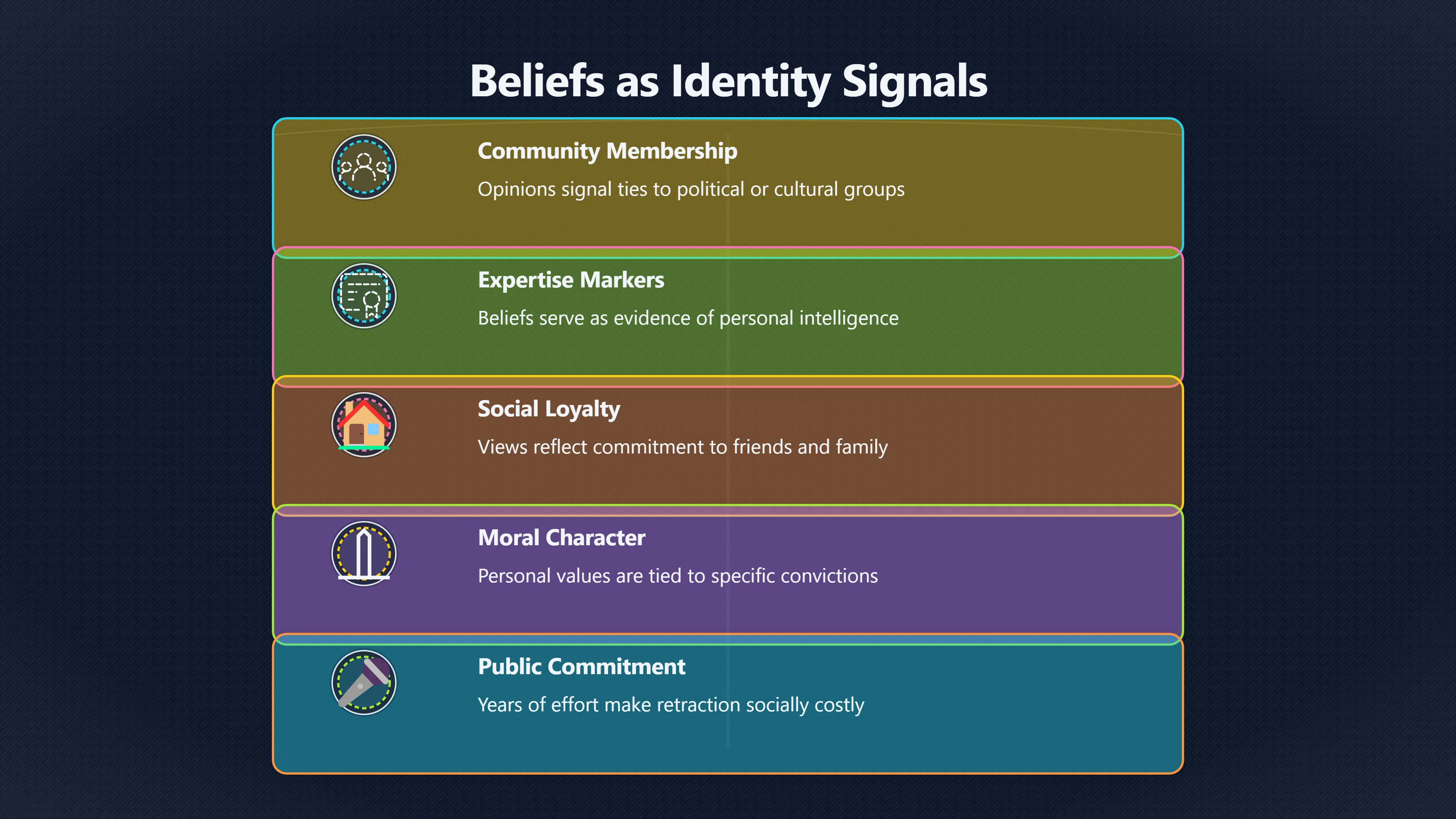
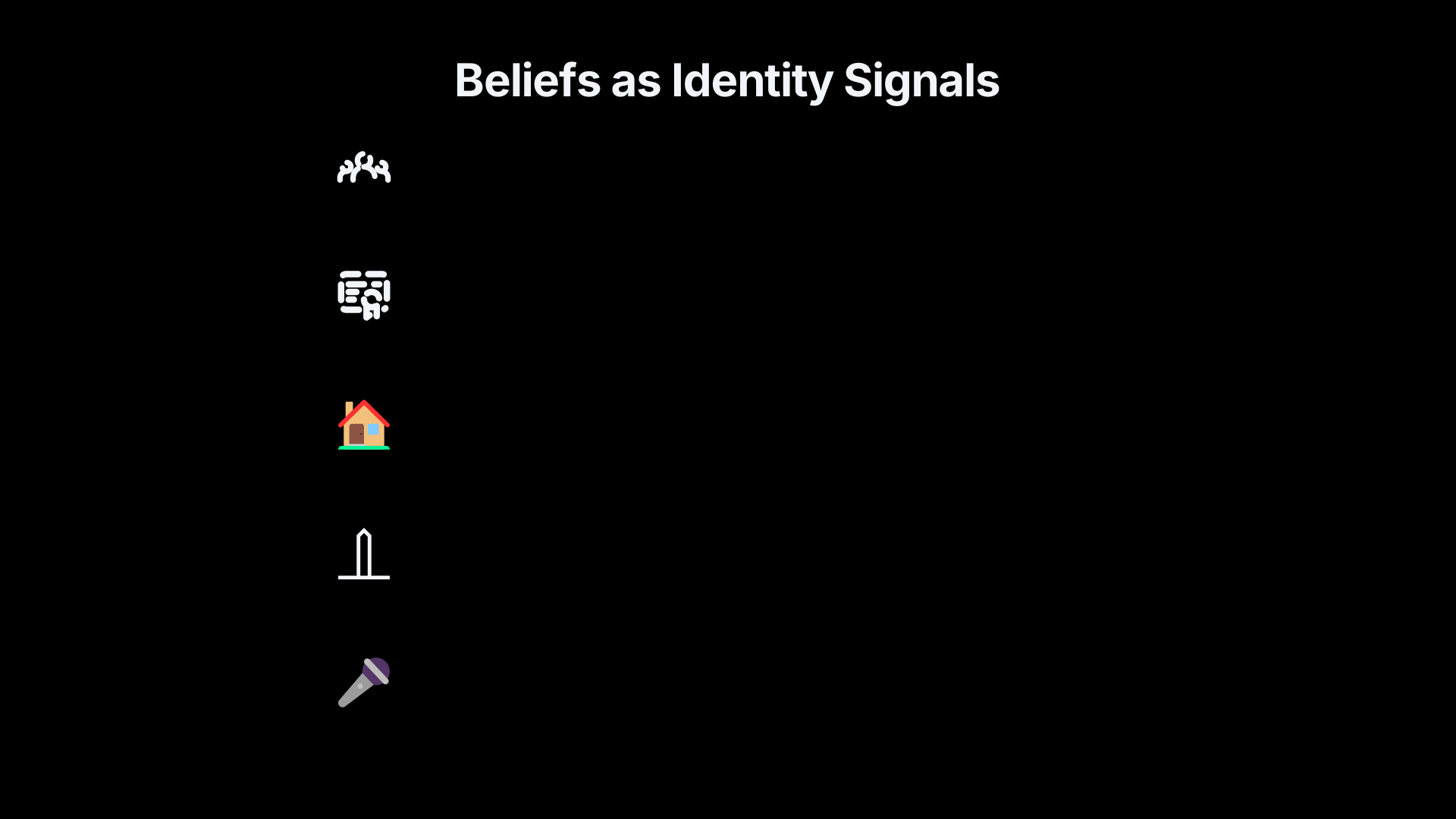
A belief often comes to represent:
- membership of a political, professional or cultural community;
- evidence of intelligence or expertise;
- loyalty to friends, colleagues or family;
- moral character or personal values;
- years of previous effort or public commitment.
Once this happens, criticism of the belief is easily experienced as criticism of the person. Instead of asking, “Is this evidence convincing?”, the mind begins asking, “What would it mean about me if this were true?”
This explains why debates frequently become less responsive to evidence as they become more public. A mistaken claim made privately can be quietly abandoned. The same claim repeated before colleagues, followers or family members becomes much harder to retract because status is now involved.
Why status threats block updating
The obstacle is not simply pride. Several psychological mechanisms work together.
Protecting the self rather than the belief
Research on self-affirmation theory argues that people have a strong motivation to preserve a coherent sense of themselves as competent and morally adequate. Information that threatens this self-image often produces defensive reasoning rather than careful evaluation.
Experiments have shown that when participants first affirm important personal values unrelated to the disputed issue, they become more willing to engage openly with threatening information and display greater intellectual humility during discussion. The affirmation does not make people indifferent to truth. Instead, it reduces the feeling that accepting evidence would diminish their worth.[PMC+2labs.psych.ucsb.edu]pmc.ncbi.nlm.nih.govUsing self-affirmation to increase intellectual humility in debateby PHP Hanel · 2023 · Cited by 45 — We tested whether intellectual h…
Public consistency
People also care about appearing consistent. Once a position has been publicly defended, reversing course risks looking unreliable or incompetent.
This creates an unfortunate incentive: the more visible a mistaken opinion becomes, the more psychological pressure exists to defend it. Escalating commitment can therefore reflect reputation management as much as genuine conviction.
Group belonging
Many beliefs function as social signals. They communicate “who I am” as much as “what I think.”
Changing such beliefs may therefore appear to threaten relationships rather than merely ideas. Someone may worry about disappointing friends, losing professional credibility or appearing disloyal, even when privately persuaded by new evidence.
In these situations, evidence competes with social incentives rather than replacing them.
Why changing your mind can increase rather than reduce credibility
People often assume that confidence requires never admitting error. Yet in many expert communities the opposite norm operates.
Scientists routinely revise explanations after new experiments. Engineers modify designs after failures. Doctors update treatments as clinical evidence improves. Financial analysts alter forecasts when markets change. In each case, refusing to update would usually damage credibility more than acknowledging revision.
The distinction lies between inconsistency and responsiveness.
A person who changes views randomly appears unreliable. A person who explains exactly what evidence altered their judgement often appears more trustworthy because their reasoning follows observable standards rather than personal attachment.
The strongest signal is not “I was always right.”
It is “I know why I believed that then, and I know why I believe something different now.”
Ways to revise a view without self-erasure
Changing your mind does not require pretending your previous reasoning was foolish. Several habits reduce the status cost of updating.

Identify with the process, not the conclusion
Instead of defining yourself by particular opinions, define yourself by the quality of your reasoning.
Compare these identities:
- Identity tied to conclusions: “I am the person who believes X.”
- Identity tied to method: “I am the kind of person who follows good evidence.”
The second identity survives belief revision intact.
Explain what changed
People often respect revisions more when they understand the reason.
Rather than saying:
“I completely reversed my position.”
A clearer explanation is:
“The new evidence answered the question that originally made me sceptical.”
This presents updating as disciplined reasoning instead of weakness.
Revise gradually when appropriate
Evidence rarely requires dramatic reversals overnight.
Useful language includes:
- “I’m less certain than I was.”
- “I’ve updated my confidence.”
- “I think the balance of evidence has shifted.”
- “Part of my earlier view still seems right, but not all of it.”
Such statements better reflect how evidence usually accumulates.
Separate identity from any single mistake
Research on self-affirmation suggests that people become less defensive when reminded that their worth depends on many valued aspects of themselves rather than one threatened belief. A disagreement about one issue does not define the entire person. labs.psych.ucsb.edu+2LSA Technology Services[labs.psych.ucsb.edu]labs.psych.ucsb.edusherman.lokande.muller.cohen.2021.saSelf‑Affirmation Interventionsby DK Sherman · 2021 · Cited by 72 — The earliest research in self- affirmation theory showed that people c…

Common traps that make updating harder
Several habits unintentionally increase the personal cost of changing position.
- Making absolute claims. Statements such as “Only an idiot believes otherwise” leave little room for graceful revision.
- Treating disagreement as moral failure. If every disagreement becomes a judgement about character, changing sides feels like confessing guilt.
- Attaching self-esteem to always being correct. No one can maintain this standard indefinitely.
- Confusing confidence with certainty. High confidence should still allow the possibility of future correction.
- Interpreting every concession as defeat. Productive reasoning often consists of many partial adjustments rather than dramatic reversals.
Each trap makes beliefs harder to update because it increases the personal penalty attached to being wrong.
A healthier model of intellectual confidence
Intellectual humility does not require becoming tentative about everything or abandoning firm convictions whenever disagreement appears. It requires changing the relationship between personal status and factual accuracy.
A useful mental model is that beliefs are working hypotheses rather than permanent possessions. Some will survive decades of scrutiny. Others will need refinement or replacement. Success lies not in avoiding revision but in making revision proportionate to the evidence.
When changing your mind ceases to threaten your identity, evidence becomes easier to evaluate on its merits. Status no longer depends on never being wrong; it comes from demonstrating that your commitment is ultimately to understanding reality rather than defending yesterday’s conclusions.
Amazon book picks
Further Reading
Books and field guides related to Why Changing Your Mind Feels Personal. Use these as the next step if you want deeper reading beyond the article.
Mistakes Were Made (but Not by Me)
Explains self-justification and resistance to admitting error.
eBay marketplace picks
Marketplace Samples
Example marketplace items related to this page. Use the search link to explore similar finds on eBay.



Endnotes
1.
Source: pmc.ncbi.nlm.nih.gov
Link:https://pmc.ncbi.nlm.nih.gov/articles/PMC9890103/
Source snippet
Using self-affirmation to increase intellectual humility in debateby PHP Hanel · 2023 · Cited by 45 — We tested whether intellectual h...
2.
Source: pmc.ncbi.nlm.nih.gov
Title: PMCPredictors and consequences of intellectual humility
Link:https://pmc.ncbi.nlm.nih.gov/articles/PMC9244574/
Source snippet
and consequences of intellectual humility - PMCby T Porter · 2022 · Cited by 359 — Intellectual humility involves acknowledging the limit...
3.
Source: labs.psych.ucsb.edu
Title: sherman.lokande.muller.cohen.2021.sa
Link:https://labs.psych.ucsb.edu/sherman/david/sites/labs.psych.ucsb.edu.sherman.david/files/pubs/sherman.lokande.muller.cohen_.2021.sa_.pdf
Source snippet
Self‑Affirmation Interventionsby DK Sherman · 2021 · Cited by 72 — The earliest research in self- affirmation theory showed that people c...
4.
Source: sites.lsa.umich.edu
Title: Critcher Aff Persp
Link:https://sites.lsa.umich.edu/sasi/wp-content/uploads/sites/275/2015/11/Critcher_AffPersp.pdf
Source snippet
LSA Technology ServicesSelf-Affirmations Provide a Broader Perspective on...by CR Critcher · 2014 · Cited by 290 — Self-affirmations exp...
Additional References
5.
Source: researchgate.net
Link:https://www.researchgate.net/publication/259650286_The_Psychology_of_Change_Self-Affirmation_and_Social_Psychological_Intervention
Source snippet
(PDF) The Psychology of Change: Self-Affirmation and...Timely affirmations have been shown to improve education, health, and relationshi...
6.
Source: psibetajournal.org
Link:https://psibetajournal.org/wp-content/uploads/PBRJ-VOL-2-ISSUE-1-MASTER.pdf
Source snippet
y (IH) refers to the degree to which people recognize their beliefs might be fallible...
7.
Source: semanticscholar.org
Link:https://www.semanticscholar.org/paper/Evidence-that-Attitudinal-Self-Justification-%28not-Dwyer-Stella/ce57e90a00c64059d1368f718c51f41fc57723c7/figure/0
Source snippet
lerance to opposing perspectives and beliefs...
8.
Source: youtube.com
Title: Why “scout mindset” is crucial to [good judgment]({{ ‘good-judgment/’ | relative_url }}) | Julia Galef | TEDx PSU
Link:https://www.youtube.com/watch?v=3MYEtQ5Zdn8
Source snippet
Intellectual humility: the rewards of being willing to change your mind...
9.
Source: youtube.com
Title: How to Change Your Mind (Update) | Freakonomics Radio | Episode 379
Link:https://www.youtube.com/watch?v=593lGys_k5o
Source snippet
Why "scout mindset" is crucial to good judgment | Julia Galef | TEDxPSU...
10.
Source: youtube.com
Title: Why It’s So HARD to Admit You’re WRONG
Link:https://www.youtube.com/watch?v=tW2W_iS1qNU
Source snippet
Growth Starts With Questioning Yourself: The Art Of Changing Your Mind w/ Charles McCaughan...
11.
Source: apa.org
Title: amp amp0001591
Link:https://www.apa.org/pubs/journals/releases/amp-amp0001591.pdf
Source snippet
The Impact of Self-Affirmation Interventions on Well-Beingby Y Zhang · 2025 · Cited by 8 — Research suggests that self-affirmation can re...
12.
Source: repository.ubn.ru.nl
Link:https://repository.ubn.ru.nl/bitstream/handle/2066/293089/293089.pdf
Source snippet
processing‐related self‐affirmations overcome...by T Emonds · 2023 · Cited by 7 — The basic premise of self‐affirmation theory (Steele...
13.
Source: youtube.com
Title: Intellectual humility: the rewards of being willing to change your mind
Link:https://www.youtube.com/watch?v=GUnIWyUwi6g
Source snippet
Why It's So HARD to Admit You're WRONG...
14.
Source: youtube.com
Link:https://www.youtube.com/watch?v=lzu-4QkasrY
Topic Tree