Within Argument Maps
What Is Your Map Really Trying to Prove?
Starting with a complete decision claim keeps an argument map focused on what is actually being defended.
On this page
- Turning topics into testable claims
- Finding the real top level conclusion
- Using job offers and policy choices as examples
Page outline Jump by section
Introduction
When people say they are “mapping a decision”, they often begin with a topic: job offer, working from home, should we introduce a new policy? The problem is that a topic is not yet an argument. An argument map becomes useful only when it is organised around a claim that could be accepted, rejected, questioned, or supported. In practice, the most effective maps for everyday decisions are often conclusion-first maps: they start by stating exactly what is being defended and then work backwards to examine the reasons, evidence, objections, and assumptions. Argument-mapping guidance consistently places identification of the main claim or conclusion at the centre of the mapping process because the structure of the rest of the map depends on it.[The Open University+2The Open University]open.eduFirst, try to find the main claim. The main claim is the overall point or conclusion that the author of the text is making.Read more…
 For improving thinking and analytical skills, this seemingly small change matters. A clear conclusion prevents a map from becoming a collection of disconnected considerations. It forces the question: what, exactly, am I trying to prove?
What Is Your Map Really Trying to Prove?
Many reasoning failures occur before any evidence is examined. The mistake is not weak support but an unclear target.
Consider the difference between these starting points:
- “Job offer”
- “City transport”
- “I should accept the offer from Company A.”
- “Our team should continue remote work three days per week.”
- “The council should introduce a bus-priority scheme.”
The first group names subjects. The second group states conclusions. Only the second group can serve as the top node of an argument map because only they make a definite claim. Argument-mapping methods therefore emphasise identifying the main claim before building the rest of the structure.[The Open University+2Reasons]open.eduFirst, try to find the main claim. The main claim is the overall point or conclusion that the author of the text is making.Read more…
A useful test is whether someone could reasonably respond “yes”, “no”, or “I’m not convinced”. If they can, the statement is probably specific enough to function as a conclusion.
Starting with a conclusion also reduces a common analytical error: endlessly collecting information without knowing what decision the information is supposed to support. Evidence gains meaning only relative to a claim.
Turning Topics into Testable Claims
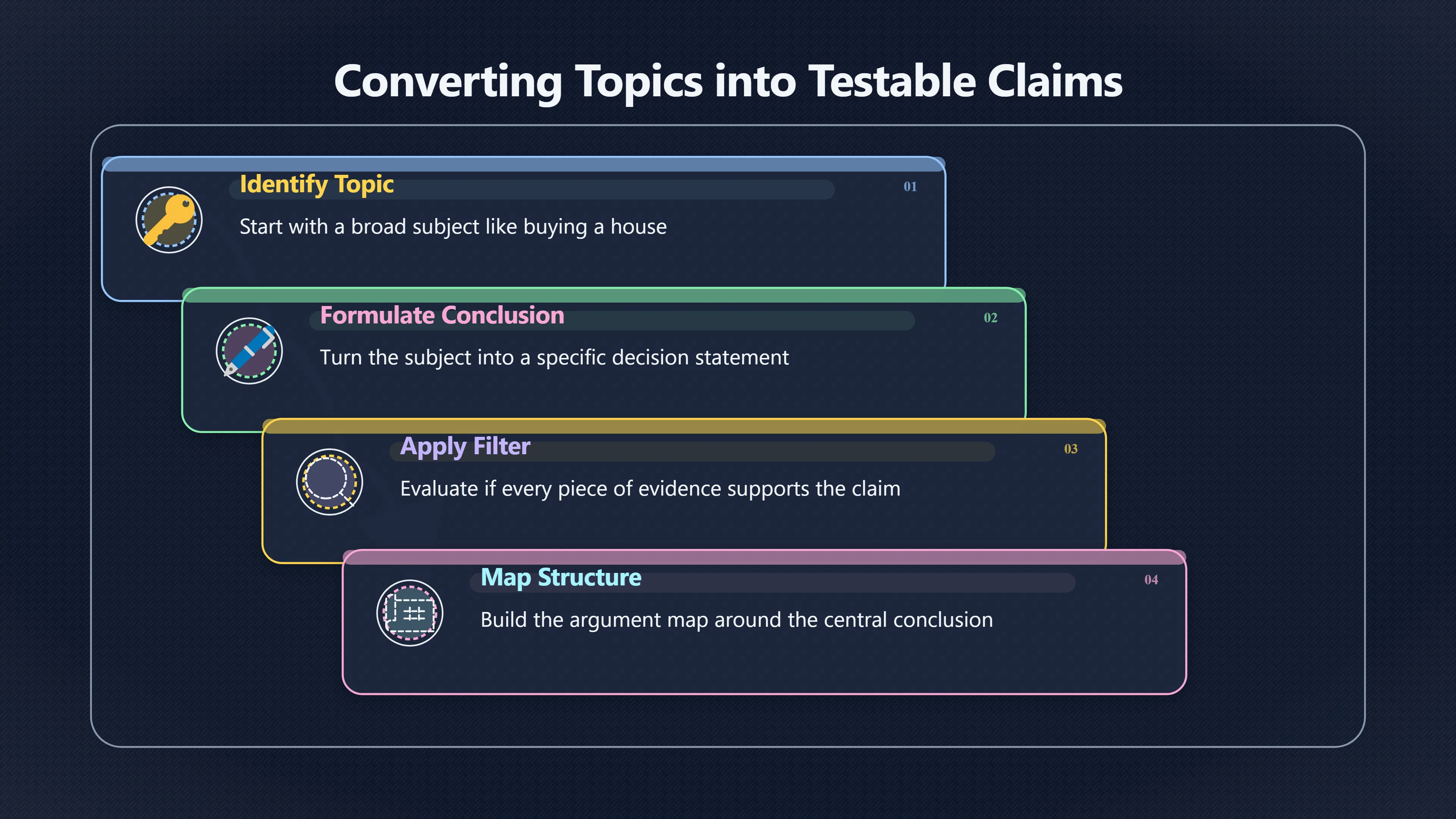
A practical way to build conclusion-first maps is to convert broad topics into explicit decision statements.
Instead of mapping:
- “Buying a house”
Map:[ddd.uab.cat]ddd.uab.catcat Argument mapmap - Wikipedia, the free encyclopedia5 Jul 2016 — An argument map typically includes the key components of the argument, traditionally c…
- “I should buy the house on Oak Street this year.”
Instead of mapping:
- “Public transport”
Map:[ddd.uab.cat]ddd.uab.catcat Argument mapmap - Wikipedia, the free encyclopedia5 Jul 2016 — An argument map typically includes the key components of the argument, traditionally c…
- “The city should expand the tram network into the northern district.”
Instead of mapping:
- “Career options”
Map:[ddd.uab.cat]ddd.uab.catcat Argument mapmap - Wikipedia, the free encyclopedia5 Jul 2016 — An argument map typically includes the key components of the argument, traditionally c…
- “I should move into product management within the next twelve months.”
The more concrete the claim, the easier it becomes to identify relevant support and irrelevant distractions.
This approach mirrors evidence-based decision-making practices, which focus on evaluating evidence in relation to a specific claim, assumption, or hypothesis rather than treating information gathering as an end in itself.[CIPD]cipd.orgEvidence-based practice for effective decision-makingEvidence-based practice for effective decision-makingMay 19, 2025 — Evidence-based practice is an approach for improving decision-mak…
A conclusion-first map therefore acts as a filter. Every reason, statistic, anecdote, or objection must answer a single question: does this help establish or weaken the conclusion?
Finding the Real Top-Level Conclusion
One of the most valuable skills in argument mapping is distinguishing the final conclusion from supporting conclusions.
In many everyday decisions, people accidentally place a supporting claim at the top of the map. For example:
- “The salary is higher.”
- “The commute is shorter.”
- “The company has better promotion prospects.”
These are not the decision. They are reasons.
The actual conclusion might be:
- “I should accept Job Offer A.”
Argument-mapping literature frequently distinguishes between the main conclusion and intermediate conclusions. Intermediate conclusions function both as conclusions and as premises: they are supported by evidence and then go on to support a higher-level claim.[Humanities LibreTexts+3LSAT Demon+3PastPaperHero]lsatdemon.comargument parts and indicatorsLSAT DemonArgument Parts and Indicators6 Mar 2022 — An intermediate conclusion is a conclusion that supports the main conclusion. Think o…
A simple diagnostic question helps identify the true top-level conclusion:
If all these reasons were proven true, what decision would follow?
The answer is usually the main conclusion.
For example:
- Evidence: Salary is 20% higher.
- Evidence: Career progression appears faster.
- Intermediate conclusion: Offer A provides stronger long-term career value.
- Main conclusion: I should accept Offer A.
Without separating these levels, maps become confused. A person may spend hours debating salary data while never clearly stating the decision the salary is supposed to justify.
Using Job Offers as a Conclusion-First Example
Imagine choosing between two jobs.
A topic-first approach often produces a list:
- Salary
- Culture
- Location
- Flexibility
- Benefits
The list is useful but lacks direction.
A conclusion-first map begins with:
“I should accept the offer from Company A.”
The next level contains supporting and opposing reasons.
Supporting reasons:
- Total compensation is higher.
- Promotion opportunities appear stronger.
- The role develops skills aligned with long-term goals.
Objections:
- Longer commute.
- Greater workload uncertainty.
- Smaller professional network in the new organisation.
Each branch can then be tested independently.
Notice what changes. The discussion is no longer about whether salary is “good”. It is about whether salary contributes enough support to justify the specific conclusion. This keeps analytical effort focused on the actual decision rather than on isolated factors.
Using Policy Choices as a Conclusion-First Example
The same principle works for public or organisational decisions.
A policy discussion often starts with a vague subject such as “school uniforms” or “congestion charging”. Participants then talk past one another because different people are defending different conclusions.
A conclusion-first map begins with a statement such as:
“The school should introduce a uniform policy next year.”
Supporters and critics can now attach reasons to the same claim.
Support might include:
- Reduced visible economic differences among pupils.
- Simpler dress-code enforcement.
Objections might include:
- Additional costs for families.
- Reduced student autonomy.
The advantage is not that disagreement disappears. Rather, the disagreement becomes easier to locate. Participants can identify whether they dispute the evidence, the assumptions, or the conclusion itself.
Argument-mapping approaches used for analysing real-world decisions similarly organise reasons around explicit conclusions so that support and objections can be examined systematically.[Insight Assessment+2Open University]insightassessment.comInsight Assessment Mapping Decisions and ArgumentsInsight AssessmentMapping Decisions and Arguments - Insight AssessmentThe twenty example maps included begin with a configuration illustr…
Common Mistakes When Building Decision Claims
Even when people try to start with a conclusion, several predictable problems appear.
Conclusions that are too vague
A claim such as “remote work is good” is difficult to evaluate because it is unclear what action follows.
A stronger conclusion is:
“Our department should continue remote work three days per week.”
The revised version identifies a decision rather than a general attitude.
Conclusions that hide multiple decisions
Consider:
“We should move offices, restructure the team, and adopt a new software platform.”
This bundles several decisions together.
A better approach is to map each decision separately and then examine any relationships between them.
Conclusions that merely restate evidence
People sometimes place a factual observation at the top:
“Employee satisfaction increased.”
That may be true, but it is not necessarily the decision being defended.
The real conclusion might be:
“Because employee satisfaction increased, the flexible-working policy should continue.”
The observation becomes evidence rather than the conclusion.
Why Conclusion-First Mapping Improves Thinking
Conclusion-first maps create a discipline that ordinary discussion often lacks. By requiring a clear decision claim at the top, they prevent the map from drifting into brainstorming, information dumping, or debates over side issues.
The practical benefits are significant:
- Better relevance: evidence must connect to the stated conclusion.
- Clearer disagreement: objections can target specific claims.
- Improved prioritisation: important reasons become visible.
- Reduced ambiguity: everyone knows what is being defended.
- Stronger decisions: assumptions and weak links are easier to identify.[The Open University+2Insight Assessment]open.eduFirst, try to find the main claim. The main claim is the overall point or conclusion that the author of the text is making.Read more…
In everyday reasoning, the most important box in an argument map is often the first one. If the top-level conclusion is unclear, every branch beneath it risks becoming confused. If the conclusion is explicit and testable, the map gains a clear purpose: showing whether the decision really deserves support.
Amazon book picks
Further Reading
Books and field guides related to What Is Your Map Really Trying to Prove?. Use these as the next step if you want deeper reading beyond the article.
A Rulebook for Arguments
Strongly reinforces the idea of identifying conclusions first and then assessing supporting reasons.
Asking the Right Questions
Emphasises identifying the issue, conclusion, and supporting evidence before judging an argument.
Critical Thinking
Shows how conclusions, premises, objections, and assumptions are organised in structured maps.
Good Arguments: How Debate Teaches Us to Listen and Be Heard
Focuses on clarifying what is actually being argued and what claim is being defended.
eBay marketplace picks
Marketplace Samples
Example marketplace items related to this page. Use the search link to explore similar finds on eBay.


Endnotes
1.
Source: open.edu
Link:https://www.open.edu/openlearn/ocw/mod/oucontent/view.php?id=96118§ion=1
Source snippet
First, try to find the main claim. The main claim is the overall point or conclusion that the author of the text is making.Read more...
2.
Source: open.edu
Link:https://www.open.edu/openlearn/mod/oucontent/view.php?id=95869§ion=2.2
Source snippet
The Open UniversityDigital thinking tools for better decision making: Session 4This is a diagram that displays the claims you have collec...
3.
Source: reasons.io
Title: Critical Thinking with Argument Maps
Link:https://reasons.io/learn/05
Source snippet
more...
4.
Source: cipd.org
Title: Evidence-based practice for effective decision-making
Link:https://www.cipd.org/uk/knowledge/factsheets/evidence-based-practice-factsheet/
Source snippet
Evidence-based practice for effective decision-makingMay 19, 2025 — Evidence-based practice is an approach for improving decision-mak...
Published: May 19, 2025
5.
Source: pastpaperhero.com
Link:https://www.pastpaperhero.com/resources/lsac-lsat-introduction-to-logical-reasoning-distinguishing-intermediate-and-main-conclusions
Source snippet
Distinguishing intermediate and main conclusionsIntermediate conclusions act as both conclusions and premises. Main conclusions are suppo...
6.
Source: human.libretexts.org
Title: 1.05: Diagramming Arguments
Link:https://human.libretexts.org/Bookshelves/Philosophy/Logic_and_Reasoning/Fundamental_Methods_of_Logic_%28Knachel%29/01%3A_The_Basics_of_Logical_Analysis/1.05%3A_Diagramming_Arguments
Source snippet
ities LibreTexts1.5: Diagramming Arguments7 Dec 2025 — Some premises support their conclusions more directly than others. Premises p...
7.
Source: lsatdemon.com
Title: argument parts and indicators
Link:https://lsatdemon.com/resources/logical-reasoning/argument-parts-and-indicators
Source snippet
LSAT DemonArgument Parts and Indicators6 Mar 2022 — An intermediate conclusion is a conclusion that supports the main conclusion. Think o...
8.
Source: insightassessment.com
Title: Insight Assessment Mapping Decisions and Arguments
Link:https://insightassessment.com/iaresource/mapping-decisions-and-arguments/
Source snippet
Insight AssessmentMapping Decisions and Arguments - Insight AssessmentThe twenty example maps included begin with a configuration illustr...
9.
Source: open.ac.uk
Link:https://www.open.ac.uk/blogs/rrimap/index.php/4-argument-map/
Source snippet
Open UniversityA4 argument map – Knowledge CartographyArgument mapping is a technique to develop evidence-based thinking using arguments...
10.
Source: Wikipedia
Title: Argument map
Link:https://en.wikipedia.org/wiki/Argument_map
Source snippet
Argument mapAn argument map typically includes all the key components of the argument, traditionally called the conclusion and the pre...
11.
Source: ddd.uab.cat
Title: cat Argument map
Link:https://ddd.uab.cat/pub/expbib/2009/34875/oratoria09/Argument_map
Source snippet
map - Wikipedia, the free encyclopedia5 Jul 2016 — An argument map typically includes the key components of the argument, traditionally c...
12.
Source: studysmarter.co.uk
Title: argument mapping
Link:https://www.studysmarter.co.uk/explanations/psychology/cognitive-psychology/argument-mapping/
Source snippet
· Premises: The supporting statements that provide evidence or reasons for the claims.Read more...
Additional References
13.
Source: damiantgordon.com
Link:https://www.damiantgordon.com/EducationalModels/CriticalThinking/ArgumentMaps/CriticalThinking-ArgumentMaps-Details.pdf
Source snippet
What are Argument Maps?Argument Maps. An argument map is a visual representation of reasoning: it shows the structure of an argument by l...
14.
Source: testpartnership.com
Link:https://www.testpartnership.com/academy/interview-questions-decision-making.html
Source snippet
How to Assess Decision-Making Skills in CandidatesLearn how to assess decision-making skills with proven interview questions and psychome...
15.
Source: patterns.sociocracy30.org
Link:https://patterns.sociocracy30.org/reasoned-decision-making.html
Source snippet
Sociocracy 3.0 PatternsReasoned Decision-MakingReasoned Decision-Making lays out the process that groups take when applying reason to che...
16.
Source: targetjobs.co.uk
Link:https://targetjobs.co.uk/careers-advice/interviews-and-assessment-centres/describe-time-when-you-had-be-effective-decision-maker-tricky-graduate-interview-question
Source snippet
Examples of effective decision making for interviews21 Aug 2025 — Need to showcase your decision-making skills in an interview? Learn how...
17.
Source: comm.pitt.edu
Title: Department of Communication Argument: Claims, Reasons, Evidence
Link:https://www.comm.pitt.edu/argument-claims-reasons-evidence
Source snippet
pitt.eduArgument: Claims, Reasons, Evidence - CommunicationArguments are claims backed by reasons that are supported by evidence. Argumen...
18.
Source: libguides.usask.ca
Title: ca Critical Thinking Tutorial: Argument Mapping
Link:https://libguides.usask.ca/CriticalThinkingTutorial/ArgumentAnalysis/ArgumentMapping
Source snippet
Thinking Tutorial: Argument Mapping - Research Guides8 Jan 2026 — Simple arguments contain one or two premises, but complex arguments con...
19.
Source: clevry.com
Link:https://www.clevry.com/en/resources/competency-based-interview-questions/decision-making-interview-questions-answers/
Source snippet
ion-making, and why is it essential in the workplace?Read more...
20.
Source: ca.indeed.com
Title: decision making interview questions
Link:https://ca.indeed.com/career-advice/interviewing/decision-making-interview-questions
Source snippet
to Answer Decision-Making Interview Questions16 Jun 2026 — Learn why employers ask decision-making interview questions and how to leave a...
21.
Source: readlite.in
Title: map argument structure
Link:https://readlite.in/concepts/map-argument-structure
Source snippet
How to Map Any Argument (Step-by-Step Guide)13 Feb 2026 — Argument mapping is a visual technique for diagramming the logical structure of...
22.
Source: ecampusontario.pressbooks.pub
Link:https://ecampusontario.pressbooks.pub/criticalthinking1234/chapter/introduction/
Source snippet
Computer-Aided Argument Mapping to Teach...by M Davies · Cited by 21 — Ideally, a good argument map requires all premises to be either s...
Topic Tree