Within Fluency Trap
Can You Explain It With the Page Closed?
Closing the source and producing the idea from memory quickly shows whether knowledge is retrievable or merely familiar.
On this page
- Why recall removes misleading cues
- What to write in a one minute recall test
- How to use misses without self punishment
Page outline Jump by section
Introduction
Closing the book, hiding your notes, or turning away from the screen and then trying to explain what you have just learned is one of the quickest ways to distinguish genuine understanding from a comforting feeling of familiarity. If you can reconstruct the main ideas without the original wording in front of you, the knowledge is becoming usable rather than merely recognisable. If you cannot, the gap has been revealed before it matters in an exam, meeting, or real decision.
 This simple habit works because it removes the cues that make information feel easier than it really is. Research on retrieval practice consistently shows that actively recalling information strengthens later memory more effectively than additional rereading, while studies of overconfidence show that people often mistake fluent recognition for understanding. [PubMed]pubmed.ncbi.nlm.nih.govtaking memory tests improves long-term retentionby HL Roediger · 2006 · Cited by 4886 — Taking a memory test not only assesses what…
Why recall removes misleading cues
Reading provides constant support. Headings remind you of the topic, diagrams reveal relationships, and familiar wording triggers recognition. These external cues can create the impression that you know the material when, in reality, you only know it in the presence of those prompts.
A recall check deliberately removes that support. Instead of asking, “Does this make sense while I am looking at it?”, it asks, “Can I produce the idea from memory?” That shift matters because most real-world thinking requires generating knowledge rather than recognising it. Explaining a recommendation to a colleague, diagnosing a problem, or evaluating an argument all depend on retrieving information without the original page in view.
The distinction is supported by research on the testing effect. In classic experiments, learners who alternated study with free recall often remembered substantially more after longer delays than learners who spent the same amount of time rereading. Immediate confidence and immediate performance sometimes favoured rereading, but the advantage shifted towards retrieval after time had passed. [PubMed]pubmed.ncbi.nlm.nih.govtaking memory tests improves long-term retentionby HL Roediger · 2006 · Cited by 4886 — Taking a memory test not only assesses what…
This is why a failed recall attempt is informative rather than discouraging. It shows which parts of your understanding exist only because the source is still visible.
What to write in a one-minute recall test
A recall check does not need to be long. In fact, keeping it brief prevents you from drifting back into passive review.
After reading a section or watching a lecture, close the source completely and spend one minute writing from memory. Aim to capture:
- The central claim. What was the main point?
- The supporting reasons. Why is that claim true?
- The mechanism. How does it work rather than simply what it is?
- One concrete example. Can you generate your own example instead of repeating the original?
- One remaining uncertainty. What could you not remember or explain?
The goal is not polished prose. Bullet points, diagrams, rough sketches and incomplete sentences are often better because they expose what is actually retrievable.
A useful test is to imagine teaching the idea to someone who has never encountered it. If you find yourself relying on remembered phrases instead of reconstructed explanations, that signals another review-and-recall cycle is needed.
How to use misses without self-punishment
The value of a recall check comes from what happens after an incomplete attempt.
Instead of treating forgotten details as failure, compare your notes with the original source and ask three questions:
- What did I remember accurately?
- What important point did I omit?
- What misunderstanding did I reveal?
This comparison is where much of the learning occurs. The contrast between what you thought you knew and what was actually present helps calibrate your judgement of your own knowledge. Repeating the recall after correcting the gaps strengthens the newly repaired memory more effectively than repeatedly rereading the same passage. [ResearchGate]researchgate.netResearchGate(PDF) The Critical Importance of Retrieval for LearningThe results demonstrate the critical role of retrieval practice in con…
The emotional framing matters as well. Retrieval practice is designed to reveal weaknesses while they are inexpensive to fix. An unsuccessful recall attempt is evidence that the exercise is working, not evidence that the learner is incapable.
Common mistakes that weaken recall checks
Several habits reduce the effectiveness of close-the-source recall without people noticing.
Looking back too quickly. The temptation to check every uncertain detail immediately removes the productive struggle that makes retrieval valuable. Spend the full minute recalling before reopening the material.
Copying familiar wording. Memorising exact sentences can disguise shallow understanding. Whenever possible, restate ideas in your own language or generate a fresh example.
Treating recall as an examination. The objective is diagnosis, not scoring. Missing information is useful because it identifies exactly what deserves another retrieval attempt.
Only recalling definitions. Real understanding includes relationships, causes, limitations and applications. If your recall consists only of isolated facts, extend it by asking “why?”, “how?” and “when would this not apply?”
Turning recall into a routine
Because a recall check takes only a minute or two, it fits naturally into reading, lectures and independent study.
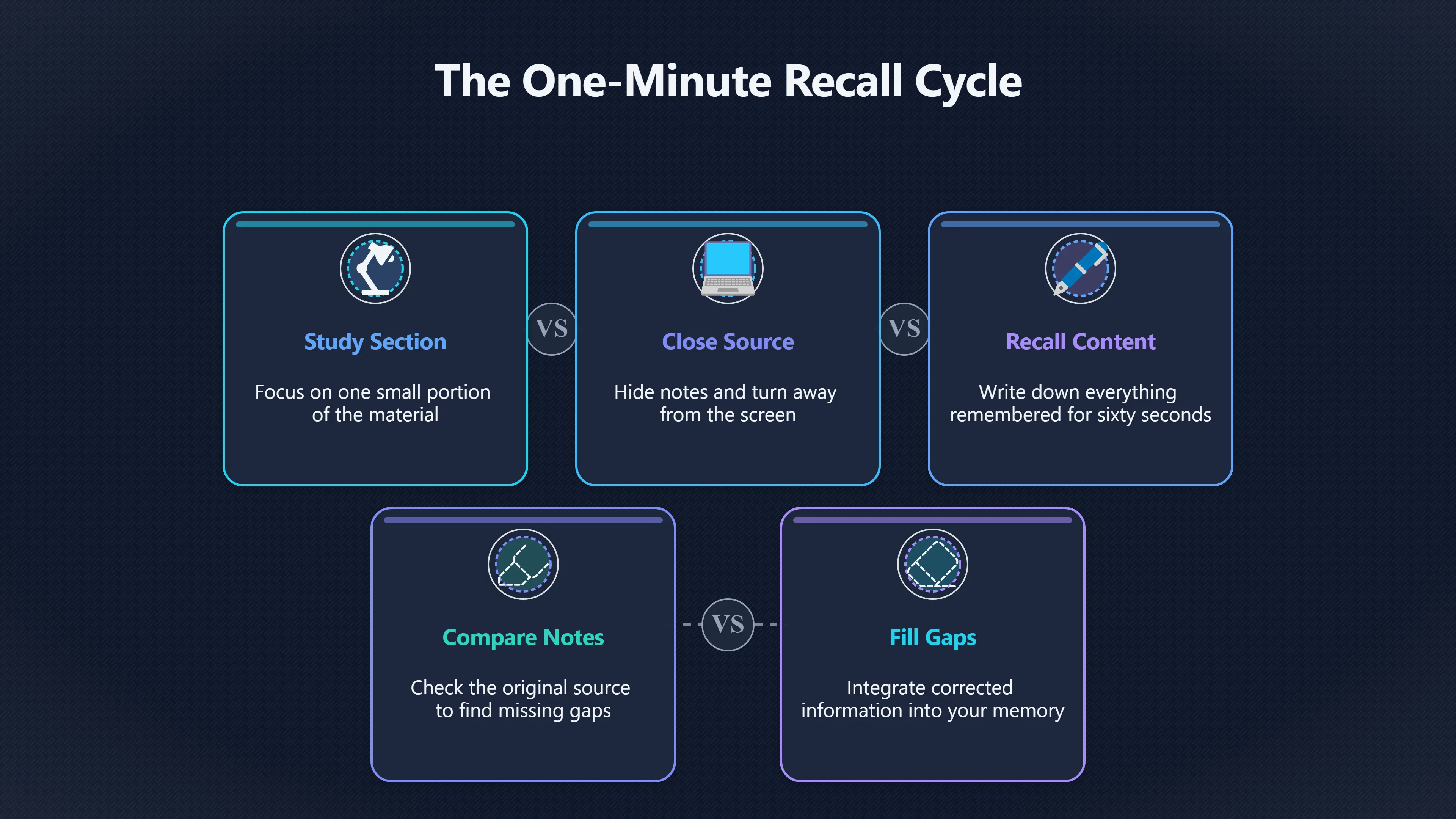
A practical cycle is simple:
- Study one small section.
- Close the source completely.
- Write or explain everything you remember for one minute.
- Compare with the original.
- Fill in the missing ideas.
- Repeat later after a delay.
Keeping the study sections small is important. Short recall cycles provide frequent feedback, making it easier to identify weak understanding before misconceptions accumulate.
Over time, these repeated reality checks improve not only memory but also judgement. You become better at distinguishing “I recognise this” from “I can actually explain and use this,” reducing one of the most common forms of overconfidence in learning. This makes close-the-source recall especially valuable for anyone trying to improve analytical thinking, where reliable reasoning depends on ideas that remain available even after the page has been closed. [PubMed+2education-ni.gov.uk]pubmed.ncbi.nlm.nih.govtaking memory tests improves long-term retentionby HL Roediger · 2006 · Cited by 4886 — Taking a memory test not only assesses what…
eBay marketplace picks
Marketplace Samples
Topic-anchored marketplace searches for visual, collectible, or second-hand items related to this page.



Endnotes
-
Source: researchgate.net
Link: https://www.researchgate.net/publication/5574966_The_Critical_Importance_of_Retrieval_for_LearningSource snippet
ResearchGate(PDF) The Critical Importance of Retrieval for LearningThe results demonstrate the critical role of retrieval practice in con...
-
Source: education-ni.gov.uk
Link: https://www.education-ni.gov.uk/sites/default/files/2025-04/May%20Newsletter%20-%20Retrieval%20Practice%20%20What%20it%20is%2C%20Why%20it%20Works%20and%20How%20to%20Do%20It%20Better.PDFSource snippet
Retrieval Practice:Karpicke and Roediger (2008) noted that students who repeatedly re-read texts may develop an “illusion of competence.”...
-
Source: pubmed.ncbi.nlm.nih.gov
Link: https://pubmed.ncbi.nlm.nih.gov/16507066/Source snippet
taking memory tests improves long-term retentionby HL Roediger · 2006 · Cited by 4886 — Taking a memory test not only assesses what...
Additional References
-
Source: psychnet.wustl.edu
Source snippet
The Power of Testing Memoryby HL Roediger III · Cited by 3306 — As noted, we (Karpicke & Roediger, 2006b) also measured performan...
-
Source: learninglab.psych.purdue.edu
Title: 2007 Karpicke Roediger JEPLMC
Link: https://learninglab.psych.purdue.edu/downloads/2007/2007_Karpicke_Roediger_JEPLMC.pdfSource snippet
Cognition and Learning LabExpanding Retrieval Practice Promotes Short-Term...by JD Karpicke · 2007 · Cited by 585 — For example, Roedige...
-
Source: youtube.com
Link: https://www.youtube.com/watch?v=5sFdf1tgL6ESource snippet
How to do ACTIVE RECALL Effectively? (3 Techniques that worked for me)...
-
Source: youtube.com
Link: https://www.youtube.com/watch?v=G6u9_lbW2hYSource snippet
eval practice (or self-testing), which is a very powerful aid to your...
-
Source: youtube.com
Title: The Most Effective Study Technique That I Use | Active Recall (4.0 GPA)
Link: https://www.youtube.com/watch?v=wHZ__4JUd8gSource snippet
neuroscience cheat code to become THAT STUDENT | trick your brain into learning anything faster...
-
Source: repub.eur.nl
Title: Proefschrift Gv Eersel
Link: https://repub.eur.nl/pub/105295/Proefschrift_GvEersel.pdfSource snippet
Experiment 2) and Roediger and Karpicke (2006b) used a one-week delayed free recall task as final test.Read more...
-
Source: youtube.com
Title: Desirable Difficulties: If Studying Feels Easy, You’re Doing It Wrong
Link: https://www.youtube.com/watch?v=KKk9IA7Su6QSource snippet
The Study Method I Wish I Learned Sooner (Active Recall)...
-
Source: youtube.com
Title: The Study Method I Wish I Learned Sooner (Active Recall)
Link: https://www.youtube.com/watch?v=TRl-SmxWa_ASource snippet
The Most Effective Study Technique That I Use | Active Recall (4.0 GPA)...
-
Source: journalofcognition.org
Link: https://journalofcognition.org/articles/455/files/687f6aa6dcf5d.pdfSource snippet
Exploring the Impact of Feedback and Final Test Timingby Y Mera · 2025 · Cited by 2 — The [pretesting]({{ 'pretesting/' | relative_url }}) effect suggests that attempting and...
Topic Tree