Within Job Offers
Can a Scorecard Clarify the Choice?
A weighted matrix can reveal whether your stated priorities match the offer you feel drawn to accepting.
On this page
- Choosing criteria before scoring the offers
- Setting weights without pretending every factor is equal
- Using the total as a prompt, not a verdict
Page outline Jump by section
Introduction
When two job offers are both attractive, intuition alone often struggles to separate them. A weighted decision matrix, sometimes called a weighted scorecard, provides a structured way to compare offers against the factors that genuinely matter to you rather than allowing the most obvious feature—usually salary—to dominate the decision. Instead of assuming every criterion is equally important, it assigns greater influence to the factors you value most, such as career development, flexibility, manager quality or financial security. This approach reflects the principles of multi-criteria decision analysis (MCDA), a family of methods designed for decisions involving competing objectives.[1000minds]1000minds.comMulti-Criteria Decision Analysis (MCDA/MCDM)MCDA, also known as Multi-Criteria Decision-Making (MCDM), is about making decisions…
 The value of a scorecard is not that it produces a mathematically perfect answer. Its real strength is revealing whether your stated priorities are consistent with the offer you feel drawn towards. If the numbers and your instincts disagree, that is often the beginning of a better conversation with yourself rather than the end of the decision.

Can a Scorecard Clarify the Choice?
A simple pros-and-cons list treats every item as though it has identical importance. A weighted matrix recognises that this is rarely true. For one person, a flexible working arrangement may be worth more than a modest salary increase. For another, a stronger pension or a stable employer may outweigh almost everything else.
By making priorities explicit before comparing offers, the scorecard reduces the influence of common decision traps such as anchoring on salary, recency bias after an impressive interview, or being swayed by a prestigious company name. Decision-matrix frameworks are widely used because they make trade-offs visible rather than leaving them implicit.[ASQ+2Lucid Software]asq.orgWhat is a Decision Matrix? Pugh, Problem, or Selection GridA decision matrix evaluates and prioritizes a list of options and is a deci…
The matrix is particularly valuable when:
- both offers satisfy your minimum requirements;
- each role has meaningful advantages and disadvantages;
- family, financial and career objectives compete with one another;
- emotions fluctuate from day to day depending on recent conversations or negotiations.
Choosing Criteria Before Scoring the Offers
The quality of the matrix depends far more on the criteria than on the arithmetic.
Choose criteria before you begin scoring individual offers. Otherwise it is easy to invent new criteria that conveniently favour the option you already prefer.
A practical scorecard often includes around six to ten criteria, such as:
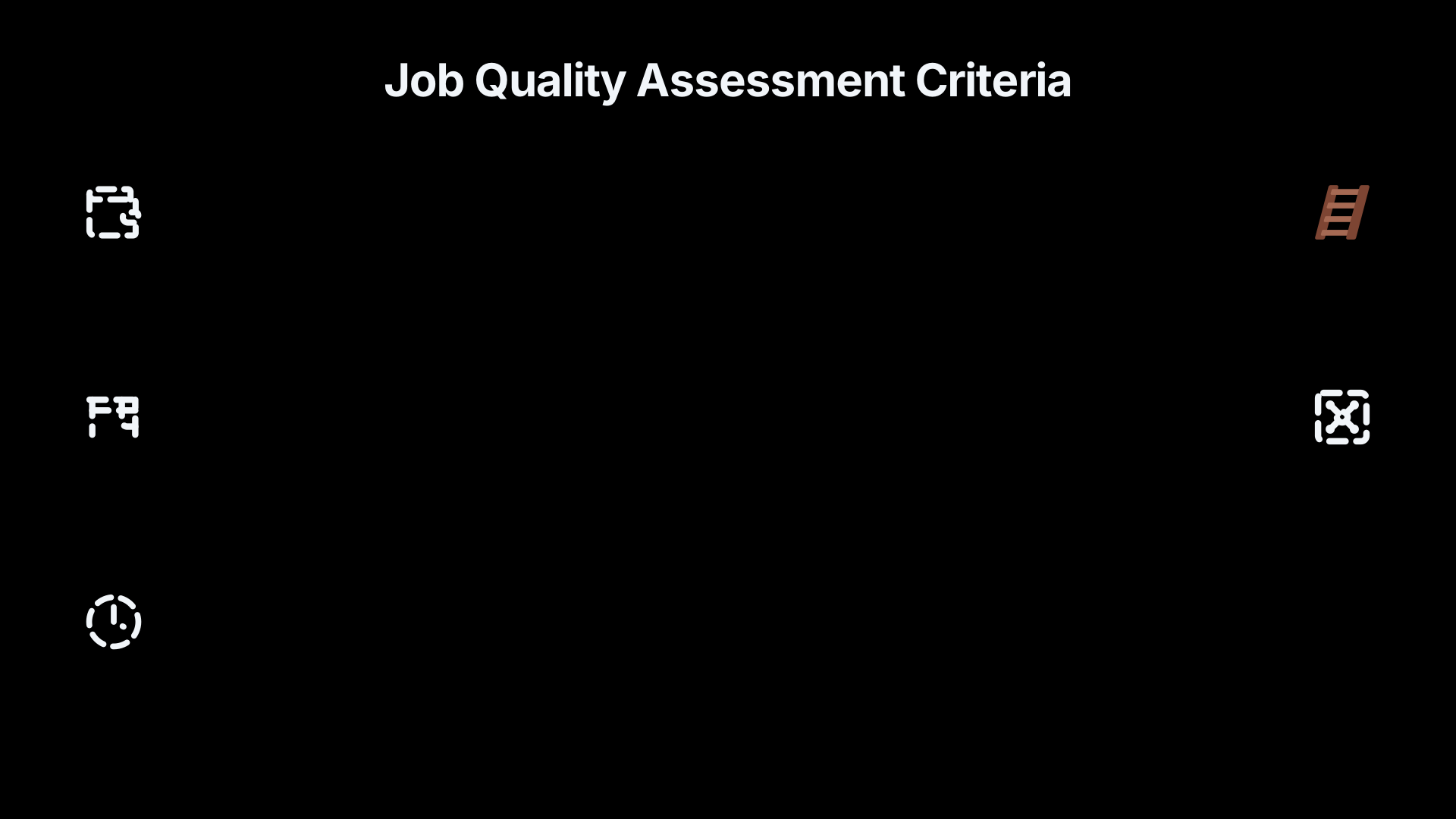
CriterionWhat you are really assessingTotal compensationSalary, bonus, pension and valuable benefits togetherCareer developmentSkills, mentoring, promotion opportunities and future employabilityManager and teamTrust, communication and quality of leadershipFlexibilityRemote working, autonomy, predictable hoursJob securityStability of employer, funding, contract termsNature of the workInterest, challenge and alignment with long-term goalsLifestyle impactCommute, travel, workload and recovery timeOrganisational cultureValues, collaboration and psychological safety
The exact list should reflect your own circumstances. Someone changing careers may legitimately give much greater importance to learning than immediate earnings, while someone supporting a family may reasonably prioritise income stability.
Frameworks for assessing job quality also emphasise looking beyond pay alone. The OECD, for example, evaluates jobs using earnings quality, labour-market security and the working environment rather than salary in isolation.[OECD]oecd.orgJob qualityThe OECD has developed a framework to measure and assess the quality of jobs that considers three objective and measurable…
Setting Weights Without Pretending Every Factor Is Equal
The defining feature of a weighted matrix is that not every criterion counts equally.[safetyculture.com]safetyculture.comdecision matrixHow to Use a Decision Matrix: A Guide28 Apr 2026 — By visually organizing options against weighted criteria, it helps reduce bias and dec…
One straightforward approach is:
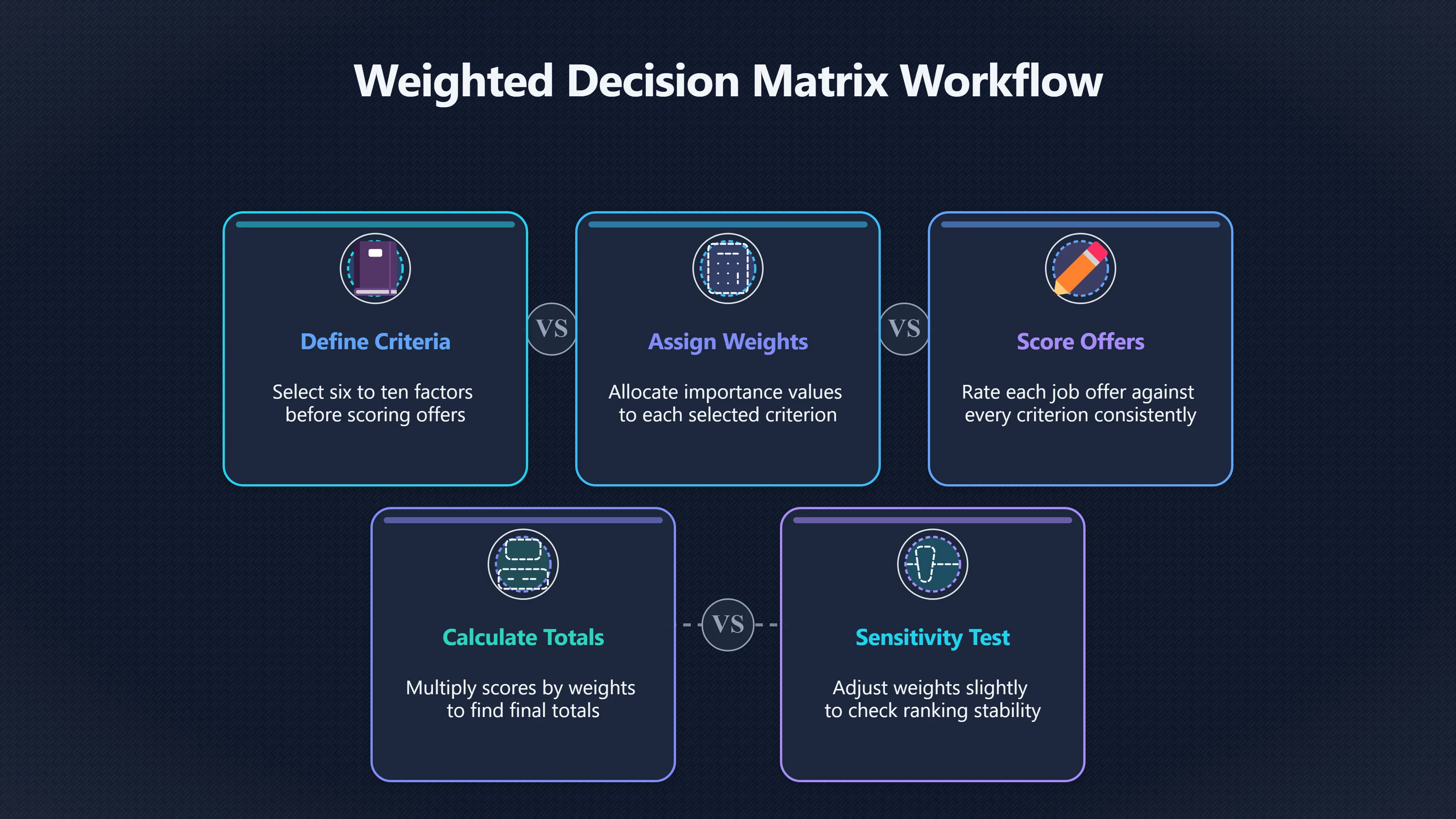
- List every criterion.
- Assign each a weight representing its importance—for example on a scale from 1–10 or as percentages adding to 100.
- Score each offer consistently against every criterion.
- Multiply each score by its weight.
- Add the weighted scores to produce an overall total. Lucid Software
The difficult part is not the multiplication; it is assigning honest weights.
Useful questions include:
- If I could improve only one aspect of either job, which would matter most?
- Which factors would still matter after two years?
- Which criteria are merely desirable, and which would genuinely affect my wellbeing or career trajectory?
- Which compromises would I regret six months after starting?
Avoid distributing weights almost evenly across every category. If every factor receives similar importance, the weighting exercise contributes little beyond a simple checklist.
A practical rule is to reserve the largest weights for only two or three genuinely decisive criteria. This forces prioritisation rather than creating an illusion that everything matters equally.
Scoring Consistently Rather Than Precisely
The numerical scores should reflect consistent judgement, not false precision.
For example, if using a five-point scale:
- 5 = strongly exceeds expectations [* 4 = better than expected](#endnote-17 “
Source snippet
we achieve 'good work' for everyone, or are some jobs...3 Jul 2020 — Mean CIPD Good Work Index scores, by occupational class Work-life b")...
- 3 = acceptable
- 2 = noticeable weaknesses
- 1 = clearly unsatisfactory
Define these meanings before scoring either offer.
Where evidence is uncertain, score conservatively. For instance, an employer’s promise of rapid promotion should not receive the same score as a documented promotion pathway with employees who have actually progressed.
Similarly, distinguish between observable facts and optimistic assumptions:
- Confirmed hybrid working deserves more confidence than “we’re considering changing the policy.”
- Written equity terms deserve more weight than informal promises.
- Conversations with future colleagues often provide stronger evidence than recruitment marketing materials.
Using the Total as a Prompt, Not a Verdict
The highest numerical score should begin reflection, not end it.
Three outcomes are particularly informative.
The winner is clear.
If one offer scores substantially higher and you remain comfortable with the result after reviewing your assumptions, the matrix has probably helped organise your thinking.
The totals are almost identical.
A difference of one or two points usually indicates that the offers are genuinely close. Rather than chasing mathematical certainty, examine which individual criteria created the difference.
Your emotions reject the highest score.
This is often the most valuable outcome. If your preferred offer loses convincingly yet you still want to choose it, ask why.
Perhaps:
- an important criterion was omitted;
- the weights do not reflect your real priorities;
- you have information that was never incorporated into the scoring;
- or your emotional response highlights a value that is difficult to quantify.
The matrix has still succeeded because it exposed the disagreement between your explicit reasoning and your intuition.
Test How Sensitive the Decision Really Is
A useful final check is a simple sensitivity test.
Adjust one or two important weights slightly and see whether the ranking changes.
For example:
- increase career development from 20% to 25%;
- reduce salary importance from 30% to 25%;
- increase flexibility after considering commuting time.
If tiny changes reverse the outcome, your decision is finely balanced and deserves further investigation rather than immediate acceptance.
If one offer remains ahead despite several reasonable adjustments, you can be more confident that the recommendation reflects your priorities rather than arbitrary numbers. Sensitivity testing is a recognised practice in multi-criteria decision analysis because rankings can sometimes depend heavily on how criteria are weighted. 1000minds
Common Mistakes That Reduce the Scorecard’s Value
Several habits weaken an otherwise useful matrix:
- Double-counting. Giving separate criteria to salary, bonus, benefits and “financial package” inflates compensation relative to everything else.
- Scoring unknowns too generously. Optimistic assumptions should not receive the same score as verified information.
- Using too many criteria. Long lists dilute genuine priorities and make weighting inconsistent.
- Confusing importance with performance. Weights measure how much you care; scores measure how well each offer performs.
- Treating the total as objective truth. The matrix supports judgement; it does not replace it.
A Better Conversation With Yourself
A weighted decision matrix is most useful when it improves the quality of your thinking rather than promising certainty. By choosing criteria before comparing offers, assigning honest weights instead of pretending every factor is equal, and treating the final score as a prompt for reflection rather than an automatic verdict, you make your reasoning visible.
That visibility is the real benefit. Whether the score confirms your instinct or challenges it, the process helps ensure that the job you ultimately accept aligns with the priorities you actually hold, not simply the feature that happened to capture your attention first.
eBay marketplace picks
Marketplace Samples
Example marketplace items related to this page. Use the search link to explore similar finds on eBay.




Endnotes
1.
Source: 1000minds.com
Link:https://www.1000minds.com/decision-making/what-is-mcdm-mcda
Source snippet
Multi-Criteria Decision Analysis (MCDA/MCDM)MCDA, also known as Multi-Criteria Decision-Making (MCDM), is about making decisions...
3.
Source: asq.org
Link:https://asq.org/quality-resources/decision-matrix?srsltid=AfmBOorUITGXWMhUvzZOzWJol_3rI17B198eyQXgbchqWwThTva1PmRv
Source snippet
What is a Decision Matrix? Pugh, Problem, or Selection GridA decision matrix evaluates and prioritizes a list of options and is a deci...
4.
Source: oecd.org
Link:https://www.oecd.org/en/topics/policy-issues/job-quality.html
Source snippet
Job qualityThe OECD has developed a framework to measure and assess the quality of jobs that considers three objective and measurable...
5.
Source: oecd.org
Link:https://www.oecd.org/en/publications/2018/12/good-jobs-for-all-in-a-changing-world-of-work_g1g995e1/full-report/component-6.html
Source snippet
Good Jobs for All in a Changing World of WorkThis chapter presents the conceptual and operational framework of the new OECD Jobs Strategy...
6.
Source: oecd.org
Title: job quality health and at work productivity 43ff6bdc en
Link:https://www.oecd.org/en/publications/job-quality-health-and-at-work-productivity_43ff6bdc-en.html
Source snippet
This paper reviews existing evidence on the relationship between the quality of the work...
7.
Source: asq.org
Title: What is a Decision Matrix?
Link:https://asq.org/quality-resources/decision-matrix?srsltid=AfmBOopm-MYt-J1etJl1t93uYulB9RvbIqZS9BS9J0YXVjAl8-saYyCb
Source snippet
Pugh, Problem, or Selection GridA decision matrix evaluates and prioritizes a list of options and is a decision-making tool. The team fir...
8.
Source: dictionary.cambridge.org
Link:https://dictionary.cambridge.org/dictionary/english/weighted
Source snippet
English meaning - Cambridge Dictionary6 days ago — prepared and arranged in a way that is likely to produce a particular effect, usuall...
9.
Source: safetyculture.com
Title: decision matrix
Link:https://safetyculture.com/topics/decision-matrix
Source snippet
How to Use a Decision Matrix: A Guide28 Apr 2026 — By visually organizing options against weighted criteria, it helps reduce bias and dec...
Additional References
10.
Source: meegle.com
Link:https://www.meegle.com/en_us/topics/decision-matrix/decision-matrix-for-career-planning
Source snippet
Decision Matrix For Career PlanningA decision matrix, also known as a prioritization matrix or weighted scoring model, is a decision-maki...
11.
Source: meegle.com
Link:https://www.meegle.com/en_us/topics/decision-matrix/decision-matrix-for-job-applications
Source snippet
Decision Matrix For Job ApplicationsThis article provides a comprehensive guide to using a decision matrix for job applications, offering...
12.
Source: hbr.org
Link:https://hbr.org/2021/05/the-big-decisions-that-impact-your-career
Source snippet
The Big Decisions that Impact Your CareerA career is a marathon not a sprint — and yours will benefit from a good strategy. Here are four...
13.
Source: thedecisionlab.com
Link:https://thedecisionlab.com/reference-guide/psychology/decision-matrix
Source snippet
Decision MatrixA decision matrix is a structured tool used to evaluate and compare multiple options based on weighted criteria, helping i...
14.
Source: cipd.org
Link:https://www.cipd.org/globalassets/media/knowledge/knowledge-hub/reports/understanding-and-measuring-job-quality-2_tcm18-36524.pdf
Source snippet
Understanding and measuring job qualityEuropean Statistics on Accidents at Work, QuInnE has produced an online map of job quality (as wel...
15.
Source: gesd.free.fr
Link:https://gesd.free.fr/mqjobs.pdf
Source snippet
the quality of jobs in OECD countriesThis column presents a new OECD framework to measure and assess the quality of jobs based on three m...
16.
Source: codesignal.com
Link:https://codesignal.com/learn/courses/decision-making-and-path-evaluation-1/lessons/weighted-decision-matrix
17.
Source: community.cipd.co.uk
Link:https://community.cipd.co.uk/cipd-blogs/b/jonny_gifford/posts/can-we-achieve-good-work-for-everyone-or-are-some-jobs-inherently-better-than-others
Source snippet
we achieve 'good work' for everyone, or are some jobs...3 Jul 2020 — Mean CIPD Good Work Index scores, by occupational class Work-life b...
18.
Source: mainthink.ai
Title: decision matrix with weighting and why strategy plan delivers the full program
Link:https://www.mainthink.ai/en/blog/decision-matrix-with-weighting-and-why-strategy-plan-delivers-the-full-program
Source snippet
Decision matrix with weighting2 Jan 2026 — A weighted decision matrix compares several options for action based on defined criteria. The...
19.
Source: youtube.com
Link:https://www.youtube.com/watch?v=j2HtqQjyt5s
Source snippet
Decision Matrix AnalysisDecision Matrix Analysis is a useful tool to use when considering a number of similar-looking options. In this vi...
Topic Tree