Within Mistakes
Why the first number sticks
Anchoring makes rough first estimates, prices or AI outputs pull later judgements even when they should be rebuilt from scratch.
On this page
- Where anchors enter ordinary decisions
- Why adjustment is often not enough
- Private estimates before group discussion
Page outline Jump by section
Introduction
The first number you hear often becomes far more influential than it deserves. Whether it is an opening salary offer, an initial budget estimate, a property asking price, a medical probability or even the first answer generated by an AI system, that number can quietly become the reference point against which later judgements are made. Psychologists call this anchoring: a tendency to begin with an available value and adjust away from it, but usually not by enough. The result is that decisions appear thoughtful while still being pulled towards an arbitrary starting point. Understanding how anchors take hold is a practical thinking skill because the problem is rarely the first number itself; it is failing to notice that it has become the baseline for every later judgement.[PubMed]pubmed.ncbi.nlm.nih.govJudgment under Uncertainty: Heuristics and Biasesby A Tversky · 1974 · Cited by 59019 — This article described three heuristics tha…
Where anchors enter ordinary decisions
Anchors rarely announce themselves. They usually arrive disguised as ordinary information.
In negotiations, the opening offer often shapes what later feels “reasonable”, even if both parties know it is a strategic starting position. In shopping, a product advertised as reduced from £300 to £180 makes £180 feel attractive because attention stays fixed on the original figure rather than the item’s independent value. During project planning, the first time estimate discussed in a meeting often becomes the unofficial schedule, even when everyone admits it was only a rough guess.[PON Harvard Law]pon.harvard.eduPON Harvard LawWhat is the Anchoring Effect?The anchoring effect is a cognitive bias that describes the tendency to rely too heavily on t…
The same mechanism appears in professional settings:
- An initial diagnosis influences later interpretation of symptoms.
- A preliminary budget frames discussions about what is “too expensive”.
- An early sales forecast becomes the benchmark for revisions.
- The first AI-generated estimate or draft can shape later editing, even when users intend to evaluate it critically.
The common feature is that the first number changes the question being asked. Instead of asking, “What is the correct value?”, people unconsciously ask, “How far should I move from this starting point?” That shift is subtle but important because the anchor now defines the search space.[PubMed]pubmed.ncbi.nlm.nih.govJudgment under Uncertainty: Heuristics and Biasesby A Tversky · 1974 · Cited by 59019 — This article described three heuristics tha…
Why adjustment is often not enough
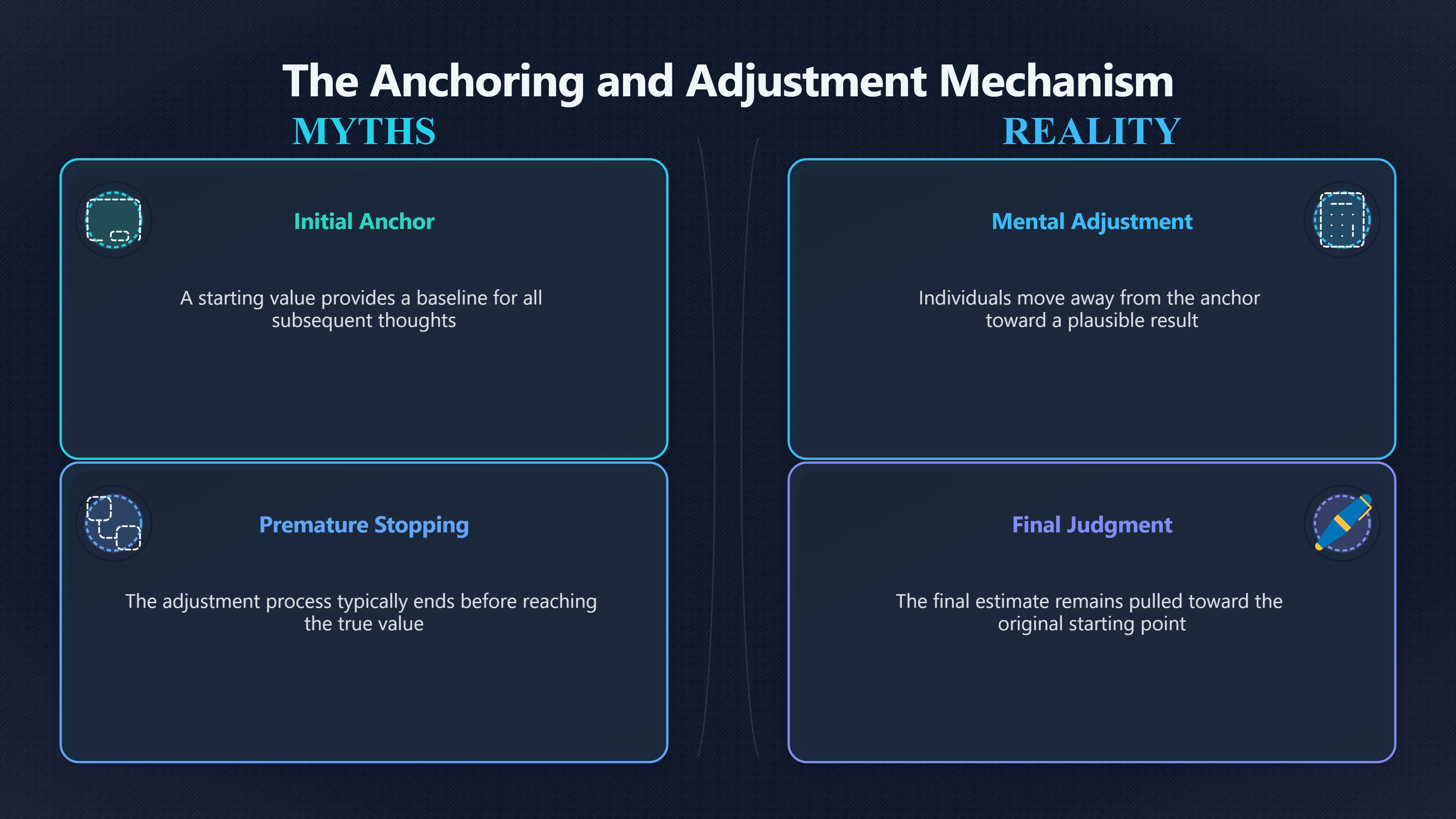
The original explanation proposed by psychologists Amos Tversky and Daniel Kahneman is known as anchoring and adjustment. When estimating an unknown quantity, people begin from an available number and mentally adjust until the answer feels plausible. The difficulty is that the adjustment process typically stops too early.[PubMed]pubmed.ncbi.nlm.nih.govJudgment under Uncertainty: Heuristics and Biasesby A Tversky · 1974 · Cited by 59019 — This article described three heuristics tha…
Classic experiments illustrate this clearly. In one study, participants estimated the percentage of African countries in the United Nations after seeing a roulette wheel stop at either 10 or 65. Although the wheel was rigged and obviously unrelated to the question, people exposed to the higher number produced substantially higher estimates than those exposed to the lower number. Another experiment asked participants to estimate the product of the numbers one to eight after seeing either an ascending or descending sequence. Early exposure to large intermediate values produced much higher final estimates than starting with small values, despite everyone solving the same mathematical problem.[PubMed]pubmed.ncbi.nlm.nih.govJudgment under Uncertainty: Heuristics and Biasesby A Tversky · 1974 · Cited by 59019 — This article described three heuristics tha…
Later research suggests that insufficient adjustment is only part of the story. Another influential explanation, known as selective accessibility, argues that an anchor changes which facts come most easily to mind. A high property price, for example, encourages people to think about premium features, while a low price encourages thoughts about defects. The anchor therefore influences not only the final calculation but also the evidence retrieved during reasoning.[Wikipedia]WikipediaAnchoring effectAnchoring effect
This helps explain why even obviously irrelevant numbers can influence judgement. They do not merely distort arithmetic; they subtly redirect attention.
Why arbitrary numbers can feel meaningful
People often assume they would ignore a completely random number. Research shows otherwise.
An anchor does not have to be accurate to become influential. It only has to be available before judgement begins. Once present, it becomes the easiest reference point for the mind to use under uncertainty. Even recognising that a number is arbitrary does not reliably eliminate its effect.[PubMed]pubmed.ncbi.nlm.nih.govJudgment under Uncertainty: Heuristics and Biasesby A Tversky · 1974 · Cited by 59019 — This article described three heuristics tha…
This is particularly likely when:
- there is no clearly known correct answer;
- the decision must be made quickly;
- information is incomplete;
- several plausible answers exist;
- confidence exceeds available evidence.
These conditions are common in forecasting, hiring, budgeting and strategic planning, making anchoring an everyday risk rather than a laboratory curiosity.
Private estimates before group discussion
Groups often believe they will correct individual bias through discussion, but anchoring can spread socially.
When one person states a numerical estimate first, later discussion frequently revolves around modifying that estimate instead of generating independent alternatives. The first speaker unintentionally establishes the reference point for the whole group. Subsequent estimates become adjustments rather than fresh judgements, and confidence in the emerging consensus can make the original anchor even harder to detect.[Wikipedia]WikipediaAnchoring effectAnchoring effect
A practical safeguard is therefore simple:
- Ask each participant to write down an independent estimate before discussion begins.
- Reveal the estimates simultaneously.
- Discuss reasons before averaging or converging on a final figure.
This process preserves genuinely independent information instead of allowing the first contribution to dominate the conversation.
The same principle applies when consulting AI systems. Recording your own estimate before requesting an AI-generated answer reduces the risk that the model’s first number becomes the unquestioned starting point for your thinking.
Making anchors visible before they shape the decision
Anchoring cannot be eliminated completely, but it can be made easier to detect.
Useful habits include:
- Generate your own estimate first. Produce a private answer before seeing market prices, expert opinions or AI outputs.
- Ask where the number came from. Distinguish measured evidence from negotiation tactics, historical defaults or rough guesses.
- Restart instead of adjusting. If the initial value may be arbitrary, rebuild the estimate from first principles rather than editing the original figure.
- Use multiple independent reference points. Compare historical data, comparable cases and objective benchmarks instead of relying on a single starting value.
- Separate exploration from commitment. Treat early numbers explicitly as placeholders until better evidence becomes available.
These practices do not prevent anchors from appearing, but they reduce the chance that an unnoticed first number quietly defines the entire decision.

The practical lesson
Anchoring is powerful because it changes the structure of reasoning before conscious analysis begins. The first number often becomes the hidden centre around which later thinking revolves, even when everyone believes they are evaluating evidence objectively. Better judgement therefore depends less on resisting persuasive numbers than on recognising when a starting point has silently become the standard of comparison. Creating independent estimates, delaying exposure to others’ numbers and occasionally rebuilding an estimate from scratch are simple routines that weaken the grip of hidden anchors and improve analytical thinking.[PMC+2The Decision Lab]pmc.ncbi.nlm.nih.govby P Teovanović · 2019 · Cited by 61 — According to Tversky and Kahneman (1974), anchoring effect is the product of anchoring and adju…
eBay marketplace picks
Marketplace Samples
Live-tested eBay searches with available results related to this page.

Top pick
critical thinking card game
Open a targeted eBay search for items related to this topic.
Browse eBay
Related search
critical thinking game
Open a targeted eBay search for items related to this topic.
Browse eBay
Related search
AI safety poster
Open a targeted eBay search for items related to this topic.
Browse eBay
Related search
artificial intelligence poster
Open a targeted eBay search for items related to this topic.
Browse eBayEndnotes
1.
Source: pon.harvard.edu
Link:https://www.pon.harvard.edu/tag/the-anchoring-effect/
Source snippet
PON Harvard LawWhat is the Anchoring Effect?The anchoring effect is a cognitive bias that describes the tendency to rely too heavily on t...
2.
Source: pmc.ncbi.nlm.nih.gov
Link:https://pmc.ncbi.nlm.nih.gov/articles/PMC6396698/
Source snippet
by P Teovanović · 2019 · Cited by 61 — According to Tversky and Kahneman (1974), anchoring effect is the product of anchoring and adju...
3.
Source: Wikipedia
Title: Anchoring effect
Link:https://en.wikipedia.org/wiki/Anchoring_effect
4.
Source: pubmed.ncbi.nlm.nih.gov
Link:https://pubmed.ncbi.nlm.nih.gov/17835457/
Source snippet
Judgment under Uncertainty: Heuristics and Biasesby A Tversky · 1974 · Cited by 59019 — This article described three heuristics tha...
5.
Source: thedecisionlab.com
Title: The Decision Lab Anchoring Bias
Link:https://thedecisionlab.com/biases/anchoring-bias
Source snippet
Anchoring Bias - The Decision LabThe anchoring bias is a cognitive bias that causes us to rely heavily on the first piece of information...
6.
Source: pmc.ncbi.nlm.nih.gov
Link:https://pmc.ncbi.nlm.nih.gov/articles/PMC6331480/
Source snippet
nih.govAnchoring-and-Adjustment During Affect Inferences - PMC - NIHby M Yik · 2019 · Cited by 23 — We showed that in a between-subject d...
Additional References
7.
Source: researchgate.net
Link:https://www.researchgate.net/publication/377180199_Anchoring_and_Adjustment_Bias_and_Its_Applications
8.
Source: chsasank.com
Link:https://chsasank.com/classic_papers/judgement-uncertainty.html
Source snippet
Judgment under Uncertainty: Heuristics and Biasesby A Tversky · Cited by 59019 — Because of anchoring, people will tend to underestimate...
9.
Source: simplypsychology.org
Link:https://www.simplypsychology.org/what-is-the-anchoring-bias.html
Source snippet
an experiment where they asked participants to make estimations of an amount, such...Read more...
10.
Source: scribd.com
Link:https://www.scribd.com/document/938855232/Tversky-and-Kahneman-Math-Problem
Source snippet
lacking the time, willpower, or resources to thoroughly analyze information.Read more...
11.
Source: themantic-education.com
Title: key study ghandi and the anchoring effect
Link:https://www.themantic-education.com/ibpsych/2020/03/10/key-study-ghandi-and-the-anchoring-effect/
Source snippet
Key Study: Gandhi and the Anchoring Effect10 Mar 2020 — This study demonstrates the anchoring effect – numerical information given to par...
12.
Source: revisiondojo.com
Title: Notes for 2.2.1 Anchoring Bias
Link:https://www.revisiondojo.com/ib/ib-psychology-new/ib-psychology-new-23-genetics-and-behaviour/notes
Source snippet
IBTversky & Kahneman (1974). Aim: To investigate how anchoring bias affects numerical estimates. Method: Participants spun a wheel rigged...
13.
Source: researchgate.net
Link:https://www.researchgate.net/publication/315710809_The_anchoring_bias_reflects_rational_use_of_cognitive_resources
Source snippet
(PDF) The anchoring bias reflects rational use of cognitive...Cognitive biases, such as the anchoring bias, pose a serious challenge to...
14.
Source: redbearnegotiation.com
Title: What Is Anchoring Bias?
Link:https://www.redbearnegotiation.com/blog/what-is-anchoring-bias
Source snippet
Negotiation's Most Misunderstood...8 Jul 2025 — Anchoring bias refers to our tendency to rely too heavily on the first piece of informat...
15.
Source: youtube.com
Title: Anchoring Bias Explained | Psychology
Link:https://www.youtube.com/watch?v=jVjHdBvX3Nc
Source snippet
Anchoring with Daniel Kahneman features the leading psychologist discussing how cognitive biases like anchoring skew human judgment and d...
16.
Source: youtube.com
Title: Anchoring, with Daniel Kahneman (author of Thinking, Fast and Slow)
Link:https://www.youtube.com/watch?v=HefjkqKCVpo
Source snippet
The Anchoring Bias: Why The First Offer Matters...
Topic Tree