Within Probabilities
Map the Branches Before Choosing
Decision trees turn uncertain choices into visible branches of probabilities, outcomes, and possible costs.
On this page
- When a decision tree is useful
- How to assign probabilities and outcomes
- Where hidden assumptions enter the tree
Page outline Jump by section
Introduction
Decision trees are a practical way to compare choices when the future is uncertain. Instead of asking which option looks best today, they map each decision into a series of possible events, attach probabilities and consequences to each branch, and make the assumptions behind a choice visible. This helps distinguish a decision that is well reasoned from one that merely turns out well by luck.
 Decision trees are especially valuable when choices unfold over time, involve several uncertain events, or require weighing costs against potential gains. They are widely used in business strategy, engineering, healthcare, public policy and finance because they make complex decisions easier to analyse, communicate and revise as new information becomes available.[PMC]pmc.ncbi.nlm.nih.govPMCDecision Analysis and Cost-effectiveness AnalysisNIHby HF Ryder · 2009 · Cited by 100 — The goal of decision analysis is to facilitate sound decisions in complex and uncertain situ…
When a decision tree is useful
A decision tree is most useful when a decision involves distinct alternatives followed by uncertain events rather than a single predictable outcome.
Typical situations include:
- Choosing between competing projects with uncertain returns.
- Deciding whether to buy insurance or self-insure against losses.
- Comparing career opportunities with different levels of salary, promotion prospects and job security.
- Planning phased investments where later decisions depend on early results.
- Deciding whether to gather more evidence before committing to an expensive action.
Unlike a simple pros-and-cons list, a decision tree captures the order in which decisions occur. It distinguishes between decisions under your control and chance events that are outside your control. This sequencing is important because many real-world decisions allow you to learn something before making the next commitment. Decision analysis refers to this as sequential decision-making.[Independent Management Consultants]umbrex.comIndependent Management ConsultantsDecision Tree Analysis ExplainedDecision Tree Analysis evaluates choices, probabilities, and payoffs to…
A typical decision tree contains three main elements:[asana.com]asana.comdecision tree analysisDecision Tree Analysis: 5 Steps with Expected Value [2025]30 Nov 2025 — Decision tree analysis helps you map decisions, probabilitie…
- Decision nodes, representing choices you control.
- Chance nodes, representing uncertain events with assigned probabilities.
- Outcome (terminal) nodes, representing the final costs, benefits or utilities associated with each path.[Asana]asana.comdecision tree analysisDecision Tree Analysis: 5 Steps with Expected Value [2025]30 Nov 2025 — Decision tree analysis helps you map decisions, probabilitie…
How to assign probabilities and outcomes
The quality of a decision tree depends less on drawing the branches than on estimating the numbers attached to them.
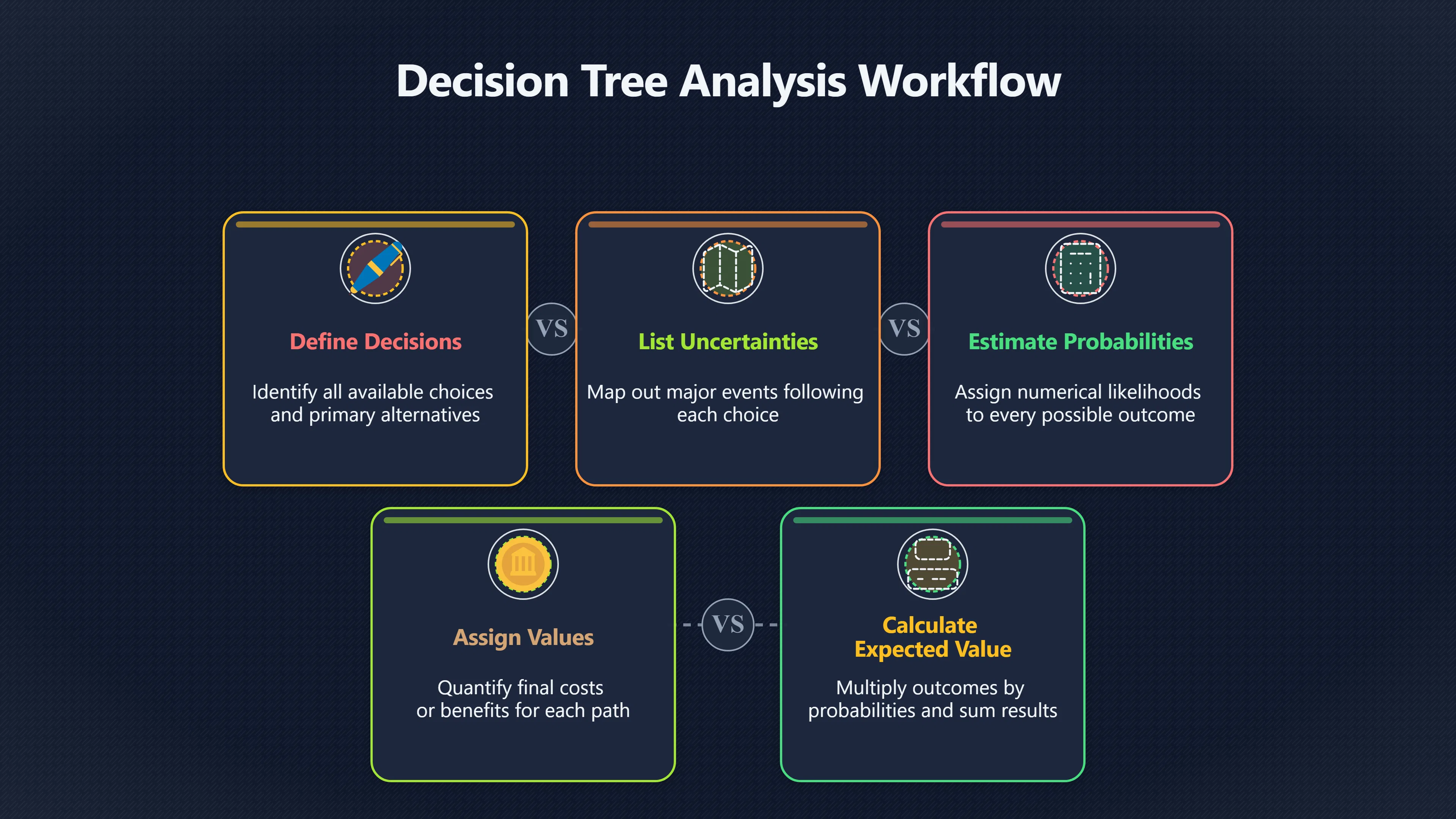
A practical workflow is:
- Define the available decisions.
- List the major uncertain events following each decision.
- Estimate the probability of each event.
- Assign a value to every final outcome.
- Calculate the expected value for each branch by multiplying outcomes by their probabilities and summing the results.
For example, imagine deciding whether to launch a new product.
- Launch immediately. 40% chance of earning £500,000. 60% chance of losing £100,000.
- Run a pilot first. Pilot costs £40,000. Successful pilot increases confidence before committing to full launch. Failed pilot allows the company to abandon the project early.
Although the pilot adds an immediate cost, it may improve the overall expected outcome by preventing expensive failures. This illustrates why decision trees are particularly valuable for staged decisions rather than one-off choices.[Independent Management Consultants]umbrex.comIndependent Management ConsultantsDecision Tree Analysis ExplainedDecision Tree Analysis evaluates choices, probabilities, and payoffs to…
Estimating probabilities realistically
Many people instinctively rely on intuition when assigning probabilities. Better estimates usually combine several sources:
- Historical data from similar situations.
- Base rates from comparable projects or industries.
- Expert judgement when data are limited.
- Updated evidence as new information becomes available.
Probabilities should represent uncertainty honestly rather than confidence or optimism. If several possible outcomes are mutually exclusive, their probabilities should add up to 100%.[interactivetextbooks.tudelft.nl]interactivetextbooks.tudelft.nlThe expected value of the return of the actions is as follows: Buying shares: 0.2(-2 %) + 0.3…Read more…
Measuring outcomes
Money is often used because it is easy to compare, but many important decisions involve additional considerations, including:
- Time.
- Personal satisfaction.
- Reputation.
- Safety.
- Environmental or social effects.
Decision analysis often uses the broader idea of utility, which represents the overall value of an outcome rather than financial return alone. This allows decision-makers to reflect differing attitudes towards risk instead of assuming that everyone values gains and losses equally.[PMC]pmc.ncbi.nlm.nih.govPMCDecision Analysis and Cost-effectiveness AnalysisNIHby HF Ryder · 2009 · Cited by 100 — The goal of decision analysis is to facilitate sound decisions in complex and uncertain situ…
Where hidden assumptions enter the tree
Decision trees appear objective, but every tree reflects assumptions that deserve scrutiny. Making those assumptions explicit is one of the tool’s greatest strengths.
Common hidden assumptions include:
- Probability estimates. Small changes can alter which branch appears preferable.
- Outcome values. Different stakeholders may value the same outcome differently.
- Missing branches. Rare but high-impact events are sometimes omitted because they are inconvenient or difficult to estimate.
- Independence. Trees often assume uncertain events occur independently when they may actually influence one another.
- Future behaviour. A tree may assume that decision-makers will follow the planned strategy even after new information emerges.
For example, a company might build a decision tree assuming it will abandon a product if market testing fails. If managers ignore that rule because they have become emotionally committed to the project, the expected value calculated from the tree no longer reflects what will actually happen.[people.stern.nyu.edu]people.stern.nyu.eduSCENARIO ANALYSIS, DECISION TREES AND…The expected value of a decision tree is heavily dependent upon the assumption that we will stay…
Sensitivity analysis helps expose these assumptions by asking questions such as:
- What if success is only half as likely?
- What if costs rise by 20%?
- What probability would make the preferred decision change?
Rather than producing one “correct” answer, this reveals which assumptions genuinely matter and which have little effect on the final recommendation.
A career decision example
Suppose someone must choose between remaining in a secure role or joining a start-up.
The secure role offers stable income with limited upside. The start-up offers several possible futures: rapid growth, moderate success or failure. A decision tree allows each of these possibilities to be represented explicitly rather than discussed vaguely.
The analysis may reveal that the start-up has a higher expected financial return but also much greater variability. Once non-financial factors—such as work-life balance, learning opportunities or family commitments—are included, the preferred option may change. The tree therefore supports discussion rather than replacing judgement.
This illustrates an important point: decision trees do not decide for you. They organise evidence so that trade-offs become easier to evaluate.
Strengths and limitations
Decision trees offer several practical advantages.
They make reasoning transparent, encourage explicit probability estimates, support communication among groups and can incorporate sequential decisions where later choices depend on earlier results. They are also relatively easy to revise when new information becomes available.[Independent Management Consultants]umbrex.comIndependent Management ConsultantsDecision Tree Analysis ExplainedDecision Tree Analysis evaluates choices, probabilities, and payoffs to…
Their limitations are equally important.
Large problems can produce extremely complex trees with hundreds of branches. Probabilities may be difficult to estimate accurately. Expected values can obscure the possibility of rare but catastrophic outcomes. Finally, a mathematically optimal choice may still be inappropriate if it conflicts with legal, ethical or strategic constraints.[people.stern.nyu.edu]people.stern.nyu.eduSCENARIO ANALYSIS, DECISION TREES AND…The expected value of a decision tree is heavily dependent upon the assumption that we will stay…

Practical habits for better decision trees
Decision trees are most effective when treated as thinking tools rather than prediction machines.
Useful habits include:
- Start with a clear decision question before drawing branches.
- Separate controllable decisions from uncontrollable events.
- Base probability estimates on evidence whenever possible.
- Include realistic costs, including time and opportunity costs.
- Test how sensitive the recommendation is to uncertain assumptions.
- Update the tree when meaningful new evidence becomes available.
- Record the assumptions behind each probability so they can be challenged later.
By making uncertainty visible rather than implicit, decision trees encourage more disciplined reasoning. They cannot eliminate risk, but they help ensure that important choices are judged on the quality of the reasoning available at the time rather than on whether events later happened to turn out favourably.
eBay marketplace picks
Marketplace Samples
Live-tested eBay searches with available results related to this page.


Endnotes
1.
Source: pmc.ncbi.nlm.nih.gov
Title: PMCDecision Analysis and Cost-effectiveness Analysis
Link:https://pmc.ncbi.nlm.nih.gov/articles/PMC3746772/
Source snippet
NIHby HF Ryder · 2009 · Cited by 100 — The goal of decision analysis is to facilitate sound decisions in complex and uncertain situ...
2.
Source: interactivetextbooks.tudelft.nl
Link:https://interactivetextbooks.tudelft.nl/risk-reliability/risk-evaluation/decision.html
Source snippet
The expected value of the return of the actions is as follows: Buying shares: 0.2(-2 %) + 0.3...Read more...
3.
Source: asana.com
Title: decision tree analysis
Link:https://asana.com/resources/decision-tree-analysis
Source snippet
Decision Tree Analysis: 5 Steps with Expected Value [2025]30 Nov 2025 — Decision tree analysis helps you map decisions, probabilitie...
4.
Source: people.stern.nyu.edu
Link:https://people.stern.nyu.edu/adamodar/pdfiles/valrisk/ch6.pdf
Source snippet
SCENARIO ANALYSIS, DECISION TREES AND...The expected value of a decision tree is heavily dependent upon the assumption that we will stay...
5.
Source: youtube.com
Title: Decision Tree Analysis for Investment Decisions- Part 1
Link:https://www.youtube.com/watch?v=hRvCj6ViVtc
Source snippet
Decision Tree Analysis | Operation or No Operation?...
6.
Source: youtube.com
Title: Decision Tree Analysis | Operation or No Operation?
Link:https://www.youtube.com/watch?v=8UefHD6tnrU
Source snippet
Decision Tree Analysis with Example and Expected Value - Easy & Fun Calculation...
7.
Source: umbrex.com
Link:https://umbrex.com/resources/frameworks/strategy-frameworks/decision-tree-analysis/
Source snippet
Independent Management ConsultantsDecision Tree Analysis ExplainedDecision Tree Analysis evaluates choices, probabilities, and payoffs to...
8.
Source: Wikipedia
Title: Decision analysis
Link:https://en.wikipedia.org/wiki/Decision_analysis
Additional References
9.
Source: investopedia.com
Link:https://www.investopedia.com/articles/financial-theory/11/decisions-trees-finance.asp
Source snippet
The expected value is the weighted average of possible outcomes, factoring in their probabilities. It helps...Read more...
10.
Source: pzs.dstu.dp.ua
Link:https://pzs.dstu.dp.ua/DataMining/tree/bibl/Decision-Analysis-for-the-Professional.pdf
Source snippet
It could also be part of an analytical methods course. The general philosophy...Read more...
11.
Source: youtube.com
Title: Decision Tree Analysis with Example and Expected Value
Link:https://www.youtube.com/watch?v=GDz_MuquByE
Source snippet
Using Decision Trees to Maximize Expected Value...
12.
Source: youtube.com
Title: Decision Tree and Expected Monetary Value for the PMP Exam
Link:https://www.youtube.com/watch?v=uC2XBGpIcAs
Topic Tree