Within Active Learning
Can the Idea Survive a New Example?
Applying a concept to a new case tests whether understanding survives beyond the example that first taught it.
On this page
- Why familiar examples can hide shallow learning
- How to choose a fresh case
- Checking whether transfer really happened
Page outline Jump by section
Introduction
The strongest sign that you truly understand an idea is not that you can recognise it in the example that taught it, but that you can use it successfully in a different situation. This ability, known as transfer, is central to improving analytical thinking. Active learning becomes far more valuable when it asks you to apply a concept to a fresh case rather than simply repeat a familiar one. Research on retrieval practice, analogical reasoning and learning transfer consistently shows that changing the context forces learners to rely on underlying principles instead of surface features, making knowledge more flexible and more likely to be used in real decisions.[PMC+2pdf.retrievalpractice.org]pmc.ncbi.nlm.nih.govFar transfer of retrieval-practice benefits: rule-based learning…by B Opitz · 2024 · Cited by 4 — Benefits of self-testing for lear…
 Within an active learning routine, introducing fresh examples is therefore not an optional extra. It is the test that reveals whether your reasoning has become portable.
Why familiar examples can hide shallow learning
A learner who repeatedly studies the same example often becomes highly fluent at recalling its details. That fluency can create the illusion of understanding even when the underlying reasoning has not been generalised.
Imagine learning confirmation bias by reading only about investment decisions. After several reviews, you may easily identify confirmation bias in stock-market examples. But if you fail to notice the same pattern in medical choices, hiring decisions or online debates, the concept has remained tied to one setting instead of becoming a general reasoning tool.
This distinction mirrors the difference between near transfer and far transfer:
- Near transfer means applying an idea to a very similar situation.
- Far transfer means recognising the same underlying principle despite substantial changes in context, subject or appearance.[TeacherToolkit]teachertoolkit.co.ukThe science of effective learning with spacing and retrieval…by SK Carpenter · Cited by 289 — Simple transfer is sometim…
Far transfer is more difficult because people naturally focus on obvious surface similarities. Effective analytical thinkers instead search for deeper structural relationships.
How to choose a fresh case
The goal is not simply to make examples different. The new example should preserve the same reasoning structure while changing the surrounding details.
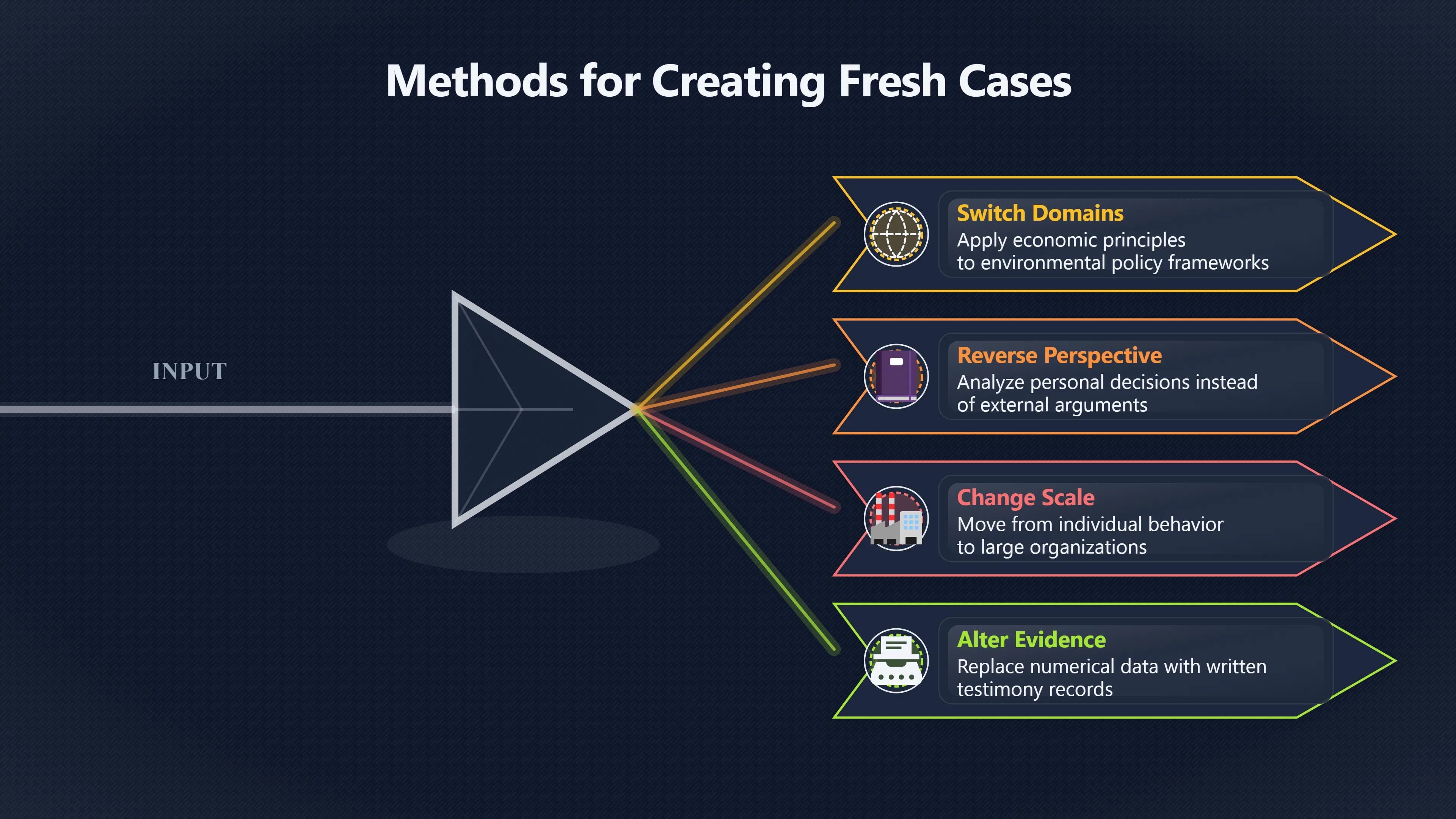
Useful ways to create fresh examples include:
- Switch domains. Apply an economic principle to environmental policy, or a scientific reasoning method to evaluating news reports.
- Reverse the perspective. Instead of identifying flaws in someone else’s argument, analyse one of your own previous decisions.
- Change the scale. Move from individual behaviour to organisations, or from international events to everyday situations.
- Alter the evidence. Replace numerical data with written testimony, diagrams or competing explanations while asking the same analytical question.
For example:
Original learning exampleFresh transfer exampleIdentify survivorship bias in successful start-up stories.Look for survivorship bias when judging exercise programmes promoted by successful athletes.Evaluate correlation versus causation in health research.Evaluate correlation versus causation in crime statistics reported in the media.Estimate opportunity cost when choosing investments.Estimate opportunity cost when deciding how to spend limited study time before an exam.
In every case, the principle stays constant while the context changes.
Why analogy helps transfer
One of the most effective ways to promote transfer is through analogical reasoning—finding the same relational structure beneath different situations.
Rather than asking, “Have I seen this example before?”, analogical reasoning asks, “What pattern is shared between these apparently different problems?”
For instance:
- Negotiating a business contract and dividing household responsibilities both involve balancing competing interests rather than maximising one side’s gain.
- Debugging computer code and diagnosing a mechanical fault both require generating competing hypotheses and eliminating them with evidence.
- Evaluating a historical source and assessing a viral social-media claim both involve judging reliability, bias and supporting evidence.
Research shows that comparing multiple examples encourages learners to extract the underlying schema—the abstract structure that can later be applied elsewhere—instead of memorising isolated cases. Self-explanation further strengthens this process because learners actively describe why the situations are equivalent rather than merely noticing that they look similar.[DigitalCommons+2PMC]digitalcommons.sacredheart.eduAnalogical Reasoning: A Process for Fostering Learning…by TE Speicher · 2009 · Cited by 18 — This study showed the value…

Fresh examples that strengthen analytical thinking
Many reasoning skills can be deliberately transferred across unrelated contexts.
Evaluating evidence
Instead of analysing only scientific studies:
- compare eyewitness testimony,
- company earnings reports,
- historical documents,
- opinion polls.
The core questions remain:
- What is the evidence?
- How reliable is it?
- What alternative explanations exist?
Recognising cognitive biases
Instead of studying confirmation bias only in politics:
- examine product reviews,
- sporting decisions,
- workplace disagreements,
- personal financial choices.
Bias becomes easier to recognise because it is detached from one emotionally familiar setting.
Building causal explanations
Rather than repeatedly explaining why one business succeeded, explain:
- why a city reduced traffic congestion,
- why an ecological system changed,
- why a software project failed,
- why an educational intervention worked.
Different facts, same reasoning process.
Checking whether transfer really happened
Using a fresh example is only valuable if it genuinely requires new reasoning rather than simple pattern matching.
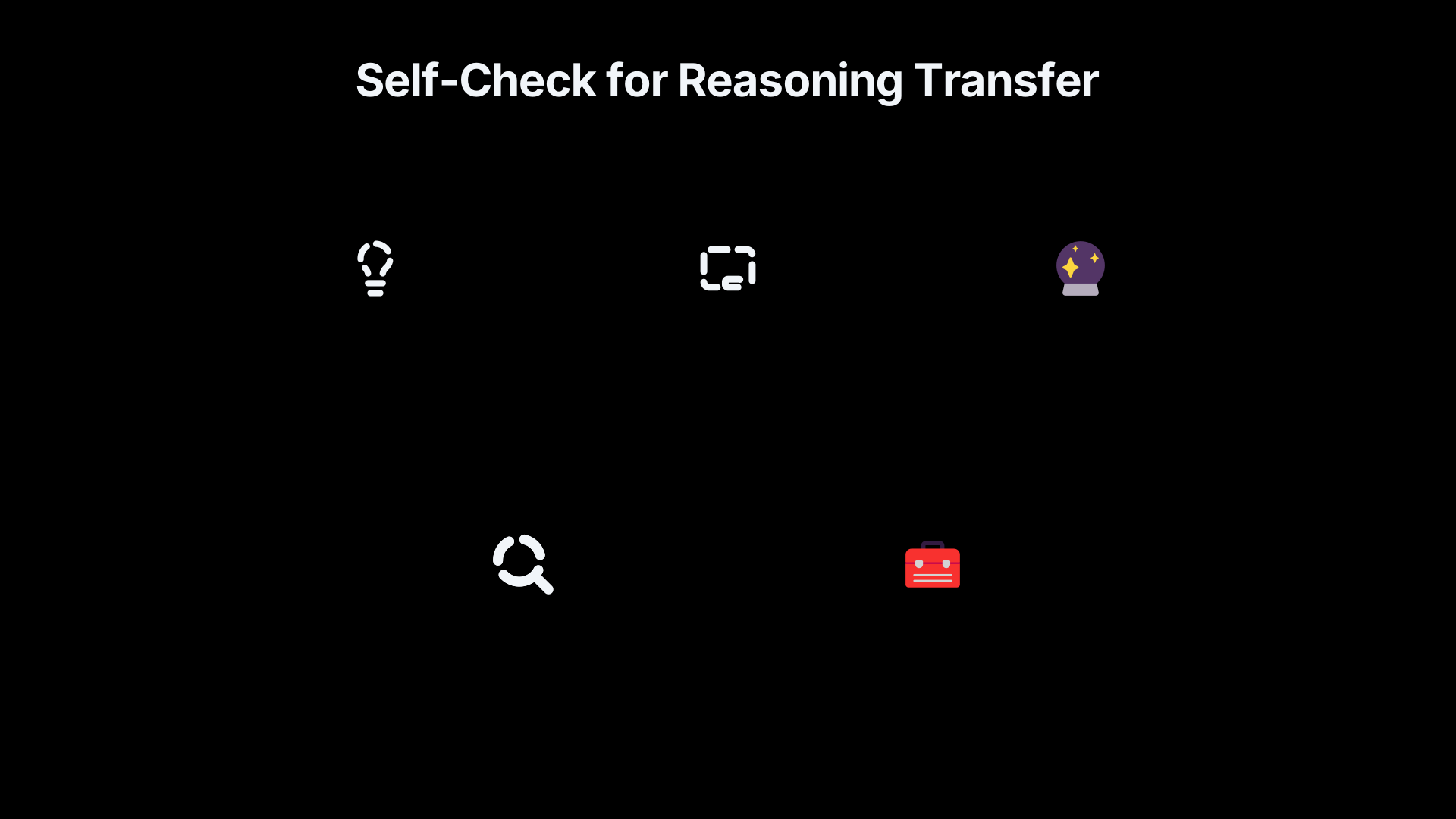
A practical self-check includes three questions:
- Could I identify the relevant principle without being told?
- Can I explain why this new case shares the same structure as the original one?
- Can I predict what should happen before checking the answer?
If you need to see the original worked example before solving the new case, transfer has probably not yet occurred.
Retrieval practice can also be adapted specifically for transfer. Instead of recalling isolated facts, retrieve broad principles and deliberately apply them to unfamiliar scenarios. Reviews of retrieval-practice research indicate that such approaches improve not only retention but also the ability to apply knowledge beyond the original learning context, although transfer tends to be stronger when practice requires explanation and flexible use rather than simple recall.[pdf.retrievalpractice.org+2PMC]pdf.retrievalpractice.orgTransfer GuideRETRIEVAL PRACTICE AND TRANSFER OF LEARNING:2020 · Cited by 20 — Based on rigorous scientific research, here we share three retrieval pra…
Common mistakes when creating new examples
Changing examples is not enough if the learner can still rely on superficial similarities.
Frequent pitfalls include:
- changing only names while leaving every other feature identical;
- practising only within one subject area;
- selecting examples whose solutions are already memorised;
- focusing on facts instead of identifying the governing principle;
- assuming that successful recall automatically means successful transfer.
Research on learning transfer suggests that far transfer rarely emerges automatically. Learners benefit when instructors or self-directed learners explicitly compare multiple cases, highlight common relationships and encourage explanation of why one principle applies across different situations.[TeacherToolkit+2DigitalCommons]teachertoolkit.co.ukThe science of effective learning with spacing and retrieval…by SK Carpenter · Cited by 289 — Simple transfer is sometim…
Making transfer a regular habit
A simple way to build transfer into active learning is to finish every study session with one unfamiliar application question.
Instead of asking, “Can I remember today’s example?”, ask:
- Where else would this reasoning apply?
- What completely different field follows the same logic?
- What would this idea predict in a case I have never studied before?
- Which details changed, and which principle stayed the same?
Over time, this habit shifts attention away from memorising examples and towards recognising structures. That shift is one of the defining characteristics of stronger analytical thinking: ideas become tools that survive changing circumstances rather than facts tied to the page on which they were first learned.
Amazon book picks
Further Reading
Books and field guides related to Can the Idea Survive a New Example?. Use these as the next step if you want deeper reading beyond the article.
Make It Stick
Directly explains retrieval practice, transfer, and applying knowledge across new situations.
How We Learn
Covers learning transfer, varied practice, and why changing contexts improves understanding.
Thinking, Fast and Slow
Provides foundational insights into cognitive biases and analytical thinking that benefit transfer of reasoning.
Range
The #1 New York Times bestseller that has all America talking: as seen/heard on CNN's Fareed Zakaria GPS, Morning Joe, CBS This Morning,...
eBay marketplace picks
Marketplace Samples
Example marketplace items related to this page. Use the search link to explore similar finds on eBay.

Endnotes
1.
Source: pmc.ncbi.nlm.nih.gov
Link:https://pmc.ncbi.nlm.nih.gov/articles/PMC11461721/
Source snippet
Far transfer of retrieval-practice benefits: rule-based learning...by B Opitz · 2024 · Cited by 4 — Benefits of self-testing for lear...
2.
Source: pdf.retrievalpractice.org
Title: Transfer Guide
Link:https://pdf.retrievalpractice.org/TransferGuide.pdf
Source snippet
RETRIEVAL PRACTICE AND TRANSFER OF LEARNING:2020 · Cited by 20 — Based on rigorous scientific research, here we share three retrieval pra...
3.
Source: pmc.ncbi.nlm.nih.gov
Title: PMCTeaching Postsecondary Students to Use Analogies as
Link:https://pmc.ncbi.nlm.nih.gov/articles/PMC10074267/
Source snippet
by JC Tise · 2023 · Cited by 17 — Although all types of relational reasoning are important, analogical reasoning is commonly employed...
4.
Source: teachertoolkit.co.uk
Link:https://www.teachertoolkit.co.uk/wp-content/uploads/2022/10/s44159-022-00089-1.pdf
Source snippet
The science of effective learning with spacing and retrieval...by SK Carpenter · Cited by 289 — Simple transfer is sometim...
5.
Source: digitalcommons.sacredheart.edu
Link:https://digitalcommons.sacredheart.edu/cgi/viewcontent.cgi?article=1061&context=pthms_fac
Source snippet
Analogical Reasoning: A Process for Fostering Learning...by TE Speicher · 2009 · Cited by 18 — This study showed the value...
6.
Source: pmc.ncbi.nlm.nih.gov
Link:https://pmc.ncbi.nlm.nih.gov/articles/PMC11720587/
Source snippet
Across Episodes of Analogical Reasoning - PMC - NIHby JA Navarrete-Ulloa · 2025 · Cited by 3 — Across three experiments, we obtained evid...
7.
Source: study.com
Link:https://study.com/academy/lesson/reasoning-by-analogy-definition-examples.html
Source snippet
Analogical Reasoning | Definition, Function & ExamplesUsing a comparison between something new and something known is analogical reasonin...
Additional References
8.
Source: ies.ed.gov
Title: multidisciplinary study analogical transfer childrens mathematical learning
Link:https://ies.ed.gov/use-work/awards/multidisciplinary-study-analogical-transfer-childrens-mathematical-learning
Source snippet
Multidisciplinary Study of Analogical Transfer in Children's...In this project, the researchers explored ways to improve children's lear...
9.
Source: teachthought.com
Link:https://www.teachthought.com/critical-thinking-posts/examples-of-analogies/
Source snippet
50 Examples Of Analogies For Critical ThinkingBelow, we offer more than 20 different types of analogies and examples of type of analogy a...
10.
Source: merriam-webster.com
Link:https://www.merriam-webster.com/dictionary/analogical
Source snippet
ANALOGICAL Definition & Meaning1. of, relating to, or based on analogy 2. expressing or implying analogy analogically ˌa-nə-ˈlä-ji-k(ə-)l...
11.
Source: dartmouthalumnimagazine.com
Link:https://dartmouthalumnimagazine.com/articles/compare-and-contrast
Source snippet
Compare and ContrastAnalogies help to sharpen the distinction between different ideas or things. They provide a compare-and-contrast appr...
12.
Source: cse.engin.umich.edu
Link:https://cse.engin.umich.edu/stories/researchers-investigate-language-models-capacity-for-analogical-reasoning-in-groundbreaking-study
Source snippet
investigate language models' capacity for...Jul 10, 2023 — Abstract analogical reasoning, our ability to identify structural similaritie...
13.
Source: researchgate.net
Link:https://www.researchgate.net/publication/330373451_The_Benefits_and_Challenges_of_Analogical_Comparison_in_Learning_and_Transfer
Source snippet
(PDF) The Benefits and Challenges of Analogical...22 May 2026 — Analogy can be employed as a powerful strategy for learning new concepts...
Published: May 2026
14.
Source: resolve.cambridge.org
Link:https://resolve.cambridge.org/core/services/aop-cambridge-core/content/view/1344AD552D2BCF49C3242A64AAB4AF9B/9780511529863c14_p369-412_CBO.pdf/analogical_learning_and_transfer_what_develops.pdf
Source snippet
Her favorite example is the analogy between Rutherford's model of an atom and the solar system.Read more...
15.
Source: colorado.edu
Link:https://www.colorado.edu/ics/sites/default/files/attached-files/92-10.pdf
Source snippet
Students are often exposed to examples in the context of learning and the examples.Read more...
16.
Source: researchgate.net
Link:https://www.researchgate.net/publication/273124975_Analogical_Reasoning_A_Process_for_Fostering_Learning_Transfer_from_the_Classroom_to_Clinical_Practice
Source snippet
lth professional students during a case-based analogical reasoning process when...Read more...
17.
Source: paulgmoss.com
Link:https://paulgmoss.com/2020/09/12/the-3-as-of-knowledge-transfer-acquire-analogise-apply-pt-2/
Source snippet
the incredible power of analogySep 12, 2020 — Analogy greatly assists students in being able to transfer knowledge into a new context...
Topic Tree