Within Claims
When Does One Example Actually Prove Anything?
A single vivid story can be a useful clue, but it rarely proves a broad claim unless it is typical and well connected.
On this page
- What an anecdote can and cannot show
- How typicality assumptions sneak in
- Questions that turn a story into better evidence
Page outline Jump by section
Introduction
Anecdotes are personal stories, individual experiences, or isolated examples used as evidence. They can be valuable because they make abstract issues concrete, reveal possibilities that statistics may miss, and sometimes point to problems worth investigating. However, a single story rarely proves a broad claim such as “this product works”, “young people no longer do X”, or “working from home reduces productivity”. The central question is not whether the anecdote is true. It is whether the anecdote is typical enough to justify a wider conclusion.[Wikipedia]WikipediaAnecdotal evidenceAnecdotal evidence
 Improving analytical thinking requires separating the truth of a story from the strength of the inference drawn from it. One person’s experience may be completely genuine and still be poor evidence for a claim about thousands or millions of people. The challenge is learning when an anecdote is a useful clue and when it is being asked to carry more weight than it can reasonably support.[Wikipedia]WikipediaAnecdotal evidenceAnecdotal evidence
What an Anecdote Can and Cannot Show
An anecdote can establish that something happened. If a colleague describes a software failure, that story is evidence that at least one user experienced a problem. If a friend reports an unexpected side effect from a treatment, that account is evidence that the experience occurred. Anecdotes can also generate hypotheses by drawing attention to patterns that deserve further investigation. In medicine, individual case reports have sometimes helped identify genuine drug side effects before larger studies were conducted.[Wikipedia]WikipediaAnecdotal evidenceAnecdotal evidence
What an anecdote usually cannot show on its own is frequency, typicality, or causation.
Consider three common claims:
- “This diet works because my neighbour lost weight.”
- “Customer service is terrible because one employee was rude.”
- “Remote work harms teamwork because our department struggled.”
Each story may be accurate. Yet the broader claim requires additional information. How many people had similar experiences? How many had different experiences? Were there other factors involved? Without answers to those questions, the leap from one case to a general conclusion remains weak.[Wikipedia]WikipediaAnecdotal evidenceAnecdotal evidence
Research on persuasion shows that anecdotal evidence often has a strong psychological impact even when broader statistical information is available. People are frequently influenced by vivid personal stories because narratives are easier to understand and remember than abstract numbers.[Taylor & Francis Online]tandfonline.comThe analysis…Read more…
A useful rule is: an anecdote can show possibility, but broad claims usually require evidence of prevalence and representativeness.
How Typicality Assumptions Sneak In
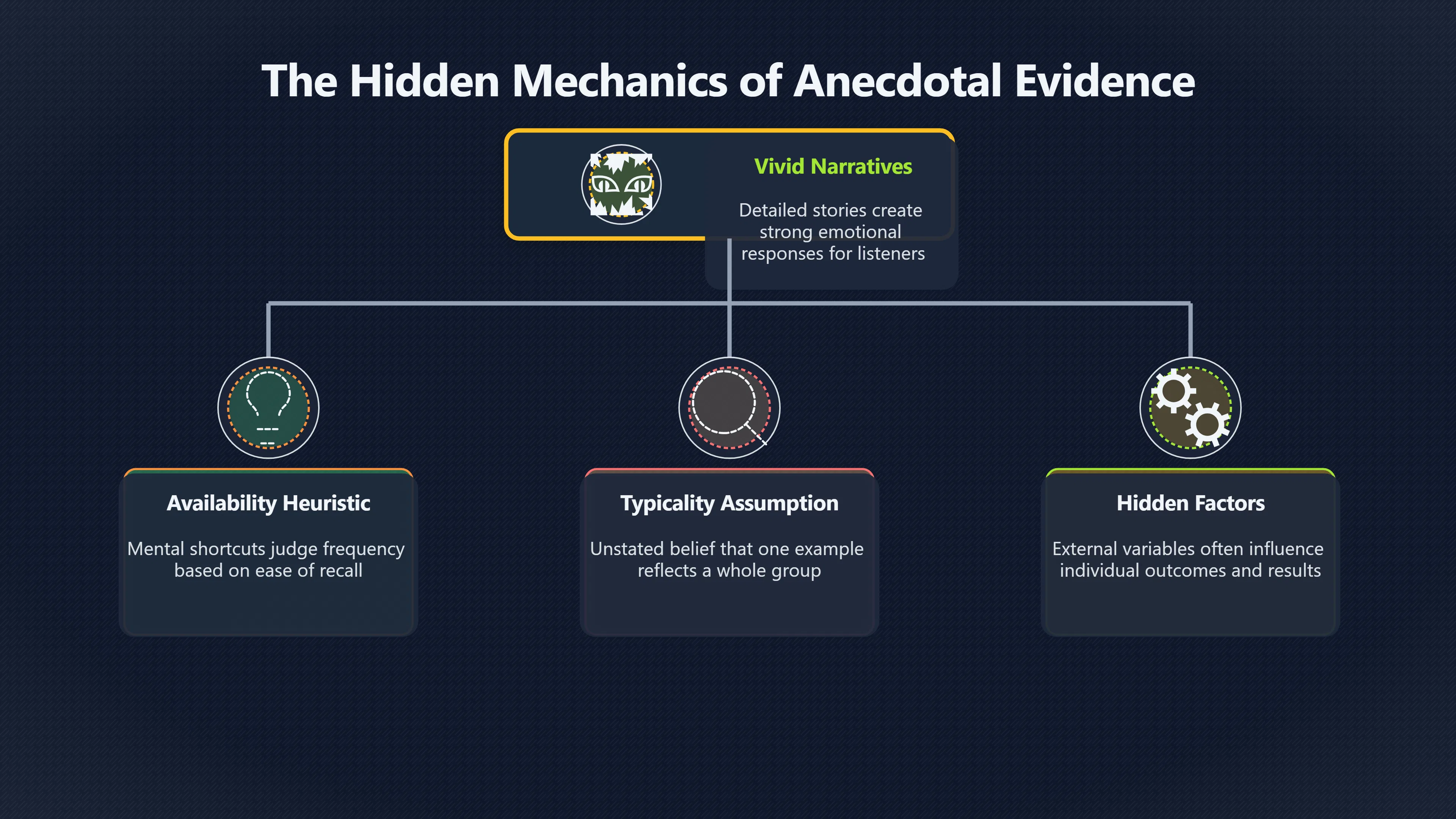
The hidden assumption behind many anecdotal arguments is that the example is representative of a larger group.
Imagine someone says:
“I know a university graduate who cannot find a job, so degrees are not worth it.”
The conclusion depends not on the existence of that graduate but on an unstated assumption that the graduate’s experience reflects the typical outcome. If the example is unusual, the argument weakens considerably.[Wikipedia]WikipediaAnecdotal evidenceAnecdotal evidence
This problem appears in everyday discussions because people naturally generalise from limited experience. Psychologists have documented related cognitive shortcuts, including the availability heuristic: the tendency to judge how common or important something is based on how easily examples come to mind. Vivid, recent, emotional, or memorable cases often feel more representative than they really are.[The Decision Lab+2Simply Psychology]thedecisionlab.comThe Decision Lab Availability HeuristicThe Decision LabAvailability Heuristic - The Decision…The availability heuristic describes our tendency to think that whatever is easi…
For example:
- After hearing a dramatic story about a burglary, people may overestimate how common burglaries are.
- After meeting one exceptionally difficult customer from a particular profession, someone may form a stereotype about the entire profession.
- After reading a viral story about a product failure, consumers may assume the problem is widespread.
In each case, the memorable example becomes a substitute for broader evidence. The ease with which the example is recalled creates an impression of frequency or importance.[The Decision Lab+2globalfactchecking.com]thedecisionlab.comThe Decision Lab Availability HeuristicThe Decision LabAvailability Heuristic - The Decision…The availability heuristic describes our tendency to think that whatever is easi…
The key analytical question is therefore not “Can I think of an example?” but “How typical is this example compared with the wider population?”

Why Vivid Stories Feel More Convincing Than Data
Human beings are natural storytellers. A single detailed narrative often creates a stronger emotional response than a table of percentages.
A story has characters, causes, consequences, and concrete details. Statistics often appear abstract and impersonal. As a result, people may remember one compelling account long after forgetting a larger dataset. Researchers studying anecdotal and statistical evidence have repeatedly found that narratives can exert a substantial influence on beliefs and decisions.[Taylor & Francis Online]tandfonline.comThe analysis…Read more…
This does not mean stories are useless. In many situations, stories provide context that numbers alone cannot supply. A hospital report may show a percentage of patients affected by a problem, while individual patient accounts reveal what the experience actually felt like.
The mistake occurs when vividness is confused with evidential strength. A dramatic example may be emotionally powerful precisely because it is unusual. Exceptional events are often more memorable than ordinary ones, which means the stories that spread most widely are not necessarily the stories that best represent reality.[Wikipedia]WikipediaAnecdotal evidenceAnecdotal evidence
When evaluating a claim, it helps to ask whether the example is memorable because it is common or memorable because it is rare.
Questions That Turn a Story into Better Evidence
Instead of dismissing anecdotes outright, analytical thinking asks better questions.
How many similar cases exist?
One story can be a starting point. Multiple independent stories pointing in the same direction are more informative. Even then, it matters how those cases were gathered. Ten complaints collected from a self-selected online group may not represent the broader population.[Wikipedia]WikipediaAnecdotal evidenceAnecdotal evidence
Is there a known comparison group?
Suppose someone says, “Everyone I know who uses this method succeeds.” A useful response is: compared with whom? Without a comparison group, it is difficult to judge whether the outcome is unusual or expected.
Could the example have been cherry-picked?
People naturally select stories that support their position. A persuasive speaker may highlight one striking success or failure while ignoring dozens of less dramatic cases. The existence of a compelling example does not tell us how many contrary examples were left out.[Wikipedia]WikipediaAnecdotal evidenceAnecdotal evidence
Is there a plausible alternative explanation?
If someone improved after taking a supplement, was the supplement responsible? Could natural recovery, lifestyle changes, coincidence, or expectation effects explain the outcome? Personal experiences often contain many interacting factors, making causal conclusions difficult from a single case.[PMC]pmc.ncbi.nlm.nih.govAnecdotes impact medical decisions even when presented…by EN Line · 2024 · Cited by 9 — We found that reading anecdotes for either…
Does broader evidence support the story?
The strongest position is often a combination of anecdotal and systematic evidence. A personal story becomes more persuasive when larger surveys, experiments, records, or datasets point in the same direction. Conversely, if the wider evidence contradicts the anecdote, the story may be real but atypical.[Taylor & Francis Online]tandfonline.comThe analysis…Read more…
A Practical Way to Handle Anecdotal Arguments
When confronted with an anecdote, avoid two extremes.
One extreme is accepting the story as proof of a broad claim. The other is dismissing it entirely because it is “only anecdotal”.
A more useful approach is:
- Accept the anecdote as evidence that one experience occurred.
- Ask whether the experience is likely to be representative.
- Look for information about frequency, comparisons, and alternative explanations.
- Check whether broader evidence aligns with the story.
This approach preserves the genuine information contained in personal experiences while avoiding the mistake of treating isolated examples as definitive proof.
In everyday reasoning, anecdotes are often best understood as signals rather than verdicts. They can point toward a possibility, raise a question, or reveal an issue that deserves attention. What they rarely do, by themselves, is establish how common, typical, or generally true a broad claim really is.[Wikipedia+2LinkedIn]WikipediaAnecdotal evidenceAnecdotal evidence
Amazon book picks
Further Reading
Books and field guides related to When Does One Example Actually Prove Anything?. Use these as the next step if you want deeper reading beyond the article.
A Field Guide to Lies
Focuses on interpreting evidence, statistics, and claims rather than relying on isolated stories.
The Demon-Haunted World
Rating: 4.5/5 from 43 Google Books ratings
Teaches how to evaluate claims, distinguish evidence from anecdotes, and apply skeptical reasoning.
Factfulness
Demonstrates how memorable anecdotes can distort perceptions of what is actually typical in the wider world.
How to Lie with Statistics
Shows why individual examples and poorly interpreted data can create misleading conclusions.
eBay marketplace picks
Marketplace Samples
Example marketplace items related to this page. Use the search link to explore similar finds on eBay.


Endnotes
1.
Source: Wikipedia
Title: Anecdotal evidence
Link:https://en.wikipedia.org/wiki/Anecdotal_evidence
2.
Source: linkedin.com
Title: how can you assess reliability anecdotal evidence usqwf
Link:https://www.linkedin.com/advice/1/how-can-you-assess-reliability-anecdotal-evidence-usqwf
Source snippet
Avoid false or misleading claims...
3.
Source: pmc.ncbi.nlm.nih.gov
Link:https://pmc.ncbi.nlm.nih.gov/articles/PMC8023527/
Source snippet
When and why do people act on flawed science? Effects of...by AL Michal · 2021 · Cited by 40 — Anecdotal evidence generally conveys n...
4.
Source: globalfactchecking.com
Link:https://globalfactchecking.com/learning_articles/the-availability-heuristic-how-the-brain-substitutes-facts-for-impressions/
Source snippet
uates the probability of an event not based on actual statistics, but on how easily it...
5.
Source: pmc.ncbi.nlm.nih.gov
Link:https://pmc.ncbi.nlm.nih.gov/articles/PMC11345347/
Source snippet
Anecdotes impact medical decisions even when presented...by EN Line · 2024 · Cited by 9 — We found that reading anecdotes for either...
6.
Source: Wikipedia
Title: Availability heuristic
Link:https://en.wikipedia.org/wiki/Availability_heuristic
Source snippet
Availability heuristicThe availability heuristic, also known as availability bias, is a mental shortcut that relies on immediate examp...
7.
Source: tandfonline.com
Link:https://www.tandfonline.com/doi/full/10.1080/0163853X.2017.1312195
Source snippet
The analysis...Read more...
8.
Source: thedecisionlab.com
Title: The Decision Lab Availability Heuristic
Link:https://thedecisionlab.com/biases/availability-heuristic
Source snippet
The Decision LabAvailability Heuristic - The Decision...The availability heuristic describes our tendency to think that whatever is easi...
9.
Source: simplypsychology.org
Title: availability heuristic
Link:https://www.simplypsychology.org/availability-heuristic.html
Source snippet
and Decision Making11 May 2026 — The availability heuristic is a mental shortcut where individuals judge the likelihood of an event based...
Published: May 2026
10.
Source: scribbr.co.uk
Title: Scribbr The Availability Heuristic | Example & Definition
Link:https://www.scribbr.co.uk/bias-in-research/availability-bias/
Source snippet
The Availability Heuristic | Example & Definition - Scribbr7 Dec 2022 — The availability heuristic occurs when we judge the likelihood of...
11.
Source: pmc.ncbi.nlm.nih.gov
Link:https://pmc.ncbi.nlm.nih.gov/articles/PMC8763848/
Source snippet
Impact of Cognitive Biases on Professionals' Decision...by V Berthet · 2022 · Cited by 297 — Most research on this topic consists in nar...
12.
Source: kellogg.northwestern.edu
Link:https://www.kellogg.northwestern.edu/faculty/uzzi/ftp/restricted/biases.pdf
Source snippet
Working from memory, the vivid instances relating to an employee...Read more...
13.
Source: insidebe.com
Title: Availability Heuristic
Link:https://insidebe.com/articles/availability-heuristic/
Source snippet
Everything You Need to KnowThe availability heuristic is a mental shortcut. It allows us to make quick and effortless judgments about the...
14.
Source: necsus-ejms.org
Title: Anecdotal evidence
Link:https://necsus-ejms.org/anecdotal-evidence/
Source snippet
NECSUSby S Cubitt — A critical function of anecdotal evidence is to decide to what degree in any unique instance the anecdote or elements...
15.
Source: study.com
Title: Availability Heuristic | Definition & Examples
Link:https://study.com/academy/lesson/availability-heuristic-examples-definition-quiz.html
Source snippet
LessonThe availability heuristic means bias occurring based on the most available memories and experiences one has.Read more...
16.
Source: logiccheck.net
Title: anecdotal evidence
Link:https://www.logiccheck.net/post/anecdotal-evidence
Source snippet
12 Nov 2021 — This is the power of anecdotal evidence, evidence based not on general facts or statistics, but on personal experience whic...
Additional References
17.
Source: researchgate.net
Link:https://www.researchgate.net/publication/373897067_Research_on_Applications_of_Availability_Heuristics
18.
Source: researchgate.net
Link:https://www.researchgate.net/publication/375551656_Availability_Heuristics_and_Its_Applications_in_Behavioral_Economics
Source snippet
rotection policies, focusing on the influence of psychological factors on consumer...Read more...
19.
Source: yukaichou.com
Link:https://yukaichou.com/behavioral-analysis/availability-heuristic-tversky-kahneman-[recall
Source snippet
Availability Heuristic: Why Recent Memories Mislead UsThe availability heuristic is a memory-fluency shortcut for probability judgment...
20.
Source: researchgate.net
Link:https://www.researchgate.net/publication/375778128Research_on_the[Application
Source snippet
e likelihood of an event based on the ease with which examples come to mind.Read more...
21.
Source: researchgate.net
Link:https://www.researchgate.net/publication/360499820_Risk_and_Availability_Heuristic_The_Role_of_Availability_in_Risk_Perception_and_Management
Source snippet
how easily they can recall relevant information from memory (Tversky and...Read more...
22.
Source: reddit.com
Link:https://www.reddit.com/r/askphilosophy/comments/d38vof/how_to_explain_to_someone_that_anecdotes_dont/
Source snippet
w a good way to explain to someone why they need more than anecdotes to substantiate...
23.
Source: researcher.life
Title: what is availability heuristic with examples
Link:https://researcher.life/blog/article/what-is-availability-heuristic-with-examples/
Source snippet
What is Availability Heuristic (with Examples)3 Oct 2024 — The availability heuristic is a cognitive bias in which you make a decision ba...
24.
Source: appinio.com
Title: What is Representativeness Heuristic?
Link:https://www.appinio.com/en/blog/market-research/representativeness-heuristic
Source snippet
Definition, ExamplesRepresentativeness bias is a cognitive bias that occurs when individuals rely heavily on stereotypes, prototypes, or...
25.
Source: larsavemarie.com
Title: accepting anecdotes is not good thinking
Link:https://www.larsavemarie.com/accepting-anecdotes-is-not-good-thinking/
Source snippet
The primary weakness of anecdotes as evidence is that they are uncontrolled; technically, they are non-systematic...Read more...
26.
Source: openjdm.github.io
Link:https://openjdm.github.io/availability_bias.html
Source snippet
ent or classification by availability.Read more...
Topic Tree