Within Confirmation Bias
What Would Make This Job Regrettable?
Before accepting or staying in a role, the regret question forces hidden warnings into view before career momentum takes over.
On this page
- Why career choices invite confirmation bias
- Signals jobseekers explain away
- A six month regret precheck
Page outline Jump by section
Introduction
Choosing whether to accept, reject or remain in a job is rarely a purely rational exercise. Career decisions affect income, identity, relationships, status and future opportunities, making them especially vulnerable to confirmation bias. Once a role starts to feel like “the right move”, many people unconsciously begin collecting reasons to justify that conclusion while discounting warning signs. The regret question is a practical way to interrupt that process: If I look back six months after taking or staying in this job, what would make me wish I had decided differently?
 This question does not ask whether the decision will succeed. Instead, it deliberately searches for the circumstances that would prove your current enthusiasm misplaced. By shifting attention from reasons to believe to reasons to doubt, it helps expose evidence that confirmation bias would otherwise explain away. Research on judgment and decision-making consistently shows that actively seeking disconfirming evidence improves the quality of important decisions compared with simply accumulating supporting arguments.[Wikipedia]WikipediaConfirmation biasConfirmation bias
Why career choices invite confirmation bias
Career decisions combine uncertainty with strong emotions. A new role may promise a higher salary, greater prestige, escape from a difficult manager or the feeling of finally moving forward. Those emotional rewards create an incentive to defend the preferred option before enough evidence has been gathered.
Unlike many everyday decisions, the consequences also unfold slowly. Poor management, unrealistic workloads or limited development opportunities may not become obvious until months after joining. Because there is no immediate feedback, it is easy to mistake optimism for good judgment.
Confirmation bias often appears through selective information gathering. Someone excited about a new employer may spend hours reading positive employee stories while dismissing repeated complaints as isolated grievances. During interviews they may interpret vague promises about progression as evidence of a strong career path because those promises fit the story they already hope is true. This reflects the broader finding that people naturally favour information consistent with an existing hypothesis unless they deliberately test competing explanations.[Wikipedia]WikipediaConfirmation biasConfirmation bias
Signals jobseekers explain away
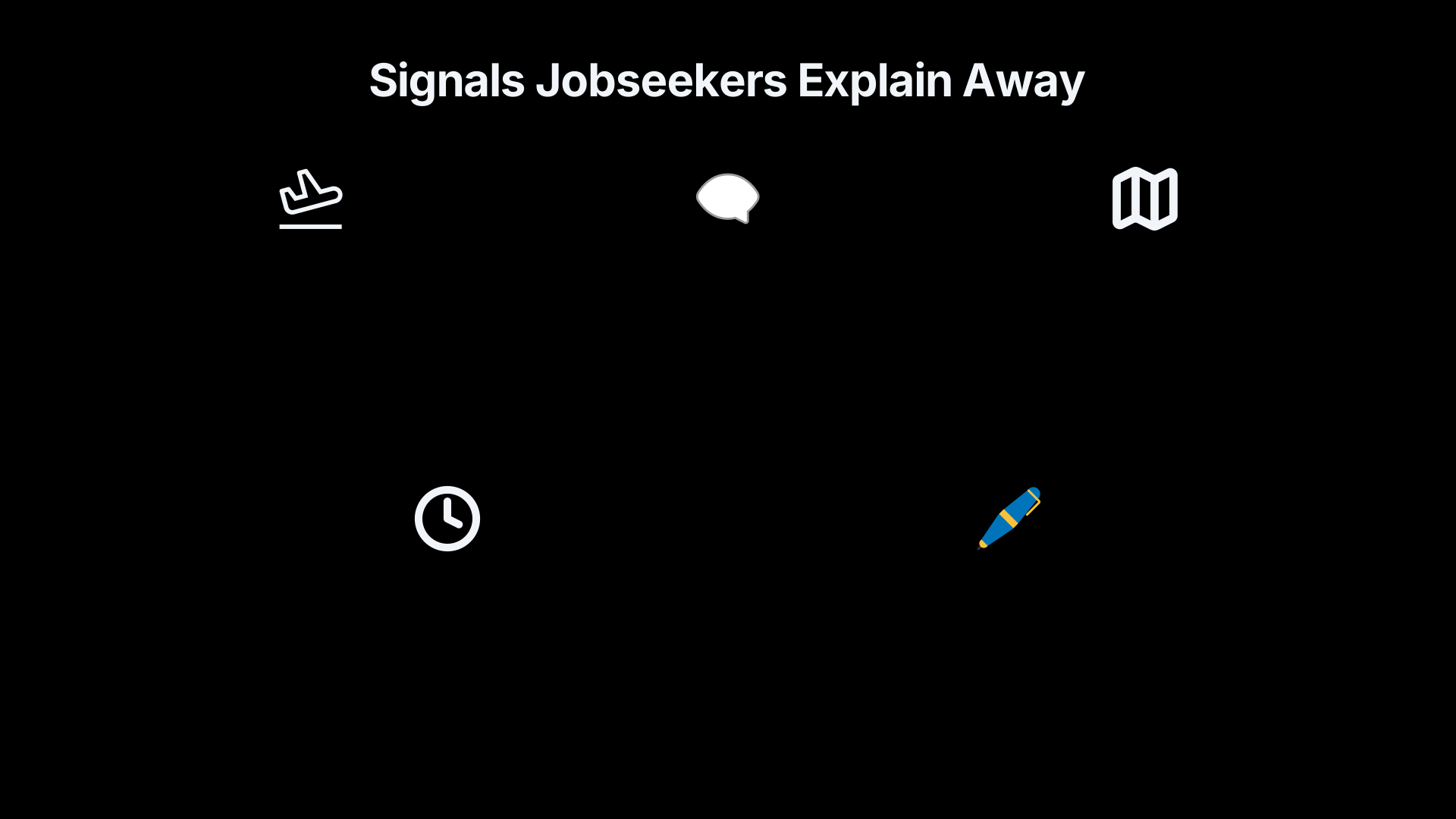
Many regretted career decisions are not caused by hidden information. They arise because visible warning signs were repeatedly reinterpreted in a favourable way.
Common examples include:
- High staff turnover. “The company is just growing quickly.”
- Interviewers contradict each other. “Everyone simply has a different perspective.”
- Unclear reporting lines. “They are probably flexible rather than disorganised.”
- Repeated delays in recruitment. “They must be very thorough.”
- Pressure to accept immediately. “They really value me.”
- Poor work-life balance described as passion. “This is just what ambitious companies are like.”
None of these signals automatically means a role is unsuitable. The problem is the asymmetry in evaluation. Positive information is accepted at face value, while negative information requires extraordinary proof before it changes the preferred conclusion.
The same pattern appears when deciding whether to remain in an existing role. Employees often reinterpret recurring frustrations as temporary because leaving would require admitting that years of investment may not produce the hoped-for outcome. Confirmation bias can therefore reinforce both unnecessary job changes and unnecessarily prolonged stays.[JobCannon]jobcannon.io8 Cognitive Biases That Derail Career Decisions (and How…April 6, 2026 — 6 Apr 2026 — Confirmation bias, sunk cost fallacy, a…
What the regret question changes
The regret question deliberately reverses the usual direction of thinking.
Instead of asking:
“Why is this a good opportunity?”
it asks:
“What future experience would make me wish I had recognised today’s warning signs?”
That subtle shift matters because it encourages diagnostic rather than supportive evidence.
For example, someone considering a management role might identify future regrets such as:
- discovering that promised autonomy never existed;
- spending most days dealing with office politics instead of meaningful work;
- accepting a salary increase that came with unsustainable hours;
- joining a team where experienced colleagues leave within months;
- finding that advancement depends more on internal alliances than performance.
Once these possible regrets have been written down, each becomes a factual question that can be investigated before accepting the offer rather than rationalised afterwards.

A six-month regret precheck
A useful way to counter confirmation bias is to imagine yourself exactly six months into the future.
Assume the decision has turned out badly. Write a brief explanation of why. Then separate genuine risks from imagined fears.
Ask questions such as:
- What specific event made me regret accepting or staying?
- Was that risk already visible before I decided?
- What evidence could I gather today that would increase or decrease that concern?
- Whom could I ask who has little incentive to sell me this role?
- What answer would genuinely change my mind?
This approach resembles the “pre-mortem” technique developed in organisational psychology, where decision-makers imagine that a project has already failed and work backwards to identify plausible causes. Research suggests this helps reveal overlooked risks because it temporarily gives people permission to think critically about an option they otherwise feel committed to supporting.[Ahead App]ahead-app.comAhead AppSelf Awareness in Decision Making: Why Knowing Your Blind…This article introduces two game-changing techniques—the pre-mortem…
The value lies not in predicting every possible problem but in identifying assumptions that deserve testing before commitment.
Distinguishing realistic regret from anxious overthinking
The regret question is not an invitation to imagine every unlikely disaster.
Helpful regret questions focus on evidence that could realistically have been examined beforehand. Examples include management quality, workload expectations, turnover, role clarity, promotion practices and organisational culture.
Less helpful questions focus on highly unpredictable events outside anyone’s reasonable foresight, such as an unexpected recession or a sudden industry-wide collapse.
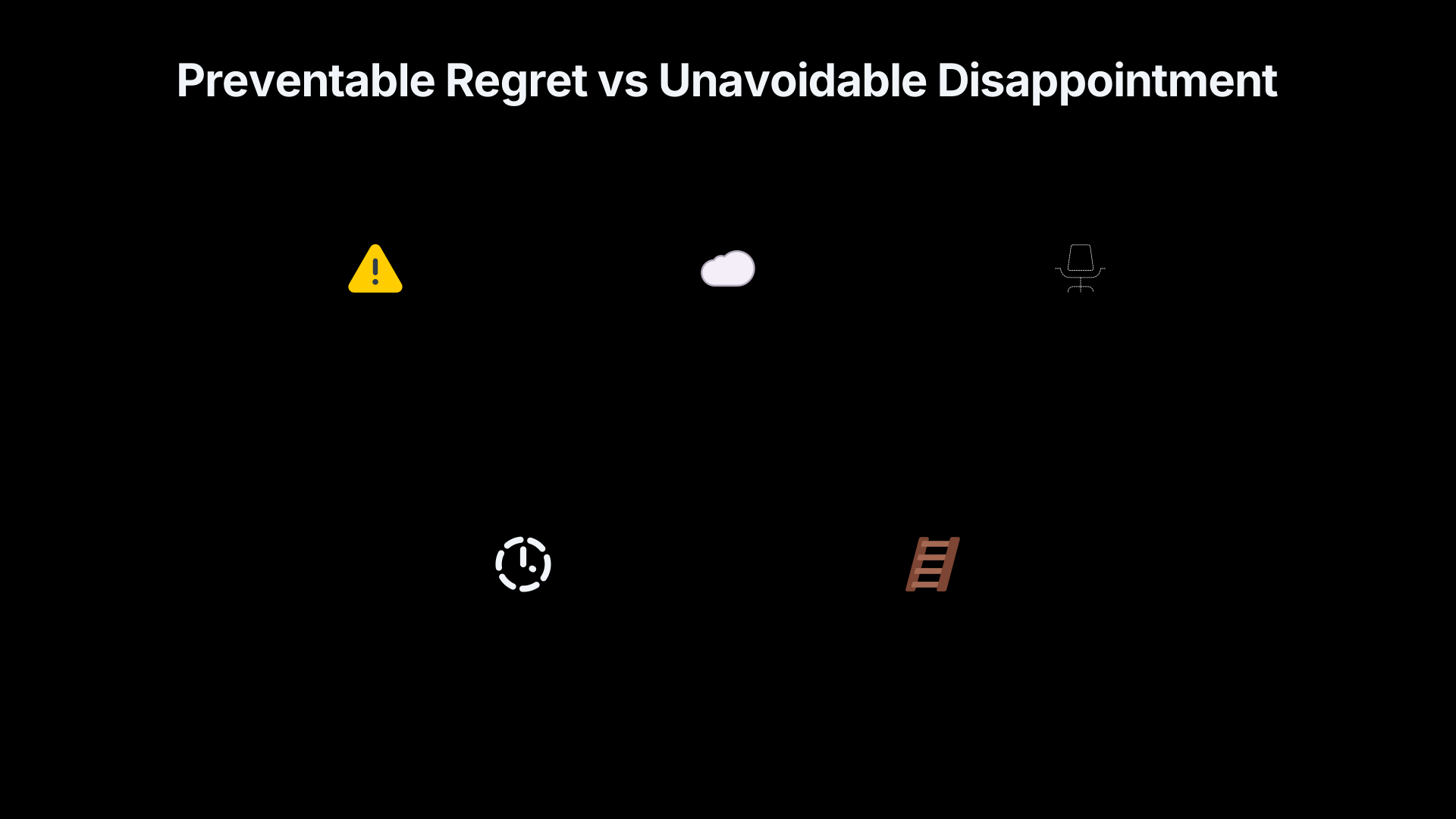
A useful distinction is:
- Preventable regret: “I ignored evidence that was available.”
- Unavoidable disappointment: “Events changed in ways nobody could reasonably predict.”
The aim is to reduce preventable regret, not eliminate uncertainty.
Practical habits that reduce confirmation bias before accepting a role
The regret question becomes much more effective when paired with deliberate evidence gathering.
Rather than asking only people who accepted similar roles successfully, seek conversations with people who left within a year. Compare interview promises with publicly available information about organisational performance and turnover. Ask interviewers what typically causes new hires to struggle rather than what makes people successful. Request concrete examples instead of general assurances.
Another useful habit is to define in advance what evidence would make you reject the offer. If no possible answer could change your decision, then the decision has already become emotional rather than analytical.
Research on debiasing consistently finds that structured decision processes outperform relying solely on intuition in high-stakes choices because they encourage people to search for information that challenges rather than merely confirms their preferred conclusion.[Wikipedia]WikipediaOpen source on wikipedia.org.
The goal is better judgment, not perfect certainty
No decision framework can guarantee that a new job will prove rewarding. Organisations change, managers leave and priorities shift. The value of the regret question lies elsewhere. It transforms confirmation bias from an invisible influence into something that can be challenged before career momentum takes over.
By asking what future version of yourself might wish you had noticed today, you replace the search for reassurance with the search for diagnostic evidence. That small change in perspective often reveals risks that enthusiasm, loyalty or the desire for change would otherwise keep hidden.
Amazon book picks
Further Reading
Books and field guides related to What Would Make This Job Regrettable?. Use these as the next step if you want deeper reading beyond the article.
Decisive
Provides practical frameworks for avoiding narrow thinking and testing assumptions before committing.
The Art of Thinking Clearly
Covers confirmation bias and related cognitive traps that can distort evaluations of new jobs.
The Proximity Principle
Helps readers evaluate career moves and make intentional job decisions rather than emotionally driven ones.
Designing Your Life
Encourages structured experimentation and reflection before making significant career commitments.
eBay marketplace picks
Marketplace Samples
Example marketplace items related to this page. Use the search link to explore similar finds on eBay.




Endnotes
1.
Source: Wikipedia
Title: Confirmation bias
Link:https://en.wikipedia.org/wiki/Confirmation_bias
2.
Source: Wikipedia
Link:https://en.wikipedia.org/wiki/Debiasing
3.
Source: Wikipedia
Link:https://en.wikipedia.org/wiki/Decision-making
4.
Source: jobcannon.io
Link:https://jobcannon.io/blog/cognitive-biases-career-decisions
Source snippet
8 Cognitive Biases That Derail Career Decisions (and How...April 6, 2026 — 6 Apr 2026 — Confirmation bias, sunk cost fallacy, a...
Published: April 6, 2026
5.
Source: ahead-app.com
Link:https://ahead-app.com/blog/Mindfulness/self-awareness-in-decision-making-why-knowing-your-blind-spots-matters
Source snippet
Ahead AppSelf Awareness in Decision Making: Why Knowing Your Blind...This article introduces two game-changing techniques—the pre-mortem...
Additional References
6.
Source: facebook.com
Link:https://www.facebook.com/groups/aivolut/posts/1834096567974878/
Source snippet
How to use premortem technique with AI for better decision makingWhen you ask what could go wrong the brain produces a polite and managea...
7.
Source: linkedin.com
Link:https://www.linkedin.com/top-content/soft-skills-emotional-intelligence/enhancing-decision-making-skills/strategies-to-improve-decision-quality/
Source snippet
Strategies to Improve Decision QualityChallenge assumptions: Regularly question your beliefs, seek out opposing evidence, and invite feed...
8.
Source: successodysseyhub.com
Link:https://successodysseyhub.com/blog/cognitive-biases-success
Source snippet
Cognitive Biases That Sabotage Your SuccessConfirmation bias is the tendency to search for, interpret, favor, and [recall]({{ 'recall/' | relative_url }}) information in a...
9.
Source: e-fellows.net
Title: Mit 80k einsteigen – Fach & Noten egal!Should I quit my job?
Link:https://www.e-fellows.net/karriere/effektiver-altruismus-arbeitszeit
Source snippet
Which of my offers should I take? Which long-term options should I explore? These decisions will affect how you spend years of your time...
10.
Source: facebook.com
Link:https://www.facebook.com/danielhpink/posts/here-are-5-science-backed-ways-to-make-better-decisions1%EF%B8%8F%E2%83%A3-take-an-outsiders-vie/1273054314198307/
Source snippet
at Bias and Improve Foresight: Duke provides practical...Read more...
11.
Source: betrtmrw.com
Title: Covers [pre-mortems]({{ ‘pre-mortems/’ | relative_url }}), second-order
Link:https://betrtmrw.com/posts/decision-making-uncertainty/
Source snippet
Better TomorrowDecision Making Under Uncertainty: Mental Models...22 Mar 2026 — Learn cognitive biases, decision frameworks, and mental...
12.
Source: youtube.com
Title: Using Regret Minimization to Make Better Decisions: Psychology of Regrets
Link:https://www.youtube.com/watch?v=5sD9oVliQfA
Source snippet
How to Make a Hard Decision—Without Regret...
13.
Source: youtube.com
Title: A Decision-Making Framework That Removes Regret
Link:https://www.youtube.com/watch?v=zDwV2Q4PVpQ
Source snippet
Using Regret Minimization to Make Better Decisions: Psychology of Regrets...
14.
Source: youtube.com
Title: How To Make Decisions Faster (WITHOUT Regret)
Link:https://www.youtube.com/watch?v=WIh-TmZNRAM
Source snippet
EP297 - How to make difficult career decisions - PodPlus Thursdays...
15.
Source: youtube.com
Title: How to Make a Hard Decision—Without Regret
Link:https://www.youtube.com/watch?v=0KDkqVgqrYg
Source snippet
How To Make Decisions Faster (WITHOUT Regret)...
Topic Tree