Within Three Parts
Why practice thinking on messy problems?
Authentic problems teach reasoning better than memorised fallacy lists because they force evidence, judgement and revision together.
On this page
- Why real problems improve transfer
- Dialogue and mentoring in reasoning practice
- Turning workplace decisions into thinking drills
Page outline Jump by section
Introduction
Critical thinking improves most when it is practised on the kinds of messy, uncertain problems people actually face. Memorising lists of logical fallacies or completing tidy textbook exercises can build useful knowledge, but it often fails to transfer into everyday decisions because real situations rarely arrive with clear premises, complete information or a single correct answer. Authentic problems require people to gather evidence, weigh competing explanations, justify judgements, recognise uncertainty and revise conclusions as new information emerges. Research on problem-based, contextual and work-based learning consistently finds that these features help learners develop reasoning that is more likely to transfer beyond the classroom into professional, civic and personal life.[BIBB+2IJELS]bibb.deBzb B Bahl Dietzen Work based learningWork-based Learning as a Pathway to Competence-…by A Bahl · 2019 · Cited by 41 — Work-based learning (WBL) is increasingly recogni…
 Within the broader goal of improving thinking and analytical skills, practising on real problems strengthens not only cognitive skills but also metacognitive habits. Learners become more aware of how they reached a conclusion, where their confidence exceeds their evidence, and when they need to rethink an initial judgement rather than defend it.
Why real problems improve transfer
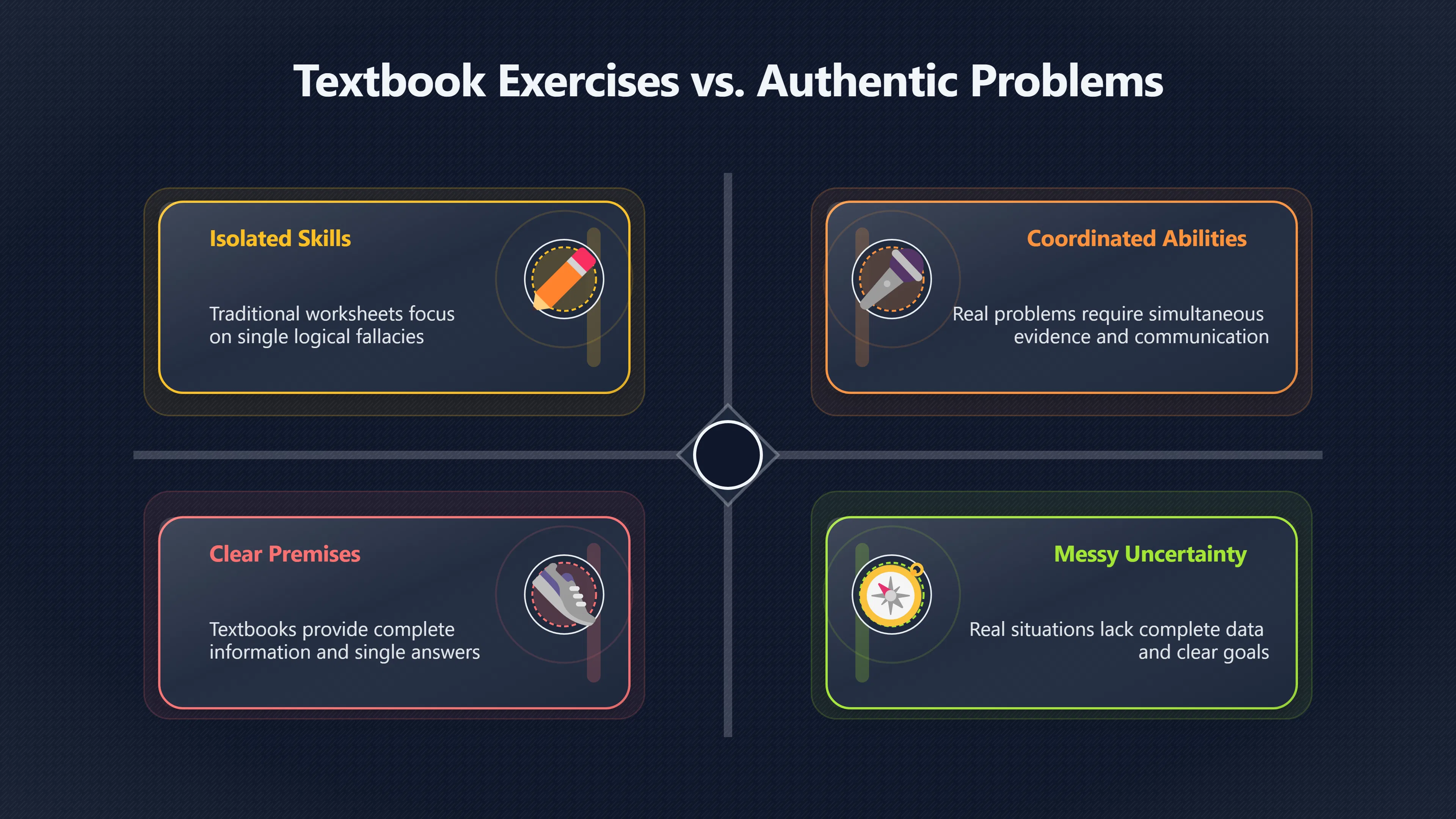
The central advantage of authentic problems is that they combine several reasoning skills at once. In real life, analysing evidence, recognising assumptions, communicating reasons and adapting to new information happen together rather than separately.
Traditional exercises often isolate one skill. A student may identify a faulty argument in a worksheet yet struggle to evaluate conflicting reports about a workplace project, a public policy or a medical decision. Real-world problems demand coordination of multiple abilities under uncertainty, making practice resemble the situations where those abilities will eventually be used.
Educational research on problem-based learning shows that authentic cases encourage learners to:
- distinguish facts from assumptions;
- identify missing information rather than ignoring it;
- compare alternative explanations instead of accepting the first plausible answer;
- justify conclusions with evidence rather than intuition alone; and
- revise decisions when contradictory evidence appears.[IJELS]ijels.com5IJELS 10320236 StrategiesStrategies for Promoting Critical Thinking in the Classroom17 Mar 2023 — Problem-based learning (PBL) is an instructional method tha…
This matters because transfer—the ability to apply learning in a new context—is notoriously difficult. People often perform well on exercises that closely resemble what they have practised yet fail when the context changes. Authentic problems increase the similarity between learning and later decision-making, making transfer more likely. Work-based learning research similarly argues that competence develops most effectively when knowledge is continually applied within realistic settings instead of remaining detached from practice.[BIBB]bibb.deBzb B Bahl Dietzen Work based learningWork-based Learning as a Pathway to Competence-…by A Bahl · 2019 · Cited by 41 — Work-based learning (WBL) is increasingly recogni…
Why messy problems reveal how people actually think
Real decisions contain ambiguity. Evidence is incomplete, stakeholders disagree, objectives conflict and time is limited. Those conditions expose reasoning habits that simplified exercises can hide.
Consider a workplace team investigating why a project missed its deadline. A classroom version may provide all relevant facts. The real version does not. Team members must decide:
- Which evidence is reliable?
- What information is still missing?
- Could several causes be operating simultaneously?
- Which explanation best fits the available evidence?
- How confident should the team be before acting?
These questions force metacognitive monitoring. Instead of asking only “What is the answer?”, participants also ask “Why do I believe this?” and “What evidence would change my mind?”
Authentic intellectual work frameworks in education were developed around precisely this insight: valuable learning requires constructing knowledge, carrying out disciplined inquiry and producing work with value beyond the classroom rather than simply recalling information.[Wikipedia]WikipediaFramework for authentic intellectual workFramework for authentic intellectual work
Dialogue and mentoring strengthen reasoning
Real-world reasoning is rarely a solitary activity. Many important decisions emerge through discussion with colleagues, mentors, clients or community members. This makes dialogue an important part of critical-thinking practice rather than merely a way of communicating conclusions.
Effective mentors rarely provide immediate answers. Instead, they ask questions that require learners to expose their assumptions:
- What evidence supports this conclusion?
- What alternative explanation have you considered?
- Which facts would contradict your current view?
- How confident are you, and why?
- What additional information would reduce uncertainty?
These questions slow intuitive judgement and encourage reflective thinking. They also make reasoning visible, allowing weaknesses to be identified before important decisions are made.
Research on collaborative and problem-based learning suggests that discussion centred on authentic problems improves both reasoning quality and the ability to explain one’s thinking because participants must defend claims with evidence rather than simply repeat memorised content.[IJELS]ijels.com5IJELS 10320236 StrategiesStrategies for Promoting Critical Thinking in the Classroom17 Mar 2023 — Problem-based learning (PBL) is an instructional method tha…
The quality of dialogue matters. Productive discussion is not debate for its own sake. Its purpose is to improve the decision, not to reward whoever argues most forcefully.

Turning workplace decisions into thinking drills
Everyday work contains numerous opportunities to practise critical thinking without creating artificial exercises.
Instead of asking only whether a decision succeeded, organisations can examine how it was reached.
For example:
After a project delay
Rather than assigning blame immediately, reconstruct the chain of reasoning. Which assumptions proved incorrect? Which warning signs were ignored? Which evidence was unavailable at the time?
After a customer complaint
Separate observations from interpretations. Which facts are established? Which explanations remain speculative? What additional evidence should be gathered before changing policy?
Before approving a proposal
Require competing explanations or alternative options. This reduces the tendency to stop searching once an acceptable answer appears.
Following an unexpected success
Ask whether the outcome resulted from good judgement, favourable circumstances or both. Successful outcomes do not necessarily validate the reasoning that produced them.
These routines transform ordinary organisational events into repeated opportunities for evidence evaluation, judgement calibration and reflective improvement.
Common mistakes when using real problems
Authentic problems are valuable only when designed to encourage reasoning rather than guesswork.
Several mistakes reduce their educational value:
- Focusing only on outcomes. A correct decision reached through poor reasoning teaches little.
- Choosing problems that are too simple. If one obvious answer exists immediately, learners do not need to evaluate competing explanations.
- Making tasks overwhelmingly complex. Excessive ambiguity can encourage random speculation rather than disciplined inquiry.
- Skipping reflection. Experience alone does not guarantee learning. Reflection connects actions to underlying reasoning.
- Rewarding speed over quality. Fast answers often discourage evidence gathering and revision.
The objective is not to make problems difficult for their own sake but to expose learners to realistic uncertainty while providing enough support to analyse it systematically.
What evidence suggests works best
Across educational and workplace settings, several principles appear consistently in the evidence.
Authentic learning is most effective when learners work on meaningful problems, receive opportunities for discussion, explain their reasoning, receive timely feedback and revisit decisions after outcomes become known. Project-based, problem-based and work-based learning all emphasise repeated cycles of analysis, action, feedback and revision rather than one-off exercises.[Illinois Publishing+3BIBB+3PMC]bibb.deBzb B Bahl Dietzen Work based learningWork-based Learning as a Pathway to Competence-…by A Bahl · 2019 · Cited by 41 — Work-based learning (WBL) is increasingly recogni…
Equally important, practice should resemble future use. Someone preparing to make policy recommendations should analyse real policy cases. Managers should examine actual organisational decisions. Healthcare professionals should work through realistic clinical scenarios. Engineers should investigate genuine design constraints. The closer the practice matches the reasoning demands of future decisions, the greater the likelihood that critical-thinking skills will transfer when they matter most.[BIBB+2Wikipedia]bibb.deBzb B Bahl Dietzen Work based learningWork-based Learning as a Pathway to Competence-…by A Bahl · 2019 · Cited by 41 — Work-based learning (WBL) is increasingly recogni…
eBay marketplace picks
Marketplace Samples
Example marketplace items related to this page. Use the search link to explore similar finds on eBay.




Endnotes
1.
Source: bibb.de
Title: Bzb B Bahl Dietzen Work based learning
Link:https://www.bibb.de/dokumente/pdf/BzbB_Bahl_Dietzen_Work-based_learning.pdf
Source snippet
Work-based Learning as a Pathway to Competence-...by A Bahl · 2019 · Cited by 41 — Work-based learning (WBL) is increasingly recogni...
2.
Source: ijels.com
Title: 5IJELS 10320236 Strategies
Link:https://ijels.com/upload_document/issue_files/5IJELS-10320236-Strategies.pdf
Source snippet
Strategies for Promoting Critical Thinking in the Classroom17 Mar 2023 — Problem-based learning (PBL) is an instructional method tha...
3.
Source: Wikipedia
Title: Contextual learning
Link:https://en.wikipedia.org/wiki/Contextual_learning
4.
Source: Wikipedia
Title: Framework for authentic intellectual work
Link:https://en.wikipedia.org/wiki/Framework_for_authentic_intellectual_work
5.
Source: pmc.ncbi.nlm.nih.gov
Title: PMCProject based learning framework integrating industry
Link:https://pmc.ncbi.nlm.nih.gov/articles/PMC12246200/
Source snippet
by F Naseer · 2025 · Cited by 129 — These competencies—creativity, critical thinking, communication, and collaboration—are foundationa...
6.
Source: publish.illinois.edu
Link:https://publish.illinois.edu/online-grad-innovation/cultivating-critical-thinking-in-online-graduate-geoscience-education-bridging-the-gap-from-theory-to-practice/
Source snippet
Illinois PublishingCultivating Critical Thinking in Online Graduate Geoscience...8 Jun 2025 — In short, integrating authentic project-ba...
Additional References
7.
Source: linkedin.com
Link:https://www.linkedin.com/posts/jeffburstein_highereducation-careerreadiness-futureofwork-activity-7473711404794089472-n8f2
Source snippet
Authentic Work vs Academic Exercises in Higher EducationThe difference is that the lessons are taught through real-world challenges, resp...
8.
Source: researchgate.net
Title: 384909685 Critical Thinking and Problem Solving Skills in the 21st Century
Link:https://www.researchgate.net/publication/384909685_Critical_Thinking_and_Problem-Solving_Skills_in_the_21st_Century
Source snippet
Critical Thinking and Problem-Solving Skills in the 21st...19 May 2026 — This study aims to explore the significance of these skills in...
Published: May 2026
9.
Source: youtube.com
Title: 5 tips to improve your critical thinking
Link:http://www.youtube.com/watch?v=dItUGF8GdTw
Source snippet
"Problem-based learning" critical thinking real world problems What Are Some Problem-Based Learning Examples? - Aspiring Teacher Guide As...
10.
Source: youtube.com
Link:http://www.youtube.com/watch?v=qmpQpRPwdi4
Source snippet
4 tips for developing critical thinking skills | Steve Pearlman, Ph.D. | TEDxCapeMay...
11.
Source: youtube.com
Title: What is Problem-Based Learning? How to use it in your classroom
Link:http://www.youtube.com/watch?v=RGoJIQYGpYk
Source snippet
Problem Based Learning: How to solve real world issues in today’s classroom – Part 1 - Feb 21, 2018...
12.
Source: youtube.com
Link:http://www.youtube.com/watch?v=Bry8J78Awq0
Source snippet
10 Real Life Examples of Critical Thinking in Action...
13.
Source: tandfonline.com
Link:https://www.tandfonline.com/doi/full/10.1080/26939169.2024.2394534
Source snippet
Taylor & Francis OnlineCultivating Critical Thinking Skills: A Pedagogical Study in...by J Bates · 2025 · Cited by 20 — We implement a q...
14.
Source: structural-learning.com
Title: stem education
Link:https://www.structural-learning.com/post/stem-education
Source snippet
Building Critical Thinkers29 Sept 2025 — STEM education builds critical thinking skills by immersing students in real-world problem-solvi...
15.
Source: youtube.com
Title: 10 Real Life Examples of Critical Thinking in Action!
Link:http://www.youtube.com/watch?v=GwyhVsqx4Xw
Source snippet
5 tips to improve your critical thinking - Samantha Agoos...
Topic Tree