Within Cause Check
What Would Have to Be True?
A causal explanation becomes stronger when its proposed steps can be checked instead of merely asserted.
On this page
- Turning a claim into a causal chain
- Checking intermediate steps
- When plausible stories still fail
Page outline Jump by section
Introduction
When people say, “X caused Y,” they often tell a story about what happened in between. The crucial question is whether that story can be tested. A causal mechanism is not simply a plausible narrative; it is a proposed sequence of intermediate steps that should leave observable traces. If those steps can be checked, measured or experimentally manipulated, the causal claim becomes stronger. If they cannot, the explanation remains speculative.
 This distinction matters whenever outcomes are messy and many factors could be responsible. Correlations can suggest where to look, but mechanisms explain how a cause could produce an effect. More importantly, they generate predictions that can be wrong. A useful mechanism therefore turns a broad causal claim into a series of smaller claims that evidence can confirm or contradict. Modern causal inference and epidemiology increasingly treat mechanistic evidence as one component of a wider body of evidence rather than as proof by itself. [PMC]pmc.ncbi.nlm.nih.govApplying the Bradford Hill criteria in the 21st century: how data…by KM Fedak · 2015 · Cited by 887 — In 1965, Sir Austin Bradford…
Turning a claim into a causal chain
A weak causal claim often has the form:
“The intervention caused the outcome.”
A stronger claim identifies the links connecting the intervention to the outcome. For example:
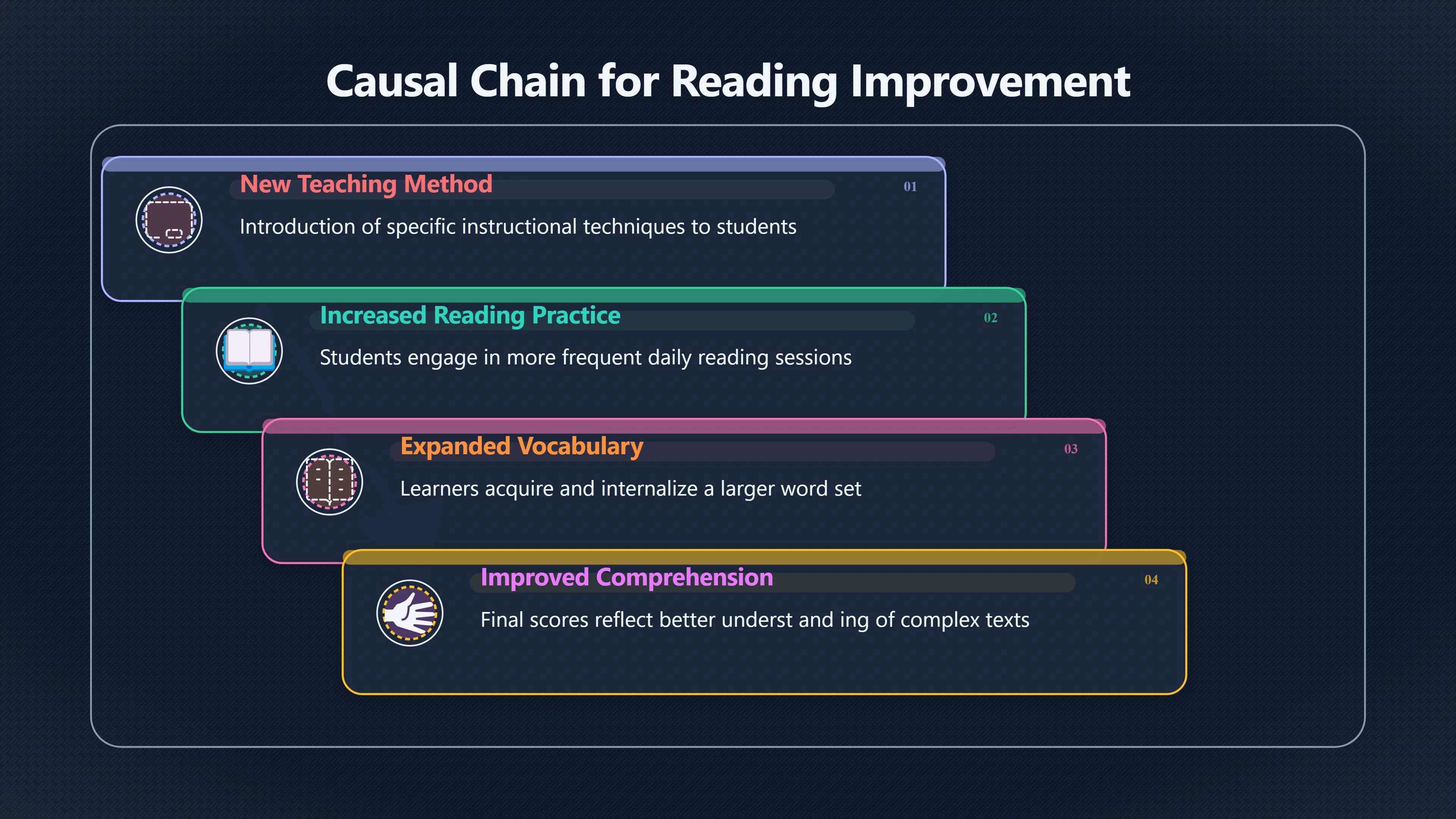
- A new teaching method improves reading because it increases daily reading practice.
- More reading practice expands vocabulary.
- Larger vocabulary improves reading comprehension scores.
Instead of one large leap, the explanation becomes several smaller steps. Each step suggests evidence that should exist if the mechanism is correct.
This changes the nature of the investigation. Rather than asking only whether pupils using the new method achieved higher scores, researchers can also ask:
- Did reading time actually increase?
- Did vocabulary improve before comprehension improved?
- Did pupils who increased reading the most gain the greatest benefit?
These intermediate questions make the explanation vulnerable to evidence rather than protected by storytelling.
Statistical methods such as mediation analysis formalise this idea by examining whether part of an observed effect appears to operate through an intermediate variable, often called a mediator. Although such analyses require strong assumptions and cannot by themselves prove the proposed pathway, they illustrate the general principle that mechanisms should create observable intermediate changes rather than mysterious leaps from cause to outcome. [Wikipedia+2arXiv]WikipediaMediation (statisticsMediation (statistics
Checking intermediate steps
A useful mechanism predicts more than the final outcome. It predicts what should happen along the way.
Suppose a company claims that shorter meetings increase productivity because employees spend more uninterrupted time on focused work. The proposed mechanism implies several observations:
- Meetings should become shorter.
- Blocks of uninterrupted work should increase.
- Employees should report fewer interruptions.
- Productivity should improve after these intermediate changes appear.
If productivity rises but uninterrupted work never increases, the proposed mechanism loses credibility. Something else may explain the improvement.
This illustrates an important feature of scientific reasoning: mechanisms generate multiple opportunities for failure. Every intermediate step is another claim that evidence can examine.
Researchers often refer to these observable consequences as the implications of a causal theory. Qualitative approaches such as process tracing apply the same logic by looking for evidence that the expected sequence of events actually occurred. Rather than asking only whether the beginning and end match, they examine whether the proposed pathway unfolded as predicted. [Wikipedia]WikipediaProcess tracingProcess tracing
Why timing matters
Mechanisms also impose constraints on time.
If the proposed process requires several stages, those stages should occur in a sensible order. Causes must precede their effects, but intermediate changes should also appear in sequence.
For example, if a dietary intervention supposedly lowers blood pressure by reducing salt intake:
- Participants should consume less salt.
- Biological measures associated with sodium balance should change.
- Blood pressure should fall afterwards.
Finding the outcome before the proposed intermediate changes would undermine the explanation.
This emphasis on temporality explains why Bradford Hill regarded timing as a particularly important consideration when evaluating causal claims. A mechanism that violates its own expected sequence is difficult to defend, regardless of how persuasive the final correlation appears. [PMC]pmc.ncbi.nlm.nih.govApplying the Bradford Hill criteria in the 21st century: how data…by KM Fedak · 2015 · Cited by 887 — In 1965, Sir Austin Bradford…
Multiple lines of evidence strengthen mechanisms
Mechanistic evidence rarely stands alone. Strong causal explanations usually survive tests from different directions.
For example, a medical explanation becomes more convincing when several independent forms of evidence point towards the same pathway:
- laboratory studies identify biological processes;
- clinical studies observe the expected intermediate biomarkers;
- population studies find the predicted association;
- interventions altering the proposed mechanism change outcomes in the expected direction.
No single type of evidence is decisive, but agreement across different methods reduces the likelihood that every observation is misleading in the same way.
Modern interpretations of Bradford Hill’s viewpoints therefore treat biological plausibility and mechanistic understanding as contributors to an overall causal judgement rather than as independent proof. Advances in genetics, molecular biology and exposure science have expanded researchers’ ability to test mechanisms directly instead of relying solely on observed associations. [PMC]pmc.ncbi.nlm.nih.govApplying the Bradford Hill criteria in the 21st century: how data…by KM Fedak · 2015 · Cited by 887 — In 1965, Sir Austin Bradford…
When plausible stories still fail
Human beings naturally construct coherent explanations after observing an outcome. Unfortunately, a convincing narrative is not necessarily a true mechanism.
Several warning signs should prompt scepticism.
The mechanism explains everything. If every possible outcome can be accommodated, the explanation cannot genuinely fail.
Intermediate steps are never measured. Claims about hidden processes remain assertions unless someone attempts to observe them.
Alternative mechanisms fit equally well. If several different pathways explain the same data, the evidence has not yet distinguished between them.
Evidence appears only at the beginning and the end. Showing that an intervention occurred and an outcome followed leaves the entire causal pathway untested.
Researchers have highlighted this problem in studies of causal mediation. Simply showing that an intervention changes a proposed mediator does not establish that the mediator actually transmitted the effect to the final outcome. Additional assumptions or experimental evidence are often required. [arXiv]arxiv.orgarXiv Assumption Smuggling in Intermediate Outcome Tests of Causal MechanismsarXiv Assumption Smuggling in Intermediate Outcome Tests of Causal Mechanisms
A practical test for everyday reasoning
When evaluating any causal claim, asking a small set of mechanism-focused questions can reveal whether the explanation is genuinely testable.
- What are the specific steps between the proposed cause and the outcome?
- Which of those steps can be directly observed or measured?
- What evidence would contradict each step?
- Does the expected sequence occur in the right order?
- Could another mechanism explain the same observations equally well?
These questions shift attention away from persuasive storytelling and towards evidence. A mechanism earns credibility not because it sounds reasonable, but because it makes predictions about what would have to be true—and those predictions can be checked.
Amazon book picks
Further Reading
Books and field guides related to What Would Have to Be True?. Use these as the next step if you want deeper reading beyond the article.
The Book of Why
Directly explains causal inference, mechanisms, and distinguishing causation from correlation.
How to Lie with Statistics
Builds intuition for interpreting statistical claims and avoiding mistaken causal conclusions.
Calling Bullshit
Helps readers evaluate causal claims, misleading narratives, and weak evidence.
Causal Inference
Covers modern approaches to causal inference and testing causal hypotheses.
eBay marketplace picks
Marketplace Samples
Live-tested eBay searches with available results related to this page.




Endnotes
-
Source: pmc.ncbi.nlm.nih.gov
Link: https://pmc.ncbi.nlm.nih.gov/articles/PMC4589117/Source snippet
Applying the Bradford Hill criteria in the 21st century: how data...by KM Fedak · 2015 · Cited by 887 — In 1965, Sir Austin Bradford...
-
Source: pmc.ncbi.nlm.nih.gov
Link: https://pmc.ncbi.nlm.nih.gov/articles/PMC8206235/Source snippet
causality in epidemiology: revisiting Bradford Hill to...by M Shimonovich · 2020 · Cited by 248 — This paper explores how these approach...
-
Source: Wikipedia
Title: Mediation (statistics)
Link: https://en.wikipedia.org/wiki/Mediation_%28statistics%29 -
Source: arxiv.org
Title: arXiv An Interventionist Approach to Mediation Analysis
Link: https://arxiv.org/abs/2008.06019 -
Source: arxiv.org
Title: arXiv Assumption Smuggling in Intermediate Outcome Tests of Causal Mechanisms
Link: https://arxiv.org/abs/2407.07072 -
Source: Wikipedia
Title: Process tracing
Link: https://en.wikipedia.org/wiki/Process_tracing -
Source: Wikipedia
Title: Bradford Hill criteria
Link: https://en.wikipedia.org/wiki/Bradford_Hill_criteriaSource snippet
Bradford Hill criteriaThe Bradford Hill criteria, otherwise known as Hill's criteria for [causation]({{ 'causation/' | relative_url }}), are a group of nine principles tha...
-
Source: iris.who.int
Link: https://iris.who.int/bitstreams/5e1eadc6-7016-4829-be3a-77c593271129/downloadSource snippet
Health Classicsby RM Lucas · 2005 · Cited by 335 — Bradford Hill's ideas about causal inference were formu- lated in the heady early year...
Additional References
-
Source: healthknowledge.org.uk
Link: https://www.healthknowledge.org.uk/e-learning/epidemiology/practitioners/causation-epidemiology-association-causationSource snippet
Causation in epidemiology: association and causationThe Bradford-Hill criteria are widely used in epidemiology as providing a framework a...
-
Source: healtheffects.org
Link: https://www.healtheffects.org/sites/default/files/pearce-causal-inference-hei-2020.pdfSource snippet
Three examples. Use and misuse of algorithms. What should we do? Page 3. EVIDENCE SYNTHESIS. [Bradford Hill, IARC, etc].Read more...
-
Source: youtube.com
Link: https://www.youtube.com/watch?v=TnuosYuKGosSource snippet
Determining Causality: A Review of the Bradford Hill CriteriaBradford Hill develops several criteria that you shold consider as you try t...
-
Source: pure.johnshopkins.edu
Title: an evolved interpretation of austin bradford hills causal viewpoi
Link: https://pure.johnshopkins.edu/en/publications/an-evolved-interpretation-of-austin-bradford-hills-causal-viewpoiSource snippet
evolved interpretation of Austin Bradford Hill's causal...1 June 2025 — In 1965, Sir Austin Bradford Hill articulated nine viewpoints fo...
Published: June 2025
-
Source: usablebuildings.co.uk
Link: https://www.usablebuildings.co.uk/UsableBuildings/Unprotected/BradfordHillCriteria.pdfSource snippet
But they could help us to weigh the evidence for or against various...Read more...
-
Source: juliankingnz.substack.com
Link: https://juliankingnz.substack.com/p/applying-bradford-hill-criteria-toSource snippet
Bradford Hill Criteria to observational evidenceIf the effect is seen more often in association with the suspected cause than without it...
-
Source: youtube.com
Title: How to Perform Causal Mediation Analysis using R
Link: https://www.youtube.com/watch?v=AuZQ2W1FnTESource snippet
The video Uncovering Causal Mechanisms explains how statistical frameworks like mediation analysis can be applied to isolate and break do...
-
Source: youtube.com
Title: Uncovering Causal Mechanisms: Mediation Analysis and Surrogate Indices
Link: https://www.youtube.com/watch?v=x03aH6G7U9USource snippet
Causal Fusion: Identification of Interventions and Causal Discovery...
-
Source: youtube.com
Title: Causal Fusion: Identification of Interventions and Causal Discovery
Link: https://www.youtube.com/watch?v=2I7AiBeBxtMSource snippet
An Interventional Approach to Causal Mediation Analysis...
-
Source: link.springer.com
Link: https://link.springer.com/article/10.1007/s40266-025-01273-7Source snippet
the Bradford Hill Criteria to Assess the Independent...by SK Thapa · 2026 — Biological plausibility, biological coherence, and analogy w...
Topic Tree