Within Claims
Are Three Complaints Enough to Blame the Software?
Three frustrated colleagues may reveal a real software problem, or they may reflect a narrow slice of the team's experience.
On this page
- Separating user frustration from system failure
- Checking whether complaints are representative
- Evidence that can confirm or weaken the claim
Page outline Jump by section
Introduction
Three colleagues complaining about a piece of software may be the first sign of a genuine problem. They may also represent only a small, unusually frustrated part of the workforce. The key analytical question is not whether the complaints are sincere, but whether they are representative.
 In workplace discussions, people often move quickly from “several employees are unhappy” to “the system is broken”. That leap contains an assumption: that the people speaking up reflect the experience of the wider group. Sometimes they do. Sometimes they do not. Improving your thinking requires separating the existence of complaints from the strength of the evidence those complaints provide. A handful of complaints can be enough to justify investigation, but not necessarily enough to justify a broad conclusion about software, managers, policies, or processes.[DavidsonMorris | Solicitors]davidsonmorris.comSolicitorsEmployee Surveys: HR Strategy, Risk and Action 2026February 7, 2026 — 7 Feb 2026 — Survey data provides an evi…
Are Three Complaints Enough to Blame the Software?
Imagine a team of fifty people using a new project-management tool. Three employees report that it is slow, confusing, and causing delays. A manager concludes that the software is harming productivity.
The complaints are real evidence. They should not be dismissed. However, the conclusion depends on information that has not yet been gathered. Are the three employees typical users? Are they among the heaviest users? Are they new to the tool? Are others experiencing the same problems but remaining silent? Or are most employees using it successfully?
The analytical mistake is treating a small number of observations as if they automatically describe the whole population. In this case, the relevant population is everyone affected by the software, not merely the people who complained.
A useful distinction is:
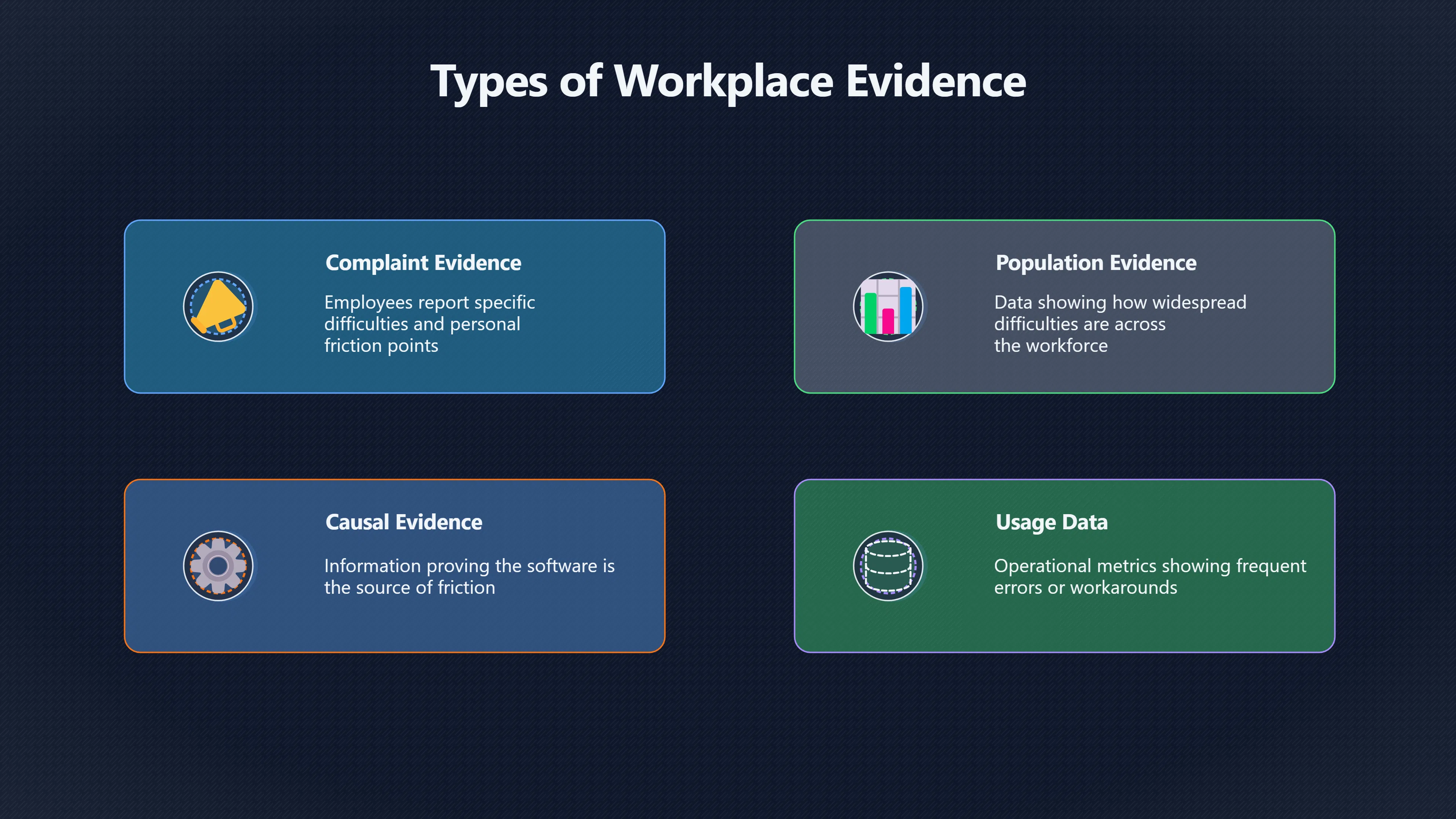
- Complaint evidence: employees report difficulties.
- Population evidence: information showing how widespread those difficulties are.
- Causal evidence: information showing that the software, rather than another factor, is producing the difficulties.
The existence of complaints establishes the first point. It does not automatically establish the second or third.
Separating User Frustration from System Failure
Complaints often reveal genuine friction. The challenge is determining whether the friction reflects a system-wide problem or a local experience.
Consider several possibilities:
- The software crashes regularly for most users.
- The software works well, but a particular team lacks training.
- The software is slow only on older hardware.
- The software performs adequately, but a recent update introduced a temporary bug.
- The software is unpopular because it changed established work habits.
Each scenario can produce frustrated employees. Yet the appropriate response differs dramatically.
This is why organisations increasingly rely on broader employee feedback systems, surveys, and performance measures rather than isolated anecdotes. Survey data can provide a wider evidential base and reduce dependence on individual stories when assessing organisational issues.[DavidsonMorris | Solicitors]davidsonmorris.comSolicitorsEmployee Surveys: HR Strategy, Risk and Action 2026February 7, 2026 — 7 Feb 2026 — Survey data provides an evi…
A complaint is therefore often best treated as a clue rather than a verdict. It identifies where to look. It does not necessarily tell you what you will find.
Checking Whether Complaints Are Representative
The central question is simple: do the complaints reflect the wider workforce?
Who Is Speaking?
People who experience strong dissatisfaction are often more motivated to speak up than people who are merely content. As a result, the visible pool of complaints may not match the underlying distribution of experiences.
Researchers studying surveys and employee feedback have long recognised that participation can be affected by people’s attitudes and experiences, creating the possibility that vocal respondents differ systematically from less vocal employees.[arXiv]arxiv.orgHow many federal employees are not satisfied? Using response times to estimate population proportions under the survey variable caus…
When evaluating workplace complaints, ask:
- How many people are affected?
- How many people were asked?
- How many chose to respond?
- Are certain groups overrepresented among complainants?
Three complaints from three users out of three contacted employees suggest something very different from three complaints out of three hundred users.
Who Is Missing?
Analytical errors often arise from paying attention only to available information.
Psychologists describe the availability heuristic as a tendency to judge situations based on examples that come easily to mind. Vivid complaints are memorable and therefore risk appearing more common than they really are.[The Decision Lab+2Ness Labs]thedecisionlab.comThe Decision Lab Availability HeuristicThe Decision LabAvailability Heuristic - The Decision…The availability heuristic describes our tendency to use information that comes…
In a workplace context, managers may repeatedly hear from the same dissatisfied employees and gradually conclude that everyone feels the same way. Yet the silent majority may have a different experience.
A useful habit is to ask: Who has not been heard from yet?

Are the Complainants Typical Users?
Representativeness depends not only on numbers but also on relevance.
Suppose three complaints come from:
- The most experienced users.
- The newest employees.
- One department.
- Remote workers only.
- Employees using specialised features.[arxiv.org]arxiv.orgHow many federal employees are not satisfied? Using response times to estimate population proportions under the survey variable caus…
Each group may encounter issues that others rarely see.
The question is not whether their experiences are valid. The question is whether those experiences can reasonably be generalised to everyone else.
Evidence That Can Confirm or Weaken the Claim
When someone claims that software, a manager, or a process is causing problems, additional evidence can either strengthen or weaken that conclusion.
Evidence That Strengthens the Claim
The claim becomes more persuasive when multiple forms of evidence point in the same direction:
- Employee surveys show widespread dissatisfaction.
- Help-desk tickets reveal recurring issues.
- Usage data shows frequent errors or workarounds.
- Productivity measures decline after implementation.
- Complaints emerge independently from different teams.
When separate sources converge, confidence increases because the conclusion no longer relies on a small set of anecdotes. Organisations frequently use employee surveys precisely because they allow comparisons across teams, locations, and time periods rather than relying solely on individual reports.[Gallup.com+2Culture Amp]gallup.coms Q12 Employee Engagement SurveyGallup's Q12 Employee Engagement SurveyOctober 26, 2021 — Use the Gallup Q12 survey to engage employees and improve performance. Drive cr…

Evidence That Weakens the Claim
The claim becomes less convincing when broader information tells a different story:
- Most users report satisfaction.
- Performance measures remain stable or improve.
- Problems are concentrated in one small group.
- Alternative explanations fit the facts better.
- The complaints disappear after training or configuration changes.
In these situations, the complaints may still reveal a real issue, but not necessarily the broad failure originally alleged.
Combining Different Sources
Research in other complaint-heavy environments has shown the value of combining multiple reporting channels. Studies comparing different forms of reporting have found that separate sources often reveal different aspects of the same problem and can produce a more complete picture when considered together.[Sage Journals]journals.sagepub.comSage JournalsIntegrating patient complaints and staff reports of unsafe care7 Jul 2021 — This paper examines the potential of combining i…
The same principle applies at work. Complaints, surveys, operational data, and direct observation each capture part of reality. Strong conclusions usually require more than one of them.
A Practical Test for Everyday Workplace Claims
When you hear statements such as:
- “Everyone hates the new software.”
- “The team thinks management is ineffective.”
- “The process is obviously failing.”
Pause and ask three questions:
- How many people are actually represented by the complaints?
- Do the complainants resemble the wider group affected by the issue?
- What independent evidence supports or challenges the claim?
These questions do not dismiss employee concerns. In fact, they take those concerns seriously enough to investigate them properly.
Good analytical thinking recognises that complaints are valuable signals. The mistake is not listening to them. The mistake is assuming that a few voices automatically describe the entire workplace. A small number of complaints may be the first warning sign of a serious problem—or simply a narrow slice of experience. Determining which requires representative evidence rather than assumption.
Amazon book picks
Further Reading
Books and field guides related to Are Three Complaints Enough to Blame the Software?. Use these as the next step if you want deeper reading beyond the article.
The Skeptics' Guide to the Universe
Provides practical tools for assessing evidence quality, representativeness, and reasoning errors.
Factfulness
Focuses on judging claims using representative data rather than vivid anecdotes or isolated complaints.
The Art of Thinking Clearly
Covers biases that lead people to overgeneralize from a handful of observations or complaints.
Calling Bullshit
Teaches readers how to evaluate evidence, detect weak inferences, and question claims supported by inadequate data.
eBay marketplace picks
Marketplace Samples
Example marketplace items related to this page. Use the search link to explore similar finds on eBay.



Endnotes
1.
Source: davidsonmorris.com
Link:https://www.davidsonmorris.com/employee-survey/
Source snippet
SolicitorsEmployee Surveys: HR Strategy, Risk and Action 2026February 7, 2026 — 7 Feb 2026 — Survey data provides an evi...
Published: February 7, 2026
2.
Source: arxiv.org
Link:https://arxiv.org/abs/2506.14915
Source snippet
How many federal employees are not satisfied? Using response times to estimate population proportions under the survey variable caus...
3.
Source: gallup.com
Title: ‘s Q12 Employee Engagement Survey
Link:https://www.gallup.com/workplace/356063/gallup-q12-employee-engagement-survey.aspx
Source snippet
Gallup's Q12 Employee Engagement SurveyOctober 26, 2021 — Use the Gallup Q12 survey to engage employees and improve performance. Drive cr...
Published: October 26, 2021
4.
Source: cultureamp.com
Title: employee survey guide
Link:https://www.cultureamp.com/blog/employee-survey-guide
Source snippet
HR's guide to employee surveys22 Feb 2023 — Employee surveys help leaders make better decisions by providing key insights into engagement...
5.
Source: thedecisionlab.com
Title: The Decision Lab Availability Heuristic
Link:https://thedecisionlab.com/biases/availability-heuristic
Source snippet
The Decision LabAvailability Heuristic - The Decision...The availability heuristic describes our tendency to use information that comes...
6.
Source: nesslabs.com
Link:https://nesslabs.com/availability-bias
Source snippet
Ness LabsAvailability bias: the tendency to use information that easily...One such constraint is the availability bias — our tendency to...
7.
Source: journals.sagepub.com
Link:https://journals.sagepub.com/doi/10.1177/13558196211029323
Source snippet
Sage JournalsIntegrating patient complaints and staff reports of unsafe care7 Jul 2021 — This paper examines the potential of combining i...
Additional References
8.
Source: cipd.org
Link:https://www.cipd.org/globalassets/media/knowledge/knowledge-hub/evidence-reviews/employee-engagement-scientific-summary-1_tcm18-89565.pdf
Source snippet
Employee engagement: an evidence reviewBecause this study was conducted in a single sitting, however, it provides evidence that levels of...
9.
Source: cipd.org
Link:https://www.cipd.org/en/views-and-insights/cipd-viewpoint/employee-voice/
Source snippet
Employee voice | CIPD ViewpointExplore the CIPD's point of view on employee voice, including actions for UK Government and recommendation...
10.
Source: linkedin.com
Link:https://www.linkedin.com/pulse/problems-employee-engagement-surveys-rob-lambert
Source snippet
The problems with employee engagement surveysThe premise behind employee engagement surveys is the idea that by asking a few simple quest...
11.
Source: hcpc-uk.org
Link:https://www.hcpc-uk.org/globalassets/resources/reports/scoping-report-on-existing-research-on-complaints-mechanisms.pdf?v=636785062220000000
Source snippet
and points to the need for more empirical research which looks at complaints...Read more...
12.
Source: researchgate.net
Link:https://www.researchgate.net/publication/45143113_Trust_and_Control_at_the_Workplace_Evidence_from_Representative_Samples_of_Employees_in_Europe
Source snippet
el and the European Social Survey, we explore the relation between certain...Read more...
13.
Source: researchgate.net
Link:https://www.researchgate.net/publication/375778128Research_on_the[Application
Source snippet
research studies that demonstrating the influence of availability bias on...Read more...
14.
Source: esrcjustenergy.files.wordpress.com
Title: how do complaints affect those complained about
Link:https://esrcjustenergy.files.wordpress.com/2018/01/how-do-complaints-affect-those-complained-about.pdf
Source snippet
do complaints affect those complained about?15 Dec 2017 — The key finding of the research was that being complained about affects the hea...
15.
Source: uk.surveymonkey.com
Link:https://uk.surveymonkey.com/learn/employee-feedback/anonymous-employee-surveys/
Source snippet
Employee Surveys: Usage, Tips And Best...Anonymous complaint forms empower employees to make complaints without fear of retaliation...
16.
Source: herrington-carmichael.com
Title: from complaint to compliance a practical case study on workplace discrimination
Link:https://www.herrington-carmichael.com/from-complaint-to-compliance-a-practical-case-study-on-workplace-discrimination/
Source snippet
Employers must foster a culture where complaints are taken seriously...Read more...
17.
Source: reddit.com
Link:https://www.reddit.com/r/work/comments/1ciblmx/how_to_respond_to_employee_survey_when_you_have/
Source snippet
The survey results are aggregated, sent to HR and each manager...
Topic Tree