Within Health Claims
Why Feeling Better Is Not Proof
Personal improvement stories can be sincere and still fail to show that a product, routine, or treatment caused the change.
On this page
- Why before and after stories persuade
- Placebo effects and regression to the mean
- What would separate cause from coincidence
Page outline Jump by section
Introduction
Feeling better after taking a supplement, starting a diet, or trying a wellness routine is a genuine experience. The key analytical question, however, is whether the improvement was caused by the intervention. Testimonials often feel convincing because they are vivid, personal, and emotionally engaging, but they cannot by themselves distinguish between a real treatment effect, natural recovery, symptom fluctuation, placebo responses, or simple coincidence. Learning to separate these possibilities is one of the most valuable thinking skills when evaluating health claims.
 This matters because many illnesses and symptoms naturally improve over time, especially those that fluctuate or are sought out when they are at their worst. Without a fair comparison, almost any intervention can appear effective. Researchers therefore rely on controlled studies rather than before-and-after stories to determine whether a treatment genuinely works.[PMC]pmc.ncbi.nlm.nih.govEffect of regression to the mean on decision making in health…by V Morton · 2003 · Cited by 404 — He noted that when the average he…
Why before-and-after stories persuade
Testimonials are persuasive because they provide what appears to be direct evidence. A person says, “I started this treatment, and now I feel better.” The sequence seems obvious: treatment first, improvement second.
The problem is that timing alone does not establish causation. Many other explanations can produce exactly the same pattern.
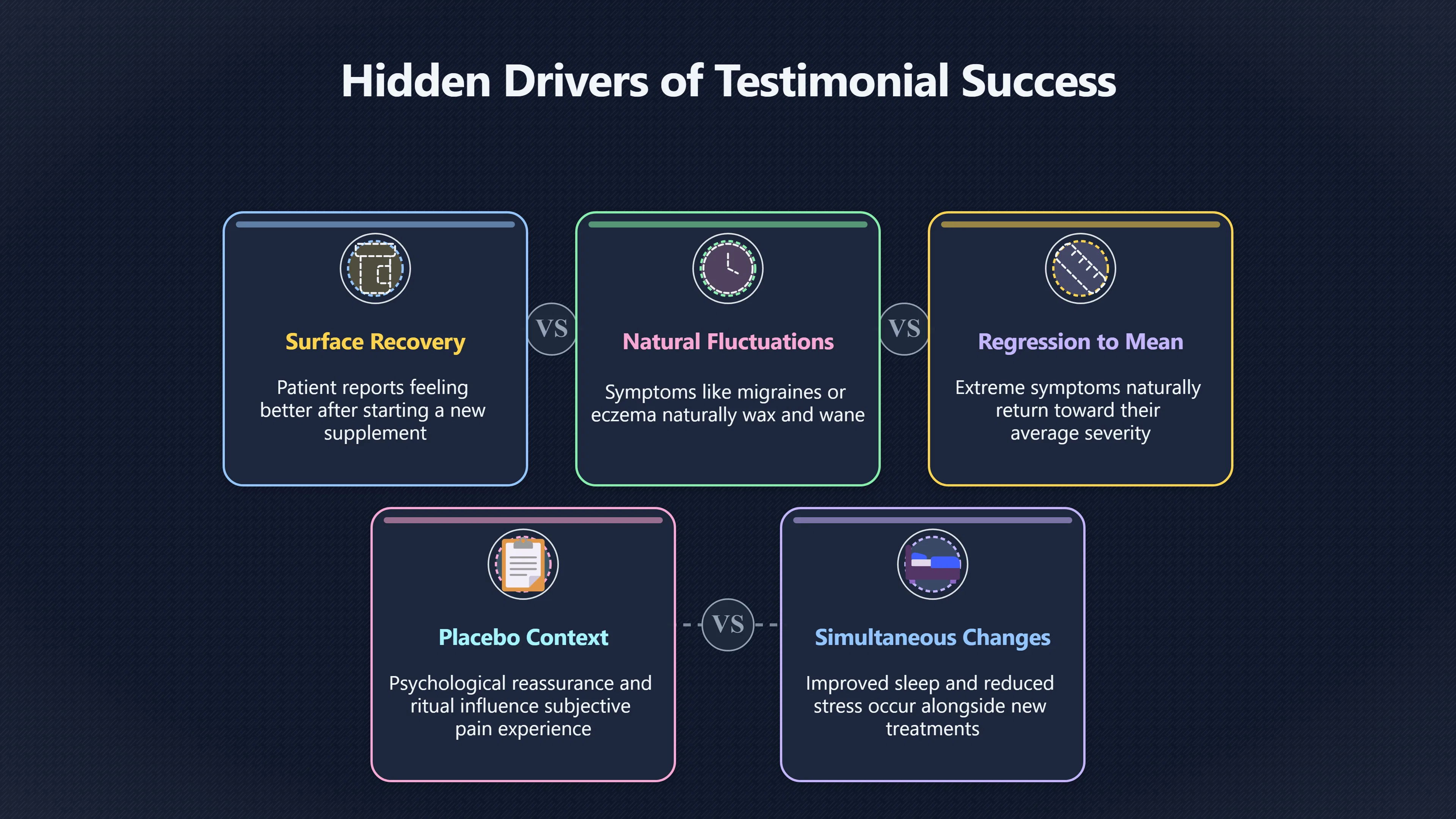
Consider someone who develops severe back pain. After several difficult weeks they purchase a new supplement, and a week later the pain eases. The improvement feels like proof that the supplement worked. Yet several other explanations remain possible:
- The condition may have been recovering naturally.
- Symptoms may have been unusually severe when treatment began and then returned towards their typical level.
- Expectations of improvement may have influenced how pain was experienced or reported.
- Other changes—better sleep, reduced stress, exercise, or medication—may have contributed.
- The improvement could simply have occurred by chance at that point in time.
The individual testimonial cannot distinguish between these explanations because there is no comparable group showing what would have happened without the intervention.
This is why regulators caution that testimonials are not substitutes for scientific evidence. Personal stories may generate hypotheses worth studying, but they cannot demonstrate that a product or treatment caused the reported benefit.[Cochrane]cochrane.orgCD003974 placebo interventions all clinical conditionsPlacebo interventions for all clinical conditions1 May 2022 — We studied the effect of placebo treatments by reviewing 202 trials…
Placebo effects and regression to the mean
Two of the most commonly misunderstood reasons why people sincerely report improvement are placebo effects and regression to the mean. They are related only in that both can make ineffective interventions appear helpful if interpreted carelessly.
Placebo effects are real, but often misunderstood
A placebo effect refers to improvements that arise from the context of treatment rather than from the specific active ingredient itself. Expectations, reassurance, the clinician–patient relationship, and the ritual of receiving care can all influence subjective experiences such as pain, fatigue, nausea, or anxiety.
Importantly, placebo effects do not mean that an illness is imaginary. They reflect genuine psychological and biological processes that can alter how symptoms are experienced.
However, systematic reviews have found that placebo treatments generally produce little or no important effect on objective disease outcomes. Their strongest and most consistent influence is on patient-reported symptoms, particularly pain, although even these effects vary substantially across conditions and studies.[Cochrane]cochrane.orgCD003974 placebo interventions all clinical conditionsPlacebo interventions for all clinical conditions1 May 2022 — We studied the effect of placebo treatments by reviewing 202 trials…
Regression to the mean explains many apparent recoveries
Regression to the mean is a statistical phenomenon that occurs whenever people seek treatment because their symptoms are unusually bad.
Imagine someone whose migraine severity varies naturally from month to month. They are most likely to buy a new remedy during an exceptionally painful episode. Even if nothing is done, the next measurement is likely to be closer to their usual average rather than remaining at the extreme.
Because treatment is often started at the worst point, ordinary improvement can easily be mistaken for treatment success.
This phenomenon affects many areas of healthcare, from blood pressure measurements to chronic pain and mental health symptoms. It can make almost any intervention appear effective unless an untreated or appropriately controlled comparison group is included.[PMC]pmc.ncbi.nlm.nih.govEffect of regression to the mean on decision making in health…by V Morton · 2003 · Cited by 404 — He noted that when the average he…
Symptom fluctuation creates convincing illusions
Many common conditions are not stable. They naturally improve and worsen over time.
Examples include:
- migraine
- chronic back pain
- eczema
- irritable bowel syndrome
- allergic conditions
- depression and anxiety symptoms
- many viral illnesses
Someone experiencing one of these conditions often seeks help during a flare-up rather than during a good period. If symptoms later return to their usual level, the timing alone can create the impression that whatever was tried caused the improvement.
Wellness marketing frequently exploits this pattern. Products are promoted using dramatic “before” photographs or stories collected immediately before treatment and several weeks afterwards. Without knowing how similar people would have changed without the product, these stories cannot establish effectiveness.
Researchers therefore compare treated participants with similar untreated or placebo groups measured over the same period. This design helps distinguish genuine treatment effects from normal symptom variation.[PMC]pmc.ncbi.nlm.nih.govEffect of regression to the mean on decision making in health…by V Morton · 2003 · Cited by 404 — He noted that when the average he…
Why sincere people can reach mistaken conclusions
People who give testimonials are rarely being dishonest. Most genuinely believe their experience.
Several cognitive and statistical factors make incorrect causal conclusions surprisingly easy:
- Selective memory. Improvements are remembered more vividly than periods when treatments produced no benefit.
- Confirmation bias. Once people expect success, they notice evidence supporting that expectation more readily than contradictory evidence.
- Multiple simultaneous changes. Diet, sleep, exercise, medication, stress, and social support often change together.
- Natural recovery. Many illnesses improve without specific treatment.
- Symptom variability. Chronic conditions often fluctuate regardless of intervention.
These influences do not invalidate personal experience. They simply mean that personal experience alone cannot reliably identify which factor produced the improvement.
What would separate cause from coincidence?
The strongest evidence comes from asking a comparison question rather than relying on a single story.
Useful questions include:
- Compared with people who did not receive the treatment, did more people improve?
- Were participants randomly assigned to treatments?
- Were outcome assessors blinded where possible?
- Was the improvement large enough to matter clinically rather than merely reaching statistical significance?
- Have independent studies found similar results?
Randomised controlled trials are especially valuable because they help balance differences between groups, making placebo effects, natural recovery, and regression to the mean much less likely to be mistaken for treatment efficacy.
Systematic reviews strengthen the evidence further by examining the results across many studies rather than relying on one positive finding.[Cochrane]cochrane.orgCD003974 placebo interventions all clinical conditionsPlacebo interventions for all clinical conditions1 May 2022 — We studied the effect of placebo treatments by reviewing 202 trials…

A practical way to read health testimonials
Testimonials need not be ignored. They can point towards ideas worth investigating and may reveal outcomes that matter to patients. The mistake is treating them as proof.
A more analytical approach is to ask:
- Could the condition have improved naturally?
- Is this a condition that commonly fluctuates?
- Was treatment started when symptoms were unusually severe?
- Could expectations have influenced symptom reporting?
- Has the same benefit been demonstrated in well-designed controlled studies?
Thinking in this way does not dismiss people’s experiences. Instead, it recognises that genuine improvement and genuine misunderstanding can occur at the same time. The central lesson is that feeling better is important—but by itself it is not reliable evidence that a particular product, routine, or treatment was responsible.
Amazon book picks
Further Reading
Books and field guides related to Why Feeling Better Is Not Proof. Use these as the next step if you want deeper reading beyond the article.
Bad Science
Shows how anecdotes, poor trials, and media stories create false confidence.
Do You Believe in Magic?
Addresses testimonials, supplements, placebo, and claims unsupported by good trials.
Suggestible You
Directly explains why real improvement can occur without proving a treatment caused it.
Testing Treatments
Explains why controlled comparisons are needed to separate cause from coincidence.
eBay marketplace picks
Marketplace Samples
Live-tested eBay searches with available results related to this page.

Top pick
critical thinking card game
Open a targeted eBay search for items related to this topic.
Browse eBay
Related search
critical thinking game
Open a targeted eBay search for items related to this topic.
Browse eBay

Related search
not memorabilia
Open a targeted eBay search for items related to this topic.
Browse eBayEndnotes
1.
Source: pmc.ncbi.nlm.nih.gov
Link:https://pmc.ncbi.nlm.nih.gov/articles/PMC1125994/
Source snippet
Effect of regression to the mean on decision making in health...by V Morton · 2003 · Cited by 404 — He noted that when the average he...
2.
Source: cochrane.org
Title: CD003974 placebo interventions all clinical conditions
Link:https://www.cochrane.org/evidence/CD003974_placebo-interventions-all-clinical-conditions
Source snippet
Placebo interventions for all clinical conditions1 May 2022 — We studied the effect of placebo treatments by reviewing 202 trials...
Published: May 2022
3.
Source: pmc.ncbi.nlm.nih.gov
Title: PMCThe Placebo Effect in Medicine and Clinical [Practice]({{ ‘practice/’ | relative_url }})
Link:https://pmc.ncbi.nlm.nih.gov/articles/PMC12510799/
Source snippet
Placebo Effect in Medicine and Clinical Practice - PMCby G Tzigkounakis · 2025 · Cited by 6 — Outcomes can also be shaped by the natural...
4.
Source: cochrane.org
Link:https://www.cochrane.org/evidence/MR000055_do-treatment-effects-randomised-trials-differ-when-using-active-placebo-compared-standard-placebo
Source snippet
1. We found no clear difference in effect between active and standard placebos, but we are very uncertain about the results.Read more...
Additional References
5.
Source: bmjopen.bmj.com
Title: Costs incurred for the different health service contacts were calculated by
Link:https://bmjopen.bmj.com/content/12/4/e049373
Source snippet
of life, healthcare use and costs in 'at-risk' children...by I Rombach · 2022 · Cited by 2 — Mean number of contacts with different heal...
6.
Source: linkedin.com
Link:https://www.linkedin.com/posts/peterwgtennant_reminder-the-placebo-effect-is-probably-activity-7325445572604141568-6wIx
Source snippet
If you select a group of people who are statistically extreme (eg Who visit their doctor...Read more...
7.
Source: researchgate.net
Link:https://www.researchgate.net/publication/10757420_Effect_of_regression_to_the_mean_on_decision_making_in_health_care
Source snippet
ined by regression towards the mean by calculating the proportion of variance...Read more...
8.
Source: researchgate.net
Link:https://www.researchgate.net/profile/Daniel-Moerman/publication/276090281Meaning_Medicine_and_the%27Placebo_Effect%27/links/5550c40108ae739bdb91fb66/Meaning-Medicine-and-the-Placebo-Effect.pdf
Source snippet
mean” – account for the placebo effect? Certainly not. 1...
9.
Source: cambridge.org
Link:https://www.cambridge.org/core/journals/advances-in-psychiatric-treatment/article/something-out-of-nothing-the-placebo-effect/D0D16113B870B61B6247F587DE86074F
Source snippet
Something out of nothing: the placebo effectby AK Vallance · 2006 · Cited by 55 — This article explores the placebo effect's history, def...
10.
Source: youtube.com
Title: Know when to use #Sham and #placebo terms
Link:https://www.youtube.com/watch?v=Xb5WE3jxdkA
Source snippet
This Why Doctors Don't Trust Anecdotal Evidence video provides an analytical breakdown by a practicing physician explaining why personal...
11.
Source: bmjopen.bmj.com
Title: e001702.draft revisions
Link:https://bmjopen.bmj.com/content/bmjopen/2/4/e001702.draft-revisions.pdf
Source snippet
peer review only19 Jun 2012 — From these we identified 431 (median 7, range 0 to 65) performance enhancing [claims]({{ 'claims/' | relative_url }}) for 104 different produ...
12.
Source: cris.unibo.it
Title: Bagnis et al 2025 HPR
Link:https://cris.unibo.it/retrieve/handle/11585/1006499/9ed37ada-d386-40a5-bf70-99f77762fd63/Bagnis%20et%20al%202025%20HPR.pdf
Source snippet
scoping review of placebo and nocebo responses and...by A Bagnis · 2025 · Cited by 11 — The current scoping review aims to synthesise ev...
13.
Source: dcscience.net
Link:https://www.dcscience.net/2015/12/11/placebo-effects-are-weak-regression-to-the-mean-is-the-main-reason-ineffective-treatments-appear-to-work/
Source snippet
Placebo effects are weak: regression to the mean is...11 Dec 2015 — “Statistical regression to the mean predicts that patients selected...
14.
Source: jamanetwork.com
Link:https://jamanetwork.com/journals/jamanetworkopen/fullarticle/2799017
Source snippet
Placebo Response and Media Attention in Randomized...by F Gedin · 2022 · Cited by 108 — Meaning These findings suggest that placebo has...
Topic Tree