Within Teaching
Do Projects Teach Thinking by Themselves?
Deep subject work does not reliably build critical thinking unless the reasoning goal is named and practised inside the task.
On this page
- What immersion leaves implicit
- How infusion changes subject learning
- When mixed courses add value
Page outline Jump by section
Introduction
Do demanding projects automatically produce better thinkers? Research suggests the answer is usually no. Students often become more knowledgeable about a subject without necessarily improving how they evaluate evidence, question assumptions or justify conclusions. The key distinction is between immersion, where learners engage in intellectually demanding subject work but critical thinking remains implicit, and infusion, where the same subject matter is taught alongside explicit reasoning goals, modelling and feedback. A third option, the mixed approach, combines explicit instruction in general thinking principles with subject-specific practice. This distinction has become one of the central debates in critical-thinking education because it determines whether thinking is treated as a hoped-for by-product of learning or as a deliberate instructional objective. Research spanning several decades, from John Ennis’s framework through modern meta-analyses, consistently indicates that making thinking explicit produces more reliable improvements than relying on immersion alone.[Sage Journals+2Taylor & Francis Online]journals.sagepub.comSage JournalsStrategies for Teaching Students to Think CriticallyIn previous analyses of current approaches (e.g., Abrami et al., 2008)…

What immersion leaves implicit
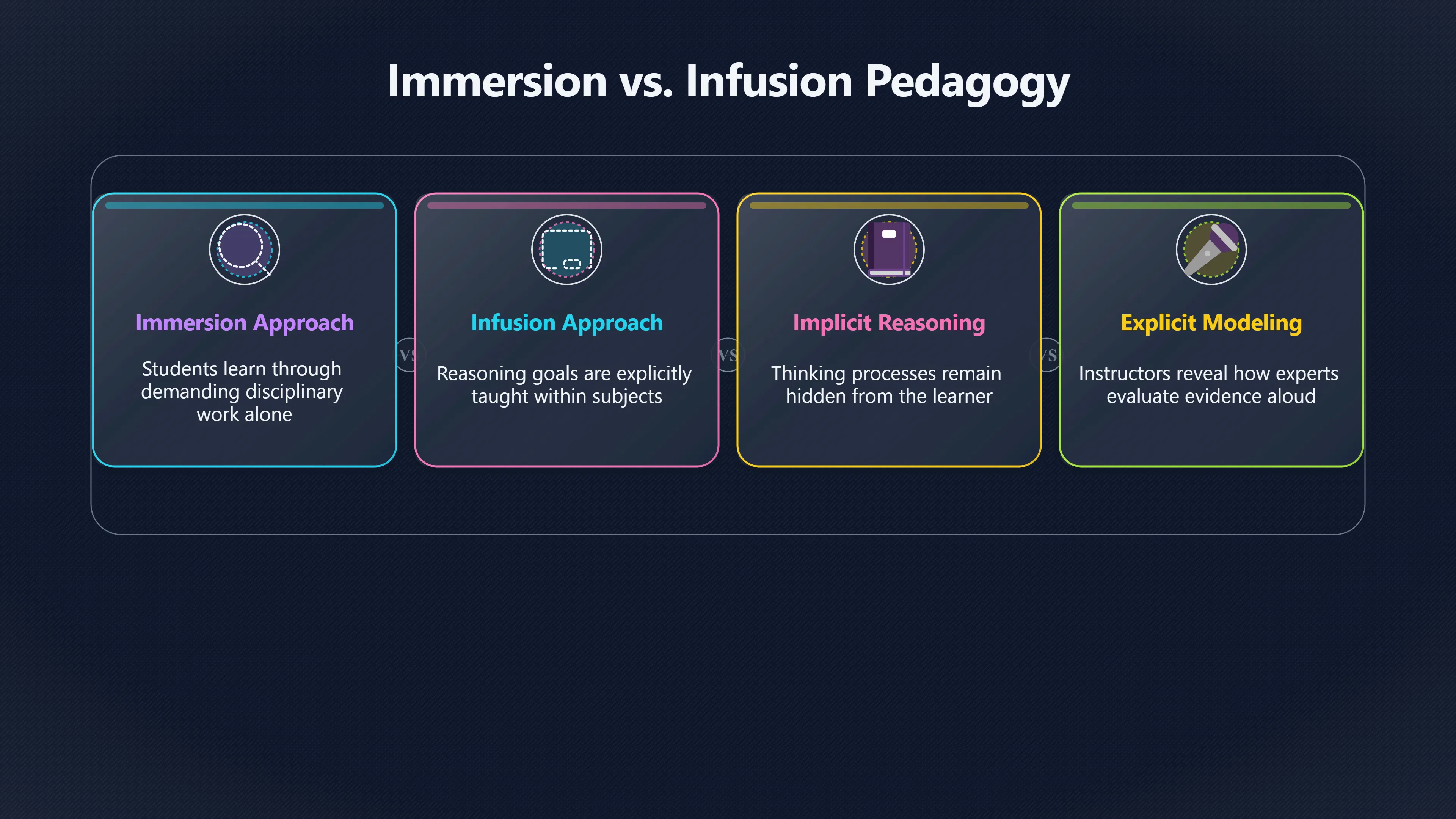
The immersion approach assumes that students will acquire critical thinking simply by engaging in demanding disciplinary work. A history student evaluates primary documents, a chemistry student designs experiments, or an engineering student solves complex design problems. The expectation is that repeated exposure to authentic intellectual work will naturally cultivate sound reasoning.
This approach has obvious strengths. Students work with genuine disciplinary problems rather than artificial exercises. They learn that reasoning is inseparable from subject knowledge, and they avoid treating critical thinking as an isolated school subject detached from real decisions.
The weakness is that many of the most important reasoning processes remain invisible. An instructor may ask students to “analyse”, “evaluate” or “justify” without ever explaining what distinguishes strong analysis from weak analysis. Students who already possess effective reasoning habits may improve further, while others simply imitate disciplinary conventions without understanding the reasoning behind them.
Research on higher education repeatedly identifies this hidden curriculum. Teachers often expect students to develop analytical abilities through participation in seminars, laboratory work or projects, yet rarely define the thinking processes being assessed. As a result, learners frequently mistake task completion for improved reasoning.[Taylor & Francis Online]tandfonline.comTaylor & Francis OnlineEnabling critical thinking development in higher education…by B Golden · 2023 · Cited by 170 — Ennis (Citation1…
Immersion also makes feedback less precise. A tutor may comment that an essay lacks depth or that an argument is weak without identifying the underlying reasoning error—for example:
- confusing evidence with interpretation;
- ignoring alternative explanations;
- relying on unsupported assumptions;
- drawing conclusions that exceed the available evidence.
Without explicit language for these reasoning moves, students may improve the assignment while leaving their thinking habits largely unchanged.
How infusion changes subject learning
Infusion keeps the authentic subject matter but makes critical thinking an explicit instructional goal.
Rather than assuming students will discover good reasoning independently, instructors identify the thinking skills required for success and teach them within normal disciplinary activities. The subject remains central, but reasoning is deliberately named, modelled, practised and assessed.
For example, in a history course an infusion lesson might require students to:
- distinguish factual claims from historical interpretation;
- compare competing explanations for the same event;
- identify assumptions within primary sources;
- explain why one body of evidence deserves greater weight than another.
In biology, students may be asked not simply to interpret experimental results but also to evaluate competing hypotheses, identify limitations in the experimental design and specify what additional evidence would change their conclusion.
The difference is subtle but important. The project has not changed; the instructional attention has shifted from merely completing the task to understanding how high-quality reasoning operates inside it.
Ennis’s influential classification distinguished infusion from immersion precisely on this basis: both teach through ordinary subjects, but only infusion explicitly teaches and evaluates critical thinking within those subjects.[Sage Journals]journals.sagepub.comSage JournalsStrategies for Teaching Students to Think CriticallyIn previous analyses of current approaches (e.g., Abrami et al., 2008)…
Why explicit reasoning improves learning
Infusion affects learning through several complementary mechanisms.
First, it creates a shared vocabulary. Students learn what teachers mean by evidence, inference, assumptions, validity and alternative explanations instead of inferring these concepts indirectly.
Second, instructors can model expert thinking aloud. Rather than presenting only finished answers, teachers reveal how experts decide which evidence matters, reject weak explanations and revise conclusions.
Third, assessment becomes aligned with reasoning. Instead of grading only factual accuracy or final products, instructors can reward the quality of justification, evaluation and decision-making.
Finally, explicit reasoning supports transfer. Students are more likely to recognise the same analytical pattern when it appears in another discipline because they have learned the underlying reasoning strategy rather than merely copying disciplinary routines.[Taylor & Francis Online+2PMC]tandfonline.comTaylor & Francis OnlineEnabling critical thinking development in higher education…by B Golden · 2023 · Cited by 170 — Ennis (Citation1…

What the evidence says about explicit versus implicit approaches
The research literature consistently finds that explicit approaches outperform purely implicit ones, although the size of the advantage depends on implementation.
John Ennis proposed four broad instructional models:
- General approach – critical thinking taught as a separate subject.[academypublication.com]academypublication.comAn Exploration into Research on Critical Thinking and Its…Paul stressed that these fundamental standards require being infused in all…
- Infusion – explicit thinking instruction embedded within disciplinary teaching.
- Immersion – subject teaching assumes thinking develops implicitly.
- Mixed approach – combines general instruction with infused disciplinary practice.[PMC]pmc.ncbi.nlm.nih.govHow to teach critical thinking: an experimental study with three…by A Orhan · 2022 · Cited by 53 — In the literature, approaches to…
Subsequent reviews have largely retained this framework.
The large meta-analysis by Abrami and colleagues examined hundreds of experimental and quasi-experimental comparisons and found that critical thinking can be taught successfully, but instructional design matters. Interventions that made critical-thinking objectives explicit generally produced stronger gains than approaches that expected improvement to emerge automatically from difficult coursework. The review also identified dialogue, authentic problems and mentoring as additional features associated with better outcomes.[Sage Journals]journals.sagepub.comSage JournalsStrategies for Teaching Students to Think CriticallyIn previous analyses of current approaches (e.g., Abrami et al., 2008)…
More recent reviews continue to reach similar conclusions. While immersion has educational value, particularly for developing disciplinary expertise, explicit and structured instruction tends to produce more consistent improvements in critical-thinking performance than implicit exposure alone.[Nature]nature.comEffectiveness of training actions aimed at improving critical…by JM Marcos-Vílchez · 2025 · Cited by 3 — The classic framework b…
Importantly, researchers do not argue that disciplinary knowledge is unimportant. Instead, they suggest that knowledge and explicit reasoning instruction reinforce one another. Strong thinking requires content to think about, but content alone is rarely sufficient.
When mixed courses add value
Many educators now favour a mixed model because it attempts to capture the advantages of both general and subject-specific instruction.
Students first encounter general reasoning concepts—such as evaluating evidence, recognising assumptions or identifying cognitive biases—in dedicated activities. They then revisit those same concepts repeatedly within disciplinary work.
For example, a university programme might introduce argument evaluation during a first-year academic skills course before requiring students to apply identical standards in economics, psychology, engineering and history modules.
This approach addresses a long-standing challenge in critical-thinking education: transfer. Students often perform well inside one subject yet fail to recognise similar reasoning demands elsewhere. Repeated exposure across different contexts helps them identify the underlying intellectual pattern rather than associating a reasoning strategy with only one discipline.
Recent higher-education research increasingly recommends institution-wide designs that integrate explicit critical-thinking outcomes across multiple courses while supporting instructors with shared frameworks, assessment criteria and professional development.[Taylor & Francis Online+2Nature]tandfonline.comTaylor & Francis OnlineEnabling critical thinking development in higher education…by B Golden · 2023 · Cited by 170 — Ennis (Citation1…
Why projects alone rarely teach thinking
Project-based learning, inquiry learning and authentic problem-solving are frequently promoted as ways to build analytical ability. They can do so—but only under particular conditions.
Projects improve thinking most reliably when students receive explicit guidance about how to reason during the project, not merely what product to deliver.
Successful infused projects typically include:
- clearly stated reasoning objectives alongside content objectives;
- examples of high-quality analytical thinking;
- structured opportunities for discussion and critique;
- feedback on reasoning quality rather than only correctness;
- reflection on how the same reasoning applies beyond the immediate task.
Without these features, students may become better at completing projects while preserving ineffective habits such as confirmation bias, premature conclusions or superficial evidence evaluation.
The practical lesson is not that projects fail, but that projects teach thinking only when thinking itself becomes part of the curriculum rather than an assumed consequence of challenging work.[Sage Journals+2PMC]journals.sagepub.comSage JournalsStrategies for Teaching Students to Think CriticallyIn previous analyses of current approaches (e.g., Abrami et al., 2008)…

Amazon book picks
Further Reading
Books and field guides related to Do Projects Teach Thinking by Themselves?. Use these as the next step if you want deeper reading beyond the article.
Making Thinking Visible
Shows how to embed thinking routines into classroom work rather than hoping projects teach thinking implicitly.
Creating Cultures of Thinking
Supports deliberate cultivation of thinking habits through culture, modelling, routines, and expectations.
Understanding by Design
Rating: 3.5/5 from 7 Google Books ratings
Helps teachers design subject learning around explicit understanding, transfer, and performance goals.
How Learning Works
Explains how prior knowledge, practice, feedback, and transfer shape learning outcomes.
eBay marketplace picks
Marketplace Samples
Live-tested eBay searches with available results related to this page.

Top pick
critical thinking game
Open a targeted eBay search for items related to this topic.
Browse eBay
Related search
critical thinking card game
Open a targeted eBay search for items related to this topic.
Browse eBay
Related search
teach poster
Open a targeted eBay search for items related to this topic.
Browse eBay
Related search
teach memorabilia
Open a targeted eBay search for items related to this topic.
Browse eBayEndnotes
1.
Source: pmc.ncbi.nlm.nih.gov
Link:https://pmc.ncbi.nlm.nih.gov/articles/PMC9244423/
Source snippet
How to teach critical thinking: an experimental study with three...by A Orhan · 2022 · Cited by 53 — In the literature, approaches to...
2.
Source: nature.com
Link:https://www.nature.com/articles/s41599-025-06143-6
Source snippet
Effectiveness of training actions aimed at improving critical...by JM Marcos-Vílchez · 2025 · Cited by 3 — The classic framework b...
3.
Source: journals.sagepub.com
Link:https://journals.sagepub.com/doi/10.3102/0034654314551063
Source snippet
Sage JournalsStrategies for Teaching Students to Think CriticallyIn previous analyses of current approaches (e.g., Abrami et al., 2008)...
4.
Source: tandfonline.com
Link:https://www.tandfonline.com/doi/full/10.1080/03323315.2023.2258497
Source snippet
Taylor & Francis OnlineEnabling critical thinking development in higher education...by B Golden · 2023 · Cited by 170 — Ennis (Citation1...
Additional References
5.
Source: researchgate.net
Title: 281952187 Strategies for Teaching Students to Think Critically A Meta Analysis
Link:https://www.researchgate.net/publication/281952187_Strategies_for_Teaching_Students_to_Think_Critically_A_Meta-Analysis
Source snippet
Strategies for Teaching Students to Think Critically: A Meta-...18 Jan 2026 — This article summarizes the available empirical evidence o...
6.
Source: youtube.com
Title: Teaching critical thinking at a master’s level
Link:https://www.youtube.com/watch?v=NeB4hpaiuXs
Source snippet
researchEDHome 2020 Greg Ashman: Explicit teaching, critical thinking and creativity...
7.
Source: ailact.wordpress.com
Link:https://ailact.wordpress.com/wp-content/uploads/2012/10/solon2006criticalthinkinginfusion.pdf
Source snippet
Critical Thinking Infusion and Course Content...Teaching critical thinking in a community college history course: Empirical evidence fro...
8.
Source: youtube.com
Link:https://www.youtube.com/watch?v=VFjBagtMCQg
Source snippet
How to teach critical thinking: in conversation with Prof. Rupert Wegerif...
9.
Source: youtube.com
Title: How to teach critical thinking: in conversation with Prof. Rupert Wegerif
Link:https://www.youtube.com/watch?v=ksorZ1umuOU
Source snippet
Introduction to Critical Thinking Fundamentals | Exclusive Lesson...
10.
Source: academypublication.com
Link:https://www.academypublication.com/issues2/tpls/vol07/12/14.pdf
Source snippet
An Exploration into Research on Critical Thinking and Its...Paul stressed that these fundamental standards require being infused in all...
11.
Source: files.eric.ed.gov
Link:https://files.eric.ed.gov/fulltext/EJ1249425.pdf
Source snippet
ERICby WLL Loh · 2020 · Cited by 8 — The current study will adopt the definitions of critical thinking conceptualized by Paul and Elder a...
12.
Source: youtube.com
Link:https://www.youtube.com/watch?v=EC2IYEWJ4Lc
Source snippet
Theory to Practice: Teaching Critical Thinking...
13.
Source: youtube.com
Title: Theory to Practice: Teaching Critical Thinking
Link:https://www.youtube.com/watch?v=8eWLWnoZms4
Topic Tree