Within Deliberate Practice
What else could explain this?
Generating rival explanations slows the jump from a plausible first story to a confident but poorly tested conclusion.
On this page
- Why the first plausible story feels convincing
- Alternative generation drills for everyday cases
- How to compare rival explanations fairly
Page outline Jump by section
Introduction
One of the most effective reasoning habits is deceptively simple: before becoming confident in your first explanation, deliberately ask what else could explain the same facts. This practice slows the natural tendency to settle on the first story that feels coherent and instead forces a comparison between competing possibilities. It is not about becoming indecisive. It is about making confidence depend on how well an explanation survives comparison with plausible alternatives rather than on how quickly it comes to mind.
 Within deliberate practice for reasoning, generating alternative explanations is a trainable skill rather than a personality trait. Research in psychology, judgement and decision-making, and diagnostic reasoning consistently shows that people become less vulnerable to confirmation bias and premature closure when they actively generate and test rival hypotheses instead of merely searching for evidence supporting their initial idea.[PubMed+2UC San Diego Pages]pubmed.ncbi.nlm.nih.govIn two separate but conceptually parallelConsidering the opposite: a corrective strategy for social…by CG Lord · 1984 · Cited by 1170 — Individuals who are induced to co…
Why the first plausible story feels convincing
Humans naturally seek coherence. Faced with incomplete information, the brain rapidly constructs a narrative that links the available facts. Once this narrative exists, it becomes the reference point against which new information is interpreted.
This tendency is closely related to confirmation bias: people preferentially notice, interpret and remember information that supports their existing explanation while overlooking evidence that would favour a different one. The process is usually unconscious rather than deliberate.[Encyclopedia Britannica+2UC San Diego Pages]britannica.comEncyclopedia BritannicaConfirmation bias | Definition, Examples, Psychology, & FactsAugust 1, 2016 — 11 Jun 2026 — Confirmation bias, peo…
Several mechanisms reinforce this effect:
- Fluency is mistaken for accuracy. A story that is easy to imagine often feels more likely than it really is.
- Early commitment shapes later search. Once an explanation is accepted, people begin collecting supporting evidence instead of asking whether another explanation would fit better.
- Confidence changes information gathering. Experimental work shows that higher confidence in an initial judgement increases selective information sampling, making people more likely to seek confirming evidence and less likely to search broadly.[PMC]pmc.ncbi.nlm.nih.govHumans actively sample evidence to support prior beliefs - PMCby P Kaanders · 2022 · Cited by 68 — Accordingly, we predict that confir…
The danger is not that the first explanation is always wrong. Often it is correct. The problem is that confidence becomes attached to arrival order rather than evidential strength.
Why deliberately generating alternatives improves reasoning
Generating alternative explanations changes the task from asking, “Can I explain this?” to asking, “Which explanation explains it best?”
This subtle shift produces several improvements.
First, it exposes hidden assumptions. An explanation that seemed inevitable often depends on assumptions that only become visible when another possibility is considered.
Second, it changes how evidence is evaluated. Instead of asking whether evidence fits a favourite explanation, the reasoner asks whether the evidence discriminates between competing explanations.
Third, it weakens motivated reasoning. Researchers Charles Lord, Mark Lepper and Elizabeth Preston found that simply instructing people to “consider the opposite” reduced several forms of biased judgement more effectively than merely telling participants to be objective or fair.[PubMed]pubmed.ncbi.nlm.nih.govIn two separate but conceptually parallelConsidering the opposite: a corrective strategy for social…by CG Lord · 1984 · Cited by 1170 — Individuals who are induced to co…
Importantly, the goal is not to generate endless possibilities. A few genuinely plausible rivals are usually enough to reveal whether the first explanation deserves confidence.
Alternative-generation drills for everyday cases
Like any reasoning skill, producing rival explanations improves with repetition.
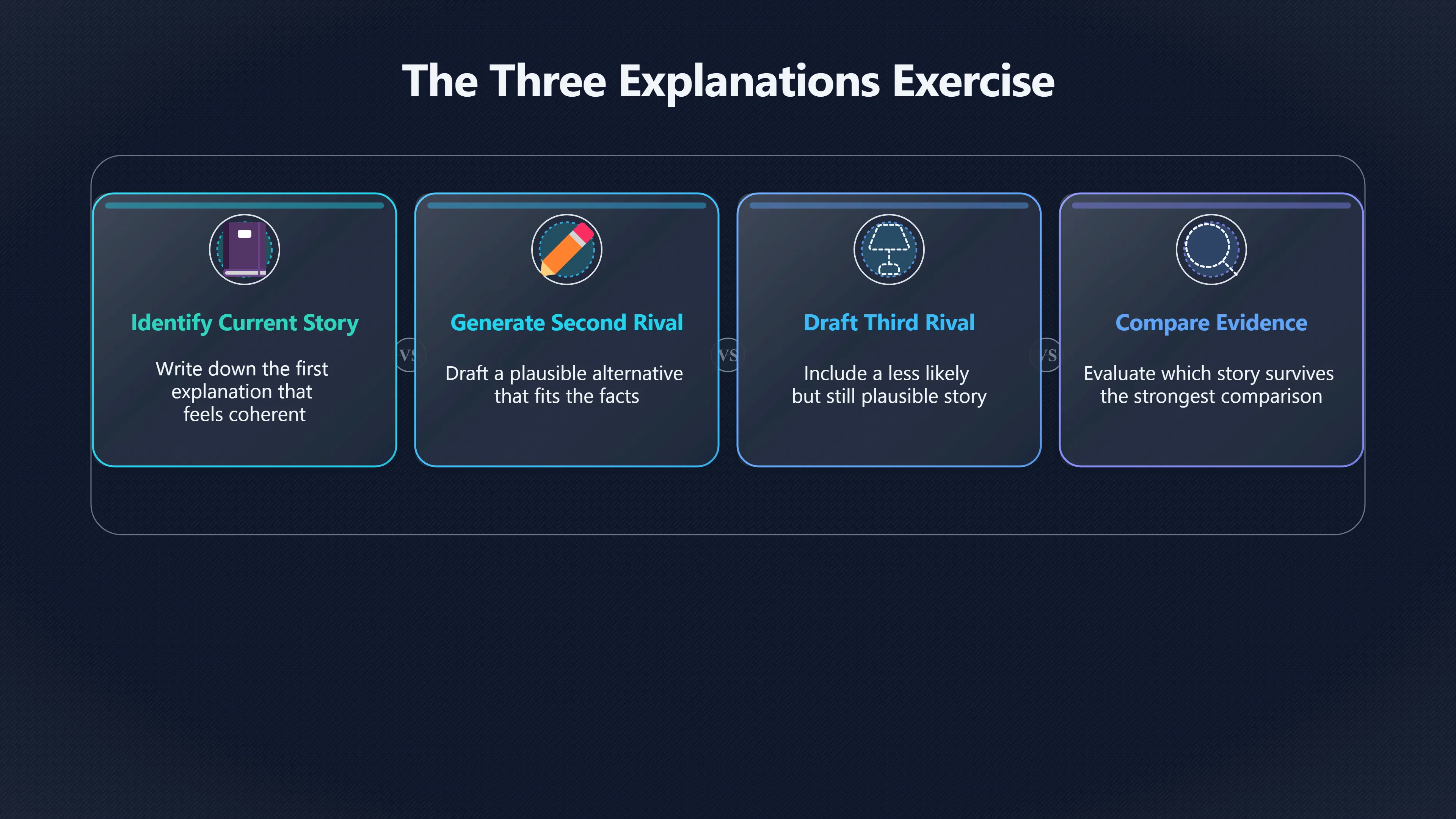
The “three explanations” exercise
Whenever a conclusion feels obvious, pause before accepting it.
Write down:
- Your current explanation.
- A second explanation that could also fit the evidence.
- A third explanation that initially seems less likely but remains plausible.
For example:
Observation: A colleague did not reply to an email.
Instead of stopping at:
- “They’re ignoring me.”
Also generate:
- “They have not seen the email.”
- “They are waiting for information before replying.”
- “The message was unclear or went to spam.”
The exercise is valuable even when the original explanation eventually proves correct because it trains the habit of separating plausibility from certainty.
Reverse your preferred conclusion
Suppose you believe:
“Project X failed because the team lacked competence.”
Ask instead:
“If that explanation were false, what would I expect to see?”
Possible alternatives might include:
- unclear objectives
- unrealistic deadlines
- inadequate resources
- changing customer requirements
This mirrors the experimentally supported “consider the opposite” strategy, which encourages active search for disconfirming possibilities rather than passive acceptance of a favoured interpretation.[PubMed]pubmed.ncbi.nlm.nih.govIn two separate but conceptually parallelConsidering the opposite: a corrective strategy for social…by CG Lord · 1984 · Cited by 1170 — Individuals who are induced to co…

Separate observations from explanations
Many reasoning mistakes arise because explanations are mistaken for observations.
Instead of writing:
“The customer was angry.”
Separate the layers:
Observed facts
- Raised voice.
- Short responses.
- Cancelled meeting.
Possible explanations
- Angry.
- Under severe time pressure.
- Distracted by another problem.
- Frustrated with a different issue entirely.
This makes it easier to compare hypotheses fairly.
How to compare rival explanations fairly
Generating alternatives is only the first step. They also need to be evaluated consistently.
Useful questions include:
- Which explanation accounts for the greatest number of observed facts?
- Which requires the fewest unsupported assumptions?
- Which makes predictions that could actually be tested?
- Which explanation would most surprise me if new evidence appeared?
- What evidence would clearly distinguish between these possibilities?
Notice that these questions compare explanations directly rather than asking whether one explanation is merely possible.
A useful practical habit is to score each explanation against the same evidence instead of evaluating only your preferred one. This reduces the temptation to apply stricter standards to competing ideas than to your own.
Lessons from diagnostic reasoning
Medicine provides one of the clearest examples of why alternative explanations matter.
Clinicians often generate several possible diagnoses early in an assessment rather than committing immediately to the first condition that matches a patient’s symptoms. The subsequent consultation is then used to collect evidence that distinguishes among these competing hypotheses.
This hypothetico-deductive approach is widely recognised in research on clinical reasoning. While experienced practitioners may recognise familiar patterns quickly, they still improve diagnostic accuracy by considering differential diagnoses rather than relying solely on the first plausible interpretation.[PMC+2Brighton University CRIS]pmc.ncbi.nlm.nih.govModels of clinical reasoning with a focus on general practiceby S YAZDANI · 2017 · Cited by 105 — Six models of clinical reasoning wer…
The lesson transfers well beyond medicine. Whether evaluating financial decisions, workplace conflicts, technical failures or news stories, the question is not simply “What explains this?” but “What competing explanations deserve consideration before I become confident?”
Common mistakes when generating alternatives
The practice is simple, but several traps reduce its effectiveness.
Inventing unrealistic alternatives. The purpose is not to imagine every conceivable possibility. Alternatives should remain plausible given the available evidence.
Stopping after one weak rival. People sometimes create a deliberately poor alternative that makes the preferred explanation appear stronger. The exercise works only when the competing explanations could genuinely be true.
Treating all explanations as equally likely. Generating alternatives does not imply that every possibility deserves equal confidence. The goal is proportional confidence based on comparative evidence.
Failing to update. Once new evidence clearly favours one explanation, continued attachment to every alternative becomes as unhelpful as premature certainty.
Turning the habit into deliberate practice
Improvement comes from repetition under realistic conditions.
Choose ordinary situations—a misunderstood conversation, a delayed delivery, a disappointing meeting, an unexpected result—and deliberately generate at least three explanations before deciding what happened. Afterwards, compare your initial explanation with what later evidence revealed.
Over time, success should not be measured by how often your first explanation is wrong. Instead, measure whether you become faster at recognising when several explanations fit the same facts, better at identifying evidence that distinguishes between them, and more willing to adjust confidence as new information appears.
The ultimate aim is not scepticism for its own sake. It is replacing premature certainty with disciplined comparison, allowing confidence to emerge from testing rival explanations rather than from whichever story arrived first.
Amazon book picks
Further Reading
Books and field guides related to What else could explain this?. Use these as the next step if you want deeper reading beyond the article.
Thinking, Fast and Slow
Explains confirmation bias, intuitive reasoning, and why generating alternative explanations improves judgment.
The Scout Mindset
Focuses on seeking truth over defending first impressions by actively exploring alternative possibilities.
The Art of Thinking Clearly
Covers common reasoning errors that make first explanations seem more convincing than they deserve.
How to Think About Weird Things: Critical Thinking for a New Age
Teaches structured comparison of competing explanations and evaluation of evidence.
eBay marketplace picks
Marketplace Samples
Example marketplace items related to this page. Use the search link to explore similar finds on eBay.

Endnotes
1.
Source: britannica.com
Link:https://www.britannica.com/science/confirmation-bias
Source snippet
Encyclopedia BritannicaConfirmation bias | Definition, Examples, Psychology, & FactsAugust 1, 2016 — 11 Jun 2026 — Confirmation bias, peo...
Published: August 1, 2016
2.
Source: pmc.ncbi.nlm.nih.gov
Link:https://pmc.ncbi.nlm.nih.gov/articles/PMC9038198/
Source snippet
Humans actively sample evidence to support prior beliefs - PMCby P Kaanders · 2022 · Cited by 68 — Accordingly, we predict that confir...
3.
Source: pmc.ncbi.nlm.nih.gov
Link:https://pmc.ncbi.nlm.nih.gov/articles/PMC5611427/
Source snippet
Models of clinical reasoning with a focus on general practiceby S YAZDANI · 2017 · Cited by 105 — Six models of clinical reasoning wer...
4.
Source: pubmed.ncbi.nlm.nih.gov
Title: In two separate but conceptually parallel
Link:https://pubmed.ncbi.nlm.nih.gov/6527215/
Source snippet
Considering the opposite: a corrective strategy for social...by CG Lord · 1984 · Cited by 1170 — Individuals who are induced to co...
5.
Source: pages.ucsd.edu
Title: nickerson Confirmation Bias
Link:https://pages.ucsd.edu/~mckenzie/nickersonConfirmationBias.pdf
Source snippet
Bias: A Ubiquitous Phenomenon in Many...by RS Nickerson · 1998 · Cited by 12455 — Confirmation bias, as the term is typically used in th...
6.
Source: cris.brighton.ac.uk
Link:https://cris.brighton.ac.uk/ws/portalfiles/portal/5965194/Final_PhD_permanent_bound_Thesis_Annamaria_Witheridge_October_2018.pdf
Source snippet
Brighton University CRISDIAGNOSTIC REASONING IN PRIMARY CARE - Sign inby AB WITHERIDGE · 2018 · Cited by 4 — In hypothetico-deductive rea...
7.
Source: pubmed.ncbi.nlm.nih.gov
Link:https://pubmed.ncbi.nlm.nih.gov/2182962/
Source snippet
knowledge and hypothesis generation in...by GM Joseph · 1990 · Cited by 318 — The role of [domain knowledge]({{ 'domain-knowledge/' | relative_url }}) in the process of hypothesis...
8.
Source: Wikipedia
Title: Confirmation bias
Link:https://en.wikipedia.org/wiki/Confirmation_bias
Source snippet
Confirmation biasConfirmation bias is the tendency to search for, interpret, favor and recall information in a way that confirms or su...
9.
Source: criticalthinkingacademy.net
Title: They recruited a group of 48 students
Link:https://criticalthinkingacademy.net/blog/confirmation-bias.html
Source snippet
Confirmation bias - Critical Thinking AcademyLord, Ross and Lepper (1979) conducted a study to see if people change their opinions in the...
Additional References
10.
Source: researchgate.net
Link:https://www.researchgate.net/publication/316486755_Cognitive_Biases_and_Their_Influence_on_Critical_Thinking_and_Scientific_Reasoning_A_Practical_Guide_for_Students_and_Teachers
Source snippet
Cognitive Biases and Their Influence on Critical Thinking...21 Jul 2023 — Researchers have discovered 200 cognitive biases that result i...
11.
Source: researchgate.net
Link:https://www.researchgate.net/publication/5640944_Diagnostic_Hypothesis_Generation_and_Human_Judgment
Source snippet
Diagnostic Hypothesis Generation and Human JudgmentThe authors introduce a general model of human judgment aimed at describing how people...
12.
Source: thedecisionlab.com
Link:https://thedecisionlab.com/biases
13.
Source: journals.sagepub.com
Link:https://journals.sagepub.com/doi/10.1177/17456916231204579
Source snippet
Sage JournalsToward a General Framework of Biased ReasoningWe apply this framework to explain a variety of well-established biased forms...
14.
Source: communicationcache.com
Title: multiple explanation a consider an alternative strategy for [debiasing]({{ ‘debiasing/’ | relative_url }}) judgments
Link:https://www.communicationcache.com/uploads/1/0/8/8/10887248/multiple_explanation-_a_consider-an-alternative_strategy_for_debiasing_judgments.pdf
Source snippet
A Consider-an-Alternative Strategy for Debiasing Judgmentsby ER Hirt · 1995 · Cited by 469 — Previous research has suggested that an effe...
15.
Source: semanticscholar.org
Link:https://www.semanticscholar.org/paper/Considering-the-opposite%3A-a-corrective-strategy-for-Lord-Lepper/e71bbae72f8ad78e97c54f5ec88c9af2c70759f2
Source snippet
Considering the opposite: a corrective strategy for social...Confirmation bias is the tendency to seek out information or interpret...
16.
Source: researchgate.net
Title: Considering the opposite: A corrective strategy for social
Link:https://www.researchgate.net/publication/374663322_Considering_the_opposite_A_corrective_strategy_for_social_judgment
Source snippet
Proposes that several biases in social judgment result from a failure to consider possibilities at odds with beliefs and perceptions of t...
17.
Source: academia.edu
Link:https://www.academia.edu/3723863/Considering_the_opposite_A_corrective_strategy_for_social_judgment
Source snippet
first noted by Francis Bacon-to consider possibilities at odds with beliefs and...
18.
Source: aclanthology.org
Link:https://aclanthology.org/2025.naacl-long.429.pdf
Source snippet
Generating Diverse Hypotheses for Inductive Reasoningby K Lee · 2025 · Cited by 7 — First, output a hypothesis for the transformation in...
19.
Source: researchgate.net
Title: In two separate but conceptually
Link:https://www.researchgate.net/publication/16669522_Considering_the_Opposite_A_Corrective_Strategy_for_Social_Judgment
Source snippet
Considering the Opposite: A Corrective Strategy for Social...4 Oct 2015 — Individuals who are induced to consider the opposi...
Topic Tree