Within Probabilities
What Matters Most When Values Clash?
Weighted criteria make conflicting values visible when no option wins on every important dimension.
On this page
- How to choose criteria that matter
- How weights change the preferred option
- How sensitivity checks reveal fragile choices
Page outline Jump by section
Introduction
When two or more options each satisfy different values, there is often no objectively “correct” answer. The challenge is not simply gathering more facts but deciding how much different considerations—such as cost, safety, fairness, speed, flexibility or environmental impact—should count. Weighted criteria provide a structured way to make those value judgements explicit rather than leaving them hidden or inconsistent.
 This approach is widely used in multi-criteria decision analysis (MCDA), a family of methods designed for decisions involving competing objectives. Instead of pretending that every criterion matters equally, it asks decision-makers to identify the factors that genuinely matter, assign each an appropriate importance, and examine how different options perform against those priorities. Modern government guidance, including the UK Green Book’s supplementary guidance on MCDA, recommends this approach where options must be judged across several objectives that cannot easily be reduced to a single monetary measure.[GOV.UK]GOV.UKuse of multi criteria decision analysis in options appraisal of economic casesUse of Multi-Criteria Decision Analysis in options appraisal…16 May 2024 — MCDA is a technique that helps decision-makers make rationa…
Why weighting matters when values conflict
Many difficult choices involve competing values rather than competing facts.
For example:
- A transport project may maximise economic growth but reduce local green space.
- A software platform may offer greater flexibility but lower security.
- A job offer may increase income while reducing family time.
- A healthcare intervention may improve outcomes but cost substantially more.
Simply listing pros and cons rarely resolves these conflicts because it leaves unanswered the crucial question: which considerations deserve greater influence?
Weighted criteria force that conversation into the open. Instead of saying “both cost and quality matter”, the decision process asks whether quality is slightly more important than cost, twice as important, or perhaps less important in this particular decision. That distinction often explains why reasonable people reach different conclusions even when they agree on the facts. MCDA is specifically intended for these situations involving multiple conflicting objectives and diverse stakeholder preferences.[GOV.UK+2analysisfunction.civilservice.gov.uk]GOV.UKuse of multi criteria decision analysis in options appraisal of economic casesUse of Multi-Criteria Decision Analysis in options appraisal…16 May 2024 — MCDA is a technique that helps decision-makers make rationa…
How to choose criteria that matter
Good criteria describe the objectives of the decision, not simply convenient measurements.[youtube.com]youtube.comrecursor to a lot of algorithms and scoring…
Useful criteria generally share several characteristics:
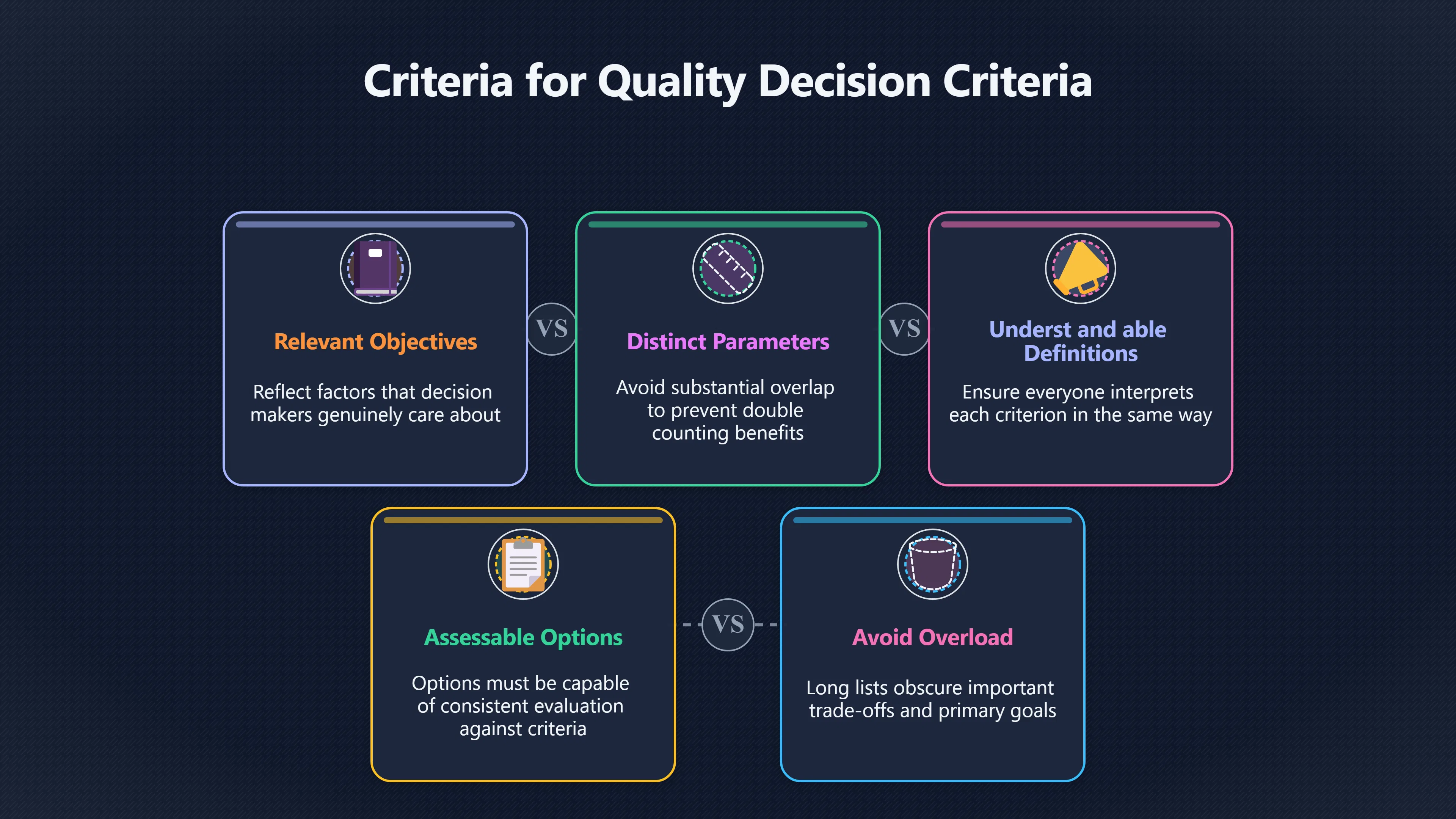
- Relevant: Each criterion reflects something decision-makers genuinely care about.
- Distinct: Criteria should avoid substantial overlap that would count the same benefit twice.
- Understandable: Everyone involved should interpret each criterion in the same way.
- Assessable: Options should be capable of being evaluated consistently against the criterion.
For example, when selecting between office locations, criteria might include:
CriterionWhy it mattersStaff travel timeProductivity and employee wellbeingAnnual operating costFinancial sustainabilityExpansion potentialFuture flexibilityEnvironmental performanceOrganisational sustainability goalsAccessibilityEqual access for employees and visitors
Notice that these criteria express objectives rather than preferred options. “Close to headquarters” is not itself a criterion unless proximity serves a broader objective such as collaboration or reduced travel.
A common mistake is creating too many criteria. Long lists often contain duplicated ideas or minor considerations that obscure the genuinely important trade-offs. Government MCDA guidance recommends carefully structuring objectives before assigning weights because unclear criteria produce misleading results regardless of how sophisticated the scoring becomes.[GOV.UK]GOV.UKuse of multi criteria decision analysis in options appraisal of economic casesUse of Multi-Criteria Decision Analysis in options appraisal…16 May 2024 — MCDA is a technique that helps decision-makers make rationa…
How weights change the preferred option
Weights express relative importance, not absolute importance.[people.cs.nott.ac.uk]people.cs.nott.ac.ukCriteria Decision Analysis: A Primerby PO Siebers — Assign weights for each of the criterion to reflect their relative importance to the…
Imagine three criteria:
CriterionWeightSafety50%Cost30%Flexibility20%
Suppose Option A scores exceptionally well on safety but poorly on flexibility, while Option B performs moderately well across all three.
If safety receives half of the total weight, Option A may clearly emerge as the preferred choice.
However, if flexibility becomes much more important—for example because future uncertainty has increased—the weights might change to:
- Safety: 35%
- Cost: 25%
- Flexibility: 40%
Without changing any factual information about the options, Option B could now become the better overall choice.
Nothing “went wrong”. The preferred option changed because the underlying values changed.
This illustrates an important principle: weighted analysis does not discover hidden objective truth. Instead, it makes explicit how stated priorities produce particular recommendations.
Assigning weights thoughtfully
The exact numerical values matter less than the reasoning behind them.
Several approaches are commonly used:
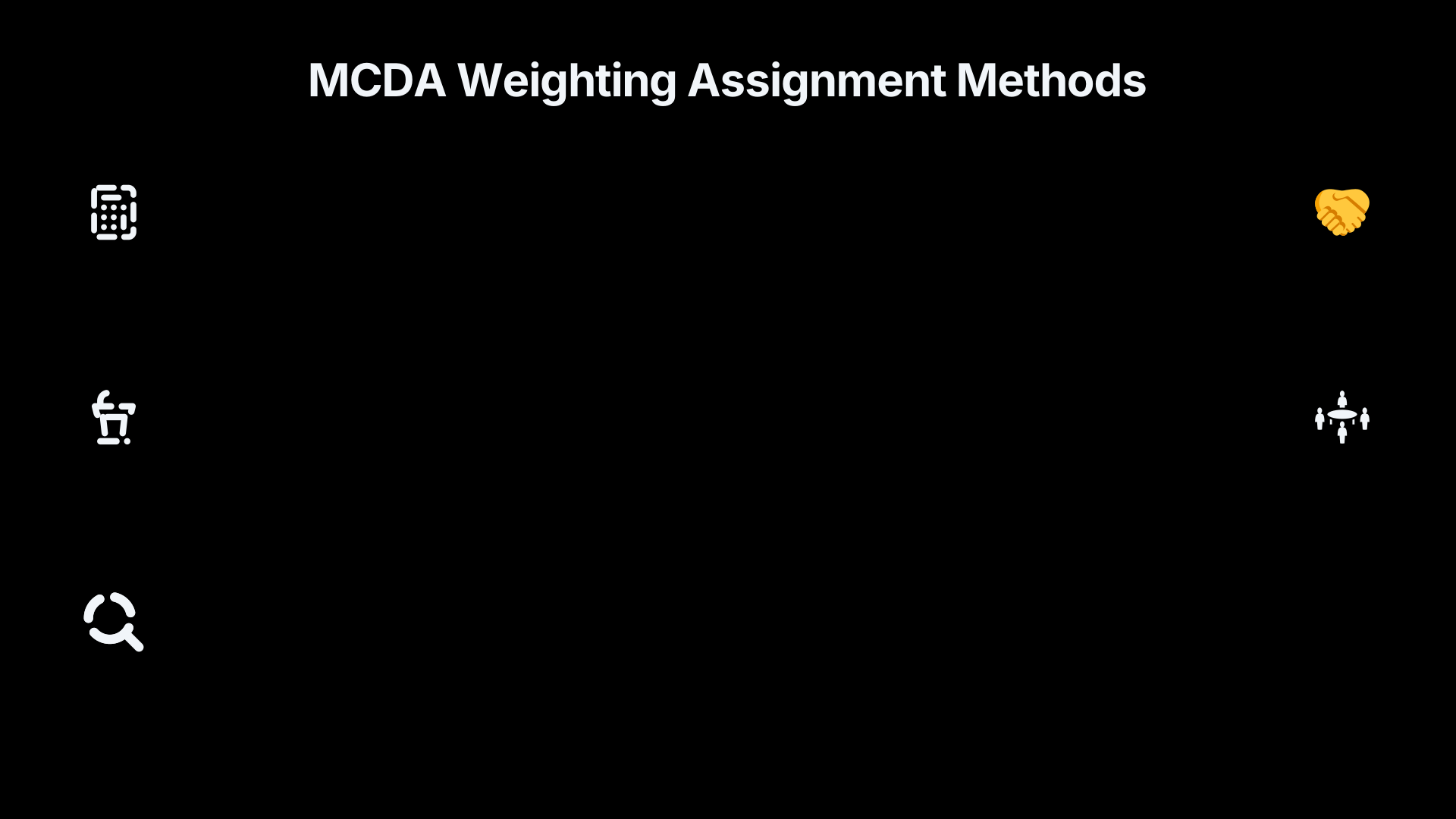
- Direct allocation: Distribute 100 points across the criteria according to importance.
- Pairwise comparison: Compare two criteria at a time, asking which matters more and by how much.
- Ranking followed by refinement: Order criteria first, then estimate the relative gaps between them.
- Stakeholder elicitation: Combine or compare weights from different participants when multiple perspectives must be represented.
Pairwise comparison is often easier than assigning numbers immediately because people generally find relative judgements more natural than absolute percentages.
Whatever approach is used, the discussion that produces the weights is often more valuable than the final numbers themselves. Disagreements about weights frequently reveal hidden assumptions, conflicting organisational priorities or different understandings of the decision’s purpose. Research reviewing MCDA methods consistently identifies preference elicitation—the process of identifying and expressing stakeholder priorities—as a central stage rather than a technical afterthought.[PMC]pmc.ncbi.nlm.nih.govHow to support the application of multiple criteria decision…by M Cinelli · 2020 · Cited by 518 — We introduce a review of the rese…
How sensitivity checks reveal fragile choices
A weighted decision should never end with a single calculated score.
Instead, ask:
- What happens if one important weight increases by 10%?
- Does the preferred option remain the same?
- Which weight would need to change before another option becomes preferable?
- Are there criteria where small disagreements completely alter the ranking?
These questions form the basis of sensitivity analysis.
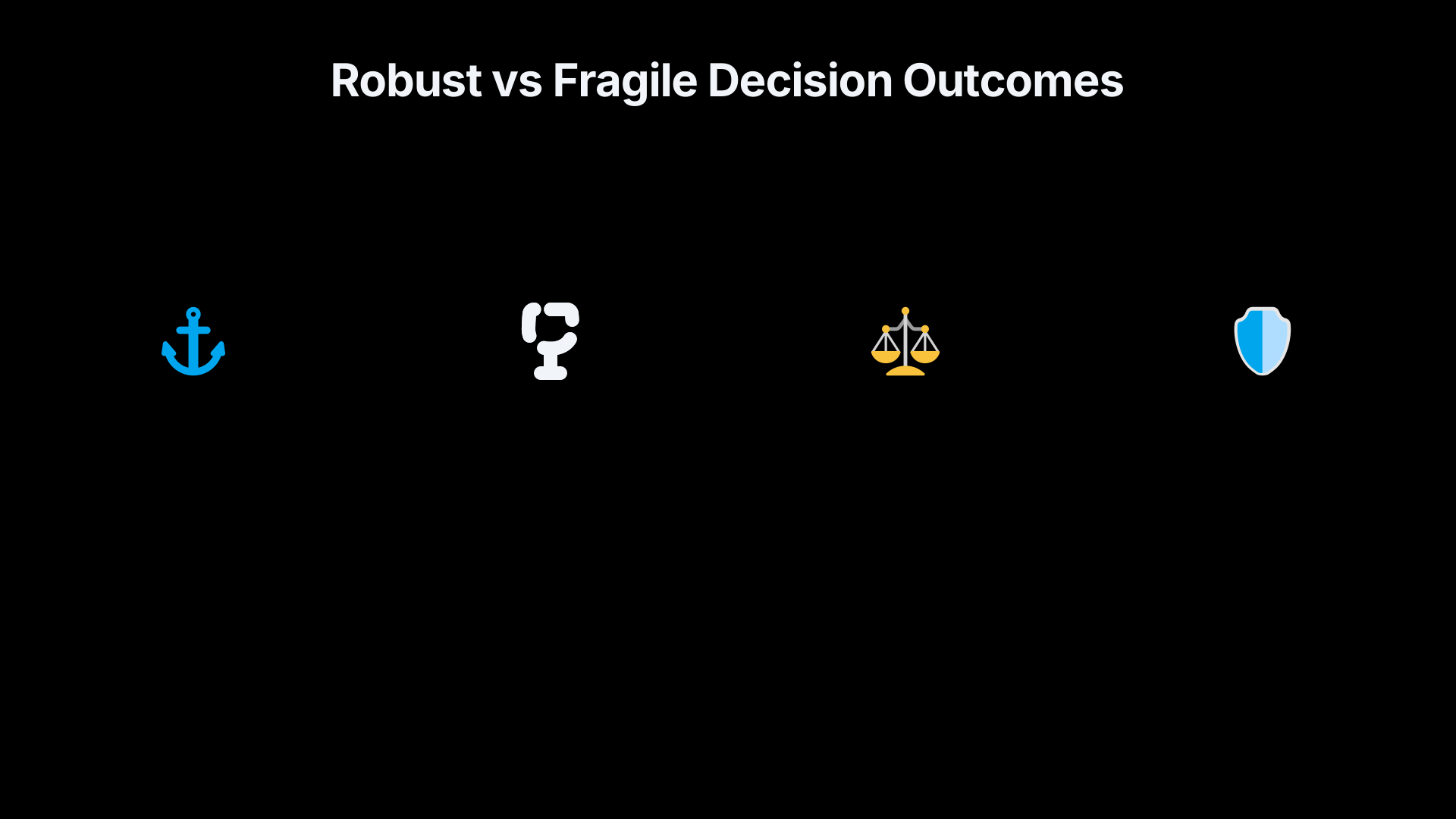
Sensitivity analysis tests whether a recommendation is robust or fragile.
A robust decision continues to favour the same option even when reasonable changes are made to the weights.
A fragile decision changes winner after only small adjustments. This does not invalidate the analysis, but it signals that the recommendation depends heavily on assumptions about priorities rather than overwhelming evidence.
For example:
- If increasing the weight on cost from 25% to 28% changes the preferred option, the decision is highly sensitive.
- If the preferred option remains unchanged even when several weights move substantially, confidence in the recommendation increases.
Modern MCDA guidance consistently recommends sensitivity analysis because weight estimates are never perfectly precise. Exploring plausible alternative weightings is therefore part of responsible implementation rather than an optional extra.[GOV.UK+2SixSigma.us]GOV.UKuse of multi criteria decision analysis in options appraisal of economic casesUse of Multi-Criteria Decision Analysis in options appraisal…16 May 2024 — MCDA is a technique that helps decision-makers make rationa…
Common mistakes when weighting values
Several recurring errors reduce the usefulness of weighted criteria.
Confusing importance with performance. A criterion’s weight reflects how important it is, not how well a particular option performs.
Double-counting. Closely related criteria such as “customer satisfaction”, “ease of use” and “user experience” may partly measure the same objective.
Using arbitrary numbers. Precise-looking weights like 17.3% create an illusion of certainty if no meaningful reasoning supports them.
Ignoring stakeholders. Different groups often value outcomes differently. Using only one person’s weights can hide important disagreements.
Treating scores as objective truth. Weighted scores organise judgement; they do not replace judgement.
The UK government’s guidance emphasises that MCDA supports decision-making rather than mechanically determining decisions. Decision-makers may still consider broader contextual issues that cannot be fully represented within a scoring framework.[GOV.UK]GOV.UKuse of multi criteria decision analysis in options appraisal of economic casesUse of Multi-Criteria Decision Analysis in options appraisal…16 May 2024 — MCDA is a technique that helps decision-makers make rationa…
Using weighted criteria in everyday thinking
Weighted criteria are useful well beyond formal policy appraisal.
In personal and professional decisions they can help with choices such as:
- comparing job offers
- prioritising projects
- selecting suppliers
- evaluating investment opportunities
- choosing between competing strategic initiatives
The objective is not mathematical precision. It is disciplined thinking.
Making criteria explicit, assigning defensible weights and checking whether conclusions survive reasonable changes encourages more transparent reasoning. It separates disagreements about evidence from disagreements about values and makes it easier to explain why one option is preferred when no alternative is superior on every dimension.
Endnotes
1.
Source: GOV.UK
Title: use of multi criteria decision analysis in options appraisal of economic cases
Link:https://www.gov.uk/government/publications/green-book-supplementary-guidance-multi-criteria-decision-analysis/use-of-multi-criteria-decision-analysis-in-options-appraisal-of-economic-cases
Source snippet
Use of Multi-Criteria Decision Analysis in options appraisal...16 May 2024 — MCDA is a technique that helps decision-makers make rationa...
Published: May 2024
2.
Source: analysisfunction.civilservice.gov.uk
Title: an introductory guide to mcda
Link:https://analysisfunction.civilservice.gov.uk/policy-store/an-introductory-guide-to-mcda/
Source snippet
An Introductory Guide to Multi-Criteria Decision Analysis...1 May 2024 — MCDA is a way of helping decision-makers rationally choose betw...
Published: May 2024
3.
Source: pmc.ncbi.nlm.nih.gov
Link:https://pmc.ncbi.nlm.nih.gov/articles/PMC7970504/
Source snippet
How to support the [application]({{ 'application/' | relative_url }}) of multiple criteria decision...by M Cinelli · 2020 · Cited by 518 — We introduce a review of the rese...
4.
Source: pmc.ncbi.nlm.nih.gov
Link:https://pmc.ncbi.nlm.nih.gov/articles/PMC10318338/
Source snippet
Using multi-criteria decision analysis to describe stakeholder...by S Khanal · 2023 · Cited by 7 — MCDA is an umbrella term that desc...
5.
Source: GOV.UK
Title: green book supplementary guidance multi criteria decision analysis
Link:https://www.gov.uk/government/publications/green-book-supplementary-guidance-multi-criteria-decision-analysis
Source snippet
Book supplementary guidance: multi-criteria...21 Apr 2013 — This note provides a brief guide for analysts and policymakers who wish to a...
6.
Source: 6sigma.us
Title: Six Sigma.us Multi Criteria Decision Analysis (MCDA)
Link:https://www.6sigma.us/six-sigma-in-focus/multi-criteria-decision-analysis-mcda/
Source snippet
All You Need to...18 Apr 2024 — Sensitivity analysis examines how changes in criteria weights or alternative evaluations affect the fina...
7.
Source: pmc.ncbi.nlm.nih.gov
Title: PMCA Review and Classification of Approaches for Dealing
Link:https://pmc.ncbi.nlm.nih.gov/articles/PMC4544539/
Source snippet
by H Broekhuizen · 2015 · Cited by 175 — Multi-criteria decision analysis (MCDA) is increasingly used to support decisions in healthca...
8.
Source: youtube.com
Link:https://www.youtube.com/watch?v=GDEWaMIBIE0
Source snippet
recursor to a lot of algorithms and scoring...
Additional References
9.
Source: researchgate.net
Link:https://www.researchgate.net/post/How_many_implementations_of_sensitivity_analysis_regarding_multiple_criteria_decision_making_MCDM_methods
Source snippet
How many implementations of sensitivity analysis...10 Jul 2021 — I want to know which ways are common sensitivity analysis that are perf...
10.
Source: researchgate.net
Link:https://www.researchgate.net/publication/30529921_Multi-Criteria_Analysis_A_Manual
Source snippet
(PDF) Multi-Criteria Analysis: A ManualThe final stage of the decision making process is the actual choice of option. This needs to be se...
11.
Source: primarycareone.nhs.wales
Link:https://primarycareone.nhs.wales/tools/healthcare-public-health-framework-toolkit/population-healthcare-framework-toolkit-resource/mcda-and-pbma-002-pptx/
Source snippet
nhs.walesMulti-Criteria Decision Analysis (MCDA)- Combine the weights and scores for each option and derive an overall value. - Analyse a...
12.
Source: netzerogo.org.uk
Link:https://netzerogo.org.uk/resources/green-book-supplementary-guidance-use-of-multi-criteria-decision-analysis/
Source snippet
d policymakers who wish to apply Multi-Criteria Decision Analysis (MCDA) in policy...Read more...
13.
Source: nationalpreparednesscommission.uk
Link:https://nationalpreparednesscommission.uk/news/introductory-guide-to-multi-criteria-decision-analysis-mcda/
Source snippet
ments to assist decision-makers in choosing between options with conflicting...Read more...
14.
Source: youtube.com
Title: Weighing Your Options: A Step-by-Step Guide to the Weighted Decision Matrix
Link:https://www.youtube.com/watch?v=RYVS3T_9H6o
Source snippet
How to Make Complex Decisions: Multi-Criteria Decision Analysis (MCDA) - YouTube How to Make Complex Decisions: Multi-Criteria Decision A...
15.
Source: linkedin.com
Link:https://www.linkedin.com/pulse/multi-criteria-decision-analysis-update-green-book-amarvir-singh-bal-eyojc
Source snippet
es by comparing them across multiple criteria or performance...Read more...
16.
Source: 1000minds.com
Link:https://www.1000minds.com/decision-making/what-is-mcdm-mcda
Source snippet
tiple criteria (or objectives) need to be considered together.Read more...
17.
Source: people.cs.nott.ac.uk
Link:https://people.cs.nott.ac.uk/pszps/docs/pos-MCDA.pdf
Source snippet
Criteria Decision Analysis: A Primerby PO Siebers — Assign weights for each of the criterion to reflect their relative importance to the...
18.
Source: linkedin.com
Link:https://www.linkedin.com/pulse/multi-criteria-decision-analysis-mcda-deepak-singh-yv0le
Source snippet
ious factors and their relative importance.Read more...
Topic Tree