Within Job Offers
What If the Offer Goes Wrong?
Thinking through base, upside and downside cases helps you price uncertainty before a bonus, equity grant or exciting title sways you.
On this page
- Base, upside and downside cases for the first year
- Bonuses, equity and start up risk under uncertainty
- Exit options if the role is mis sold
Page outline Jump by section
Introduction
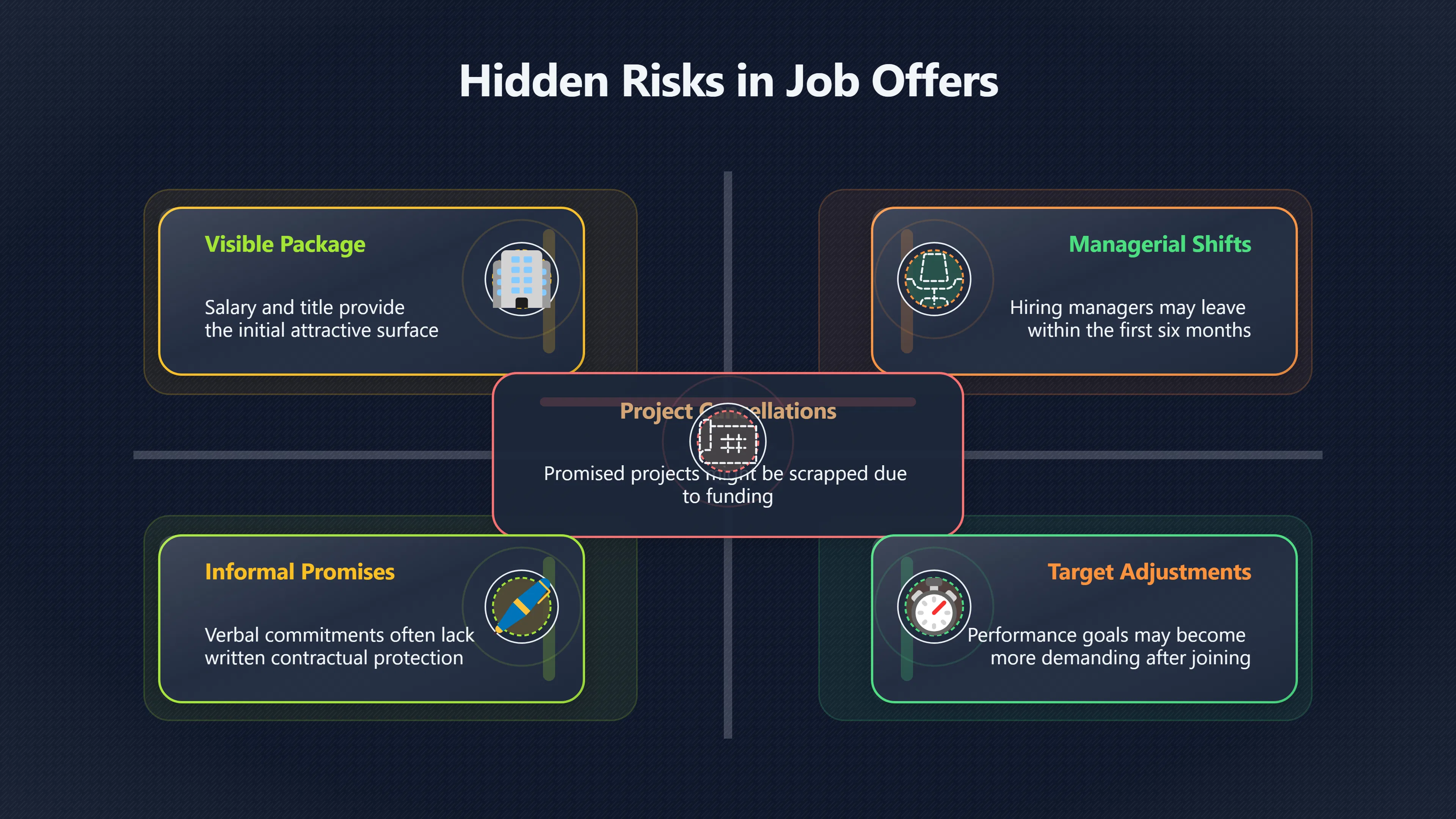
Every job offer contains uncertainty. The visible parts of the package—salary, title and benefits—can distract from risks that only become apparent after you join: a manager leaves, promised bonuses fail to materialise, funding tightens, priorities change, or the role turns out to be very different from the interview. Thinking explicitly about downside scenarios is not pessimism. It is a practical way to improve decision quality by testing whether an offer still makes sense if important assumptions prove wrong.
 A useful approach is to compare a realistic base case, an optimistic upside case and a credible downside case for the first year. This helps separate attractive opportunities from offers that only look good if everything goes perfectly.
Base, upside and downside cases for the first year
Instead of asking whether an offer is “good”, ask what is most likely to happen under three different but plausible scenarios.
ScenarioTypical assumptionsQuestions to askBase caseMost promises are delivered, normal performance, business remains stableWould I still be happy if everything is merely average?Upside caseStrong performance, rapid learning, promotion opportunities, higher bonusHow much additional value is genuinely achievable?Downside caseReorganisation, weak manager, lower bonus, changing priorities, slower growthCould I tolerate this outcome financially and professionally?
The base case should reflect normal business conditions rather than the most optimistic recruiting pitch. The downside case should not assume disaster, but it should include events that occur regularly across organisations, such as restructurings, delayed projects, leadership changes or tighter budgets.
A useful test is to identify the assumptions that matter most. If the offer only looks attractive because you expect an exceptional bonus, rapid promotion or an unusually supportive manager, your decision depends heavily on events you cannot control.
Common first-year downside scenarios include:
- Your hiring manager leaves within six months.
- Performance targets become more demanding after joining.
- Expected hybrid or remote working arrangements change.
- A promised project is cancelled.
- Team restructuring changes your responsibilities.
- The probation period is extended or expectations become unclear.
- Recruitment promises were informal rather than written into the contract.
Thinking through these possibilities helps distinguish between manageable uncertainty and unacceptable risk.
Bonuses, equity and start-up risk under uncertainty
Variable compensation deserves separate analysis because it often carries more uncertainty than base salary.
Bonuses are not guaranteed income
Many candidates unconsciously treat a target bonus as part of their annual salary. In reality, bonus payments usually depend on combinations of company performance, business unit results and individual objectives.
Questions worth asking include:
- How often has the company actually paid the target bonus?
- Are bonus targets objective or discretionary?
- Must you still be employed on the payment date?
- What happens if objectives change during the year?
- Are new employees eligible immediately?
Research reviewed by the Chartered Institute of Personnel and Development (CIPD) shows that financial incentives can improve performance, but their effectiveness depends heavily on perceived fairness and transparent processes. Employees respond less positively when reward systems appear arbitrary or poorly explained.[CIPD]cipd.orgFinancial incentives: an evidence reviewFinancial incentives: an evidence review - scentific summaryJanuary 21, 2022 — In the realm of financial incentives, a recent longitu…
Rather than valuing a bonus at its maximum advertised amount, estimate an expected value based on realistic probabilities.
Equity can be valuable—or worth very little
Equity compensation introduces another layer of uncertainty.
Questions to investigate include:
- What percentage ownership do the shares actually represent?
- What is the current valuation based on?
- How long is the vesting schedule?
- What happens if you leave before vesting?
- Are there restrictions on selling shares?
- Has the company previously raised funding successfully?
Many employees mentally anchor on impressive headline valuations without considering dilution, future fundraising, tax consequences or the possibility that there may never be a liquidity event.
A useful analytical habit is to separate:
- Guaranteed value: salary and contractual benefits.
- Probable value: bonuses based on realistic performance.
- Speculative value: equity whose eventual worth may range from zero to substantial gains.
Treating speculative compensation as guaranteed income increases decision risk.

Start-up uncertainty is broader than failure
People often think only about bankruptcy when assessing start-up risk. In practice, more common issues include changing priorities, delayed fundraising, product pivots, management turnover and repeated organisational restructuring.
Young firms often offer faster learning, broader responsibilities and potentially significant upside. However, they may also experience greater operational uncertainty than established employers, even if they compensate employees through higher salaries or more secure contract terms in some cases. OECD research suggests that once comparable workers are considered, young firms can offer competitive pay and permanent contracts, illustrating that start-up risk cannot be judged from company age alone. The important question is how individual firms manage uncertainty rather than assuming all start-ups are either highly risky or exceptionally rewarding.[OECD]oecd.orgDo start-ups provide better jobs? What new…18 Nov 2025 — New OECD analysis using data from France and Portugal challenges the assu…
Useful indicators include:
- cash runway and recent funding;
- customer concentration;
- leadership stability;
- hiring pace relative to revenue;
- employee turnover;
- whether growth depends on future investment rounds.
What if the role is mis-sold?
Not every disappointing role results from deliberate deception. Interviews naturally emphasise attractive aspects of the job, while changing business conditions can alter priorities before a new employee even starts.
However, some warning signs deserve closer attention:
- Interviewers describe the role inconsistently.
- Responsibilities remain unusually vague.
- Multiple interviewers give conflicting answers about reporting lines.
- High turnover is dismissed without explanation.
- Success measures cannot be clearly described.
- Important promises are made verbally but omitted from written documentation.
The best defence is evidence rather than optimism. Ask for examples of recent projects, team structure, typical performance objectives and how success is evaluated after six or twelve months.
Planning your exit before you need it
Considering exit options is not a sign that you expect failure. It reduces the emotional pressure to accept unnecessary risk.
Before accepting an offer, consider:
- Financial resilience. How many months could you manage if the role ended unexpectedly?
- Transferable skills. Would the experience strengthen your CV even if the company struggled?
- Professional network. Will you continue building relationships outside the organisation?
- Contract terms. Understand probation arrangements, notice periods, restrictive covenants and any repayment clauses for bonuses or training.
- Marketability. Would six to twelve months in the role make you more employable than remaining in your current position?
A strong exit option changes negotiations as well. People who know they can recover from a poor outcome are less likely to overvalue uncertain promises during recruitment.
A practical downside-risk checklist
Before accepting an offer, ask yourself:
- What assumptions must be true for this offer to outperform my alternatives?
- Which parts of the compensation are guaranteed and which are uncertain?
- If the manager changed after three months, would I still accept the role?
- Could I comfortably absorb a significantly smaller bonus?
- If the company missed growth targets, how would my responsibilities change?
- Are the most important promises documented in writing?
- If I wanted to leave after one year, would this experience improve my future opportunities?
Thinking through these questions shifts attention from the most attractive possible outcome to the range of realistic outcomes. That makes job decisions more resilient to uncertainty, reducing the chance that an exciting offer, impressive title or optimistic forecast outweighs the practical risks that matter most.
Amazon book picks
Further Reading
Books and field guides related to What If the Offer Goes Wrong?. Use these as the next step if you want deeper reading beyond the article.
Fooled by Randomness
Rating: 4.0/5 from 15 Google Books ratings
Helps distinguish luck from sound judgement.
The Black Swan
Rating: 4.0/5 from 25 Google Books ratings
Encourages thinking about uncertainty and unexpected outcomes.
eBay marketplace picks
Marketplace Samples
Example marketplace items related to this page. Use the search link to explore similar finds on eBay.


Endnotes
1.
Source: cipd.org
Title: Financial incentives: an evidence review
Link:https://www.cipd.org/globalassets/media/knowledge/knowledge-hub/evidence-reviews/financial-incentives-scientific-summary_tcm18-105468.pdf
Source snippet
Financial incentives: an evidence review - scentific summaryJanuary 21, 2022 — In the realm of financial incentives, a recent longitu...
Published: January 21, 2022
2.
Source: oecd.org
Link:https://www.oecd.org/en/blogs/2025/11/do-start-ups-provide-better-jobs-what-new-oecd-evidence-shows-on-wage-gaps-contract-security-and-opportunities.html
Source snippet
Do start-ups provide better jobs? What new...18 Nov 2025 — New OECD analysis using data from France and Portugal challenges the assu...
3.
Source: oecd.org
Link:https://www.oecd.org/en/about/projects/measuring-job-creation-by-start-ups-and-young-firms.html
Source snippet
Measuring job creation by start-ups and young firmsThe DynEmp project presents new evidence on the employment dynamics of start-ups and i...
4.
Source: committees.parliament.uk
Link:https://committees.parliament.uk/writtenevidence/130779/pdf/
Source snippet
optimises employer investment and involvement in skills development and...
Additional References
5.
Source: qmul.ac.uk
Link:https://www.qmul.ac.uk/news/latest-news/2025/humanities-and-social-sciences/hss/new-study-reveals-triple-disadvantage-for-workers-from-lower-socio-economic-backgrounds.html
Source snippet
New study reveals triple disadvantage for workers from...17 Jun 2025 — They found that those from less privileged backgrounds scored con...
6.
Source: centaur.reading.ac.uk
Title: reading.ac.uk The impact of private equity on employment
Link:https://centaur.reading.ac.uk/72427/1/BJIR%20Country%20of%20Origin%20Effects%20and%20New%20Financial%20Actors%20V3%20-clean-%20proofed%20111017.pdf
Source snippet
impact of private equity on employment - CentAURby L Guery · 2017 · Cited by 44 — This is a study of the effects of alternative investors...
7.
Source: ifow.org
Link:https://www.ifow.org/news-articles/a-people-challenge-not-a-tech-one—findings-on-workplace-ai-from-our-cipd-backed-case-studies
Source snippet
individual level Refocuses attention on high impact areas for human outcomes...
8.
Source: ora.ox.ac.uk
Link:https://ora.ox.ac.uk/objects/uuid%3A6a3c7698-3246-45bf-b810-187a5f37462d/files/s2b88qf36m
Source snippet
and employmentby C Benedetti-Fasil · 2022 · Cited by 8 — Another possibility is that older firms will hire more, compensating for the emp...
9.
Source: peoplemanagement.co.uk
Title: lack strategy undermining employee benefits
Link:https://www.peoplemanagement.co.uk/article/1957963/lack-strategy-undermining-employee-benefits
Source snippet
How a lack of strategy is undermining employee benefits15 May 2026 — According to Benifex research, financially stressed employees lose a...
Published: May 2026
10.
Source: youtube.com
Title: How to Evaluate a Job Offer: [Red Flags]({{ ‘red-flags/’ | relative_url }}) & Negotiation Tips
Link:https://www.youtube.com/watch?v=AxheEL80srM
Source snippet
Should You Accept Or Decline Your Job Offer? How To Evaluate A Job Offer...
11.
Source: youtube.com
Title: Should You Accept Or Decline Your Job Offer? How To Evaluate A Job Offer
Link:https://www.youtube.com/watch?v=RCg3kSp7RD4
Source snippet
I Ignored The Red Flags | Here's What It Cost Me...
12.
Source: youtube.com
Title: 7 Red Flags With Your New Job Offer
Link:https://www.youtube.com/watch?v=a2qDJRaEaWY
Source snippet
3 Red Flags in a Job Offer You Should NEVER Ignore...
13.
Source: youtube.com
Title: I Ignored The Red Flags | Here’s What It Cost Me
Link:https://www.youtube.com/watch?v=LKwkeWfJtwE
Source snippet
7 Red Flags With Your New Job Offer...
14.
Source: youtube.com
Title: 3 Red Flags in a Job Offer You Should NEVER Ignore
Link:https://www.youtube.com/watch?v=lsUG7RoMHL4
Topic Tree