Within Critical Thinking
How to Catch Your Own Double Standards
Self-regulation turns critical thinking inward by asking whether your own standards are fair, consistent, and evidence-led.
On this page
- Bias checks inside the thinking process
- Questions that expose uneven standards
- Revising confidence without losing face
Page outline Jump by section
Introduction
Purposeful judgement in critical thinking is not only about evaluating other people’s claims. It also requires monitoring your own reasoning while you are using it. This process is known as self-regulation: deliberately checking whether your standards are consistent, whether you are giving evidence the weight it deserves, and whether your confidence still matches what you actually know. Rather than assuming bias only affects other people, self-regulation assumes that every thinker is vulnerable to predictable distortions such as confirmation bias, motivated reasoning and overconfidence. The practical goal is not to become perfectly objective, but to catch these distortions early enough to improve the quality of a judgement before acting on it.[PMC]pmc.ncbi.nlm.nih.govPMCActively Open-Minded Thinking and Its Measurementby KE Stanovich · 2023 · Cited by 133 — Actively open-minded thinking (AOT) is measured by items that tap the willingness to consider…
 Within critical thinking, self-regulation is the mechanism that turns good intentions into reliable decisions. It asks not, “Can I find flaws in someone else’s argument?” but, “Am I applying the same standards to my own conclusion?”
Bias checks inside the thinking process
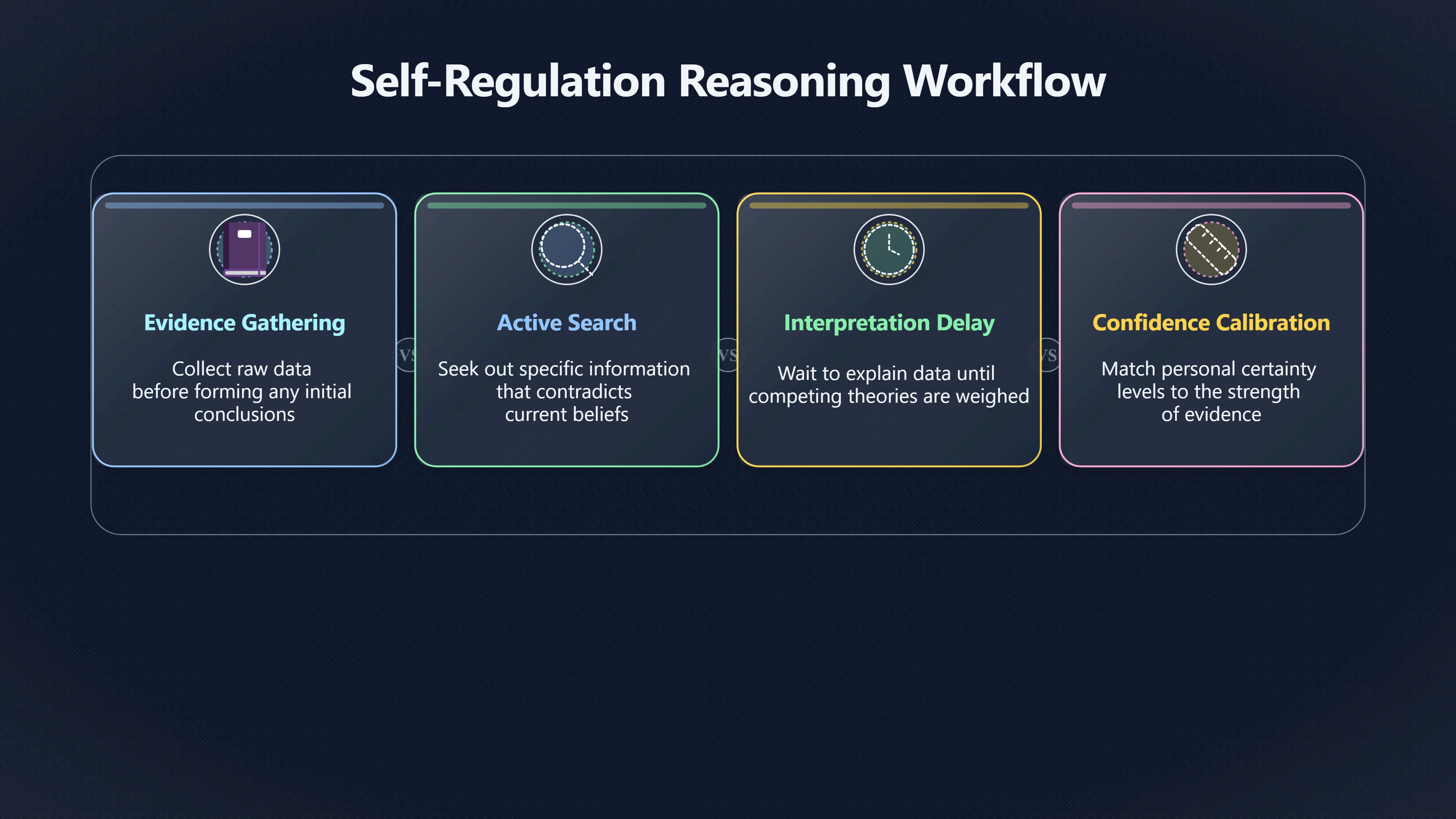
Self-regulation is a continuous monitoring process rather than a final inspection. Instead of waiting until a decision has been made, effective thinkers repeatedly compare their reasoning against a few simple questions:
- Have I looked for evidence that could prove me wrong?
- Would I accept this evidence if it supported the opposite conclusion?
- Am I interpreting ambiguous information differently because of what I already believe?
- Is my confidence greater than the strength of the available evidence?
These questions interrupt automatic thinking before it hardens into certainty. Research on metacognition—the ability to think about one’s own thinking—shows that people who monitor the quality of their reasoning are generally better at recognising uncertainty and adjusting their confidence appropriately.[PMC]pmc.ncbi.nlm.nih.govPMCMetacognitive sensitivity: The key to calibrating trustby D Lee · 2025 · Cited by 25 — Metacognitive sensitivity, measured by meta-d', estimates how effectively confidence judgments disting…
The aim is not constant self-doubt. Instead, it is calibration: making confidence proportional to evidence. A well-calibrated thinker can be highly confident when evidence is strong and openly uncertain when evidence is incomplete.
Why confirmation bias survives intelligence
One of the most important findings in cognitive psychology is that intelligence alone does not eliminate bias. Confirmation bias encourages people to seek, remember and interpret information that supports an existing belief while discounting conflicting evidence. Because this often happens unconsciously, simply intending to be objective is usually insufficient.[PMC]pmc.ncbi.nlm.nih.govPMCStop Fooling Yourself!Diagnosing and Treating Confirmation…by RT Born · 2024 · Cited by 9 — Confirmation bias (CB) is a cognitive bias that allows us to fo…
Self-regulation works by inserting deliberate pauses into reasoning:
- separate gathering evidence from interpreting it;
- actively search for disconfirming information;
- delay commitment to a preferred explanation until competing explanations have been considered.
Studies of judicial decision-making illustrate this principle clearly. Once judges or investigators form an early theory of a case, later evidence is more likely to be interpreted in ways that reinforce that theory. Deliberately separating evidence collection from conclusion formation reduces this risk.[Erasmus University Rotterdam]pure.eur.nlRepub 124724Erasmus University RotterdamEUR Research Information PortalToday — by S van Brussel · 2020 · Cited by 42 — The confirmation bias appears…
Questions that expose uneven standards
Double standards are often easier to detect through comparison than through introspection. Instead of asking whether your reasoning is “objective”, compare how you treat similar situations.
Useful self-checks include:
Would I accept this evidence if it supported the opposite side?
Many reasoning errors become visible when beliefs are reversed. If identical evidence suddenly seems weak only because it favours a different conclusion, your evaluation may be driven by preference rather than evidence.
Am I demanding different levels of proof?
People frequently require overwhelming evidence before changing a favoured belief while accepting relatively weak evidence for beliefs they already hold. Self-regulation looks for symmetry in evidential standards.
Have I considered realistic alternatives?
Actively generating competing explanations weakens the tendency to stop searching once the first plausible answer appears. Research on actively open-minded thinking consistently links willingness to consider alternatives with better judgement and more accurate confidence calibration.[Cambridge University Press & Assessment]cambridge.orgCambridge University Press & AssessmentThe role of actively open-minded thinking in information…by U Haran · 2013 · Cited by 427 — We…
Could someone explain my conclusion without mentioning the evidence?
If the explanation depends mainly on identity, emotion, loyalty or preference, evidence may be playing a smaller role than assumed.
These questions are effective because they test the reasoning process itself rather than merely inspecting its outcome.

Revising confidence without losing face
One reason people resist correcting themselves is psychological rather than intellectual. Changing a judgement can feel like admitting failure or inconsistency. Self-regulation reframes revision as evidence that the thinking process is functioning properly.
Critical thinkers distinguish between:
- changing an opinion because new evidence appeared;
- changing confidence because evidence became stronger or weaker;
- abandoning a conclusion because its supporting assumptions proved false.
These are signs of disciplined reasoning, not weakness.
Research on overconfidence shows that people commonly overestimate the accuracy of their own judgements across domains ranging from medicine to business and everyday decision-making. Better performance often comes not from becoming less confident overall, but from matching confidence more closely to actual accuracy.[APA]apa.orgThis bias is thought to be robust…Read more…
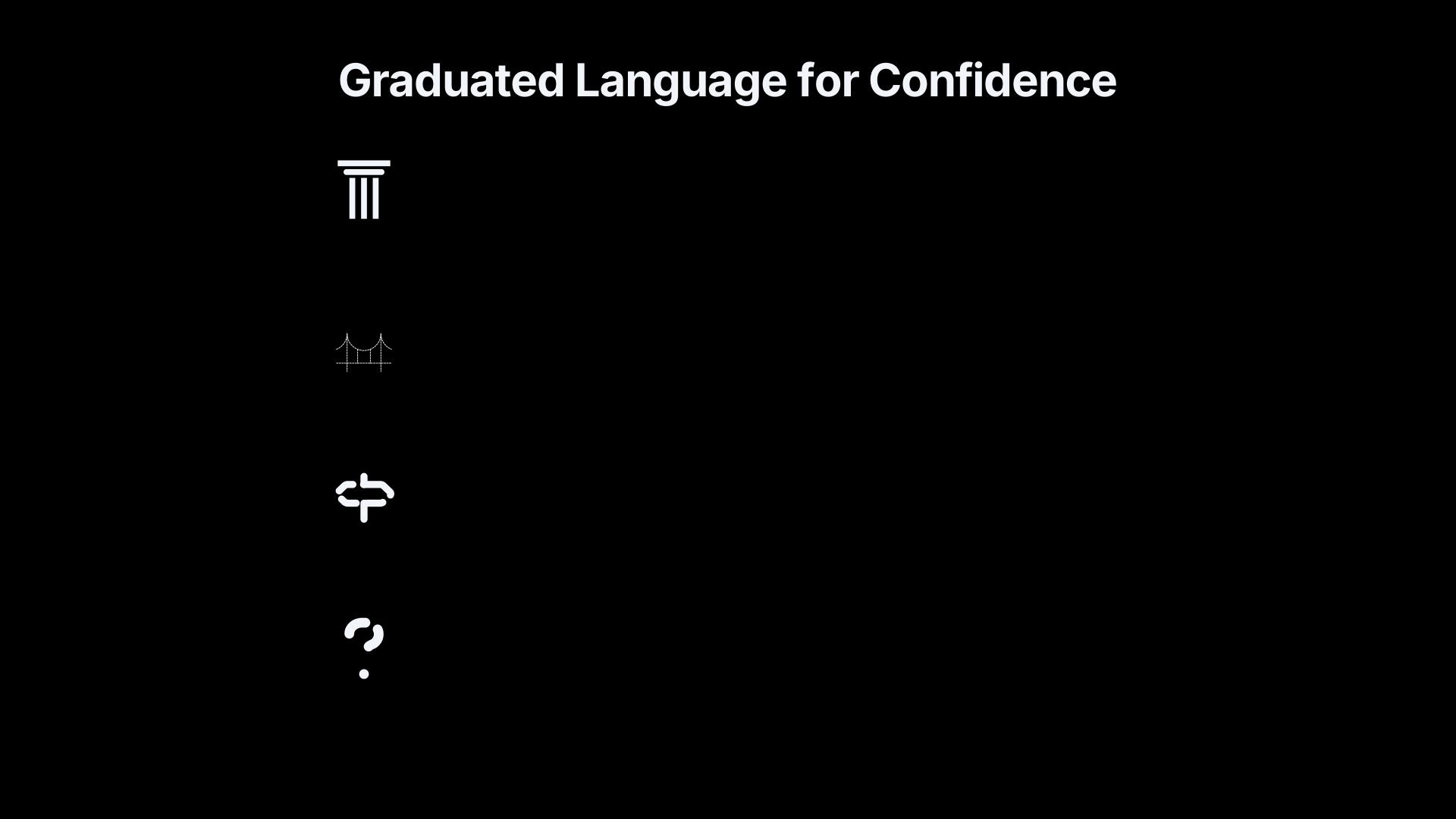
A useful habit is expressing conclusions in graduated language:
- “The evidence strongly supports…”
- “The balance of evidence currently suggests…”
- “There are several plausible explanations…”
- “I do not yet know.”
This approach preserves intellectual honesty without requiring false certainty or unnecessary hesitation.
Building habits that reduce bias over time
Self-regulation is more effective when it becomes routine rather than occasional. Research on metacognition and actively open-minded thinking suggests several habits that strengthen resistance to biased reasoning:
- Seek contradiction deliberately. Before finalising a judgement, spend time looking specifically for credible evidence that challenges it rather than only confirming it.[PMC]pmc.ncbi.nlm.nih.govPMCStop Fooling Yourself!Diagnosing and Treating Confirmation…by RT Born · 2024 · Cited by 9 — Confirmation bias (CB) is a cognitive bias that allows us to fo…
- Separate observation from interpretation. Record what is directly known before explaining what it might mean.
- Estimate confidence numerically when appropriate. Assigning approximate confidence levels encourages calibration instead of treating every conclusion as simply true or false.[PMC]pmc.ncbi.nlm.nih.govPMCMetacognitive sensitivity: The key to calibrating trustby D Lee · 2025 · Cited by 25 — Metacognitive sensitivity, measured by meta-d', estimates how effectively confidence judgments disting…
- Review significant decisions afterwards. Compare predictions with actual outcomes. Looking back for calibration errors often reveals recurring personal biases more effectively than relying on memory alone.
- Treat disagreement as diagnostic. When informed people reach different conclusions, ask which assumptions differ rather than assuming one side is obviously irrational.
These habits do not eliminate bias, but they make biases easier to detect before they influence important decisions.
The real test of critical thinking
Spotting weaknesses in another person’s reasoning is valuable, but it is only half of critical thinking. The more demanding skill is applying exactly the same standards to your own beliefs.
Self-regulation transforms critical thinking from an outward-facing activity into an inward discipline. It replaces the question “Where is someone else mistaken?” with the more productive question “What would convince me that I might be mistaken?” That shift is what allows purposeful judgement to remain fair, evidence-led and proportionate, even when the conclusions challenge one’s own assumptions.[PMC+2Informal Logic]pmc.ncbi.nlm.nih.govPMCActively Open-Minded Thinking and Its Measurementby KE Stanovich · 2023 · Cited by 133 — Actively open-minded thinking (AOT) is measured by items that tap the willingness to consider…
Amazon book picks
Further Reading
Books and field guides related to How to Catch Your Own Double Standards. Use these as the next step if you want deeper reading beyond the article.
Mistakes Were Made (but Not by Me)
Shows why people defend inconsistent standards and how to recognize them.
The Scout Mindset
Focuses on updating beliefs, avoiding double standards and intellectual honesty.
The Demon-Haunted World
Rating: 4.5/5 from 43 Google Books ratings
Encourages skepticism and consistent standards of evidence.
Superforecasting
Demonstrates calibration, updating confidence and evidence-based judgment.
eBay marketplace picks
Marketplace Samples
Example marketplace items related to this page. Use the search link to explore similar finds on eBay.




Endnotes
1.
Source: pmc.ncbi.nlm.nih.gov
Title: PMCActively Open-Minded Thinking and Its Measurement
Link:https://pmc.ncbi.nlm.nih.gov/articles/PMC9966223/
Source snippet
by KE Stanovich · 2023 · Cited by 133 — Actively open-minded thinking (AOT) is measured by items that tap the willingness to consider...
2.
Source: pmc.ncbi.nlm.nih.gov
Title: PMCMetacognitive sensitivity: The key to calibrating trust
Link:https://pmc.ncbi.nlm.nih.gov/articles/PMC12103939/
Source snippet
by D Lee · 2025 · Cited by 25 — Metacognitive sensitivity, measured by meta-d', estimates how effectively confidence judgments disting...
3.
Source: pmc.ncbi.nlm.nih.gov
Title: PMCStop Fooling Yourself!
Link:https://pmc.ncbi.nlm.nih.gov/articles/PMC11495861/
Source snippet
(Diagnosing and Treating Confirmation...by RT Born · 2024 · Cited by 9 — Confirmation bias (CB) is a cognitive bias that allows us to fo...
4.
Source: cambridge.org
Link:https://www.cambridge.org/core/journals/judgment-and-decision-making/article/role-of-actively-openminded-thinking-in-information-acquisition-accuracy-and-calibration/1D78BE16863F3F6B2D1C8B5307C9C3B3
Source snippet
Cambridge University Press & AssessmentThe role of actively open-minded thinking in information...by U Haran · 2013 · Cited by 427 — We...
5.
Source: apa.org
Link:https://www.apa.org/pubs/journals/features/cou-0000105.pdf
Source snippet
This bias is thought to be robust...Read more...
6.
Source: cambridge.org
Link:https://www.cambridge.org/core/journals/judgment-and-decision-making/article/when-deciding-creates-overconfidence/CFBE92B067A3DF55E5DB9A05CF497064
Source snippet
When deciding creates overconfidence | Judgment and...by PJ Boyle · 2025 · Cited by 6 — We demonstrate how the distortion of information...
7.
Source: informallogic.ca
Link:https://informallogic.ca/index.php/informal_logic/article/view/4187/3469
Source snippet
Informal LogicCritical Thinking and Cognitive Bias - Informal Logicby J Maynes · 2015 · Cited by 101 — In this paper, I argue that a focu...
8.
Source: pure.eur.nl
Title: Repub 124724
Link:https://pure.eur.nl/ws/portalfiles/portal/48276679/Repub_124724.pdf
Source snippet
Erasmus University RotterdamEUR Research Information PortalToday — by S van Brussel · 2020 · Cited by 42 — The confirmation bias appears...
9.
Source: pure.eur.nl
Title: proefschrift suzan van brussel 622673a0478ce
Link:https://pure.eur.nl/files/52175983/proefschrift_suzan_van_brussel_622673a0478ce.pdf
Source snippet
Erasmus University RotterdamInstructional Design Principles to Reduce Confirmation Biasby S van Brussel · 2022 — The dissertation consist...
10.
Source: pmc.ncbi.nlm.nih.gov
Link:https://pmc.ncbi.nlm.nih.gov/articles/PMC12988131/
Source snippet
and diagnostic decision-making: short "blips" of...by S Hong · 2026 — We show that overconfidence is not merely a distortion in metacogn...
11.
Source: helda.helsinki.fi
Title: fi Actively open-minded thinking
Link:https://helda.helsinki.fi/bitstreams/acfce61e-9176-4d02-b620-0b65b4c1ded8/download
Source snippet
open-minded thinking - Helda - University of Helsinkiby AM Svedholm-Häkkinen · Cited by 158 — Actively open-minded thinking: development...
Additional References
12.
Source: researchgate.net
Link:https://www.researchgate.net/publication/316486755_Cognitive_Biases_and_Their_Influence_on_Critical_Thinking_and_Scientific_Reasoning_A_Practical_Guide_for_Students_and_Teachers
Source snippet
Cognitive Biases and Their Influence on Critical Thinking...21 Jul 2023 — Researchers have discovered 200 cognitive biases that result i...
13.
Source: marnixacademie.nl
Link:https://www.marnixacademie.nl/wp-content/uploads/2025/10/proefschrift_suzan_van_brussel_622673a0478ce.pdf
Source snippet
Instructional Design Principles to Reduce Confirmation BiasThe dissertation consists of four empirical studies on the effect of three imp...
14.
Source: jbsfm.org
Link:https://jbsfm.org/vol3no1/biases-in-managerial-decision-making–overconfidence–status-quo–anchoring–hindsight–[availability
Source snippet
Biases in Managerial Decision Making: Overconfidence...30 Jul 2021 — The first type of overconfidence, overestimation or miscalibration...
15.
Source: athensjournals.gr
Link:https://www.athensjournals.gr/education/2024-11-3-5-Uyar.pdf
Source snippet
rning tendencies and metacognitive learning strategies and analysing the predictive relationships...
16.
Source: psychology.ku.dk
Title: different mechanisms are responsible for underconfidence
Link:https://psychology.ku.dk/news/2026/different-mechanisms-are-responsible-for-underconfidence/
Source snippet
mechanisms are responsible for underconfidence30 Jan 2026 — Two paths to doubt · Anxiety: The more time a person with anxiety spends refl...
17.
Source: sjdm.org
Link:https://sjdm.org/dmidi/Actively_Open-Minded_Thinking_Beliefs.html
Source snippet
ciding") is good. This scale is based on a much longer version...
18.
Source: researchgate.net
Link:https://www.researchgate.net/publication/265394044_The_Role_of_Actively_Open-Minded_Thinking_in_Information_Acquisition_Accuracy_and_Calibration
Source snippet
tendency to maximize or satisfice when making decisions...
19.
Source: Wikipedia
Title: List of cognitive biases
Link:https://en.wikipedia.org/wiki/List_of_cognitive_biases
Source snippet
List of cognitive biasesIn psychology and cognitive science, cognitive biases are systematic patterns of deviation from norm and/or ra...
20.
Source: youtube.com
Link:https://www.youtube.com/watch?v=f921a4E__9w
Source snippet
Every Level of Metacognition Explained in 8 Minutes...
21.
Source: journals.plos.org
Link:https://journals.plos.org/mentalhealth/article/file?id=10.1371%2Fjournal.pmen.0000259&type=printable
Source snippet
biases in anxiety-depression and compulsivity...by TXF Seow · 2025 · Cited by 16 — Across cognitive domains, we found that underconfiden...
Topic Tree