Within Pressure
When gut feelings start judging the facts
Gut feelings can flag real stakes, but they can also make risks, benefits, and sources seem clearer than they really are.
On this page
- How the affect heuristic changes perceived risk and benefit
- Why complex or politicised claims are especially vulnerable
- Self checks for separating emotional salience from evidence
Page outline Jump by section
Introduction
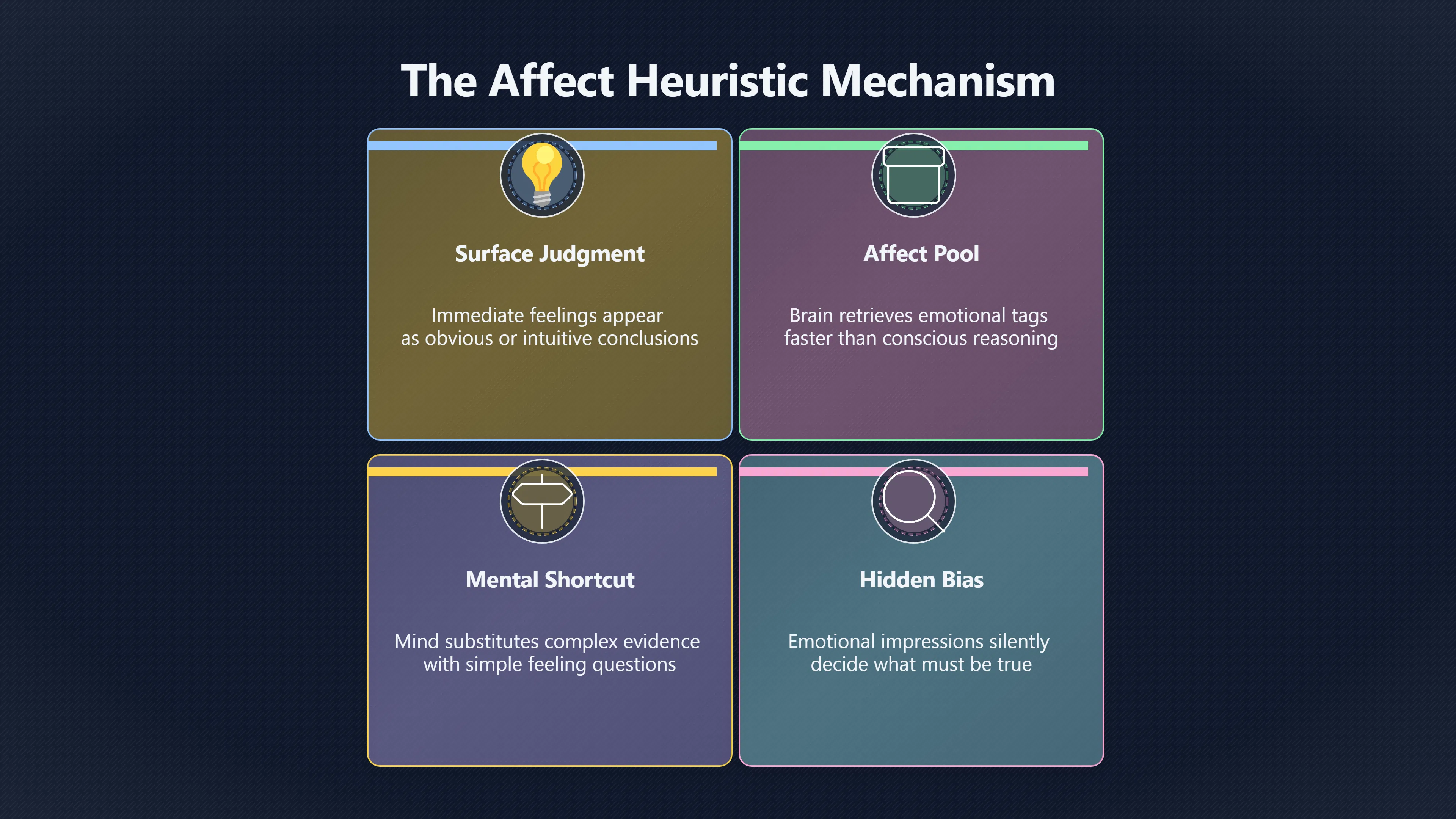
Gut feelings are not random. They often compress past experience, rapid pattern recognition and emotional reactions into a fast judgement that can be genuinely useful when time is short or information is incomplete. The problem arises when that emotional impression is treated as evidence rather than as a signal to investigate further. This mental shortcut is known as the affect heuristic: people use their immediate positive or negative feelings about a person, idea, technology or event to judge its risks, benefits and credibility, often before they consciously examine the facts.[Warrington College of Business]bear.warrington.ufl.eduslovic affect heuristic 2002Judgments of risk and benefit…Read more…
 For improving analytical thinking, the key lesson is not to distrust intuition altogether. Instead, it is to recognise when emotion has shifted from highlighting what deserves attention to silently deciding what must be true. This distinction becomes especially important when issues are urgent, unfamiliar, morally charged or politically contested.
How the affect heuristic changes perceived risk and benefit
The affect heuristic is one of the best-established findings in research on judgement under uncertainty. Rather than estimating risks and benefits independently, people often derive both from a single emotional impression. If something feels attractive, familiar or morally desirable, its benefits tend to seem larger and its risks smaller. If it feels threatening or repellent, the opposite happens.[UCLA Anderson School of Management]anderson.ucla.eduFin Alh Slovic John Affect Heur00UCLA Anderson School of ManagementThe AАect Heuristic in Judgments of Risks and Bene®tsby ML FINUCANE · 2000 · Cited by 4654 — According…
This creates a characteristic pattern:
- A favourable emotional reaction leads people to underestimate possible harms.
- An unfavourable emotional reaction leads them to overlook genuine advantages.
- Confidence in these judgements often exceeds the amount of supporting evidence.
Experimental research by Melissa Finucane, Paul Slovic and colleagues demonstrated that altering participants’ emotional evaluation of technologies or activities systematically changed both their perceived risks and their perceived benefits, even when the underlying facts remained unchanged. Time pressure strengthened this effect, suggesting that emotional shortcuts become more influential when careful analysis is harder.[Stanford University]stanford.eduWe propose that this relationship occurs…Read more…
Importantly, this is not simply “being emotional”. The shortcut operates quickly and often outside awareness. People usually experience the resulting judgement as obvious or intuitive rather than as emotionally driven.
Why gut feelings often feel like evidence
The brain continuously attaches emotional value to experiences. These positive and negative associations form what researchers describe as an “affect pool” that can be consulted far faster than conscious reasoning. When a new judgement is needed, the emotional tag is often retrieved before probabilities, statistics or competing explanations.[Warrington College of Business]bear.warrington.ufl.eduslovic affect heuristic 2002Judgments of risk and benefit…Read more…
This makes emotional impressions efficient because they reduce mental effort. Instead of asking:
- How reliable is the evidence?
- What are the uncertainties?
- What alternative explanations exist?
the mind unconsciously substitutes an easier question:
“How do I feel about this?”
Psychologists call this a heuristic because it is a practical rule of thumb rather than a formal reasoning process. In many everyday situations it works surprisingly well, particularly when someone has accumulated genuine expertise through repeated experience. However, it becomes much less reliable when the situation is novel, highly technical or deliberately designed to provoke emotion.[BehavioralEconomics.com | The BE Hub]behavioraleconomics.comaffect heuristicThe BE HubAffect heuristic4 Dec 2024 — The affect heuristic represents a reliance on good or bad feelings experienced in relation to a st…
Why complex or politicised claims are especially vulnerable
The affect heuristic becomes particularly influential when people lack direct knowledge. Complex issues such as climate policy, artificial intelligence, public health, nuclear energy or biotechnology contain technical uncertainties that are difficult to evaluate directly. Emotional impressions therefore become an attractive substitute for detailed analysis.
Several factors increase reliance on affect:
- Limited expertise. Without a clear understanding of the subject, emotional reactions fill informational gaps.
- Information overload. Large volumes of conflicting evidence encourage simpler judgement strategies.
- Identity relevance. When a topic is associated with political, cultural or social identity, emotional responses become intertwined with belonging.
- Urgency. Perceived crises encourage rapid decisions rather than deliberate evaluation.
In these situations, people may interpret identical evidence very differently because they begin with different emotional meanings attached to the issue rather than different factual knowledge. The same study, graph or expert statement can therefore appear reassuring to one audience and deeply suspicious to another.[Sage Journals+2MPG.PuRe]journals.sagepub.comSage Journals Risk Perception and AffectRisk as feelings refers to individuals' instinctive and intuitive reactions to danger.Read more…
This helps explain why simply providing more information often fails to resolve disagreements. The disagreement is frequently rooted in differing emotional interpretations rather than missing facts alone.

Emotional salience changes what seems credible
The affect heuristic influences more than risk perception. It also changes how people judge sources.
A report that supports an emotionally comfortable conclusion may feel balanced, objective and trustworthy before its methodology has been examined. Conversely, evidence that challenges an emotionally significant belief may immediately appear biased, selective or politically motivated.
This does not mean people consciously reject evidence. Instead, emotional impressions influence several earlier stages of reasoning:
- which information attracts attention;
- which experts appear trustworthy;
- how much uncertainty seems acceptable;
- when enough evidence feels sufficient.
Because these judgements occur rapidly, people often experience them as rational evaluations rather than emotional responses.
When gut feelings help rather than hinder
The existence of the affect heuristic does not imply that intuition should be ignored.[bear.warrington.ufl.edu]bear.warrington.ufl.eduslovic affect heuristic 2002Judgments of risk and benefit…Read more…
Experienced firefighters, emergency clinicians, pilots and other experts often make remarkably accurate rapid judgements because their intuitions reflect thousands of previous encounters. Their gut feelings frequently represent compressed learning rather than arbitrary emotion.
The important distinction is whether intuition comes from relevant experience or from emotional association alone.
Useful intuition typically has several characteristics:
- it develops through repeated feedback;
- it operates within a familiar environment;
- it can often be explained after reflection;
- it remains open to correction when contradictory evidence appears.
By contrast, intuitive certainty about unfamiliar scientific, political or statistical questions deserves greater caution because emotional impressions may be doing most of the work.

Self-checks for separating emotional salience from evidence
The goal is not to eliminate emotion but to prevent emotional importance from becoming mistaken for factual strength.
When a claim immediately feels obviously true or obviously false, it can help to pause and ask:
- What exactly triggered my reaction? Was it the evidence itself, the language, the speaker or the wider topic?
- Would I judge this evidence the same way if it supported the opposite conclusion?
- Am I evaluating probabilities or merely reacting to vividness?
- Have I confused familiarity with accuracy?
- What evidence would genuinely change my mind?
A practical technique is to separate two independent questions:
Emotional questionAnalytical questionHow strongly do I feel about this?How strong is the evidence?
Keeping these questions distinct reduces the tendency for emotional intensity to masquerade as evidential quality.
Another helpful habit is deliberately searching for one credible source that presents the strongest reasonable counterargument. The aim is not forced neutrality but checking whether emotional certainty has become disconnected from the actual balance of evidence.
Improving analytical thinking without suppressing emotion
Emotions are essential for identifying priorities, recognising danger and motivating action. Research on judgement and decision-making consistently shows that people cannot reason effectively by eliminating feeling altogether. The challenge is ensuring that emotional reactions guide attention rather than determine conclusions.[Cambridge University Press & Assessment]cambridge.orgCambridge University Press & AssessmentIntuition and affect in risk perception and decision makingby G Böhm · 2008 · Cited by 136 — Intui…
For analytical thinking under pressure, the most reliable mindset is therefore:
- treat gut feelings as hypotheses, not verdicts;
- recognise that emotionally charged topics deserve more scrutiny, not less;
- evaluate risks and benefits separately instead of assuming one determines the other;
- remember that confidence generated by emotion is not the same as confidence justified by evidence.
The affect heuristic is powerful because it makes complex judgements feel simple. Better reasoning begins by recognising that the feeling of certainty and the quality of evidence are related only sometimes—and in unfamiliar or emotionally charged situations, they can diverge dramatically.[frontiersin.org]frontiersin.orgThe Affect Heuristic and Risk Perception – Stability Across…by K Skagerlund · 2020 · Cited by 131 — A plausible hypothesis is that hig…
eBay marketplace picks
Marketplace Samples
Example marketplace items related to this page. Use the search link to explore similar finds on eBay.



Endnotes
1.
Source: anderson.ucla.edu
Title: Fin Alh Slovic John Affect Heur00
Link:https://www.anderson.ucla.edu/faculty/keith.chen/negot.%20papers/FinAlhSlovicJohn_AffectHeur00.pdf
Source snippet
UCLA Anderson School of ManagementThe AАect Heuristic in Judgments of Risks and Bene®tsby ML FINUCANE · 2000 · Cited by 4654 — According...
2.
Source: stanford.edu
Link:https://stanford.edu/~knutson/jdm/finucane00.pdf
Source snippet
We propose that this relationship occurs...Read more...
3.
Source: behavioraleconomics.com
Title: affect heuristic
Link:https://www.behavioraleconomics.com/resources/mini-encyclopedia-of-be/affect-heuristic/
Source snippet
The BE HubAffect heuristic4 Dec 2024 — The affect heuristic represents a reliance on good or bad feelings experienced in relation to a st...
4.
Source: pure.mpg.de
Link:https://pure.mpg.de/rest/items/item_2098897/component/file_2098896/content
Source snippet
Do People Judge Risks: [Availability]({{ 'availability/' | relative_url }}) Heuristic, Affect...by T Pachur · 2012 · Cited by 368 — Consistent with the notion of the affect heu...
5.
Source: cambridge.org
Link:https://www.cambridge.org/core/journals/judgment-and-decision-making/article/intuition-and-affect-in-risk-perception-and-decision-making/0543A143C95E7FA4D695BC357279A0CA
Source snippet
Cambridge University Press & AssessmentIntuition and affect in risk perception and decision makingby G Böhm · 2008 · Cited by 136 — Intui...
6.
Source: frontiersin.org
Link:https://www.frontiersin.org/journals/psychology/articles/10.3389/fpsyg.2020.00970/full
Source snippet
The Affect Heuristic and Risk Perception – Stability Across...by K Skagerlund · 2020 · Cited by 131 — A plausible hypothesis is that hig...
7.
Source: bear.warrington.ufl.edu
Title: slovic affect heuristic 2002
Link:https://bear.warrington.ufl.edu/brenner/mar7588/Papers/slovic-affect-heuristic-2002.pdf
Source snippet
Judgments of risk and benefit...Read more...
8.
Source: journals.sagepub.com
Title: Sage Journals Risk Perception and Affect
Link:https://journals.sagepub.com/doi/abs/10.1111/j.1467-8721.2006.00461.x
Source snippet
Risk as feelings refers to individuals' instinctive and intuitive reactions to danger.Read more...
9.
Source: db.arabpsychology.com
Title: affect heuristic 2
Link:https://db.arabpsychology.com/affect-heuristic-2/
Source snippet
Heuristic: Emotions & Decision-MakingThe affect heuristic is a heuristic in which current affect influences decisions. Simply put, it is...
10.
Source: es.scribd.com
Link:https://es.scribd.com/document/229832629/Affect
Source snippet
Heuristic in Risk Perception | PDFThe perception of risk can differ nowadays, as we may find risk as feelings (instinctive and intuitive...
11.
Source: varify.io
Title: affect heuristic
Link:https://varify.io/en/blog/affect-heuristic/
Source snippet
Understanding affect heuristics16 May 2023 — What exactly is the affect heuristic? Affect heuristics refers to a mental shortcut in which...
Published: May 2023
12.
Source: journals.sagepub.com
Title: j.1467 8721.2006.00461.x
Link:https://journals.sagepub.com/doi/10.1111/j.1467-8721.2006.00461.x
Source snippet
Evidence of risk as feelings was present in early studies of risk perception (Fischhoff, Slovic, Lichtenstein, Read, & Combs, 1978).Read...
Additional References
13.
Source: researchgate.net
Link:https://www.researchgate.net/publication/327207250_Affect_Heuristic_and_Format_Effect_in_Risk_Perception
Source snippet
(PDF) Affect Heuristic and Format Effect in Risk PerceptionPDF | The affect heuristic can evoke a format effect so that different ways of...
14.
Source: thedecisionlab.com
Link:https://thedecisionlab.com/biases/affect-heuristic
Source snippet
Affect HeuristicThe affect heuristic describes how we often rely on our emotions, rather than concrete information, when making decisions...
15.
Source: researchgate.net
Link:https://www.researchgate.net/publication/340308928_The_affect_heuristic_in_judgments_of_risks_and_benefits
Source snippet
The affect heuristic in judgments of risks and benefitsSlovic and colleagues proposed the "affect heuristic" as a mental shortcut through...
16.
Source: taylorfrancis.com
Link:https://www.taylorfrancis.com/chapters/edit/10.4324/9781315661773-26/affect-heuristic-judgments-risks-benefits-melissa-finucane-ali-alhakami-paul-slovic-stephen-johnson
Source snippet
The Affect Heuristic in Judgments of Risks and Benefits | 26by ML Finucane · 2016 · Cited by 4682 — Although affect has long played a key...
17.
Source: oamonitor.ireland.openaire.eu
Link:https://oamonitor.ireland.openaire.eu/rfo/sfi_rfo/search/publication?pid=10.1037%2F0278-6133.24.4.s35
Source snippet
openaire.euAffect, risk, and decision making.Reliance on risk as feelings is described with "the affect heuristic." heuristic impacts how...
18.
Source: researchgate.net
Link:https://www.researchgate.net/publication/342128868The_Affect_Heuristic_and_Risk_Perception-_Stability_Across_Elicitation_Methods_and_Individual_Cognitive_Abilities
Source snippet
To fill this gap, the present review highlights differences and similarities between integral and incidental affect.Read more...
19.
Source: crestresearch.ac.uk
Title: risk benefits and the affect heuristic in security behaviours
Link:https://crestresearch.ac.uk/comment/risk-benefits-and-the-affect-heuristic-in-security-behaviours/
Source snippet
Risk, benefits, and the affect heuristic in security behaviours24 Jun 2021 — Steven Watson explains why a focus on risk is ineffective in...
20.
Source: scribd.com
Link:https://www.scribd.com/document/958126340/fpsyg-11-00970
Source snippet
tions, highlighting the interplay between intuitive and deliberative...Read more...
21.
Source: cancercontrol.cancer.gov
Title: Judgments of risk and benefit are assumed to be.Read more
Link:https://cancercontrol.cancer.gov/sites/default/files/2020-06/slovic.pdf
Source snippet
Thoughts about Affect, Reason, Risk, and Rationalityby P Slovic · Cited by 5763 — A model of the affect heuristic explaining the risk/ben...
22.
Source: consensus.app
Link:https://consensus.app/search/can-the-affect-heuristic-be-mitigated-in-risk-perc/qntv8-s-QI2ZggoS7Vc9IA/
Source snippet
emotional responses to judge risks—strongly influences risk perception...
Topic Tree