Within Sharper Thinking
What Makes a Strong Thinker?
Strong reasoning combines ability, self-monitoring, and the willingness to seek reasons and revise views.
On this page
- Cognitive skill
- Metacognitive control
- Intellectual disposition
Page outline Jump by section
Introduction
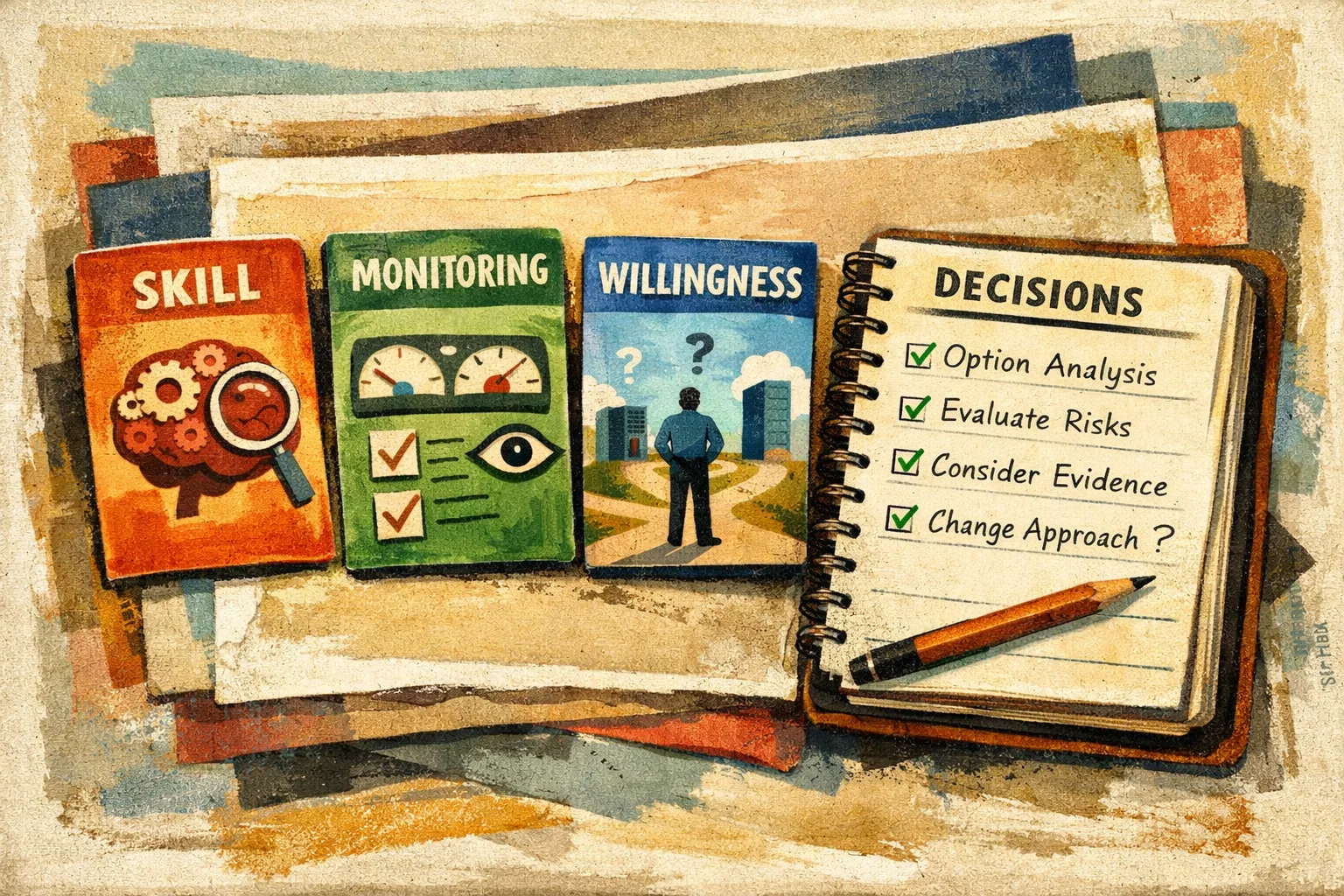
A strong thinker is not simply someone with a high stock of facts or a quick mind. Strong reasoning combines three working parts: cognitive skill, the ability to analyse and infer; metacognitive control, the ability to monitor and correct one’s own thinking; and intellectual disposition, the willingness to seek reasons, face uncertainty and revise a view. This matters because many poor judgements do not come from not knowing any reasoning rule. They come from using the rule too late, applying it to other people but not oneself, or resisting the evidence when it becomes inconvenient.
Within the wider goal of improving thinking and analytical skills, this three-part model is useful because it explains why “be more rational” is too vague. Better thinking needs machinery, a dashboard and a motive. The machinery is reasoning skill. The dashboard is self-monitoring. The motive is the disposition to care about truth, accuracy and fair evaluation more than comfort, speed or winning.
Why strong thinking needs three parts
The American Philosophical Association’s Delphi report described critical thinking as purposeful, self-regulatory judgement that produces interpretation, analysis, evaluation and inference, together with an explanation of the evidence, concepts, methods, criteria and context behind that judgement. It also described the ideal critical thinker as inquisitive, well-informed, open-minded, fair-minded, honest about personal bias, willing to reconsider and persistent in seeking precise results where precision is possible.[ERIC]files.eric.ed.govERICed315423.tif.pdf…
That definition is important because it refuses to reduce thinking to one thing. A person may have the cognitive skill to detect a weak argument yet lack the metacognitive control to notice when they are rationalising their own position. Another person may be reflective and cautious yet lack the analytic tools needed to distinguish a correlation from a causal explanation. A third may have both ability and self-awareness but lack the intellectual courage to change their mind publicly.
The Delphi report made this split explicit by treating critical thinking as having both a cognitive-skill dimension and a dispositional dimension. It also recorded a real dispute: experts largely agreed that good critical thinkers have certain dispositions, but they did not fully agree on whether those dispositions are part of the meaning of critical thinking itself or qualities of the person who uses critical-thinking skills well.[ERIC]files.eric.ed.govERICed315423.tif.pdf… For practical improvement, the dispute matters less than the lesson: ability alone is not enough. The useful question is not “Can this person reason?” but “Will this person reason carefully, at the moment when it counts, about a claim they care about?”

Cognitive skill: doing the reasoning work
Cognitive skill is the visible work of thinking: interpreting a problem, analysing its parts, evaluating claims, drawing inferences and explaining why a conclusion follows. The Delphi report’s consensus list included interpretation, analysis, evaluation, inference, explanation and self-regulation, with sub-skills such as clarifying meaning, identifying arguments, assessing claims, querying evidence, conjecturing alternatives and drawing conclusions.[ERIC]files.eric.ed.govERICed315423.tif.pdf…
A practical example is a workplace decision about why a project is late. A weak analysis jumps to a single cause: “The team is disorganised.” A stronger analysis separates possibilities: unclear requirements, underestimated complexity, dependency delays, poor prioritisation, insufficient staffing or unrealistic deadlines. Cognitive skill is what lets someone break the issue into testable claims rather than treat the first plausible explanation as the answer.
These skills also include the ability to explain reasoning. The Delphi report describes explanation as stating the results of one’s reasoning, justifying that reasoning in terms of evidence and context, and presenting it as a cogent argument.[ERIC]files.eric.ed.govERICed315423.tif.pdf… This is why strong thinkers often write things down. A conclusion that feels solid in the mind may look incomplete when forced into sentences: the premise is vague, the comparison is unfair, or the evidence does not quite support the claim.
Cognitive skill improves when reasoning is made visible and practised deliberately. A meta-analysis of critical-thinking instruction found 341 effect sizes from quasi-experimental or true-experimental studies using standardised critical-thinking measures; the average effect was positive, and dialogue, authentic problems and mentoring were associated with better outcomes.[ERIC]eric.ed.govOpen source on ed.gov. This supports a practical principle: people learn to think better when they practise on real arguments and decisions, not only when they memorise definitions of fallacies.
Argument mapping is one concrete method because it turns reasoning into a structure that can be inspected. Tim van Gelder’s review argues that high-intensity argument-mapping instruction has strong evidence as a way to accelerate critical-thinking gains in higher education, partly because maps sit between messy natural language and overly formal logic, helping learners see claims, reasons and objections.[Reasoninglab]reasoninglab.comTvG Using argument mapping to improve critical thinking skills 2015TvG Using argument mapping to improve critical thinking skills 2015 The deeper mechanism is simple: once reasoning is externalised, it becomes easier to test.
Metacognitive control: knowing when your thinking needs help
Metacognition means monitoring and regulating one’s own thinking. In the classic Nelson and Narens framework, metacognitive monitoring informs control: people judge what they know, how difficult something is, whether to continue searching memory, how much study time to allocate, and whether to revise or stop. Their work also warned that inaccurate monitoring can mislead control, such as when people allocate effort poorly because they misjudge what they do and do not know.[UC Irvine Social Sciences]sites.socsci.uci.eduUC Irvine Social Sciences Untitled.PD FUC Irvine Social Sciences Untitled.PD F
In everyday thinking, metacognitive control sounds like a set of internal checks: “Do I understand the question?” “What evidence would change my mind?” “Am I more confident than my evidence permits?” “Have I considered the strongest alternative?” These questions do not replace reasoning skill. They decide when to deploy it.
The Education Endowment Foundation’s updated guidance on metacognition and self-regulated learning draws on a detailed review of 355 studies and emphasises that successful approaches develop knowledge of oneself as a learner, of strategies and of tasks. It recommends explicitly teaching learners to plan, monitor and evaluate their learning, and stresses that these strategies are best applied to specific content and tasks rather than treated as free-floating slogans.[Cloudfront]d2tic4wvo1iusb.cloudfront.netMetacognition and Self-Regulated LearningMetacognition and Self-Regulated Learning
This specificity matters outside school as well. A doctor reviewing a diagnosis, a manager assessing a hiring decision, or a reader checking a news claim does not need generic “self-awareness” in the abstract. They need task-sensitive monitoring: What are the usual failure points in this kind of judgement? What would a competent reviewer check? Where might my confidence be inflated?
Good metacognitive control also depends on feedback. The EEF guidance notes that learners need timely feedback and strategies to judge accurately how effectively they are learning.[Cloudfront]d2tic4wvo1iusb.cloudfront.netMetacognition and Self-Regulated LearningMetacognition and Self-Regulated Learning Without feedback, reflection can become theatre: a person may feel thoughtful while simply reinforcing a preferred story. Feedback connects self-monitoring to reality.
Intellectual disposition: the will to use the skill
Intellectual disposition is the habit of caring enough about good reasons to use one’s skills even when it is uncomfortable. The Delphi report’s portrait of the ideal critical thinker includes being inquisitive, well-informed, trustful of reason, open-minded, fair-minded, honest about personal bias, prudent in judgement and willing to reconsider.[ERIC]files.eric.ed.govERICed315423.tif.pdf… These are not decorative virtues. They are what make analytical skill available under pressure.
A person with strong reasoning skills but weak disposition may become a clever defender of whatever they already believe. They can detect flaws in opponents’ arguments, invent sophisticated excuses for their own side and treat uncertainty as something to exploit rather than investigate. This is one reason intellectual humility and open-mindedness are central to improving thinking: they reduce the temptation to use intelligence merely as a shield.
Research on actively open-minded thinking treats this disposition as a measurable willingness to consider alternative views and attend to evidence that contradicts one’s beliefs. Stanovich and colleagues describe actively open-minded thinking as involving sensitivity to contradictory evidence and willingness to consider alternative opinions.[PMC]pmc.ncbi.nlm.nih.govPMCActively Open-Minded Thinking and Its MeasurementPMCActively Open-Minded Thinking and Its Measurement That does not mean giving every claim equal weight. It means giving relevant reasons a chance to count against one’s current view.
The difference is clearest in disagreement. Weak open-mindedness says, “Everyone has their opinion.” Strong open-mindedness says, “Let us compare the reasons, define what would count as evidence, and see whether either of us should revise.” It is not passive tolerance. It is active testing.
How the three parts fail separately
The three-part model is useful because each part can fail while the others appear intact.
Skill without disposition produces motivated reasoning. The person can analyse, but mainly when analysis helps them win. They ask sharp questions of other people’s evidence and soft questions of their own.
Disposition without skill produces sincere but weak judgement. The person wants to be fair and open, but lacks the tools to evaluate probability, causal claims, sample size, source quality or argument structure.
Metacognition without feedback produces confident introspection. The person reflects on their thinking, but never checks whether their self-assessment is accurate. They may mistake a feeling of fluency for understanding.
Skill without metacognitive control produces untriggered competence. The person has learned useful methods, but does not notice the moment when a problem requires them. They know about confirmation bias after the fact, but not while scrolling, arguing, investing, voting or deciding.
This is why strong thinking is not best understood as a personality label. It is a control system. Cognitive skill supplies possible moves. Metacognition decides when and how to use them. Disposition keeps the person willing to keep testing, especially when the test is inconvenient.
How to build the three together
The most effective improvement routines join the three parts rather than training them separately.
First, make the reasoning explicit. Write the claim, the reasons for it, the evidence, the assumptions and the strongest alternative explanation. This trains cognitive skill because it forces interpretation, analysis and evaluation. It also trains metacognition because the thinker can inspect the path from premise to conclusion.
Second, build checkpoints before judgement hardens. Before accepting a conclusion, ask: “What is the strongest reason this might be wrong?” “Am I relying on one source, one example or one vivid story?” “Would I accept this argument if it supported the opposite side?” These questions create metacognitive control at the moment of decision, not afterwards.
Third, use feedback that can correct confidence. In learning, this may mean practice tests, worked examples, peer review or teacher modelling. The EEF guidance recommends explicit modelling of expert thinking and scaffolds such as worked examples, because revealing the thought process helps learners develop both cognitive and metacognitive skills without overloading them.[Cloudfront]d2tic4wvo1iusb.cloudfront.netMetacognition and Self-Regulated LearningMetacognition and Self-Regulated Learning In adult judgement, feedback may mean prediction logs, decision reviews, red-team critique or comparing forecasts with later outcomes.
Fourth, practise on real content. The EEF cautions that metacognitive strategies are best taught in relation to specific content and tasks.[Cloudfront]d2tic4wvo1iusb.cloudfront.netMetacognition and Self-Regulated LearningMetacognition and Self-Regulated Learning The same is true for analytical thinking in daily life. “Think critically” becomes useful only when attached to a concrete task: evaluating a medical claim, reading a contract, choosing between explanations, checking a statistic, planning a project or revising an opinion after new evidence.
Finally, protect the disposition. Good thinking depends on small norms: rewarding changed minds, asking for reasons without humiliation, separating criticism of an argument from criticism of a person, and treating uncertainty as a normal stage of inquiry. These norms matter because people rarely use their best reasoning when the social cost of being wrong is too high.
What makes a strong thinker?
A strong thinker is not someone who is permanently sceptical, endlessly slow or never wrong. A strong thinker is someone whose reasoning system has three working parts:
- Cognitive skill: they can interpret, analyse, evaluate, infer and explain.
- Metacognitive control: they can monitor uncertainty, detect weak understanding and adjust strategy.
- Intellectual disposition: they are willing to seek reasons, face counter-evidence and revise when the case changes.
The practical payoff is a different relationship with confidence. Confidence becomes something earned by a process, not merely felt. A strong thinker can still make mistakes, but they are more likely to notice when the situation calls for care, expose their reasoning to correction, and treat a better argument as a gain rather than a defeat.
Amazon book picks
Further Reading
Books and field guides related to What Makes a Strong Thinker?. Use these as the next step if you want deeper reading beyond the article.
The Demon-Haunted World
Rating: 4.5/5 from 43 Google Books ratings
Promotes scientific scepticism and evidence-based thinking.
eBay marketplace picks
Marketplace Samples
Example marketplace items related to this page. Use the search link to explore similar finds on eBay.



Endnotes
1.
Source: reasoninglab.com
Title: TvG Using argument mapping to improve critical thinking skills 2015
Link:https://www.reasoninglab.com/wp-content/uploads/2013/10/TvG-Using-argument-mapping-to-improve-critical-thinking-skills-2015.pdf
2.
Source: d2tic4wvo1iusb.cloudfront.net
Title: Metacognition and Self-Regulated Learning
Link:https://d2tic4wvo1iusb.cloudfront.net/production/eef-guidance-reports/metacognition/metacognition-and-self-regulated-learning_guidance-report.v.2.4.0.pdf
3.
Source: pmc.ncbi.nlm.nih.gov
Title: PMCActively Open-Minded Thinking and Its Measurement
Link:https://pmc.ncbi.nlm.nih.gov/articles/PMC9966223/
4.
Source: reasoninglab.com
Link:https://www.reasoninglab.com/wp-content/uploads/2013/10/INTED2013-Ter-Berg_Van-der-Brugge.pdf
5.
Source: d2tic4wvo1iusb.cloudfront.net
Title: Metacognition and Self-regulated Learning
Link:https://d2tic4wvo1iusb.cloudfront.net/production/eef-guidance-reports/metacognition/metacognition-and-self-regulation_evidence-to-decision-framework_v.2.2.0.pdf
6.
Source: files.eric.ed.gov
Link:https://files.eric.ed.gov/fulltext/ED315423.pdf
Source snippet
ERICed315423.tif.pdf...
7.
Source: eric.ed.gov
Link:https://eric.ed.gov/?id=EJ1061695
8.
Source: sites.socsci.uci.edu
Title: UC Irvine Social Sciences Untitled.PD F
Link:https://sites.socsci.uci.edu/~lnarens/1990/Nelson%26Narens_Book_Chapter_1990.pdf
9.
Source: educationendowmentfoundation.org.uk
Link:https://educationendowmentfoundation.org.uk/education-evidence/guidance-reports/metacognition
10.
Source: pmc.ncbi.nlm.nih.gov
Link:https://pmc.ncbi.nlm.nih.gov/articles/PMC10300824/
11.
Source: pmc.ncbi.nlm.nih.gov
Link:https://pmc.ncbi.nlm.nih.gov/articles/PMC12982428/
12.
Source: pmc.ncbi.nlm.nih.gov
Link:https://pmc.ncbi.nlm.nih.gov/articles/PMC9242397/
13.
Source: pmc.ncbi.nlm.nih.gov
Link:https://pmc.ncbi.nlm.nih.gov/articles/PMC4546034/
14.
Source: pmc.ncbi.nlm.nih.gov
Link:https://pmc.ncbi.nlm.nih.gov/articles/PMC12968245/
15.
Source: pmc.ncbi.nlm.nih.gov
Link:https://pmc.ncbi.nlm.nih.gov/articles/PMC12360536/
16.
Source: pmc.ncbi.nlm.nih.gov
Link:https://pmc.ncbi.nlm.nih.gov/articles/PMC10912288/
17.
Source: pmc.ncbi.nlm.nih.gov
Link:https://pmc.ncbi.nlm.nih.gov/articles/PMC12103939/
18.
Source: pmc.ncbi.nlm.nih.gov
Link:https://pmc.ncbi.nlm.nih.gov/articles/PMC8187395/
19.
Source: pmc.ncbi.nlm.nih.gov
Link:https://pmc.ncbi.nlm.nih.gov/articles/PMC11836092/
20.
Source: pubmed.ncbi.nlm.nih.gov
Link:https://pubmed.ncbi.nlm.nih.gov/9572008/
21.
Source: pmc.ncbi.nlm.nih.gov
Link:https://pmc.ncbi.nlm.nih.gov/articles/PMC4713033/
22.
Source: pmc.ncbi.nlm.nih.gov
Link:https://pmc.ncbi.nlm.nih.gov/articles/PMC9862149/
23.
Source: lincs.ed.gov
Link:https://lincs.ed.gov/federal-initiatives/teal/guide/metacognitive
24.
Source: eric.ed.gov
Link:https://eric.ed.gov/?id=ED612286
25.
Source: Wikipedia
Link:https://en.wikipedia.org/wiki/Metacognition
26.
Source: Wikipedia
Link:https://en.wikipedia.org/wiki/Critical
27.
Source: ro.ecu.edu.au
Link:https://ro.ecu.edu.au/cgi/viewcontent.cgi?article=1797&context=ecuworks2013
28.
Source: dictionary.cambridge.org
Link:https://dictionary.cambridge.org/dictionary/english/critical
29.
Source: dictionary.cambridge.org
Link:https://dictionary.cambridge.org/us/dictionary/english/metacognitive
30.
Source: tll.mit.edu
Link:https://tll.mit.edu/teaching-resources/how-people-learn/metacognition/
31.
Source: support-for-early-career-teachers.education.gov.uk
Title: education.gov.uk Evidence
Link:https://support-for-early-career-teachers.education.gov.uk/education-development-trust/year-1-developing-effective-classroom-practice/spring-week-2-ect-evidence/
32.
Source: drcharlesmrusso.substack.com
Title: argument mapping
Link:https://drcharlesmrusso.substack.com/p/argument-mapping
33.
Source: researchrepository.universityofgalway.ie
Link:https://researchrepository.universityofgalway.ie/server/api/core/bitstreams/4034a5fa-43a2-4fb3-b889-847ee48dbb60/content
34.
Source: vocabulary.com
Link:https://www.vocabulary.com/dictionary/critical
35.
Source: education.nsw.gov.au
Link:https://education.nsw.gov.au/content/dam/main-education/teaching-and-learning/education-for-a-changing-world/media/documents/Metacognition_Full_Report_FINAL.pdf
36.
Source: jtl.uwindsor.ca
Link:https://jtl.uwindsor.ca/index.php/jtl/article/view/8813
Additional References
37.
Source: youtube.com
Title: Jordan Peterson
Link:https://www.youtube.com/watch?v=x0vUsxhMczI
Source snippet
"Cognitive skill" "metacognition" "disposition" critical thinking Thinking Dispositions, Thinking Routines 1 ppfancier...
38.
Source: youtube.com
Link:https://www.youtube.com/watch?v=rkYWwbjj7Yw
Source snippet
Metacognition: The Missing Link to a Deeper Think...
39.
Source: youtube.com
Title: Metacognition: motivated v. critical reasoning
Link:https://www.youtube.com/watch?v=8-it2m50oB4
Source snippet
Thinking About Thinking: How to Challenge & Change Metacognitive Beliefs | Katy O'Brien | TEDxUGA...
40.
Source: youtube.com
Title: Metacognition: The Missing Link to a Deeper Think
Link:https://www.youtube.com/watch?v=F6Wl5T6HRd4
Source snippet
Jordan Peterson - The Best Way To Learn Critical Thinking...
41.
Source: researchgate.net
Link:https://www.researchgate.net/publication/335851083Inaccuracy_and[Overconfidence
42.
Source: researchgate.net
Link:https://www.researchgate.net/publication/272705035_The_Halpern_Critical_Thinking_Assessment_A_Review
43.
Source: researchgate.net
Link:https://www.researchgate.net/publication/242279575_Critical_Thinking_A_Statement_of_Expert_Consensus_for_Purposes_of_Educational_Assessment_and_Instruction
44.
Source: researchgate.net
Link:https://www.researchgate.net/publication/258279871_Rational_Thinking_and_Cognitive_Sophistication_Development_Cognitive_Abilities_and_Thinking_Dispositions
45.
Source: researchgate.net
Link:https://www.researchgate.net/publication/284066045_Metacognitive_monitoring_accuracy_and_student_performance_in_the_postsecondary_classroom
46.
Source: researchgate.net
Link:https://www.researchgate.net/publication/308991285_METACOGNITIVE_MONITORING_ACCURACY_AND_ACADEMIC_PERFORMANCE_AT_UNIVERSITY_STUDENTS
Topic Tree
Follow this branch
Parent topic
Sharper ThinkingRelated pages 29
- Argument Maps Can mapping an argument expose bad reasoning?
- Humility Can smart people reason themselves into error?
- Open Mindedness How open minded should good reasoning be?
- Overconfidence When should you distrust your confidence?
- Real Problems Why practice thinking on messy problems?
- +1 more in sidebar