Within Critical Thinking
Is Doubt Helping or Just Hardening?
Critical thinking is not automatic distrust; it means matching trust to the quality of the reasons available.
On this page
- How cynicism differs from judgement
- When acceptance is the critical conclusion
- Using confidence levels instead of yes or no answers
Page outline Jump by section
Introduction
Critical thinking is often confused with permanent doubt, but the two are not the same. The aim of purposeful judgement is not to reject claims by default but to match your level of trust to the quality of the available reasons. Sometimes the most critical conclusion is that a claim is well supported and should be accepted. At other times the evidence is too weak, conflicting, or incomplete, making a qualified judgement more appropriate than either belief or rejection. This distinction matters because reflexive cynicism can be as misleading as unquestioning acceptance. A disciplined thinker adjusts confidence to evidence instead of treating every claim as either certainly true or certainly false.[Insight Assessment]insightassessment.comInsight Assessment The Delphi ReportInsight AssessmentThe Delphi Report - Insight AssessmentThe “Delphi Report” has come to be regarded internationally as a seminal document…
Is doubt helping or just hardening?
Healthy doubt asks questions that can be answered. Cynicism often assumes the answer before the investigation begins.
A critically minded person asks:
- What exactly is being claimed?
- What evidence supports it?
- Are there credible alternative explanations?
- How confident should I be given what I know?
A cynical person often begins from a different premise:
- “They are probably lying.”
- “Experts always have an agenda.”
- “Nothing can be trusted.”
The difference is subtle but important. Critical thinking treats evidence as capable of changing one’s mind. Cynicism frequently treats distrust itself as evidence. If no possible evidence could increase your confidence in a claim, you are no longer evaluating it—you are defending a fixed position.
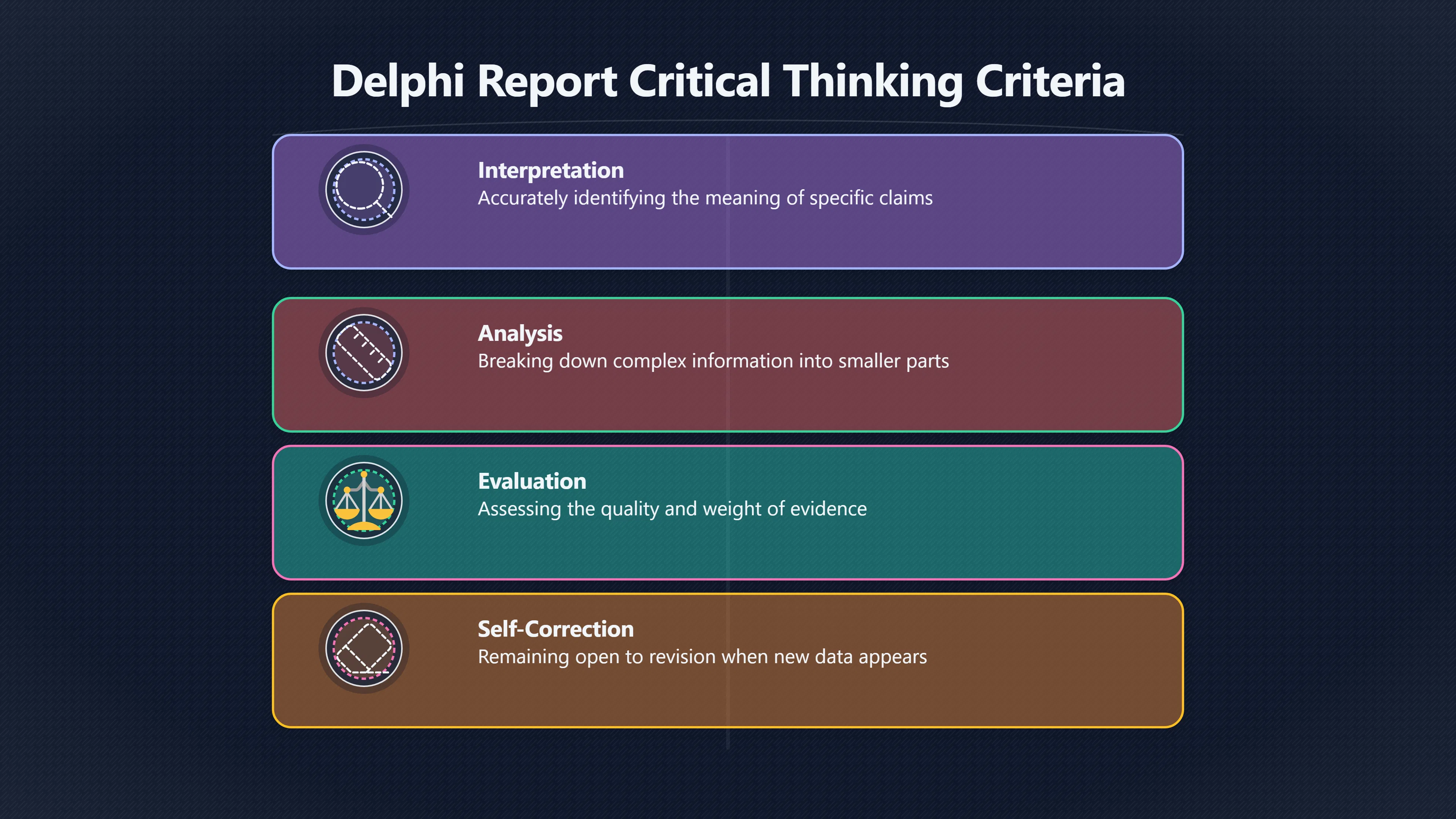
The influential Delphi Report describes critical thinking as “purposeful, self-regulatory judgement” involving interpretation, analysis, evaluation and reflective self-correction. The inclusion of self-correction is significant: good judgement must remain open to revision when better evidence appears.[Insight Assessment]insightassessment.comInsight Assessment The Delphi ReportInsight AssessmentThe Delphi Report - Insight AssessmentThe “Delphi Report” has come to be regarded internationally as a seminal document…
How cynicism differs from disciplined judgement
Although both scepticism and cynicism question claims, they operate very differently.
Disciplined judgementCynicismBegins with uncertaintyBegins with distrustSeeks evidence before decidingTreats suspicion as sufficientCan accept, reject or suspend judgementTends towards rejection regardless of evidenceChanges with new informationOften resists revisionDistinguishes stronger from weaker sourcesTreats all sources as equally suspect
This distinction explains why critical thinkers may sometimes appear trusting. They are not trusting because they avoid scrutiny; they are trusting because scrutiny has produced adequate reasons for confidence.
Research in psychology also suggests that cynicism should not be mistaken for scientific scepticism. Studies have found that scientific scepticism—evaluating claims against evidence—is associated with lower endorsement of unsupported beliefs, whereas general cynicism does not reliably produce better judgement and may even accompany greater acceptance of some unsubstantiated beliefs. Simply distrusting people is therefore not the same as evaluating claims carefully.[ResearchGate]researchgate.netSkepticism, cynicism, and cognitive style predictors of the…January 4, 2022 — Discussion centers on whether cynicism and s…
When acceptance is the critical conclusion
One of the most common misunderstandings about critical thinking is the belief that a “critical” person should always find flaws.
In reality, careful evaluation often supports accepting a claim. For example:
- A medicine supported by multiple well-designed clinical trials deserves more confidence than one promoted through testimonials alone.
- A scientific finding independently replicated by different research groups deserves greater trust than a single preliminary study.
- An official statistic with transparent methods generally deserves more confidence than an anonymous social media graphic with no identifiable source.
Acceptance becomes the critical conclusion when the evidence is:
- relevant to the claim;
- collected using reliable methods;
- independently confirmed where possible;
- stronger than the competing explanations.
Rejecting well-supported conclusions merely to appear independent is not evidence of critical thinking. It is another form of bias.
Purposeful judgement therefore asks not, “Can I find a reason to doubt this?” but, “How much confidence is justified by the evidence available?”
Why all-or-nothing thinking causes problems
Real-world evidence rarely produces absolute certainty.
Many important decisions—from choosing a medical treatment to evaluating economic forecasts—must be made under uncertainty. Critical thinking therefore works better with degrees of confidence than with simple yes-or-no categories.
Philosophers have long recognised suspension of judgement as a legitimate intellectual position alongside belief and disbelief. When evidence is insufficient, withholding commitment is often the most rational response rather than forcing a premature conclusion.[Stanford Encyclopedia of Philosophy]plato.stanford.eduEncyclopedia of Philosophy SkepticismStanford Encyclopedia of PhilosophySkepticism - Stanford Encyclopedia of Philosophyby J Comesaña · 2001 · Cited by 77 — Philosophically i…
All-or-nothing thinking creates predictable errors:
- treating incomplete evidence as proof;
- demanding impossible certainty before accepting anything;
- confusing low confidence with zero confidence;
- treating uncertainty as evidence against a claim.
These habits encourage overconfidence in both believers and doubters.
Using confidence levels instead of yes-or-no answers
A more reliable habit is to estimate confidence rather than asking whether something is simply true or false.
Instead of saying:
- “This must be true.”
consider:
- “The current evidence makes this highly likely.”
Instead of saying:
- “That cannot be trusted.”
consider:
- “The available evidence is weak, so my confidence is low.”
Confidence can increase or decrease as better information becomes available.
A practical scale might look like this:
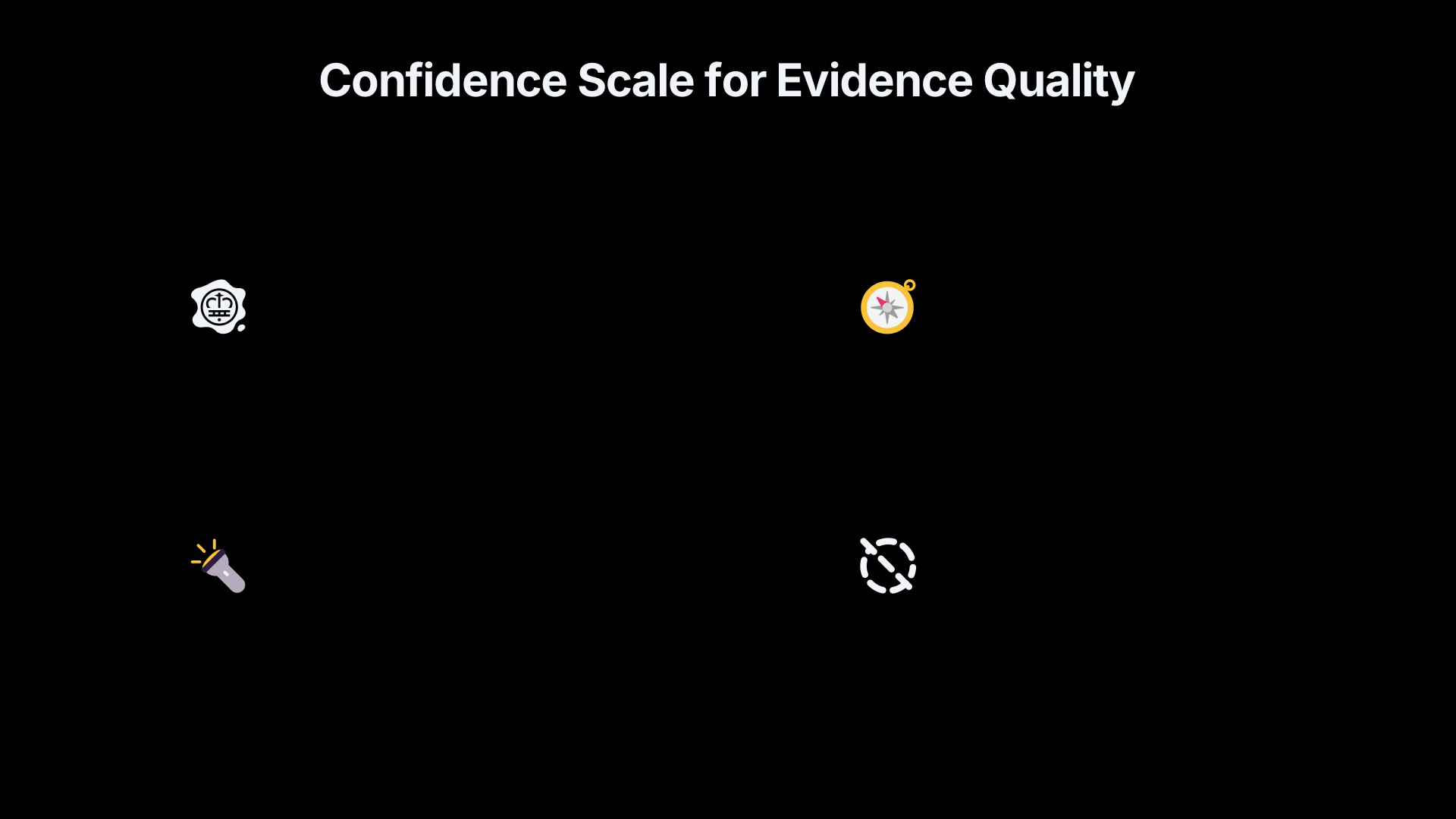
- Very high confidence: supported by multiple independent, high-quality sources.
- Moderate confidence: generally supported but with recognised limitations or unanswered questions.
- Low confidence: limited, conflicting or indirect evidence.
- No justified conclusion: insufficient information to favour one explanation over another.
Thinking this way reduces unnecessary certainty while avoiding the paralysis of believing nothing.

Practical habits for critical trust
Developing disciplined trust is less about becoming more suspicious than about becoming more proportionate.
Useful habits include:
- Separate the claim from the person making it.
- Look for evidence before looking for confirmation of your existing opinion.
- Ask what evidence would change your mind.
- Distinguish confidence from certainty.
- Revise conclusions when stronger evidence appears.
- Accept well-supported claims without treating acceptance as intellectual weakness.
These habits keep judgement flexible rather than defensive.
The balance worth aiming for
Purposeful judgement occupies the space between credulity and cynicism. It recognises that some claims deserve confidence, some deserve rejection, and many deserve provisional acceptance while evidence continues to develop. The defining feature of critical thinking is therefore not relentless doubt but proportional trust: believing as strongly as the reasons justify, remaining willing to revise those beliefs, and resisting the temptation to mistake permanent suspicion for intellectual rigour.[Insight Assessment+2Stanford Encyclopedia of Philosophy]insightassessment.comInsight Assessment The Delphi ReportInsight AssessmentThe Delphi Report - Insight AssessmentThe “Delphi Report” has come to be regarded internationally as a seminal document…
Amazon book picks
Further Reading
Books and field guides related to Is Doubt Helping or Just Hardening?. Use these as the next step if you want deeper reading beyond the article.
The Demon-Haunted World
Rating: 4.5/5 from 43 Google Books ratings
Distinguishes skepticism from blanket distrust.
eBay marketplace picks
Marketplace Samples
Example marketplace items related to this page. Use the search link to explore similar finds on eBay.



Endnotes
1.
Source: plato.stanford.edu
Title: Encyclopedia of Philosophy Skepticism
Link:https://plato.stanford.edu/entries/skepticism/
Source snippet
Stanford Encyclopedia of PhilosophySkepticism - Stanford Encyclopedia of Philosophyby J Comesaña · 2001 · Cited by 77 — Philosophically i...
2.
Source: researchgate.net
Link:https://www.researchgate.net/publication/356409740_Skepticism_cynicism_and_cognitive_style_predictors_of_the_generality_of_unsubstantiated_belief
Source snippet
Skepticism, cynicism, and cognitive style predictors of the...January 4, 2022 — Discussion centers on whether cynicism and s...
Published: January 4, 2022
3.
Source: insightassessment.com
Title: Insight Assessment The Delphi Report
Link:https://insightassessment.com/iaresource/the-delphi-report-a-statement-of-expert-consensus-on-the-definition-of-critical-thinking/
Source snippet
Insight AssessmentThe Delphi Report - Insight AssessmentThe “Delphi Report” has come to be regarded internationally as a seminal document...
Additional References
4.
Source: philarchive.org
Link:https://philarchive.org/archive/MORD-10
Source snippet
Skepticism and Epistemic Closure: Two Bayesian Accountsby L Moretti · 2017 · Cited by 2 — This paper considers two novel Bayesian respons...
5.
Source: centaur.reading.ac.uk
Title: reading.ac.uk The role of confidence in knowledge ascriptions
Link:https://centaur.reading.ac.uk/112613/9/112613%20VoR.pdf
Source snippet
role of confidence in knowledge ascriptions - CentAURby KB Francis · 2022 · Cited by 3 — To investigate the role of confidence in knowled...
6.
Source: transcript-open.de
Link:https://www.transcript-open.de/pdf_chapter/9783839463475/9783839463475-008/9783839463475-008.pdf
Source snippet
eason, open-minded, flexible, fair-minded in evaluation, honest in.Read more...
7.
Source: medium.com
Link:https://medium.com/%40drmozellemartin/inheriting-skepticism-navigating-the-fine-line-between-critical-thinking-and-cynicism-da9ded09ddf6
Source snippet
Navigating the Fine Line Between Critical Thinking and...Skepticism is transmitted through cultural norms, direct observation of method...
8.
Source: pmc.ncbi.nlm.nih.gov
Link:https://pmc.ncbi.nlm.nih.gov/articles/PMC10503486/
Source snippet
is predicted by pre- and post-choice decision...by JP Grogan · 2023 · Cited by 33 — It is well established that one's confidence in a ch...
9.
Source: youtube.com
Title: Why Don’t People Think? | Critical Thinking in an Age of Reaction
Link:https://www.youtube.com/watch?v=ITQP_Lsttq4
Source snippet
CYNICISM VS CRITICAL THINKING - Stupidity disguised as intelligence...
10.
Source: youtube.com
Title: Cynicism vs. Skepticism: Why One Makes You Easier to Manipulate
Link:https://www.youtube.com/watch?v=3LGM7HAuQe4
Source snippet
Why Don't People Think? | Critical Thinking in an Age of Reaction...
11.
Source: youtube.com
Title: CYNICISM VS CRITICAL THINKING
Link:https://www.youtube.com/watch?v=s1X-QQOzXjQ
Source snippet
Evaluating Arguments – How to Spot Strong and Weak Claims...
12.
Source: youtube.com
Title: Evaluating Arguments – How to Spot Strong and Weak Claims
Link:https://www.youtube.com/watch?v=S_xwx7BcqBw
Source snippet
Intellectual humility: the rewards of being willing to change your mind...
13.
Source: youtube.com
Title: Intellectual humility: the rewards of being willing to change your mind
Link:https://www.youtube.com/watch?v=GUnIWyUwi6g
Topic Tree