Within Pressure
How outrage makes false claims feel urgent
Misinformation spreads more easily when urgency, repetition, outrage, and identity cues make checking feel like delay.
On this page
- Why emotional arousal increases sharing and reduces checking
- How identity cues and repetition shape belief
- Prebunking tactics for recognising manipulation early
Page outline Jump by section
Introduction
False and misleading claims often spread not because people have carefully evaluated them, but because the message changes the emotional conditions under which judgement takes place. Urgency, outrage and identity cues can make verification feel like an obstacle rather than a safeguard. Instead of asking, “Is this true?”, people are nudged towards asking, “Should I act now?” or “What does this say about my side?” For anyone seeking to improve analytical thinking, recognising these emotional tactics is as important as checking facts. Research in psychology and communication consistently shows that emotional manipulation can increase willingness to share content, reduce careful scrutiny and make repeated claims feel more familiar and therefore more believable.[SDM Lab]sdmlab.psychol.cam.ac.ukSDM Lab Countering misinformation through psychological inoculationSDM LabCountering misinformation through psychological inoculationMarch 2, 2024 — by S van der Linden · 2024 · Cited by 72 — In this chap…
Why emotional arousal increases sharing and reduces checking
Misinformation frequently succeeds by altering attention rather than by presenting compelling evidence. Messages framed as emergencies—”before they delete this”, “share immediately”, or “they don’t want you to know”—create a sense that delay carries a cost. Under those conditions, the perceived value of rapid action can outweigh the perceived value of verification.
This works because heightened emotional arousal changes how people allocate mental effort. Anger narrows attention towards blame and action, while fear prioritises rapid responses to possible threats. In social media environments, these emotional states combine with platforms that reward speed and engagement. A post that provokes outrage is more likely to attract comments, shares and algorithmic amplification before careful correction has time to spread.[SDM Lab]sdmlab.psychol.cam.ac.ukSDM Lab Countering misinformation through psychological inoculationSDM LabCountering misinformation through psychological inoculationMarch 2, 2024 — by S van der Linden · 2024 · Cited by 72 — In this chap…
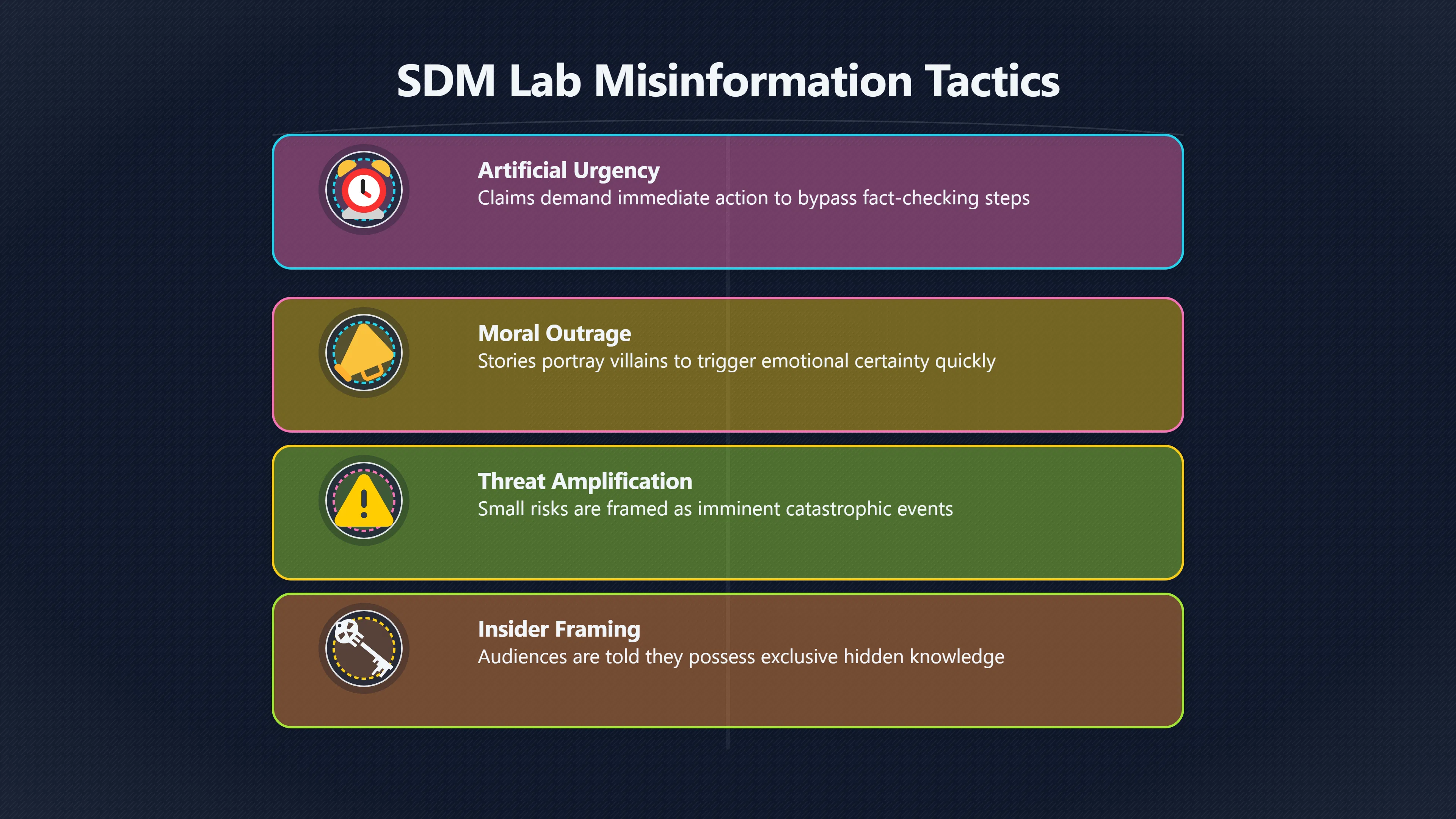
Several recurring tactics exploit this pattern:
- Artificial urgency. Claims insist that action must happen immediately, discouraging fact-checking because checking is framed as dangerous delay.
- Moral outrage. Stories portray obvious villains and innocent victims, encouraging emotional certainty before evidence is examined.
- Threat amplification. Small risks are presented as imminent catastrophes, making caution appear irresponsible.
- Exclusive insider framing. Audiences are told they possess hidden knowledge unavailable to ordinary people, making scepticism feel like betrayal rather than critical thinking.
These techniques are not confined to one ideology or topic. They appear in health misinformation, election rumours, financial scams, conspiracy theories and fabricated breaking news because they exploit general features of human decision-making rather than particular political beliefs.[SDM Lab]sdmlab.psychol.cam.ac.ukSDM Lab Countering misinformation through psychological inoculationSDM LabCountering misinformation through psychological inoculationMarch 2, 2024 — by S van der Linden · 2024 · Cited by 72 — In this chap…
How identity cues and repetition shape belief
Emotional manipulation rarely relies on urgency alone. Many misleading messages also signal group identity. Rather than presenting evidence, they imply that accepting or rejecting a claim demonstrates loyalty.
Identity cues often include phrases such as “real patriots know”, “people like us understand”, or “only the corrupt deny this”. These statements subtly redefine agreement as membership. Rejecting the claim can therefore feel like rejecting one’s community rather than evaluating information.
Repetition strengthens this effect. Psychological research has long shown that repeated statements tend to feel more familiar, and familiarity can be mistaken for accuracy, especially when people are distracted or emotionally engaged. Repetition across multiple accounts, screenshots or reposts can create the impression of widespread independent confirmation even when every version traces back to the same unsupported source.[SDM Lab]sdmlab.psychol.cam.ac.ukSDM Lab Countering misinformation through psychological inoculationSDM LabCountering misinformation through psychological inoculationMarch 2, 2024 — by S van der Linden · 2024 · Cited by 72 — In this chap…
Identity and repetition also reinforce each other:
- Repeated exposure normalises emotionally charged narratives.
- Seeing trusted members of one’s own group repeat a claim increases perceived credibility.
- Public agreement creates social pressure to conform before independent evaluation.
- Contradictory evidence may then feel socially costly, encouraging motivated reasoning rather than open investigation.
The important analytical point is that social agreement is not itself evidence. Large numbers of people can sincerely repeat inaccurate information, particularly when repetition is driven by emotional engagement rather than independent verification.

Why outrage often feels like evidence
One reason outrage is persuasive is that it changes the standards people use when judging claims. Strong emotional reactions can create an intuitive sense that “something this shocking must be true.”
This is a form of emotional reasoning rather than evidential reasoning. Instead of evaluating the quality of sources, people use the intensity of their reaction as an indirect measure of credibility.
Misleading content often reinforces this by combining several persuasive signals:
- emotionally vivid anecdotes instead of representative evidence;
- selective images or video clips stripped of context;
- claims that institutions are deliberately hiding the truth;
- demands for immediate sharing before verification becomes possible.
None of these techniques proves a claim is false. Genuine emergencies and genuine scandals also produce strong emotions. The key distinction is whether emotional intensity replaces evidence rather than directing attention towards evidence.
An analytical reader therefore separates two questions:
- Does this deserve an emotional response?
- Has the evidence earned that response?
Keeping those questions separate makes manipulation substantially more difficult.
Prebunking tactics for recognising manipulation early
Traditional fact-checking happens after misinformation has already been encountered. Increasing evidence suggests that prebunking—warning people about common manipulation techniques before exposure—can make them more resistant to later misinformation. Rather than teaching individual facts, prebunking teaches recognition of recurring persuasive strategies.[SDM Lab+2Taylor & Francis]sdmlab.psychol.cam.ac.ukSDM Lab Countering misinformation through psychological inoculationSDM LabCountering misinformation through psychological inoculationMarch 2, 2024 — by S van der Linden · 2024 · Cited by 72 — In this chap…
Research led by social psychologists has found that exposing people to weakened examples of misleading techniques can improve their ability to recognise manipulation across different topics. Interactive approaches, including educational games that let participants practise identifying tactics such as impersonation, emotional manipulation and conspiracy framing, have shown measurable improvements in resilience to misinformation.[Taylor & Francis+2SDM Lab]taylorfrancis.compsychological inoculation fake news sander van der linden jon roozenbeekTaylor & FrancisPsychological Inoculation Against Fake News | 11by S van der Linden · 2020 · Cited by 165 — We provide empirical evidence…
A practical prebunking routine asks readers to pause before reacting:
- Why does this message want me to feel urgency?
- Am I being encouraged to share before checking?
- Is outrage doing most of the persuasive work?
- Does the message rely on loyalty or identity more than evidence?
- Have I seen the same claim repeated without independent confirmation?
- Would I apply the same standards if this supported the opposite side?
These questions shift attention away from emotional momentum and back towards evidence quality.
Emerging research also suggests that prebunking can reduce intentions to share misleading content, not merely improve recognition of falsehoods. Experimental studies using interactive interventions have found improvements in discerning manipulation techniques and greater caution about forwarding questionable material.[World Bank]documents1.worldbank.orgWorld BankFind the Fake: Boosting Resistance to Health Misinformation…by M Dugas · 2024 — This study experimentally tests the impact o…
What this means for better reasoning under pressure
Within the broader challenge of reasoning under emotional pressure, urgency and outrage deserve particular attention because they target the conditions of judgement rather than the facts themselves. They encourage speed instead of reflection, identity instead of evidence and emotional certainty instead of proportional confidence.
Improving analytical thinking therefore does not require suppressing emotion altogether. It requires recognising when emotion is being deliberately recruited as a substitute for evidence. The habit of briefly delaying judgement—long enough to ask who benefits from immediate belief, whether multiple independent sources agree, and whether the evidence justifies the emotional response—can substantially reduce vulnerability to these forms of manipulation. Research on psychological inoculation indicates that learning to recognise these tactics in advance can strengthen resistance across many different misinformation topics, making thoughtful evaluation more likely even when messages are designed to provoke immediate reactions.[SDM Lab+2PMC]sdmlab.psychol.cam.ac.ukSDM Lab Countering misinformation through psychological inoculationSDM LabCountering misinformation through psychological inoculationMarch 2, 2024 — by S van der Linden · 2024 · Cited by 72 — In this chap…
eBay marketplace picks
Marketplace Samples
Example marketplace items related to this page. Use the search link to explore similar finds on eBay.




Endnotes
1.
Source: sdmlab.psychol.cam.ac.uk
Title: SDM Lab Countering misinformation through psychological inoculation
Link:https://www.sdmlab.psychol.cam.ac.uk/files/media/countering.pdf
Source snippet
SDM LabCountering misinformation through psychological inoculationMarch 2, 2024 — by S van der Linden · 2024 · Cited by 72 — In this chap...
Published: March 2, 2024
2.
Source: pmc.ncbi.nlm.nih.gov
Link:https://pmc.ncbi.nlm.nih.gov/articles/PMC10498317/
Source snippet
Inoculation for Credibility Assessment, Sharing...by C Lu · 2023 · Cited by 131 — Van der Linden's team [1] introduced psychological ino...
3.
Source: taylorfrancis.com
Title: psychological inoculation fake news sander van der linden jon roozenbeek
Link:https://www.taylorfrancis.com/chapters/oa-edit/10.4324/9780429295379-11/psychological-inoculation-fake-news-sander-van-der-linden-jon-roozenbeek
Source snippet
Taylor & FrancisPsychological Inoculation Against Fake News | 11by S van der Linden · 2020 · Cited by 165 — We provide empirical evidence...
4.
Source: documents1.worldbank.org
Link:https://documents1.worldbank.org/curated/en/099227409302412051/pdf/IDU113ce23951c3cc145541a19c1152b035fd129.pdf
Source snippet
World BankFind the Fake: Boosting Resistance to Health Misinformation...by M Dugas · 2024 — This study experimentally tests the impact o...
Additional References
5.
Source: future-industry.org
Link:https://www.future-industry.org/t41-psychological-inoculation-against-misinformation-sander-van-der-linden-university-of-cambridge/
Source snippet
Sander van der Linden (University of Cambridge)9 Dec 2024 — Inoculation theory offers a natural basis for developing a psychological 'vac...
6.
Source: europarl.europa.eu
Link:https://www.europarl.europa.eu/cmsdata/242285/Sander%20van%20der%20Linden.pdf
Source snippet
Sander van der Linden. 15/11/2021. Professor of Social Psychology in Society. Director, Cambridge Social...Read more...
7.
Source: youtube.com
Title: Foolproof in the Age of Misinformation | Sander van der Linden, ep95
Link:https://www.youtube.com/watch?v=uE8sy7rVMOE
Source snippet
"Sander van der Linden" misinformation Stopping the spread of misinformation, with Sander van der Linden, PhD | Speaking of Psychology Am...
8.
Source: linkedin.com
Link:https://www.linkedin.com/posts/sander-van-der-linden-156a08203_prebunking-inoculation-badnews-activity-7461018385804591104-p4Lt
Source snippet
It reveals the techniques used to...Read more...
9.
Source: youtube.com
Link:https://www.youtube.com/watch?v=EIFSofwEoOc
Source snippet
Foolproof in the Age of Misinformation | Sander van der Linden, ep95...
10.
Source: csar.org.uk
Title: 20250210 vanderlinden
Link:https://www.csar.org.uk/lectures/2024-2025/20250210_vanderlinden/
Source snippet
Psychological Inoculation Against Misinformation10 Feb 2025 — Inoculation theory offers a natural basis for developing a psychological 'v...
11.
Source: youtube.com
Title: How “rage bait” manipulates emotions for online engagement
Link:https://www.youtube.com/watch?v=NAAkVEvEiyU
Source snippet
Stopping the spread of misinformation, with Sander van der Linden, PhD | Speaking of Psychology...
12.
Source: youtube.com
Title: Why People Believe Misinformation: The Psychology of Fear | Beyond the Books
Link:https://www.youtube.com/watch?v=_7otmig_7Co
Source snippet
How "rage bait" manipulates emotions for online engagement...
13.
Source: youtube.com
Title: Psychological inoculation against misinformation
Link:https://www.youtube.com/watch?v=OQ8Dlu6sgYc
Source snippet
Bennett School of Public Policy•756 views · 46:39 · Go to channel...
14.
Source: youtube.com
Title: How “prebunking” misinformation works
Link:https://www.youtube.com/watch?v=1RmxeZHPeHg
Source snippet
Why People Believe Misinformation: The Psychology of Fear | Beyond the Books...
Topic Tree