Within Sharper Thinking
Can Mapping an Argument Improve It?
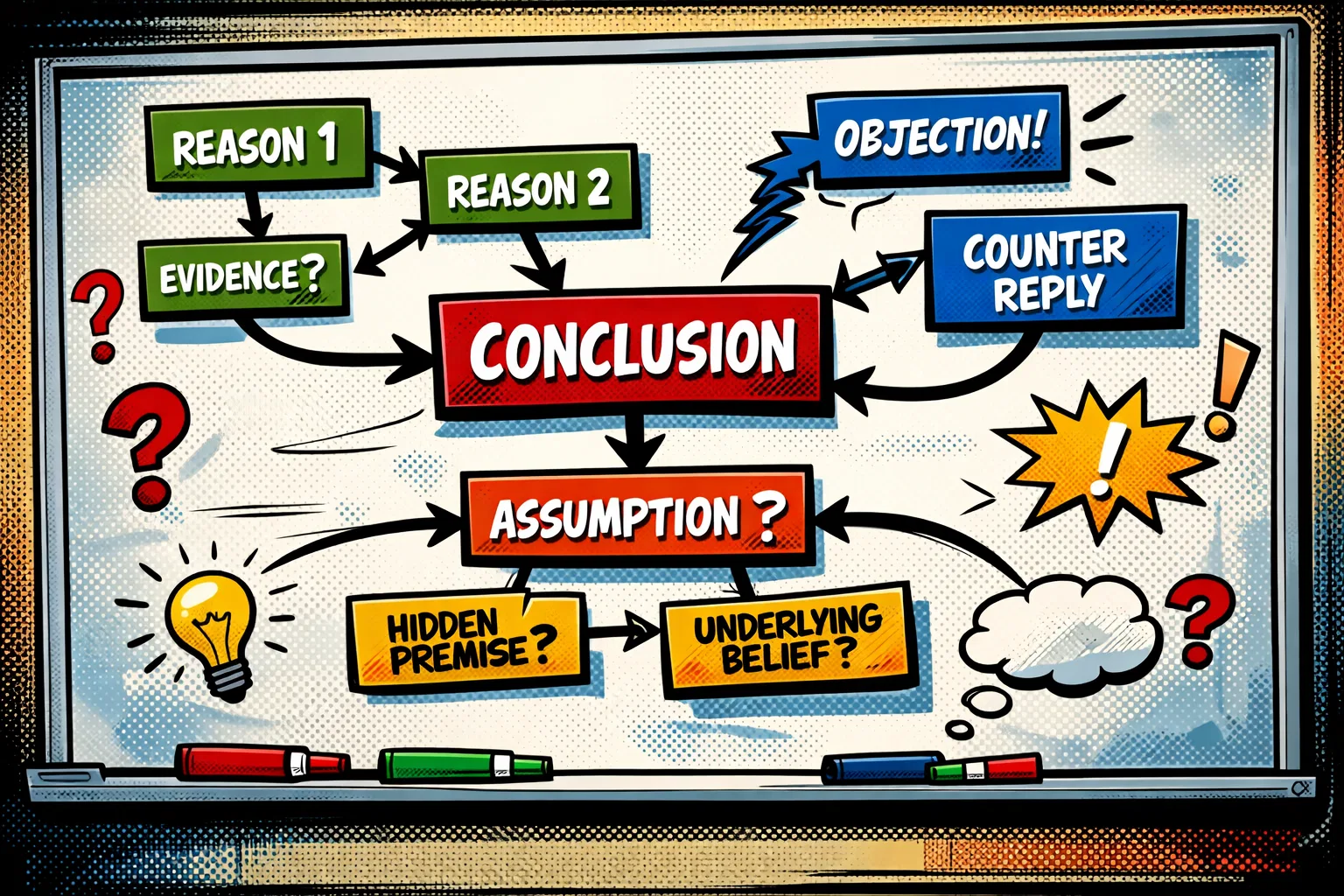
Argument maps turn conclusions, reasons, objections, and assumptions into a visible structure that can be tested.
On this page
- How argument maps work
- What maps reveal
- Simple no software templates
Page outline Jump by section
Introduction
Argument mapping improves reasoning by turning a chain of thought into something you can inspect. Instead of holding a vague position in your head, you place the main conclusion, supporting reasons, objections, replies and hidden assumptions into a visible structure. That structure makes it easier to ask: which claim is actually being defended, which reasons support it, where does the evidence stop, and what would have to be true for the conclusion to follow? Argument mapping is therefore less a decorative study technique than a practical intervention for clearer thinking: it slows the rush from impression to verdict and gives reasoning a shape that can be tested.
The evidence is not that drawing boxes magically makes people smarter. The stronger claim is more precise: structured practice in mapping arguments, especially with feedback, can improve critical-thinking performance more reliably than many loose “think harder” approaches. Studies and reviews of argument-mapping instruction report benefits for evaluation, comprehension and reflective judgement, while also noting that effects depend on practice intensity, task design and the kinds of arguments being mapped.[Research Repository+2AJET]researchrepository.universityofgalway.ieResearch RepositoryAn evaluation of argument mapping as a method…by CP Dwyer · 2012 · Cited by 238 — Results are discussed in light of…
How argument maps work
An argument map is a diagram of reasoning, not a general brainstorm. Its basic unit is a claim: a statement that can be accepted, rejected, questioned or supported. The map then shows how claims relate to one another. A top-level conclusion might be supported by several independent reasons; a reason might itself need evidence; an objection might attack either the conclusion, a supporting claim, or the link between them. This is why argument maps are different from mind maps. Mind maps are useful for association and memory, while argument maps are built to expose inferential structure: what is supposed to support what, and whether the support is strong enough.[Springer]link.springer.comConcept mapping, mind mapping and argument mappingby M Davies · 2011 · Cited by 1536 — This paper offers an outline of the variou…
A simple map starts with the conclusion. For example: “The council should pedestrianise this street.” Below it might sit reasons such as “traffic injuries would probably fall”, “local air quality would improve”, and “nearby shops may gain footfall”. Each of those reasons then needs its own support: collision data, pollution readings, evidence from comparable streets, or survey results from affected businesses. Objections sit alongside the reasons: “disabled access may become harder”, “traffic may be displaced into neighbouring streets”, or “delivery costs may rise”. The map makes the debate more honest because it stops a general pro-or-con mood from standing in for a tested argument.
Good maps usually distinguish four things:
- Conclusion: the claim the argument is trying to establish.
- Reasons: claims offered in support of that conclusion.
- Objections: claims that weaken the conclusion, a reason, or an inference.
- Assumptions: unstated claims that must be true for the reasoning to work.
The assumption layer is often where the most useful thinking happens. In ordinary prose, people skip steps because the missing premise feels obvious to them. In an argument map, the gap becomes visible. If someone argues that “remote work should continue because productivity has not fallen”, the hidden assumption may be that productivity is the main criterion for deciding the policy. A map allows that assumption to be examined rather than smuggled into the conclusion.
What maps reveal that prose can hide
The chief value of argument mapping is that it separates the psychological force of an argument from its logical structure. A confident paragraph can sound persuasive because it moves quickly, uses vivid examples, or mixes several claims together. A map interrupts that flow. It asks each claim to stand in its own box and show its relation to the rest of the argument.
That visibility helps reveal several common reasoning problems. A conclusion may have many words around it but only one real reason supporting it. A reason may look strong until the map shows that it depends on an untested assumption. An objection may appear to refute a whole argument when it only weakens one branch. Conversely, a small-looking objection may be devastating if it attacks a crucial inference rather than a peripheral detail.
Researchers and teachers of argument mapping often stress this “externalisation” effect: the map reduces the burden on working memory. Instead of trying to remember every strand of a debate at once, the thinker can inspect the structure on the page. Tim van Gelder’s work on critical-thinking instruction argues that students improve faster when they practise reasoning in a visible, feedback-rich form rather than relying only on conventional discussion or essay writing.[University of Bath Personal Homepages]people.bath.ac.ukOpen source on bath.ac.uk.
A second benefit is that maps encourage fairer disagreement. In a heated discussion, people often respond to tone, identity, or the weakest version of the other side. A map asks a more disciplined question: “Which exact claim are you objecting to?” That can reveal whether the disagreement is about evidence, values, definitions, risk tolerance, or an unstated assumption. The result is not automatic consensus, but a cleaner disagreement.

Why mapping can improve analytical skill
Argument mapping works best when treated as deliberate practice. The learner repeatedly breaks arguments into claims, tests support relations, identifies missing assumptions, receives feedback, and revises the map. That matters because critical thinking is not simply a set of definitions. People may know the names of fallacies yet fail to notice weak reasoning in real time. Mapping gives them a repeatable action: locate the conclusion, identify the reasons, test the links, add objections, and revise.
Several studies have examined argument mapping in higher education. Charles Twardy reported that computer-based argument mapping produced large gains in critical-thinking courses compared with typical gains from other methods, though the study belongs to a specific instructional context rather than a universal guarantee.[University of Southampton Web Archive]web-archive.southampton.ac.ukOpen source on southampton.ac.uk. Dwyer, Hogan and Stewart evaluated argument mapping in e-learning environments and found that argument-mapping groups could outperform controls on aspects of critical-thinking performance, while later work also cautioned that short interventions may produce smaller or less stable effects than semester-length practice.[Research Repository]researchrepository.universityofgalway.ieResearch RepositoryAn evaluation of argument mapping as a method…by CP Dwyer · 2012 · Cited by 238 — Results are discussed in light of…
The pattern across this evidence is useful for implementation. Argument mapping is strongest when it is not a one-off worksheet. It needs repeated practice, examples of good maps, feedback on errors, and tasks that require genuine evaluation rather than merely copying statements into boxes. A 2009 study of web-based argument-mapping exercises with automated feedback reported a 0.45 standard-deviation improvement from pre-test to post-test in a single undergraduate critical-thinking course, describing the result as modest but encouraging.[AJET]ajet.org.auImproving critical thinking using web based argument…by S Butchart · 2009 · Cited by 136 — In this paper we describe a simple soft…
The mechanism is also plausible. Mapping forces a person to perform the operations that good reasoning requires: distinguish a claim from evidence, decide whether two premises work independently or jointly, check whether an objection attacks a premise or an inference, and make missing assumptions explicit. These are small cognitive moves, but repeated practice makes them more available when the thinker later reads an article, writes a proposal, analyses a policy, or evaluates a disputed claim.
A simple map for everyday decisions
Argument maps do not have to be software-heavy. A useful beginner template can be done on paper or in a plain document. The aim is not to produce a beautiful chart; it is to make the reasoning inspectable.
Start with a decision claim. For example: “I should accept the new job offer.” Then build the map in layers:
- Put the main conclusion at the top.
Write it as a complete sentence, not a topic label. “Accept the job offer” is less useful than “I should accept the job offer from Company A.”
- Add the main reasons underneath.
Each reason should be a claim that supports the conclusion. “Salary” is only a topic; “The salary is high enough to improve my financial security” is a claim.
- Separate independent and linked reasons.
Some reasons stand alone. Others only work together. “The commute is shorter” may independently support the conclusion. “The role is more senior” and “the company will provide management training” may work together if the argument is about career development.
- Add objections in a different branch.
“The company has had high staff turnover” is not just a negative feeling; it is a claim that may weaken the decision. It should be mapped and then supported or tested.
- Write the hidden assumptions.
The argument may assume that career growth matters more than stability, that the company’s financial position is sound, or that the new manager will provide the promised support.
- Mark what evidence is missing.
A map becomes especially useful when it shows not only what you believe, but what you need to check: contract terms, turnover data, probation conditions, pension differences, or conversations with current employees.
This template improves thinking because it changes the task from “How do I feel about the offer?” to “Which claims support the decision, which claims weaken it, and which uncertain assumptions matter most?” It does not remove judgement. It improves the conditions under which judgement is made.
What good maps reveal in policy reasoning
Argument mapping is especially useful for policy questions because policy arguments are rarely single-strand. They mix evidence, values, trade-offs, risks, definitions and predictions. A policy proposal may be supported by evidence of benefit but weakened by cost, fairness, feasibility or unintended consequences. In prose, these dimensions can become tangled. A map lets the reader see whether the dispute is empirical, ethical or practical.
Take the policy claim: “Schools should ban smartphones during the school day.” A map might show supporting reasons about attention, cyberbullying and classroom management. It might show objections about emergency contact, accessibility needs, enforcement burden and student autonomy. It might then reveal hidden assumptions: that distraction costs outweigh convenience, that exceptions can be administered fairly, and that the ban will be enforceable without damaging trust.
This is clearer than a list of pros and cons because the map shows where each point lands. Evidence about attention supports one branch. Evidence about emergency contact attacks another. A practical objection about enforcement may not refute the educational aim, but it may weaken the policy’s feasibility. The decision-maker can then ask a better question: “What design would preserve the strongest reasons while answering the strongest objections?”
Modern argument-mapping research also emphasises that objections can attack different targets. Some objections challenge a premise, some challenge the conclusion directly, and some challenge the inference from premise to conclusion. That distinction matters. If an objection shows that a policy has a serious implementation cost, it may not prove the policy aim is wrong; it may show that the current route to the aim is weak.[Springer]link.springer.comOpen source on springer.com.
Simple no-software templates
The easiest way to begin is with a compact, repeatable format. Software can help with large maps, but the core skill is independent of the tool. A notebook, whiteboard or document is enough for most everyday reasoning.
The five-box test
Use this when a claim feels persuasive but you have not yet inspected it.
Claim: What is being concluded?
Because: What is the strongest reason?
Evidence: What supports that reason?
But: What is the strongest objection?
So what must be true?: What assumption connects the reason to the claim?
For example:
Claim: “This article is probably reliable.”
Because: “It cites several named experts.”
Evidence: “The experts are identifiable and relevant to the topic.”
But: “The article may have selected only experts who support its angle.”
So what must be true?: “The article’s expert selection is broad enough to represent the serious range of views.”
This small template catches a common failure: mistaking the presence of evidence for the quality, relevance and balance of evidence.
The three-column dispute map
Use this when two people disagree and the conversation keeps circling.
Supports the claimChallenges the claimNeeds checkingReasons and evidence for the conclusionObjections, counterexamples and alternative explanationsMissing facts, hidden assumptions and ambiguous terms
This format is less formal than a full map, but it still improves the discussion. It keeps disagreement from becoming a contest of repeated assertions. If a point belongs in “needs checking”, it should not be treated as settled. If a point challenges only a minor reason, it should not be presented as a total refutation.
The assumption ladder
Use this when an argument jumps too quickly from fact to recommendation.
Write the argument as:
“Because A, we should B.”
Then ask:
- What has to be true for A to support B?
- Is that assumption factual, ethical, practical or definitional?
- What evidence would test it?
- Who might reasonably reject it?
For example: “Because the meeting format wastes time, we should cancel weekly meetings.” The missing assumptions may include: that the lost time outweighs coordination benefits, that the same information can be shared asynchronously, and that fewer meetings will not reduce accountability. Mapping those assumptions may lead to a better conclusion: not “cancel all meetings”, but “replace the weekly status meeting with a written update and hold a shorter decision meeting only when needed.”
Where argument maps can mislead
Argument maps are useful, but they are not a complete theory of judgement. A tidy map can give a false sense of precision if the underlying evidence is poor. A person can map biased claims beautifully. The diagram may make the argument clearer without making it true.
There are also types of reasoning that are harder to represent cleanly. Recent work on the limits of argument-map representation highlights difficulties with reductio arguments, equivocation charges, logical analogies and mathematical arguments. These cases often involve reasoning about language, form, or indirect implication in ways that do not fit neatly into simple support-and-objection branches.[Springer]link.springer.comOpen source on springer.com.
Another risk is over-fragmentation. If every sentence becomes a box, the map can become harder to understand than the original argument. Good mapping requires judgement about granularity: claims should be specific enough to test but not so tiny that the structure disappears into clutter. For everyday use, the best map is often the smallest one that reveals the main conclusion, strongest reasons, strongest objections and most important assumptions.
Finally, mapping should not become a way to avoid values. Many real decisions do not turn solely on evidence. A policy argument may depend on how much weight people give to fairness, autonomy, safety, cost or dignity. A good map can clarify those value assumptions, but it cannot decide them by diagram alone.
How to use argument mapping as a thinking habit
The most practical use of argument mapping is not to map every argument. It is to recognise the moments when mapping will repay the effort. Use it when a decision is important, a disagreement is stuck, a text feels persuasive but complicated, or your own conclusion feels obvious before you can explain why.
A useful routine is:
- Map before judging.
Spend a few minutes representing the argument before deciding whether you agree. This prevents first impressions from selecting the structure.
- Steelman before objecting.
Put the strongest version of the opposing reason on the map. Weak objections to weak versions of an argument do little for analytical skill.
- Attack the link, not just the claim.
Ask whether the reason, even if true, really supports the conclusion. Many arguments fail at the inference stage.
- Mark confidence levels.
Label claims as strong, plausible, weak or unknown. This keeps uncertain claims from silently carrying too much weight.
- Revise the conclusion.
The best outcome of a map is often not “yes” or “no”, but a better-shaped conclusion: narrower, more conditional, or more evidence-sensitive.
This habit fits naturally within broader analytical skill. It strengthens the bridge between reading, writing, decision-making and self-correction. When reasoning stays in the head, weak links can hide behind fluency. When reasoning is mapped, the thinker has to show the route from claim to conclusion — and that route can finally be improved.
Amazon book picks
Further Reading
Books and field guides related to Can Mapping an Argument Improve It?. Use these as the next step if you want deeper reading beyond the article.
A Rulebook for Arguments
Provides practical guidance on constructing and assessing arguments that can then be visualised in maps.
Asking the Right Questions
Teaches evaluation of claims, reasons, assumptions, and evidence—the same reasoning elements exposed by argument maps.
Critical Thinking
Directly covers mapping arguments, analysing support structures, and improving reasoning through visual representation.
The Thinker's Guide to Analytic Thinking
Focuses on breaking reasoning into components and evaluating logical structure.
eBay marketplace picks
Marketplace Samples
Example marketplace items related to this page. Use the search link to explore similar finds on eBay.



Endnotes
1.
Source: ajet.org.au
Link:https://ajet.org.au/index.php/AJET/article/download/1154/402/3631
Source snippet
Improving critical thinking using web based argument...by S Butchart · 2009 · Cited by 136 — In this paper we describe a simple soft...
2.
Source: link.springer.com
Link:https://link.springer.com/article/10.1007/s10734
Source snippet
Concept mapping, mind mapping and argument mappingby M Davies · 2011 · Cited by 1536 — This paper offers an outline of the variou...
3.
Source: link.springer.com
Link:https://link.springer.com/chapter/10.1057/9781137378057_12
4.
Source: link.springer.com
Link:https://link.springer.com/article/10.1007/s10503-023-09626-5
5.
Source: youtube.com
Title: Critical Thinking with Generative AI and Argument Maps
Link:https://www.youtube.com/watch?v=RrihZ3JKZPE
Source snippet
Tim van Gelder - Argument Mapping & Intelligence Augmentation...
6.
Source: youtube.com
Title: Tim van Gelder
Link:https://www.youtube.com/watch?v=C2t1Qqcwd5Q
Source snippet
Argument Mapping Demonstration...
7.
Source: researchrepository.universityofgalway.ie
Link:https://researchrepository.universityofgalway.ie/server/api/core/bitstreams/4034a5fa-43a2-4fb3-b889-847ee48dbb60/content
Source snippet
Research RepositoryAn evaluation of argument mapping as a method...by CP Dwyer · 2012 · Cited by 238 — Results are discussed in light of...
8.
Source: Wikipedia
Title: Argument map
Link:https://en.wikipedia.org/wiki/Argument_map
9.
Source: people.bath.ac.uk
Link:https://people.bath.ac.uk/edspd/Weblinks/PGCES%20ULL%20articles/Learning%20to%20Learn/van%20Gelder%202005%20CT.pdf
10.
Source: web-archive.southampton.ac.uk
Link:https://web-archive.southampton.ac.uk/cogprints.org/3008/1/reasonpaper.pdf
11.
Source: frontiersin.org
Link:https://www.frontiersin.org/journals/education/articles/10.3389/feduc.2025.1672105/full
12.
Source: research.universityofgalway.ie
Link:https://research.universityofgalway.ie/en/publications/the-promotion-of-critical-thinking-skills-through-argument-mappin-6
13.
Source: experientialwriting.byu.edu
Title: argument mapping
Link:https://experientialwriting.byu.edu/0000017b-e213-da71-a7ff-eab38cd90001/argument-mapping
14.
Source: repository.gatech.edu
Link:https://repository.gatech.edu/server/api/core/bitstreams/4a0ccc5d-0aee-45f9-92cd-99ad52eb1ba1/content
15.
Source: teachingchannel.com
Title: argument mapping
Link:https://www.teachingchannel.com/k12-hub/blog/argument-mapping/
16.
Source: vaia.com
Title: argument mapping
Link:https://www.vaia.com/en-us/explanations/psychology/cognitive-psychology/argument-mapping/
17.
Source: philosophy.lander.edu
Link:https://philosophy.lander.edu/logic/diagram.html
18.
Source: figma.com
Link:https://www.figma.com/templates/argument-mapping/
Additional References
19.
Source: onlinelibrary.wiley.com
Link:https://onlinelibrary.wiley.com/doi/10.1111/hequ.70063
Source snippet
Wiley Online LibraryArgument Mapping in Higher Education: A Systematic...15 Oct 2025 — A thesis by Alvarez (2007) reported a meta-analys...
20.
Source: researchgate.net
Link:https://www.researchgate.net/publication/259286333_The_promotion_of_critical_thinking_skills_through_argument_mapping
21.
Source: researchgate.net
Link:https://www.researchgate.net/publication/225631292_Concept_Mapping_Mind_Mapping_and_Argument_Mapping_What_are_the_Differences_and_Do_They_Matter
22.
Source: criticalthinking.org
Link:https://www.criticalthinking.org/pages/42nd-conference-guest-presentations/1528
23.
Source: ijcai.org
Link:https://www.ijcai.org/proceedings/2025/0495.pdf
24.
Source: reddit.com
Link:https://www.reddit.com/r/philosophy/comments/999bg/a_tutorial_on_argument_mapping_argument_mapping/
25.
Source: reasoninglab.com
Link:https://www.reasoninglab.com/wp-content/uploads/2013/10/Argument-Maps-the-Rules.pdf
26.
Source: rationaleonline.com
Link:https://rationaleonline.com/docs/en/tutorials/argument-mapping
27.
Source: reasoninglab.com
Link:https://www.reasoninglab.com/research-on-critical-thinking-argument-mapping/
28.
Source: cliffsnotes.com
Link:https://www.cliffsnotes.com/study-notes/23881351
Topic Tree