Within Teach It
The Question That Finds Hidden Confusion
Asking someone to explain an idea back in their own words often finds confusion that yes-or-no checks miss.
On this page
- Why 'Do you understand?' is a weak check
- How teach back works in healthcare and learning
- How to respond when the explanation fails
Page outline Jump by section
Introduction
A teach-back question is designed to uncover misunderstanding, not to confirm agreement. Instead of asking, “Do you understand?”, it asks someone to explain an idea, decision, or process in their own words. That small change often exposes gaps that a simple “yes” cannot. Within the broader practice of using plain-English explanation as a thinking test, teach-back is especially valuable because it reveals whether someone has built a working mental model rather than merely recognising familiar terminology.
 Healthcare has developed teach-back into a practical safety tool because misunderstandings about medicines, treatment plans, or follow-up care can have serious consequences. The same principle applies to learning, management, and analytical thinking: when people explain an idea back in their own words, hidden confusion becomes visible early enough to correct it.[AHRQ]ahrq.govUse the Teach-Back Method: Tool 5The teach-back method is a way of checking understanding by asking patients to state in their own wo…
Why “Do you understand?” is a weak check
The question “Do you understand?” feels polite and efficient, but it provides remarkably little information. Many people answer “yes” because they believe they understand, because they do not want to appear confused, or because they assume the missing pieces will become clear later. In other cases, they may understand individual facts but not how those facts fit together.
Research and practical guidance from the Agency for Healthcare Research and Quality (AHRQ) emphasise that yes-or-no questions are not teach-back questions precisely because they fail to distinguish confidence from comprehension. The person giving the explanation receives reassurance without evidence that the explanation actually worked.[AHRQ]ahrq.govUse the Teach-Back Method: Tool 5The teach-back method is a way of checking understanding by asking patients to state in their own wo…
This weakness becomes especially important when people are learning causal ideas rather than memorising facts. Someone may confidently recognise terms such as “feedback loop”, “opportunity cost”, or “correlation” while being unable to explain how those ideas operate in a concrete situation. Teach-back makes that distinction visible because it requires reconstruction rather than recognition.[PMC]pmc.ncbi.nlm.nih.govUse and Effectiveness of the Teach-Back Method in Patient…by PH Yen · 2019 · Cited by 612 — By using the teach-back method, HCPs ca…
How teach-back reveals hidden confusion
A good teach-back question does not ask for repetition. It asks for reconstruction.[ahrq.gov]ahrq.govTool: Teach-Back | Agency for Healthcare Research and…In a teach-back, you ask the patient or family caregiver to explain the info…
Instead of repeating the original wording, the learner must:
- organise the information into a coherent explanation;
- identify the important steps;
- connect causes with consequences;
- translate technical language into everyday language; and
- explain what actions should follow.
Each of these steps tests understanding in a different way. If someone can only quote definitions, they may have memorised vocabulary rather than built an explanatory model. If they skip important links in the chain, those missing links identify exactly where further teaching is needed.
This explains why teach-back is a stronger thinking test than recall alone. Remembering isolated facts is compatible with misunderstanding how those facts relate to one another. Explaining an idea forces those relationships into the open.[AHRQ]ahrq.govUse the Teach-Back Method: Tool 5The teach-back method is a way of checking understanding by asking patients to state in their own wo…
How teach-back works in healthcare and learning
Healthcare provides one of the clearest demonstrations of teach-back because misunderstandings can directly affect safety.
Rather than ending an explanation with:
“Do you understand how to take this medicine?”
a clinician might ask:
“When you get home, how will you take this medicine tomorrow?”
Or instead of asking whether discharge instructions make sense:
“Can you tell me, in your own words, what you’ll do if your symptoms get worse?”
These questions reveal practical misunderstandings that otherwise remain hidden. A patient may remember the medicine’s name but confuse the dosage, misunderstand when to seek emergency help, or incorrectly combine treatments. The explanation can then be corrected immediately rather than after a preventable mistake. AHRQ also recommends “show-me” demonstrations for physical tasks such as using inhalers or changing dressings, since being able to describe a procedure does not always mean being able to perform it correctly.[AHRQ]ahrq.govUse the Teach-Back Method: Tool 5The teach-back method is a way of checking understanding by asking patients to state in their own wo…
The same structure transfers naturally into education and analytical work.
Rather than asking:
- “Does that chapter make sense?”
ask:
- “How would you explain the main idea to a colleague?”
- “Why does the second step follow from the first?”
- “What problem is this method trying to solve?”
- “What would happen if one assumption changed?”
These questions expose whether the learner has formed a usable explanation rather than merely recognising familiar material.

What effective teach-back questions look like
Strong teach-back questions share several characteristics.[ahrq.gov]ahrq.govTool: Teach-Back | Agency for Healthcare Research and…In a teach-back, you ask the patient or family caregiver to explain the info…
They ask for explanation, not confirmation.
Instead of:
- “Do you understand inflation?”
ask:
- “How would you explain inflation to someone leaving school?”
They focus on action when appropriate.
Instead of:
- “Is the process clear?”
ask:
- “What would you do first after reading these instructions?”
They require causal reasoning.
Instead of:
- “Do you know why this works?”
ask:
- “Why does this step make the next one possible?”
They encourage ordinary language.
Instead of encouraging technical vocabulary, invite explanations that avoid jargon wherever possible. Translating specialised language into everyday speech often exposes where understanding depends on memorised labels.
These questions shift attention from recalling words towards demonstrating understanding.
Signs that the explanation has failed
A failed teach-back is not simply a wrong answer. More often, it reveals specific patterns of misunderstanding.
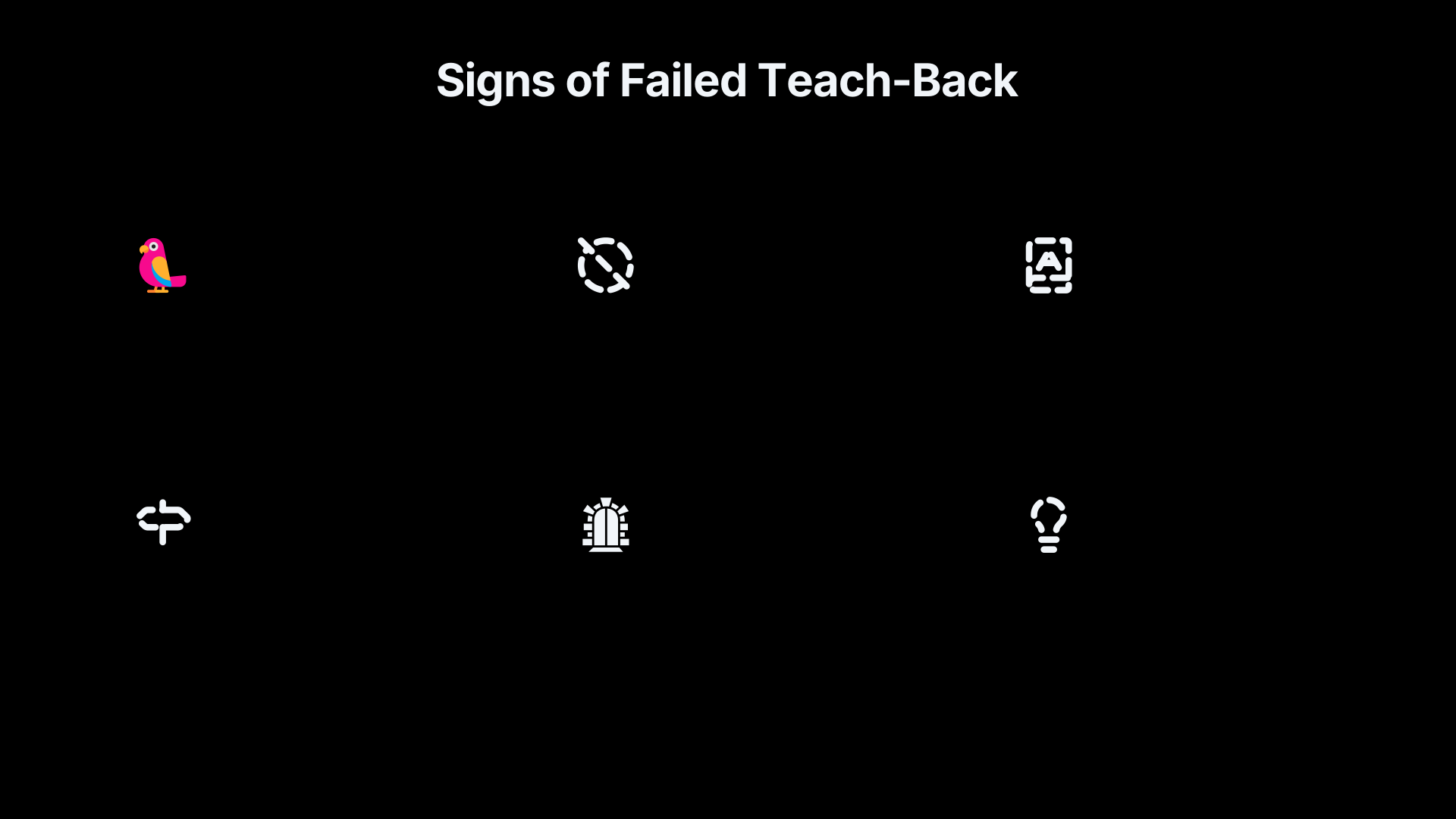
Common warning signs include:
- explaining procedures without explaining why they matter;
- repeating phrases almost word for word from the original explanation;
- skipping critical intermediate steps;
- using technical vocabulary correctly but inconsistently;
- giving examples that contradict the intended principle;
- confusing conditions with outcomes (“this happens because…” when the causal direction is reversed); or
- changing the topic when asked for a causal explanation.
These failures are valuable because each one identifies a different instructional problem. Someone who repeats memorised wording may need opportunities to translate concepts. Someone who consistently skips intermediate steps may need help building a clearer mental model rather than receiving more information.
How to respond when the explanation fails
Teach-back is not a test that produces pass-or-fail results. It is a feedback loop.[ahrq.gov]ahrq.govTool: Teach-Back | Agency for Healthcare Research and…In a teach-back, you ask the patient or family caregiver to explain the info…
Healthcare guidance consistently recommends treating misunderstanding as evidence that the explanation should change, not evidence that the learner has failed. A common framing is:
“I may not have explained that clearly. Let me try a different way.”
This matters because it reduces embarrassment and encourages honest responses. People are more willing to expose confusion when the emphasis is on improving the explanation rather than judging their ability.[AHRQ]ahrq.govUse the Teach-Back Method: Tool 5The teach-back method is a way of checking understanding by asking patients to state in their own wo…
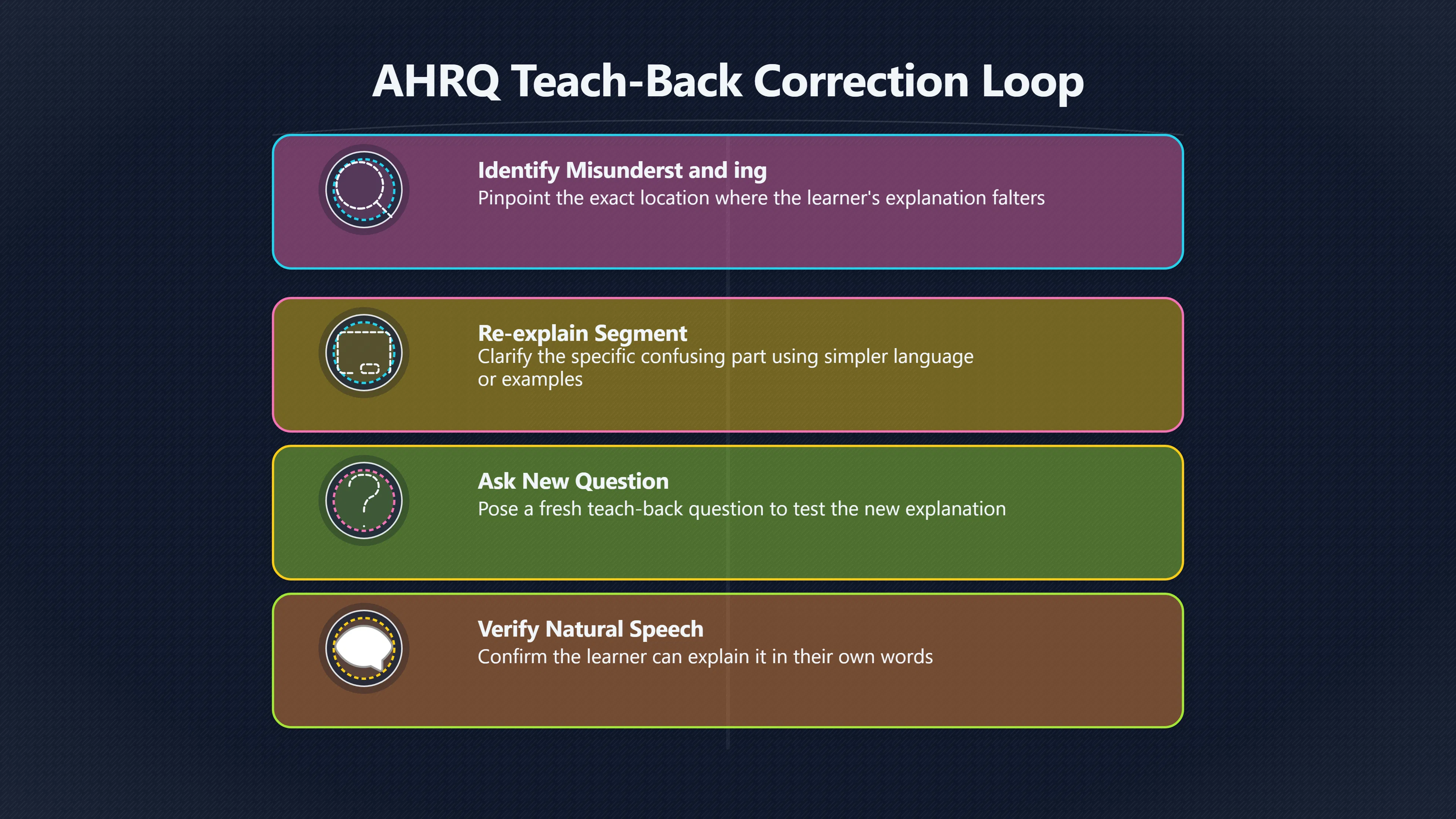
An effective response usually follows four steps:
- Identify exactly where the misunderstanding appeared.
- Re-explain only that part, preferably using different examples or simpler language.
- Ask another teach-back question rather than repeating the original explanation verbatim.
- Continue until the explanation is both accurate and expressed naturally in the learner’s own words.
Importantly, simply repeating the same explanation more loudly or with more technical detail rarely solves the underlying problem. Changing the explanation is usually more effective than repeating it.
Why teach-back improves analytical thinking
Teach-back does more than improve communication. It strengthens reasoning by forcing explanations to survive outside the speaker’s own internal assumptions.
When you ask yourself, “How would someone else explain this after hearing me?”, you begin to notice unsupported leaps, hidden assumptions, vague terminology, and missing causal links. The explanation becomes an external test of your own thinking.
That makes teach-back particularly valuable when analysing complex ideas. If another person can accurately explain the reasoning in their own words—and answer simple follow-up questions without relying on memorised phrases—it provides stronger evidence that the underlying explanation is genuinely clear than any number of affirmative responses to “Do you understand?”.
eBay marketplace picks
Marketplace Samples
Live-tested eBay searches with available results related to this page.



Endnotes
1.
Source: ahrq.gov
Link:https://www.ahrq.gov/health-literacy/improve/precautions/tool5.html
Source snippet
Use the Teach-Back Method: Tool 5The teach-back method is a way of checking understanding by asking patients to state in their own wo...
2.
Source: pmc.ncbi.nlm.nih.gov
Link:https://pmc.ncbi.nlm.nih.gov/articles/PMC6590951/
Source snippet
Use and Effectiveness of the Teach-Back Method in Patient...by PH Yen · 2019 · Cited by 612 — By using the teach-back method, HCPs ca...
3.
Source: ahrq.gov
Link:https://www.ahrq.gov/teamstepps-program/curriculum/communication/tools/teachback.html
Source snippet
Tool: Teach-Back | Agency for Healthcare Research and...In a teach-back, you ask the patient or family caregiver to explain the info...
4.
Source: pmc.ncbi.nlm.nih.gov
Link:https://pmc.ncbi.nlm.nih.gov/articles/PMC12680514/
Source snippet
teach-back method as a tool for health literacy - PMCby H Mahmoodi · 2025 · Cited by 7 — This simple yet powerful technique allows provid...
Additional References
5.
Source: healthliteracyplace.org.uk
Link:https://www.healthliteracyplace.org.uk/toolkit/techniques/teach-back/
Source snippet
Teach BackThe teach back method is a useful way to confirm that the information you provide is being understood by getting people to 'tea...
6.
Source: childrenandaids.org
Link:https://www.childrenandaids.org/media/6286/file/Macintosh%20HD%3AUsers%3Ajoelboches%3ALibrary%3ACaches%3AAdobe%20InDesign%3AVersion%2015.0%3Aen_US%3AInDesign%20ClipboardScrap1.pdf
Source snippet
because patients are asked to “teach back” what they have learned during their visit...Read more...
7.
Source: migrantcliniciansnetwork.substack.com
Title: the teach back method enhancing patient
Link:https://migrantcliniciansnetwork.substack.com/p/the-teach-back-method-enhancing-patient
Source snippet
Teach-Back Method: Enhancing Patient...Teach-back is a proven health literacy intervention in which clinicians ask patients to repeat he...
8.
Source: youtube.com
Title: What Is Teach-Back? (The Communication Technique That Improves Understanding)
Link:https://www.youtube.com/watch?v=cIdnW69a4oQ
Source snippet
Hospital Hill - Teach-back Method - Diabetes Medication Instructions...
9.
Source: youtube.com
Title: Hospital Hill
Link:https://www.youtube.com/watch?v=DcfPhZu2bi4
Source snippet
Health Literacy in Community Pharmacy - The 'Teach Back' Method...
10.
Source: nivel.nl
Link:https://www.nivel.nl/nl/publicatie/use-teach-back-method-patient-provider-communication-during-first-dispense-counseling
Source snippet
Use of the teach-back method in patient-provider...1 Feb 2023 — The teach-back method is effective to improve comprehension of informati...
11.
Source: teachback.org
Title: Teach Back Toolkit for website Sept 2021
Link:https://teachback.org/wp-content/uploads/2022/02/Teach-Back-Toolkit_for-website_Sept-2021.pdf
Source snippet
Any misunderstandings are then clarified by the health...Read more...
12.
Source: youtube.com
Title: What Is Teach-Back?
Link:https://www.youtube.com/watch?v=bzpJJYF_tKY
Source snippet
Teach back - a technique for clear communication...
13.
Source: youtube.com
Title: Health Literacy in Community Pharmacy
Link:https://www.youtube.com/watch?v=EtXGv-U-5D8
Source snippet
What Is Teach-Back?...
14.
Source: youtube.com
Title: Teach back
Link:https://www.youtube.com/watch?v=d702HIZfVWs
Topic Tree