Within Problem Framing
What Kind of Problem Are You Solving?
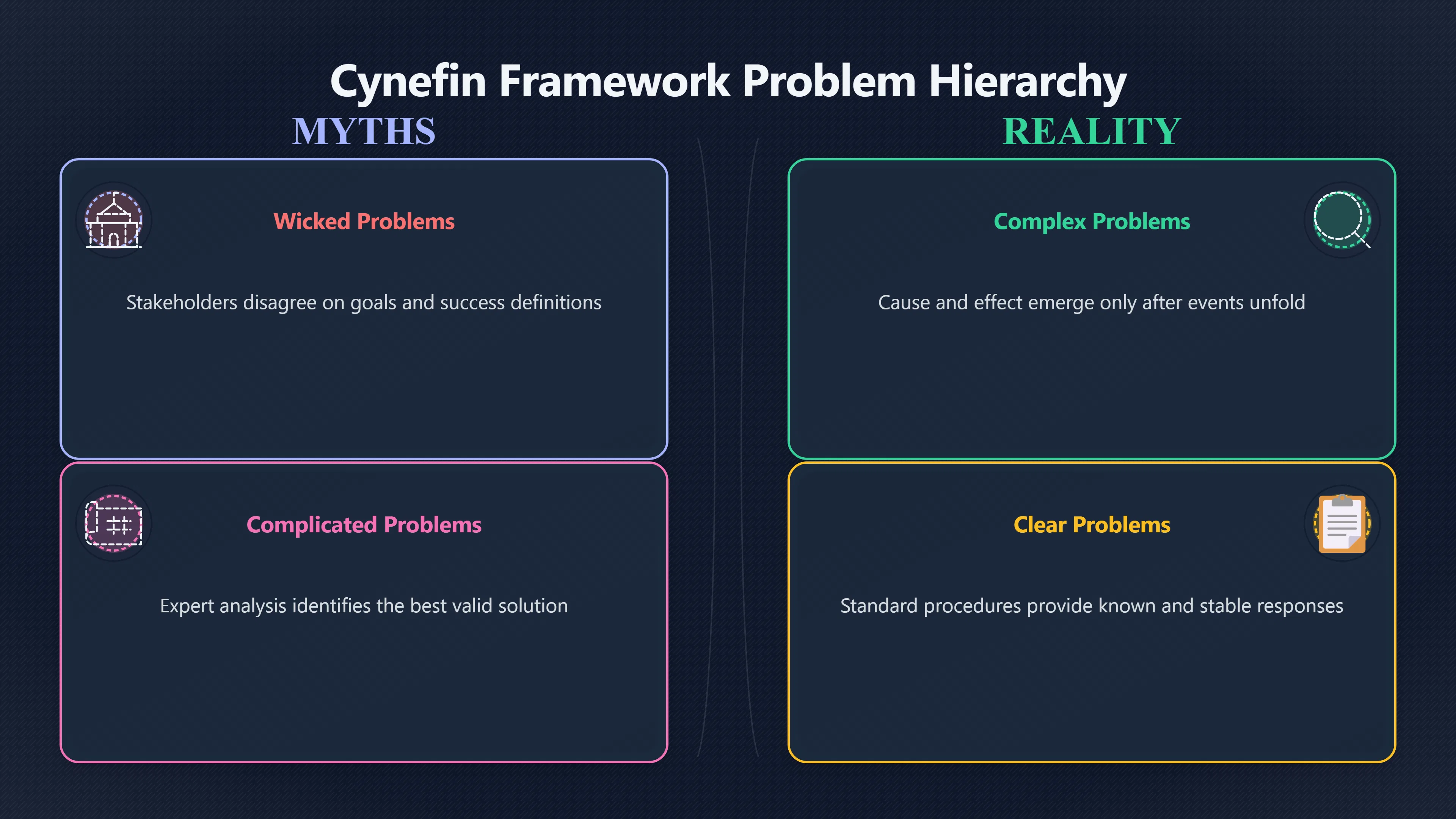
Clear, complicated, complex, and wicked problems fail when treated as the same kind of task.
On this page
- Clear and complicated problems
- Complex problems and small experiments
- Wicked problems and contested success
Page outline Jump by section
Introduction
One of the fastest ways to improve your thinking is to stop assuming that every problem can be solved in the same way. A broken machine, a software architecture decision, a cultural change programme, and a national housing shortage may all be called “problems”, but they differ fundamentally in how causes work, how evidence accumulates, and what success looks like. When people apply the wrong reasoning style to the wrong problem type, they often become trapped in cycles of overconfidence, endless analysis, or ineffective action. Research on decision-making, complexity, and policy design repeatedly shows that effective reasoning begins with recognising what kind of problem you are facing.[The Cynefin Co]thecynefin.coThe Cynefin Co AboutThe Cynefin CoAbout - Cynefin FrameworkThe Cynefin Framework was developed to help leaders understand their challenges and to make decisi…
 A useful distinction separates problems into clear, complicated, complex, and wicked forms. Each requires a different relationship between analysis, expertise, experimentation, and judgement. The key skill is not choosing the smartest reasoning method in general, but choosing the reasoning method that fits the problem.
Clear and Complicated Problems
Clear and complicated problems both have underlying cause-and-effect relationships, but they differ in how difficult those relationships are to understand.
When best practice is enough
Clear problems are situations where the correct response is already known. The cause-and-effect relationship is stable, repeatable, and widely understood. A missing file, a standard payroll calculation, or a routine safety checklist usually falls into this category.
In these cases, the most effective reasoning approach is often not deep analysis but reliable execution. Checklists, standard operating procedures, and established best practices outperform creativity because the challenge is consistency rather than discovery. Frameworks such as Cynefin describe this as a domain where people should identify the situation, categorise it correctly, and apply proven practice.[Wikipedia]WikipediaOpen source on wikipedia.org.
The common mistake is overcomplicating a clear problem. Organisations sometimes hold lengthy meetings to debate issues that already have known solutions.
When expertise and analysis matter
Complicated problems are different. The answer exists, but finding it requires investigation, specialist knowledge, or careful analysis.
Examples include:
- Designing a bridge.
- Diagnosing a rare engineering fault.
- Planning a spacecraft mission.
- Determining the cause of a manufacturing defect.
In these situations, evidence gathering and expert judgement become valuable. Multiple valid solutions may exist, but rigorous analysis can identify better and worse options. The relationship between cause and effect is discoverable even if it is not immediately obvious. Cynefin characterises this domain as one where leaders should analyse, consult experts, and compare alternatives before acting.[TXM Lean Solutions+2Open Practice Library]txm.comLean Solutions Cynefin Framework ExplainedTXM Lean SolutionsCynefin Framework Explained - The 5 Domains with…Approach for Complicated Problems: · Assess the situation and Sense…
A useful historical comparison illustrates the distinction. A routine aircraft maintenance procedure is largely a clear problem. Designing a new aircraft engine is a complicated problem. Both are technical, but one depends primarily on following established knowledge while the other depends on generating and applying expert knowledge.
The failure mode here is assuming that more expertise automatically solves every problem. That assumption works reasonably well in complicated domains but often breaks down elsewhere.
Complex Problems and Small Experiments
Complex problems look similar to complicated ones at first, yet they behave differently in an important way: the future cannot be fully predicted from existing knowledge.
In complex systems, many interacting elements influence one another. Human behaviour, organisational culture, markets, ecosystems, and social networks frequently display these characteristics. Cause and effect may only become visible after events unfold.[Wikipedia+2castintelligence.com]WikipediaOpen source on wikipedia.org.
Consider launching a new product. A technical team may analyse customer preferences, pricing, and competitors, but no amount of modelling can perfectly predict how consumers will react. Unexpected feedback loops, trends, and social influences can reshape outcomes.
Because prediction is limited, the reasoning method changes.
Rather than asking, “What is the optimal solution?”, the more useful question becomes, “What can we learn through safe-to-fail experiments?”
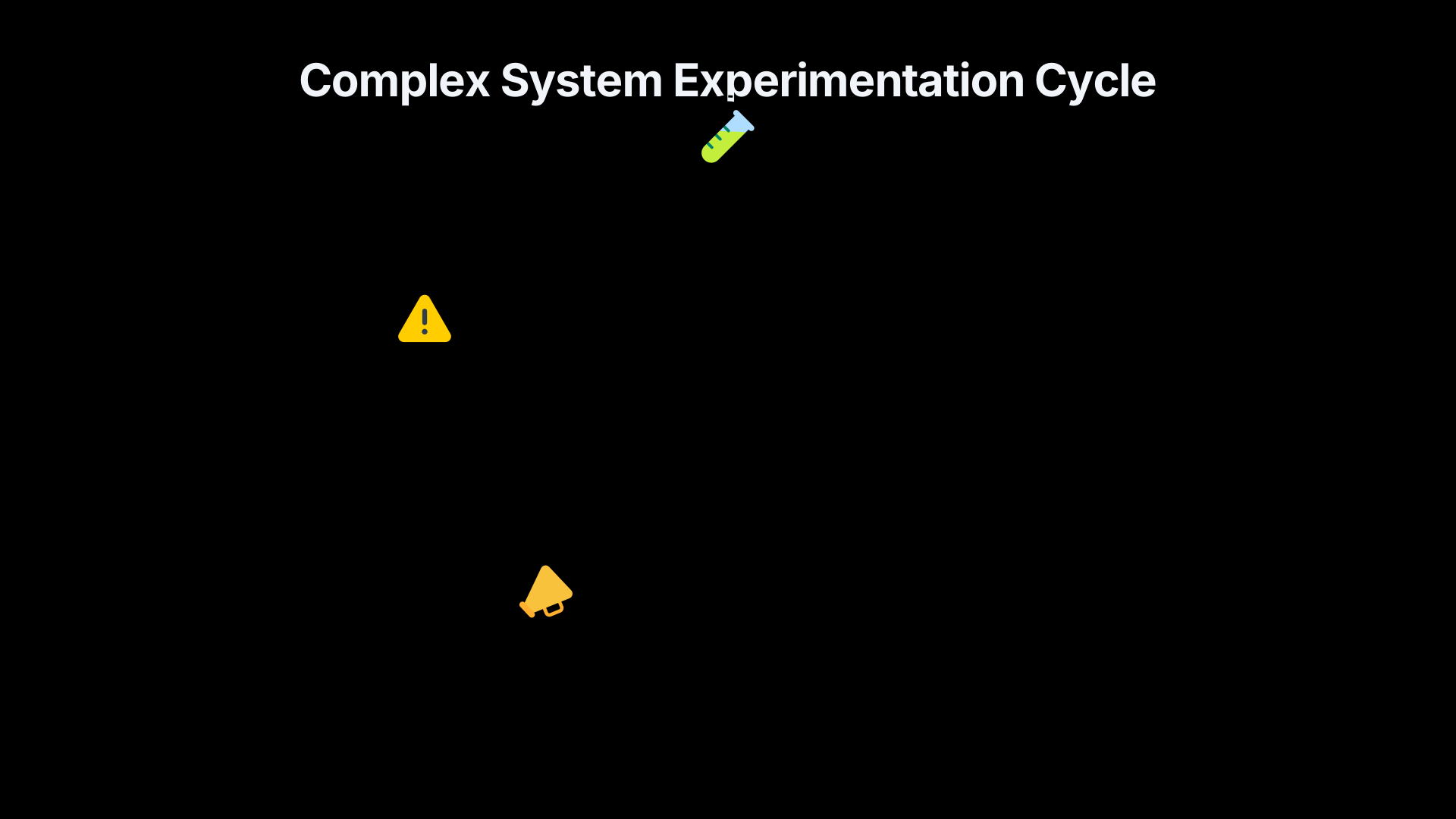
Researchers and practitioners working with complexity frameworks often recommend a pattern of:
- Run small probes or experiments.
- Observe what emerges.
- Adapt based on feedback.
- Expand successful approaches.
- Stop unsuccessful ones quickly. Wageningen University & Research eDepot+3SI Labs+3Open Practice Library
This differs sharply from the reasoning used for complicated problems. If an engineer is calculating the load-bearing capacity of a bridge, experimentation is usually secondary to analysis. If a company is trying to change workplace culture, experimentation is often primary because the system itself changes in response to intervention.
One sign that a problem is complex is that experts disagree despite having access to the same information. Another is that successful solutions in one context fail when copied elsewhere. In these environments, learning matters more than certainty.
Wicked Problems and Contested Success
Wicked problems occupy an even more challenging category. The concept emerged from the work of Horst Rittel and Melvin Webber, who argued that many social and policy challenges differ fundamentally from technical problems. sympoetic.net+2Springer
The defining feature of a wicked problem is not merely complexity. It is disagreement about what the problem actually is and what success should mean.
Examples often include:
- Housing affordability.
- Climate policy.
- Healthcare reform.
- Educational inequality.
- Urban development.
In these cases, stakeholders frequently disagree on goals, causes, trade-offs, and acceptable outcomes. A proposed solution may improve one measure while worsening another. There is rarely a definitive stopping point at which everyone agrees the problem has been solved. Rittel and Webber argued that solutions to wicked problems are often judged as better or worse rather than true or false. sympoetic.net+2Wikipedia
The British housing shortage provides a useful illustration. Different groups attribute the problem to planning rules, construction costs, infrastructure constraints, skills shortages, financing conditions, environmental regulation, population growth, or political choices. Each explanation implies a different solution. Because stakeholders value outcomes differently, even defining success becomes contested. The Times
Reasoning about wicked problems therefore requires methods that go beyond technical analysis:
- Stakeholder mapping.
- Deliberation and negotiation.
- Explicit discussion of values.
- Scenario exploration.
- Iterative policy adjustment.
- Recognition of trade-offs rather than optimisation.
The failure mode is treating a wicked problem as if it were merely a difficult engineering challenge. More data and better models can help, but they cannot eliminate disagreements about values, priorities, or acceptable risks. ResearchGate+2Sage Journals
Why Misclassification Creates Bad Decisions
Many reasoning failures occur because people correctly analyse the wrong type of problem.
Several recurring mistakes appear across organisations and public life:
- Using procedures for complex situations. Leaders impose rigid rules on evolving human systems and become surprised when behaviour changes.
- Using expert analysis for wicked problems. Technical reports answer factual questions while political and value conflicts remain unresolved.
- Using experimentation where reliability is required. Trial-and-error approaches create unnecessary risk in domains where proven practices already exist.
- Treating every challenge as unique. Teams repeatedly reinvent solutions to problems that are actually clear and well understood.
These errors are costly because they create an illusion of progress. People work hard, gather evidence, and produce plans, yet the reasoning method does not match the nature of the task.
A Quick Diagnostic Before You Begin
Before starting detailed analysis, ask four questions:
QuestionLikely problem typeIs there an established best practice that reliably works?ClearCan experts discover the answer through analysis?ComplicatedWill the answer emerge only through experimentation and adaptation?ComplexDo stakeholders disagree about goals, definitions, or what counts as success?Wicked
Many real-world situations contain elements of more than one category. A healthcare system, for example, includes clear procedures, complicated medical expertise, complex organisational dynamics, and wicked policy disputes simultaneously.
The practical lesson is not to force every challenge into a single box. It is to recognise that different parts of a problem may require different reasoning methods. Good problem framing begins by identifying which kind of uncertainty you are facing, because the quality of your thinking depends as much on choosing the right mode of reasoning as on reasoning well.
Amazon book picks
Further Reading
Books and field guides related to What Kind of Problem Are You Solving?. Use these as the next step if you want deeper reading beyond the article.
Thinking, Fast and Slow
Helps readers understand reasoning styles, judgment, bias, and when different forms of thinking fit different situations.
Thinking in Systems
Explains feedback loops, complex systems, interventions, and why different problems require different approaches.
Superforecasting
Demonstrates evidence-based reasoning under uncertainty, especially useful for complex and evolving problems.
The Great Mental Models, Volume 1
Provides frameworks for identifying problem types and selecting suitable reasoning approaches.
eBay marketplace picks
Marketplace Samples
Example marketplace items related to this page. Use the search link to explore similar finds on eBay.

Endnotes
1.
Source: Wikipedia
Link:https://en.wikipedia.org/wiki/Cynefin_framework
2.
Source: txm.com
Title: Lean Solutions Cynefin Framework Explained
Link:https://txm.com/making-sense-problems-cynefin-framework/
Source snippet
TXM Lean SolutionsCynefin Framework Explained - The 5 Domains with...Approach for Complicated Problems: · Assess the situation and Sense...
3.
Source: castintelligence.com
Title: cynefin framework
Link:https://castintelligence.com/blog/cynefin-framework/
Source snippet
The Cynefin framework: Complex vs Complicated16 Aug 2022 — The Cynefin Framework is used as a sensemaking construct tool designed to guid...
5.
Source: sympoetic.net
Title: 1973 Rittel and Webber Wicked Problems
Link:https://www.sympoetic.net/Managing_Complexity/complexity_files/1973%20Rittel%20and%20Webber%20Wicked%20Problems.pdf
Source snippet
pdfby HWJ Rittel · 1973 · Cited by 31010 — The kinds of problems that planners deal with-societal problems-are inherently different from...
6.
Source: link.springer.com
Link:https://link.springer.com/chapter/10.1007/978-3-030-94580
Source snippet
Rise of 'Wicked Problems'—Uncertainty, Complexity and...by BW Head · 2022 · Cited by 48 — Horst Rittel and Mel Webber's paper 'Dilemmas...
7.
Source: Wikipedia
Title: Wicked problem
Link:https://en.wikipedia.org/wiki/Wicked_problem
Source snippet
Wicked problemIn planning and policy, a wicked problem is a problem that is difficult or impossible to solve because of incomplete, co...
8.
Source: researchgate.net
Link:https://www.researchgate.net/publication/320883976The_enduring_challenge_of%27wicked_problems%27_revisiting_Rittel_and_Webber
Source snippet
ResearchGate(PDF) The enduring challenge of 'wicked problems'6 Nov 2017 — This review revisits Rittel and Webber's work and its enduring...
9.
Source: Wikipedia
Title: Wicked (2024 film)
Link:https://en.wikipedia.org/wiki/Wicked_%282024_film%29
Source snippet
Wicked (2024 film)Wicked (titled on-screen as Wicked: Part I) is a 2024 American musical fantasy film directed by Jon M. Chu and writt...
10.
Source: researchgate.net
Title: Characteristics of wicked problems Rittel Webber 1973 fig1 353292698
Link:https://www.researchgate.net/figure/Characteristics-of-wicked-problems-Rittel-Webber-1973_fig1_353292698
Source snippet
Characteristics of wicked problems (Rittel & Webber, 1973).In urban planning, Rittel and Webber (1974) viewed "wicked problems" as those...
11.
Source: researchgate.net
Title: The Wickedness of Rittel and Webber’s Dilemmas1
Link:https://www.researchgate.net/publication/342676494_The_Wickedness_of_Rittel_and_Webber%27s_Dilemmas
Source snippet
There is no definite formulation of wicked problems; · 2. Wicked problems have no stopping rule; · 3. Solutions to wicked problems are no...
12.
Source: thecynefin.co
Title: The Cynefin Co About
Link:https://thecynefin.co/about-us/about-cynefin-framework/?srsltid=AfmBOop-bBFC2mZVwkpg2mtq1Kz76DQxmE_oRYog_7WG0ZhL-EEMR4XE
Source snippet
The Cynefin CoAbout - Cynefin FrameworkThe Cynefin Framework was developed to help leaders understand their challenges and to make decisi...
13.
Source: openpracticelibrary.com
Title: cynefin framework
Link:https://openpracticelibrary.com/practice/cynefin-framework/
Source snippet
28 Oct 2024 — The Cynefin Framework is a sense-making model that categorizes situations into five domains: Clear: Cause-and-effect relati...
14.
Source: edepot.wur.nl
Link:https://edepot.wur.nl/690876
Source snippet
21: Cynefin Frameworkperceived in retrospect, but not in advance, the approach is to Probe - Sense. - Respond and we can sense emergent p...
15.
Source: thetimes.com
Title: The Times The wicked problem of housebuilding needs bold solutions
Link:https://www.thetimes.com/comment/columnists/article/this-wicked-problem-needs-bold-solutions-rjc33dc6p
Source snippet
Although Prime Minister Sir Keir Starmer proposed building 1.5 million homes by the next election, the realities on the ground are far mo...
16.
Source: journals.sagepub.com
Link:https://journals.sagepub.com/doi/10.1177/0095399720934010
Source snippet
Rittel and Webber (1973) introduced the...
17.
Source: thecynefin.co
Link:https://thecynefin.co/about-us/about-cynefin-framework/?srsltid=AfmBOopjw0NQwa6CAWshL4vwWbMN64XD2iYE4SEL0KYbPPpHgPEqKEhy
Source snippet
Cynefin FrameworkThe idea of the Cynefin framework is that it offers decision-makers a "sense of place" from which to view their perceptions...
18.
Source: thecynefin.co
Title: 7 principles of intervention in complex systems
Link:https://thecynefin.co/7-principles-of-intervention-in-complex-systems/?srsltid=AfmBOorXTmlOT9r-VOI4FAndDEjENMUwNvI3-rkmY3MTlP_rhJrOD_Fn
Source snippet
9 Feb 2012 — One of the basic Cynefin mantras is that of safe-fail interventions, and lots of them, if the problem is complex.Read more...
19.
Source: complexsystemsframeworks.ca
Link:https://www.complexsystemsframeworks.ca/framework/cynefin/
Source snippet
Complex Systems Frameworks CollectionThe Cynefin framework, developed by Dave Snowden in 1999, is another conceptual model which helps to...
20.
Source: tristanls.medium.com
Title: cynefin complexity ac9641f7188f
Link:https://tristanls.medium.com/cynefin-complexity-ac9641f7188f
Source snippet
Complexity - Tristan Slominski - MediumFor a Complex System, the heuristic for sense-making is probe-sense-respond. We probe via multiple...
21.
Source: parayma.co
Link:https://www.parayma.co/blog/cynefin
Source snippet
The Cynefin Framework26 Jun 2025 — The Cynefin Framework is a sense-making tool, a way of looking at reality, to guide our decision-makin...
22.
Source: jstor.org
Link:https://www.jstor.org/stable/48722944
Source snippet
The enduring challenge of 'wicked problems'by K Crowley · 2017 · Cited by 393 — Rittel and Webber's basic aim was to reject both a system...
Additional References
23.
Source: conversational-leadership.net
Link:https://conversational-leadership.net/complex-complicated/
Source snippet
Complex Is Not the Same as ComplicatedThe Cynefin Framework categorizes problems into distinct domains. Understanding the difference betw...
24.
Source: modelthinkers.com
Link:https://modelthinkers.com/mental-model/cynefin-framework
Source snippet
Cynefin FrameworkThe Cynefin Framework is a sense-making / decision-making tool that recommends effective approaches to different domains...
25.
Source: umbrex.com
Link:https://umbrex.com/resources/frameworks/organization-frameworks/cynefin-framework/
Source snippet
Cynefin Framework | Systems ThinkingThe Cynefin Framework is a sense‑making and decision framework that helps leaders diagnose the nature...
26.
Source: medium.com
Link:https://medium.com/%40volochkov/problem-solving-decision-making-framework-cynefin-a2d40ba5981a
Source snippet
Problem-solving & decision-making framework CynefinComplex. The complex domain represents the “unknown unknowns”. Cause and effect can on...
27.
Source: wickedthemusical.co.uk
Link:https://www.wickedthemusical.co.uk/
Source snippet
Wicked the Musical LondonWICKED, the smash hit musical that tells the incredible untold story of the Witches of Oz, is “one of the most s...
28.
Source: conversational-leadership.net
Link:https://conversational-leadership.net/cynefin-framework/
29.
Source: ceur-ws.org
Link:https://ceur-ws.org/Vol-2010/paper10.pdf
30.
Source: youtube.com
Link:https://www.youtube.com/watch?v=N7oz366X0-8
Source snippet
The Cynefin FrameworkThe Cynefin Framework is central to Cognitive Edge methods and tools. It allows executives to see things from new vi...
31.
Source: systemsthinkingalliance.org
Link:https://systemsthinkingalliance.org/wicked-problems/
Source snippet
Understanding Wicked Problems: 10 Key Properties by...13 Jul 2024 — Wicked problems are inherently different...
32.
Source: linkedin.com
Title: systems engineering tidbits cynefin framework turns chaos erik puik luvve
Link:https://www.linkedin.com/pulse/systems-engineering-tidbits-cynefin-framework-turns-chaos-erik-puik-luvve
Source snippet
Systems Engineering Tidbits: The Cynefin Framework turns...The Cynefin framework is a conceptual model used to aid decision-making...
Topic Tree