Within Retrieval
Can the Idea Survive a Real Example?
Asking where an idea would change a decision shows whether knowledge can move beyond definitions into real analysis.
On this page
- Why definitions alone are too easy
- How to design decision based prompts
- How application practice supports transfer
Page outline Jump by section
Introduction
Retrieval practice is most valuable when it shows whether knowledge can be used, not merely repeated. A learner who can define a concept may still fail to recognise when it matters in a real decision. Application prompts are designed to close that gap. Instead of asking, “What is this idea?”, they ask, “When would this idea change your judgement?” or “Which option would you choose, and why?” That shift matters because analytical thinking depends on transferring knowledge into unfamiliar situations rather than reproducing memorised wording. Research on retrieval practice consistently shows that testing can improve not only retention but also the ability to apply knowledge to new contexts, especially when learners retrieve information while explaining, comparing or making decisions rather than recalling isolated facts.[PubMed+2Andyʼs working notes]pubmed.ncbi.nlm.nih.govThe critical role of retrieval practice in long-term retentionby HL Roediger 3rd · 2011 · Cited by 2839 — The power of retrieval pr…

Why definitions alone are too easy
Definitions are an important starting point, but they provide only a partial picture of understanding. A learner may correctly define “confirmation bias”, “opportunity cost” or “correlation” while failing to notice these ideas in a practical problem. Recognition of terminology is easier than selecting and applying the correct concept under realistic conditions.
This difference explains why many learners appear confident during revision yet struggle when confronted with novel examples. A definition often relies on familiar wording from a textbook, whereas application requires choosing relevant information, ignoring distractions and explaining why a concept changes the outcome. These additional demands are much closer to the reasoning required in professional work, policy analysis and everyday decision-making.[The Learning Scientists]learningscientists.orgThe Learning Scientists Optimising Learning Using Retrieval PracticeThe Learning ScientistsOptimising Learning Using Retrieval PracticeSeptember 27, 2018 — 27 Sept 2018 — Retrieval practice, or reconstruct…
A useful test therefore asks questions such as:
- Which principle is most relevant here?
- Would using this idea alter your recommendation?
- What evidence would make you change your mind?
- Which option violates the concept, even if it initially appears attractive?
These prompts force learners to reconstruct knowledge rather than simply recognise familiar language.
How to design decision-based prompts
Good application prompts begin with a realistic decision rather than an abstract request for explanation. The learner should have to select, justify and defend a choice using the target concept.
Effective prompts typically have four characteristics.
Present a concrete situation. Instead of asking for a definition, introduce a short scenario with enough detail to require interpretation.
Rather than:
“Define base-rate neglect.”
Ask:
“A doctor receives a positive screening result for a rare disease. What additional information is essential before concluding the patient probably has the disease?”
The learner must retrieve both the concept and its practical implications.
Require a decision. The prompt should end with an action, recommendation or judgement.
Examples include:
- Which proposal should receive funding?
- Which explanation is better supported?
- Should the manager intervene now or collect more evidence?
- Which statistic would you trust?
A decision creates consequences for the reasoning instead of rewarding memorised wording alone.
Include plausible distractions. Real analytical problems rarely contain only relevant information. Introducing irrelevant but believable details tests whether learners know what actually matters.
For example, a policy scenario might mention political popularity, media attention and cost, while the critical concept concerns confounding variables or selection bias. Learners who truly understand the concept can identify the information that should influence the decision and ignore what should not.
Ask for justification, not only an answer. A brief explanation reveals whether the decision resulted from sound reasoning or guessing. The explanation often exposes misconceptions that a multiple-choice answer would hide.
Research suggests retrieval is especially valuable when learners elaborate during recall rather than producing isolated facts, because elaborated retrieval strengthens meaningful connections that support later transfer.[Andyʼs working notes]notes.andymatuschak.orgRetrieval practice and transfer learningAndyʼs working notesRetrieval practice and transfer learning16 Apr 2024 — This meta-analysis of transfer effects in retrieval practice fi…

What application prompts look like
Well-designed application prompts can remain short while demanding substantial thinking.
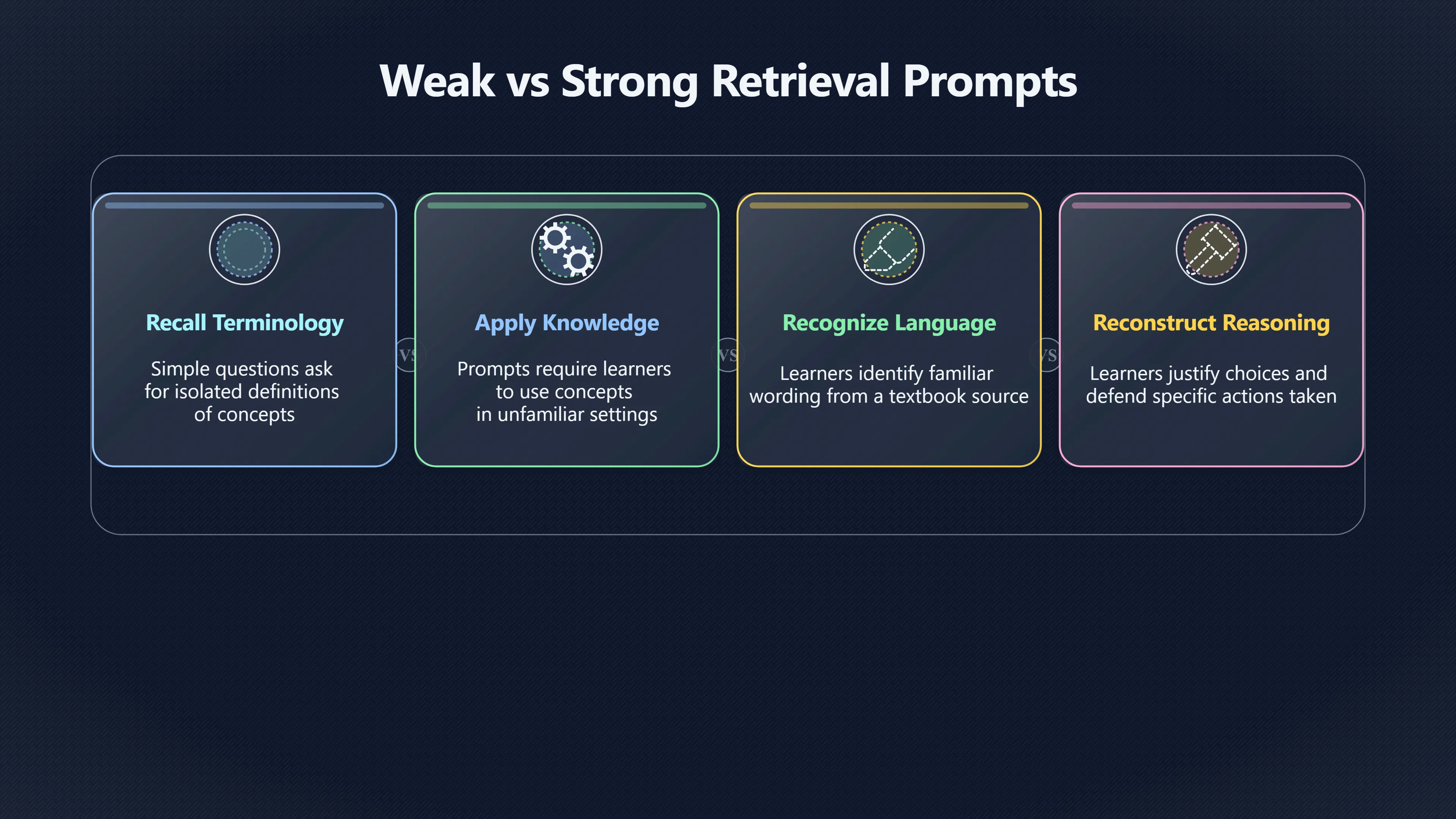
Instead of recalling terminology, they ask learners to use concepts in unfamiliar settings.
Weak retrieval promptStrong application promptWhat is opportunity cost?Which investment should the council reject after considering opportunity cost? Explain why.Define confirmation bias.Which investigator is more vulnerable to confirmation bias in this case, and what should they do differently?What is a confounding variable?Which conclusion about this health study becomes questionable once the missing variable is considered?What is marginal analysis?At what point should the company stop expanding production? Justify your recommendation.
Notice that each stronger prompt requires the learner to identify where the concept changes a practical judgement rather than merely recalling its wording.
How application practice supports transfer
The central goal is transfer: using knowledge beyond the exact situation in which it was learned.
Researchers distinguish between near transfer, where new problems closely resemble previous ones, and far transfer, where knowledge must be adapted to substantially different situations. Retrieval practice generally produces reliable benefits for near transfer and smaller but meaningful improvements for broader transfer, especially when learners repeatedly retrieve ideas using varied examples rather than identical questions.[Andyʼs working notes+2Squarespace]notes.andymatuschak.orgRetrieval practice and transfer learningAndyʼs working notesRetrieval practice and transfer learning16 Apr 2024 — This meta-analysis of transfer effects in retrieval practice fi…
One influential experiment showed that repeated testing produced better performance on inference and transfer questions than repeated studying, demonstrating that retrieval can strengthen flexible understanding rather than rote memory alone.[Andyʼs working notes]notes.andymatuschak.orgRetrieval practice and transfer learningAndyʼs working notesRetrieval practice and transfer learning16 Apr 2024 — This meta-analysis of transfer effects in retrieval practice fi…
Later work has also found that varying the examples used during repeated retrieval encourages learners to develop multiple retrieval routes to the same underlying concept. Instead of associating an idea with one familiar example, they begin recognising the deeper pattern across different contexts. That flexibility is precisely what analytical thinking requires.[Squarespace]static1.squarespace.comRetrieving and Applying Knowledge to Different Examples…by AC Butler · Cited by 87 — However, there is growing interest in…
At the same time, research cautions against expecting dramatic improvements in every form of complex reasoning. Transfer becomes harder as tasks grow more complicated, meaning application prompts should progress gradually from familiar to unfamiliar situations instead of jumping immediately to highly novel problems.[Oxford University Research Archive]ora.ox.ac.ukford University Research ArchiveAn investigation into the impact of retrieval practice…February 10, 2023 — by P Robotham · 2020 — St…
Common mistakes when writing application prompts
Several design choices reduce the value of application practice.
Disguised definition questions. Simply changing names or numbers without altering the underlying reasoning still rewards memorisation.
Overly complicated stories. Long scenarios filled with unnecessary detail may test reading endurance more than analytical thinking.
Only one familiar example. Repeating the same context teaches learners to associate a concept with that example rather than the underlying principle.
No feedback. Retrieval practice works best when learners eventually compare their reasoning with an accurate explanation. Without feedback, incorrect reasoning can become reinforced. Pooja K. Agarwal, Ph.D.[retrievalpractice.org]retrievalpractice.orgPooja KAgarwal, Ph.D.Download our Transfer of Learning Practice Guide18 May 2018 — We are thrilled to share our free downloadable practice guide…
A simple framework for creating better prompts
A practical way to design application questions is to work backwards from a decision.

- Identify the concept you want learners to use.
- Create a realistic situation where that concept should influence a judgement.
- Add one or two believable distractions.
- Ask for a decision and a brief explanation.
- Provide feedback explaining not only the correct answer but why competing options are weaker.
This structure transforms retrieval practice from an exercise in remembering definitions into an exercise in reasoning.
Within a broader programme of retrieval practice for better understanding, application prompts are valuable because they reveal whether knowledge has become usable. The most important question is no longer “Can you state the idea?” but “Can the idea survive a real example?” When learners repeatedly retrieve concepts while making decisions in varied contexts, they build knowledge that is more likely to transfer beyond revision sessions and into genuine analytical thinking.
Amazon book picks
Further Reading
Books and field guides related to Can the Idea Survive a Real Example?. Use these as the next step if you want deeper reading beyond the article.
Make It Stick
Directly explains why application-focused retrieval strengthens learning and transfer.
How We Learn
Covers evidence-based learning methods including retrieval and applying knowledge in practice.
Thinking, Fast and Slow
Provides foundational insight into judgment, decision-making, and applying concepts to real situations.
Ultralearning
Emphasizes active learning, problem solving, and transferring knowledge into practical contexts.
eBay marketplace picks
Marketplace Samples
Example marketplace items related to this page. Use the search link to explore similar finds on eBay.

Endnotes
1.
Source: static1.squarespace.com
Link:https://static1.squarespace.com/static/5c8baca1e5f7d136349ea789/t/5e739a3d46338e7dec37aaf6/1584634429337/Butler%2Bet%2Bal%2B2017.pdf
Source snippet
Retrieving and Applying Knowledge to Different Examples...by AC Butler · Cited by 87 — However, there is growing interest in...
2.
Source: retrievalpractice.org
Title: Pooja K
Link:https://www.retrievalpractice.org/strategies/2018/5/18/transfer-guide
Source snippet
Agarwal, Ph.D.Download our Transfer of Learning Practice Guide18 May 2018 — We are thrilled to share our free downloadable practice guide...
Published: May 2018
3.
Source: pubmed.ncbi.nlm.nih.gov
Link:https://pubmed.ncbi.nlm.nih.gov/20951630/
Source snippet
The critical role of retrieval practice in long-term retentionby HL Roediger 3rd · 2011 · Cited by 2839 — The power of retrieval pr...
4.
Source: notes.andymatuschak.org
Title: Retrieval practice and transfer learning
Link:https://notes.andymatuschak.org/Retrieval_practice_and_transfer_learning
Source snippet
Andyʼs working notesRetrieval practice and transfer learning16 Apr 2024 — This meta-analysis of transfer effects in retrieval practice fi...
5.
Source: learningscientists.org
Title: The Learning Scientists Optimising Learning Using Retrieval Practice
Link:https://www.learningscientists.org/blog/2018/9/27-1
Source snippet
The Learning ScientistsOptimising Learning Using Retrieval PracticeSeptember 27, 2018 — 27 Sept 2018 — Retrieval practice, or reconstruct...
Published: September 27, 2018
6.
Source: ora.ox.ac.uk
Link:https://ora.ox.ac.uk/objects/uuid%3A315bf33a-6e5c-4792-bc1c-4d50404d5915/files/dv692t679g
Source snippet
ford University Research ArchiveAn investigation into the impact of retrieval practice...February 10, 2023 — by P Robotham · 2020 — St...
Published: February 10, 2023
Additional References
7.
Source: nko.nl
Link:https://www.nko.nl/sites/nro/files/migrate/411-10-910-010-Proefschrift_Reijners.pdf
Source snippet
in long-term memory and results in a strong memory representation (...
8.
Source: youtube.com
Link:https://www.youtube.com/watch?v=9aegB1Uyge0
Source snippet
4 How to Study Effectively #3: Active Retrieval & Desirable Difficulties...
9.
Source: youtube.com
Title: Using Desirable Difficulties to Enhance Learning, Dr. Robert Bjork
Link:https://www.youtube.com/watch?v=XPllm-gtrMM
Source snippet
3 The Six Strategies of Effective Learning With Learning Scientist, Dr. Megan Sumeracki (Ep.7 Rebroad...
10.
Source: youtube.com
Title: How to Study Effectively #3: Active Retrieval & Desirable Difficulties
Link:https://www.youtube.com/watch?v=h9FM4t4HW0Y
Source snippet
5 Understanding and Applying Retrieval Practice in Lesson Planning...
11.
Source: openriver.winona.edu
Link:https://openriver.winona.edu/cgi/viewcontent.cgi?article=1400&context=eie
Source snippet
Memorization: AI Chatbots for Smarter Retrieval Practiceby MA Faircloth · 2026 — Integrating AI chatbots as retrieval practice tools serv...
12.
Source: youtube.com
Title: Study Strategies: Concrete Examples
Link:https://www.youtube.com/watch?v=7wF0lCBMh9Y
Source snippet
2 Using Desirable Difficulties to Enhance Learning, Dr. Robert Bjork...
13.
Source: youtube.com
Title: Understanding and Applying Retrieval Practice in Lesson Planning
Link:https://www.youtube.com/watch?v=_u26OooxS8g
Topic Tree