Within Weakest Link
Why Imagining Failure Can Improve a Plan
A premortem makes failure safe to imagine so teams can name weak links before they become real losses.
On this page
- How a project premortem works
- Why hypothetical failure lowers defensiveness
- Turning failure stories into checks and safeguards
Page outline Jump by section
Introduction
A premortem is a structured thinking exercise in which a team imagines that a project has already failed, then works backwards to explain why. Instead of asking, “What might go wrong?”, participants are told that the launch has been a disaster and must identify the causes. This subtle shift changes how people think. It encourages them to surface hidden concerns, challenge optimistic assumptions and identify weak links before they become expensive mistakes. Within weakest-link thinking, a premortem is a practical way of stress-testing the assumptions that matter most rather than simply collecting more arguments in favour of the current plan. [Harvard Business Review]hbr.orgperforming a project premortemHarvard Business ReviewPerforming a Project PremortemReprint: F0709A In a premortem, team members assume that the project they are planni…
 The technique was popularised by cognitive psychologist Gary Klein, building on research into “prospective hindsight”—the finding that imagining an event has already happened helps people generate more plausible explanations for its causes. Rather than replacing planning, a premortem strengthens it by converting imagined failures into concrete safeguards before launch. [CLTR]cltr.nlPerforming a Project PremortemThe leader starts the exercise by informing everyone that the project has failed …Read more
How a project premortem works
A premortem is most valuable after a team has developed a credible plan but before significant resources have been committed. At this point there is enough detail to analyse, yet enough flexibility to make meaningful changes.
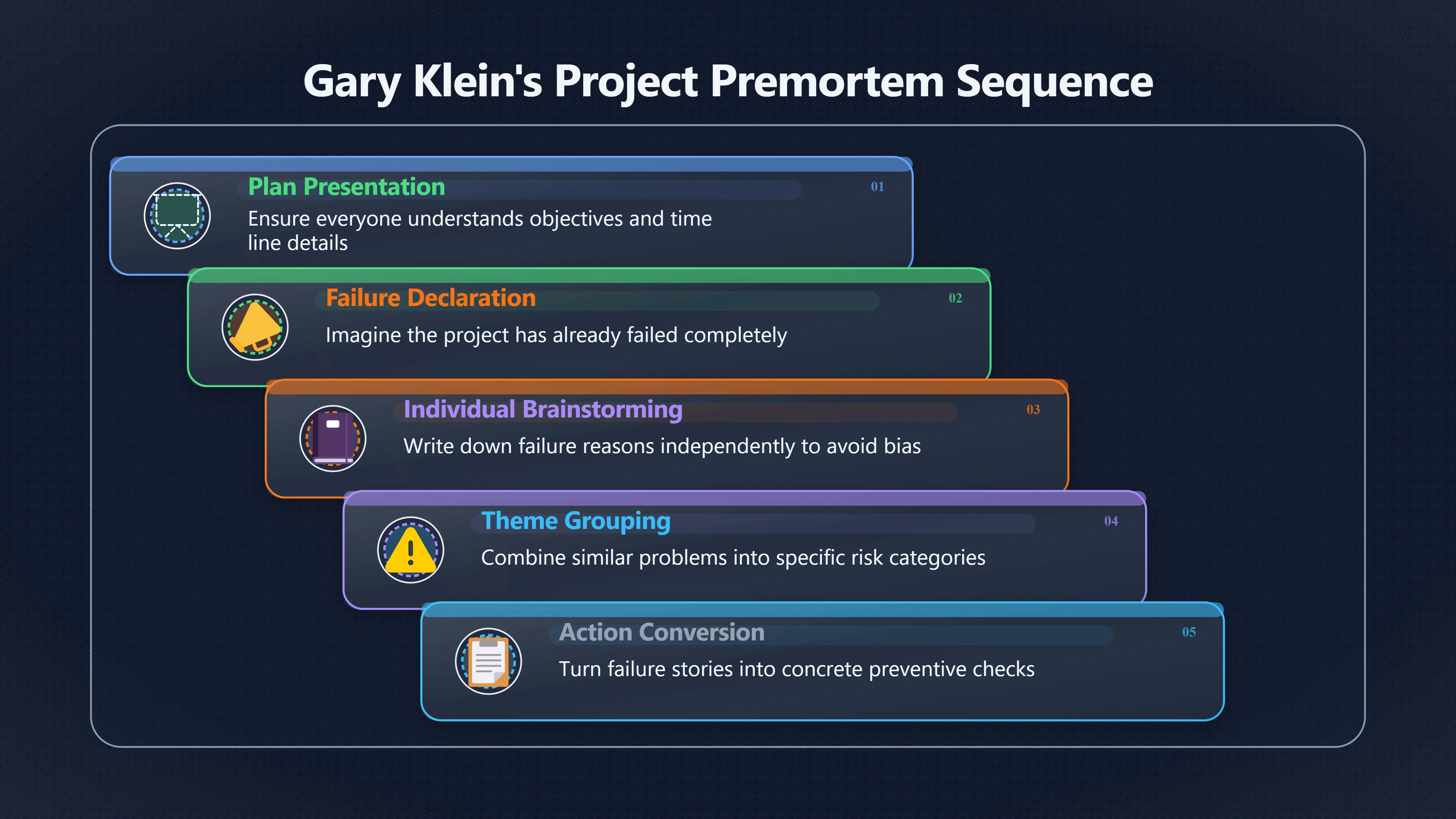
A typical session follows a simple sequence:
- Present the current plan. Everyone should understand the objectives, assumptions and timeline.
- Declare that the project has failed. The facilitator asks participants to imagine that it is several months in the future and the project has failed completely.
- Generate failure explanations individually. Team members first write down reasons independently rather than discussing them immediately. This prevents early voices from dominating.
- Collect every explanation. Participants share their ideas in turn until all plausible causes have been listed.
- Group related causes. Similar problems are combined into themes such as technical risks, customer behaviour, organisational coordination or external events.
- Convert risks into actions. Each major failure story becomes a preventive check, contingency plan or design change. CLTR+2strategyunitwm.nhs.uk
The key output is not a catalogue of worries. It is a revised project plan that explicitly addresses the most credible failure paths.
Why hypothetical failure lowers defensiveness
Many planning meetings unintentionally reward optimism. Once a proposal has gathered support, criticising it can feel like criticising the people behind it. Team members may stay silent because they do not want to appear negative, uninformed or disloyal.
A premortem changes the social rules. Because failure is presented as an established fact within the exercise, participants are no longer predicting failure or opposing colleagues. Instead, they are helping explain an imaginary outcome. This makes dissent psychologically safer and encourages people to voice concerns they would otherwise suppress. Gary Klein developed the method specifically to make it easier for knowledgeable sceptics to contribute before projects begin. Harvard Business Review
The exercise also counters several common thinking errors:
- Overconfidence. Teams naturally underestimate uncertainty during planning.
- Planning fallacy. People routinely expect projects to finish faster and more smoothly than they actually do.
- Groupthink. Pressure for agreement discourages minority viewpoints.
- Confirmation bias. Decision-makers often seek evidence supporting the preferred plan rather than evidence that could invalidate it. Wikipedia+2Ness Labs
Importantly, the premortem does not encourage pessimism for its own sake. Its purpose is to make optimism more realistic by identifying assumptions that deserve stronger evidence or additional protection.
Turning failure stories into checks and safeguards
The value of a premortem comes from what happens after the brainstorming session. Every imagined failure should lead to one of several practical responses.
Strengthen weak assumptions. If success depends on customer demand growing quickly, gather additional market evidence before committing to production.
Add monitoring indicators. If supplier delays appear repeatedly in the failure stories, establish early warning measures instead of waiting until deadlines are missed.
Create contingency plans. If regulatory approval emerges as a critical uncertainty, prepare alternative launch schedules or fallback product features.
Clarify responsibilities. If several failure scenarios involve poor communication, assign explicit ownership rather than assuming coordination will happen naturally.
Reduce single points of failure. If one specialist, supplier or software component appears repeatedly in imagined disasters, introduce redundancy where feasible.
The exercise therefore transforms abstract concerns into implementation decisions. Instead of merely saying “communication might fail”, the team defines who reports progress, how frequently and what triggers escalation.
Using premortems to test the weakest links
Premortems work particularly well alongside weakest-link thinking because both approaches ask which assumptions deserve the greatest scrutiny rather than treating every risk equally.
Suppose a company plans to launch a new software product. During the premortem, participants imagine the launch has failed and produce explanations such as:
- Customers did not perceive enough value to switch.
- Integration with existing systems proved harder than expected.
- Customer support became overwhelmed during the first week.
- A competitor announced a similar feature shortly before launch.
These explanations are not equally important. Weakest-link thinking asks which one would most undermine the project’s success if true.
If nearly every failure story ultimately depends on customers not adopting the product, validating customer demand becomes the highest-priority activity. If instead multiple scenarios trace back to unreliable infrastructure, technical resilience becomes the critical weak link. The premortem therefore helps reveal which assumptions deserve additional testing before launch rather than spreading attention evenly across dozens of minor risks.
Common implementation mistakes
Although premortems are straightforward, several practices reduce their effectiveness.
Running them too late. If contracts are signed, budgets allocated and public commitments made, participants may feel that meaningful changes are impossible.
Jumping straight into discussion. Independent idea generation usually produces a broader range of risks than immediate group conversation because early comments do not anchor everyone else’s thinking. CLTR
Treating every risk equally. Long lists are less valuable than prioritised lists. Teams should rank failure causes by both likelihood and potential impact.
Stopping after brainstorming. A premortem without follow-up actions becomes an interesting conversation rather than a planning tool. Every major risk should be linked to an owner, mitigation strategy or monitoring mechanism.
Confusing imagination with prediction. The exercise explores plausible failure paths, not certain futures. Some imagined risks will never occur, but they can still reveal hidden assumptions that deserve attention.
When premortems are most valuable
Premortems provide the greatest benefit when decisions involve uncertainty, complex coordination or irreversible commitments. They are commonly used before:
- Product launches.
- Large technology implementations.
- Strategic organisational changes.
- Research programmes.
- Major construction or engineering projects.
- Policy initiatives involving multiple stakeholders. Brookings
For routine work with well-understood procedures, a full premortem may add little value. The technique is designed for situations where unknown interactions, optimistic assumptions or hidden dependencies could determine success or failure.
Why premortems improve thinking rather than merely risk management
The lasting value of a premortem is not simply that it identifies more risks. It trains people to ask a better question.
Instead of asking, “Why are we confident this plan will work?”, participants ask, “If this confidence proved misplaced, what would we wish we had noticed beforehand?” That shift encourages active search for disconfirming evidence, exposes hidden dependencies and directs attention towards the assumptions carrying the greatest weight.
Within weakest-link thinking, a premortem is therefore more than a project management exercise. It is a disciplined method for making potential failure intellectually safe to discuss, allowing teams to strengthen their reasoning before reality performs the test.
Amazon book picks
Further Reading
Books and field guides related to Why Imagining Failure Can Improve a Plan. Use these as the next step if you want deeper reading beyond the article.
Sources of Power
Explains the thinking behind prospective hindsight and decision-making methods that underpin project premortems.
The Checklist Manifesto
Shows how identified failure modes can be converted into practical safeguards and execution checks.
Decisive
Offers structured techniques for improving decisions and challenging assumptions before committing to a plan.
The Art of Thinking Clearly
Covers common thinking errors that premortems are designed to expose before projects fail.
eBay marketplace picks
Marketplace Samples
Live-tested eBay searches with available results related to this page.



Endnotes
-
Source: strategyunitwm.nhs.uk
Link: https://www.strategyunitwm.nhs.uk/sites/default/files/2018-12/SU%20guide%20to…the%20premortem.pdfSource snippet
The Pre-MortemStep 2: 1) Imagine that the project has failed spectacularly! 2) Individually, write down every possible reason for the fai...
-
Source: Wikipedia
Link: https://en.wikipedia.org/wiki/Pre-mortem -
Source: brookings.edu
Link: https://www.brookings.edu/articles/the-art-and-science-of-pre-mortems/Source snippet
Imagining failure to attain success: The art and science of...February 6, 2025 — 6 Feb 2025 — This “prospective hindsight” help...
Published: February 6, 2025
-
Source: gary-klein.com
Title: pre-mortem method of risk [assessment]({{ ‘assessment/’ | relative_url }})
Link: https://www.gary-klein.com/premortemSource snippet
As a team, everyone contributes to an exercise where potential threats...Read more...
-
Source: hbr.org
Title: performing a project premortem
Link: https://hbr.org/2007/09/performing-a-project-premortemSource snippet
Harvard Business ReviewPerforming a Project PremortemReprint: F0709A In a premortem, team members assume that the project they are planni...
-
Source: nesslabs.com
Link: https://nesslabs.com/pre-mortem-anticipate-failure-with-prospective-hindsightSource snippet
Pre-mortem: how to anticipate failure with prospective...A pre-mortem is an exercise where we imagine that a project has failed, and whe...
-
Source: linkedin.com
Title: Prospective Hindsight
Link: https://www.linkedin.com/pulse/prospective-hindsight-critical-leadership-life-practice-todd-zipperSource snippet
A Critical Leadership and Life...A premortem, on the other hand, is a managerial strategy in which a manager imagines that a project has...
-
Source: asana.com
Link: https://asana.com/resources/premortemSource snippet
How to Run a Project Pre-Mortem Meeting [2025]Jul 3, 2025 — A project premortem is a risk assessment technique in which your team imagine...
-
Source: hbr.org
Title: Postmortems Are Essential
Link: https://hbr.org/video/2919363904001/postmortems-are-essentialSource snippet
HBR VideoPutting in systems and processes from planning and initiating projects all the way through to closing and doing post-mortems on...
-
Source: store.hbr.org
Link: https://store.hbr.org/product/performing-a-project-premortem/F0709A?srsltid=AfmBOoq5D41k2T8cHdcggLl32t6Xwd-iyWXTPj1rg3sxL3IWMjeR9z0RSource snippet
a Project PremortemTools are editable [templates]({{ 'templates/' | relative_url }}) that are available to download from your HBR account immediately after purchase. These te...
Additional References
-
Source: linkedin.com
Link: https://www.linkedin.com/posts/byrdkw_gary-kleins-pre-mortem-a-simple-yet-effective-activity-7051246764724518912-nnntSource snippet
Kyle Byrd's PostGary Klein's Pre-Mortem: A simple, yet effective technique to help prepare for future [outcomes]({{ 'outcomes/' | relative_url }}). "Prospective hindsight—im...
-
Source: theuncertaintyproject.org
Link: https://www.theuncertaintyproject.org/tools/pre-mortemSource snippet
Pre-MortemIt is based on 'prospective hindsight' – imagining that the project has already failed and then generating plausible reasons fo...
-
Source: researchgate.net
Link: https://www.researchgate.net/publication/3229642_Performing_a_Project_PremortemSource snippet
(PDF) Performing a Project PremortemPre-mortem analysis-whereby management teams systematically project failure scenarios before approvin...
-
Source: stephenlynch.net
Link: https://stephenlynch.net/pre-mortem/ -
Source: researchgate.net
Link: https://www.researchgate.net/publication/355070855_Project_Pre-mortem_using_Prospective_Hindsight_An_Unexplored_Tool_to_address_Healthcare_Projects_Implementation_barriersSource snippet
Gary Klein (3) used this concept of prospective hindsight. to devise a method called a pre-mortem, which helps. project...Read more...
-
Source: researchgate.net
Link: https://www.researchgate.net/publication/320343389_Pre-empting_project_failure_by_using_a_pre-mortemSource snippet
Pre-empting project failure by using a pre-mortem23 Oct 2017 — Pre-mortem thinks prospectively about why a project might not...
-
Source: atlanticcouncil.org
Title: Strategy Consortium 12 Premortems for NSS Miller and Rosenblum FINAL
Link: https://www.atlanticcouncil.org/content-series/strategy-consortium/conducting-a-pre-mortem/wp-content/uploads/2019/08/Strategy-Consortium_12_Premortems_for_NSS_Miller_and_Rosenblum_FINAL.pdfSource snippet
Conducting a Pre-MortemFeb 6, 2017 — The pre-mortem is a technique often used in the private sector to identify and mitigate key risks to...
-
Source: thehuntingdynasty.com
Title: By proactively identifying and addressing potential risks,
Link: https://www.thehuntingdynasty.com/2024/10/the-premortem-a-proactive-approach-to-project-success/Source snippet
The Premortem: A Proactive Approach to Project Success15 Oct 2024 — The premortem is a powerful tool for project teams seeking to improve...
-
Source: rochester.edu
Link: https://www.rochester.edu/college/learningcenter/studying/blog/2026-02-25-the-premortem-technique.htmlSource snippet
The Premortem Technique: Planning for Success Before...Feb 25, 2026 — The 5-Step Premortem in Action · Step 1: Define and identify the Goal...
-
Source: medium.com
Link: https://medium.com/%40shreyashere/how-to-use-pre-mortems-to-prevent-problems-blunders-and-disasters-6ecc6df6e22aSource snippet
novel technique of using Tigers, Paper Tigers, and Elephants to run effective...Read more...
Topic Tree