Within Gut vs Analysis
Why wrong answers can feel so right
A quick answer can feel fluent and satisfying even when it rests on weak evidence, luck or misleading cues.
On this page
- Fluency, vividness and first impressions
- Cognitive reflection and everyday traps
- Small pauses that expose misleading ease
Page outline Jump by section
Introduction
Many thinking mistakes begin not with confusion but with certainty. An answer appears immediately, feels coherent and satisfying, and is accompanied by a strong sense of confidence. Yet that feeling is often a poor guide to whether the answer is actually correct. Psychological research consistently shows that confidence is influenced not only by the quality of evidence but also by how easily the mind produces an answer. A judgment that comes quickly, fits existing expectations or is supported by vivid mental images can feel more trustworthy than one that requires careful thought, even when the underlying evidence is weaker. This helps explain why sincere, intelligent people can hold incorrect beliefs with remarkable conviction.
 Within everyday decision-making, this distinction is crucial. The problem is rarely that intuition exists; intuition is an essential part of human cognition. The problem arises when people mistake the experience of certainty for evidence of correctness. Understanding why wrong answers can feel so right is therefore an important step towards improving analytical thinking. Rather than treating confidence as proof, effective thinkers learn to distinguish between confidence generated by genuine expertise and confidence generated by cognitive ease, familiarity or an incomplete mental model. Research on processing fluency, metacognition, cognitive reflection and explanatory illusions provides a detailed account of how this happens. [USC Dornsife+2PMC]dornsife.usc.eduDornsife Processing fluency in consumer judgment and decision makingSection 2) and conceptualize the use of metacognitive experiences in judgment and…Read more…
Fluency, vividness and why easy thoughts feel true
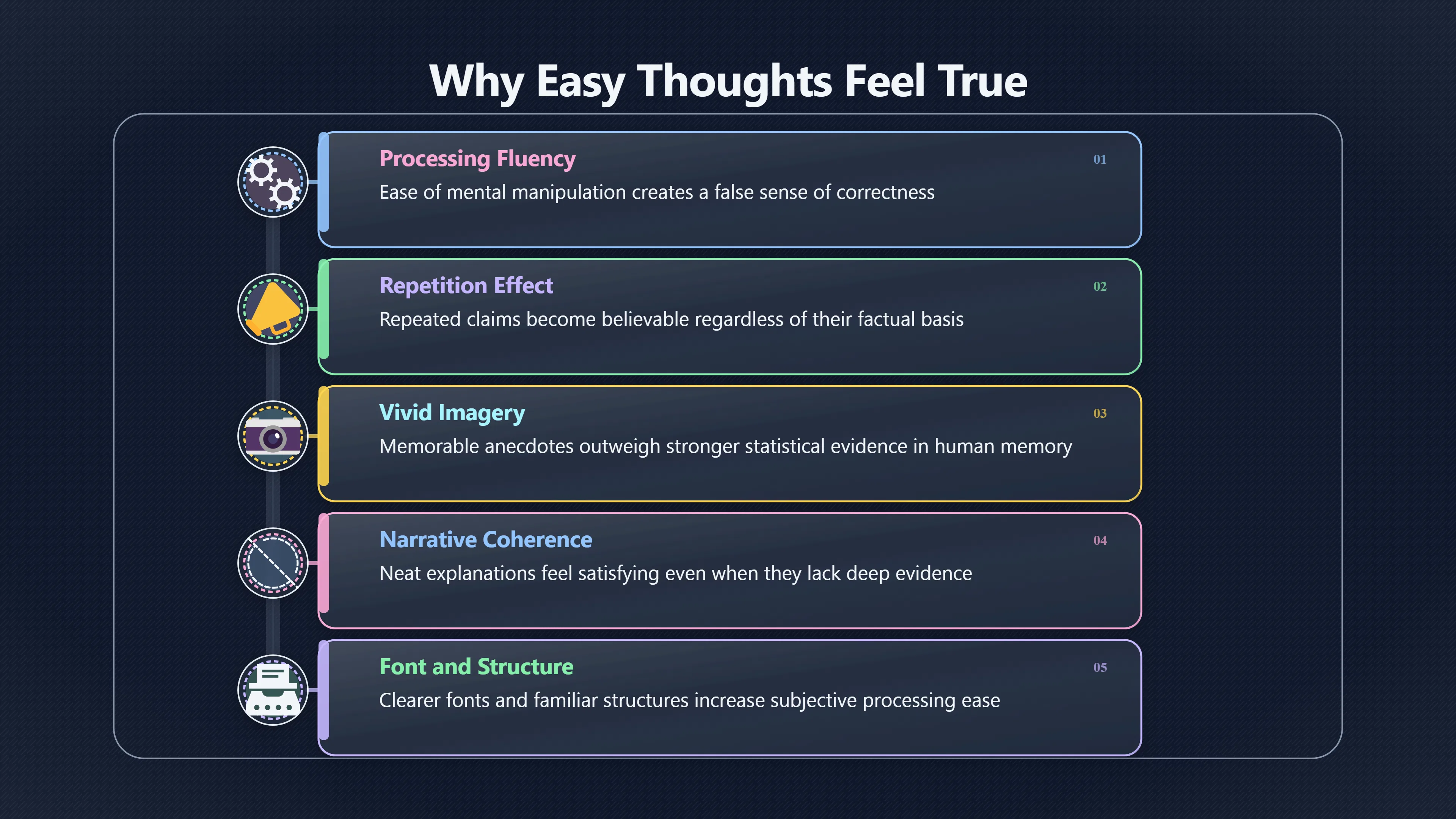
One of the strongest mechanisms behind misplaced confidence is processing fluency—the subjective experience that thinking feels easy. Processing fluency is not the same as intelligence or understanding. Instead, it refers to the speed and ease with which information is perceived, remembered or mentally manipulated. Decades of research show that people unconsciously use this feeling of ease as information when making judgements. If an idea is easy to process, it often feels more familiar, more believable and more likely to be correct. [USC Dornsife+2UCSD Pages]dornsife.usc.eduDornsife Processing fluency in consumer judgment and decision makingSection 2) and conceptualize the use of metacognitive experiences in judgment and…Read more…
Importantly, fluency can increase for reasons that have nothing to do with truth. Information becomes easier to process because it has been repeated, written in a clearer font, presented with a familiar structure or associated with memorable imagery. These changes alter the experience of thinking without changing the underlying facts. People often fail to distinguish between these sources of ease and instead infer that “this feels right, therefore it probably is right.” [USC Dornsife]dornsife.usc.eduDornsife Processing fluency in consumer judgment and decision makingSection 2) and conceptualize the use of metacognitive experiences in judgment and…Read more…
This mechanism explains several familiar experiences:
- Repeated claims become increasingly believable through the illusion of truth effect.
- Vivid anecdotes outweigh stronger statistical evidence because they are easier to imagine and retrieve.
- Smooth, confident speakers often appear more knowledgeable than hesitant speakers even when both possess identical evidence.
- Simple explanations are frequently preferred over accurate but necessarily more complex accounts.
The important point is not that fluent thinking is always misleading. Experts often reach correct conclusions rapidly because years of learning have made accurate pattern recognition highly fluent. The difficulty is that the subjective feeling of fluency is generated by both genuine expertise and entirely superficial cues. The mind experiences both as “easy”, even though only one deserves confidence. [USC Dornsife]dornsife.usc.eduDornsife Processing fluency in consumer judgment and decision makingSection 2) and conceptualize the use of metacognitive experiences in judgment and…Read more…
First impressions create a powerful anchor
Wrong answers often feel convincing because they become the first coherent explanation available. Once an interpretation has been formed, later information is naturally organised around it.
Psychologists have long observed that first impressions exert disproportionate influence on later judgement. Early interpretations provide a framework that reduces uncertainty and creates internal coherence. Once this coherent story exists, contradictory evidence often feels awkward, incomplete or implausible because accepting it would require rebuilding the mental model already in place.
The feeling of coherence itself can therefore be mistaken for evidence. A neat explanation feels psychologically satisfying, whereas uncertainty feels uncomfortable. This encourages premature closure: people stop searching for additional evidence because the question already feels answered.
The risk becomes particularly large in ambiguous situations such as evaluating job candidates, interpreting social interactions or assessing news stories. Initial interpretations often determine which later evidence is noticed, remembered and regarded as important, creating a feedback loop between confidence and selective attention rather than between confidence and objective accuracy.
Cognitive reflection reveals how intuition can mislead
One of the clearest demonstrations of false confidence comes from the Cognitive Reflection Test (CRT) developed by psychologist Shane Frederick. The problems are carefully designed so that an appealing but incorrect answer immediately comes to mind. Participants who simply accept the first response frequently answer incorrectly despite feeling highly confident. Those who succeed usually do not possess extraordinary mathematical ability; instead, they recognise that the immediate answer deserves further inspection. [gmarks.org]gmarks.orgwhen confidence is not a signal of knowingby B Finn · 2015 · Cited by 156 — In the current article, we focus on metacognitive miscalibration, with particular attention to overconf…
The significance of the CRT extends well beyond puzzles. It demonstrates that many thinking errors originate not because people cannot reason, but because they fail to notice that reasoning is required.
Everyday decisions contain similar traps:
- A financial investment appears obviously attractive because recent success stories are easy to recall.
- A medical claim feels convincing because it matches existing beliefs.
- A rumour spreads because repetition creates familiarity rather than because evidence has improved.
- A product review seems trustworthy because it tells a vivid personal story.
In each case, intuitive confidence arrives before analytical evaluation. Cognitive reflection interrupts this process by asking whether the immediate answer is supported by evidence or merely by ease of retrieval. Rather than opposing intuition entirely, reflection functions as a monitoring system that asks whether intuition has earned the right to guide action. [gmarks.org]gmarks.orgwhen confidence is not a signal of knowingby B Finn · 2015 · Cited by 156 — In the current article, we focus on metacognitive miscalibration, with particular attention to overconf…

The illusion of explanatory depth: mistaking familiarity for understanding
A separate but closely related mechanism is the illusion of explanatory depth. Leonid Rozenblit and Frank Keil demonstrated that people routinely believe they understand everyday systems in far greater detail than they actually do. Familiarity creates confidence, but attempting a detailed explanation quickly exposes substantial gaps in understanding. [PMC]pmc.ncbi.nlm.nih.govby L Rozenblit · 2002 · Cited by 1507 — We argue that the illusion of depth seen with explanatory knowledge is a separate phenomenon f…
Participants in classic experiments initially rated themselves as understanding familiar objects—such as bicycles, zips, toilets and helicopters—quite well. After being asked to explain precisely how these objects worked, they realised their knowledge was much shallower than expected and dramatically lowered their self-ratings. The important discovery was not that people lacked expertise; rather, they had confused recognition with explanation. [PMC]pmc.ncbi.nlm.nih.govby L Rozenblit · 2002 · Cited by 1507 — We argue that the illusion of depth seen with explanatory knowledge is a separate phenomenon f…
This illusion extends beyond physical objects.
Researchers have observed similar effects in domains including politics, economics and public policy. People often express considerable confidence in complex social systems until they are required to explain causal mechanisms step by step. Producing a detailed explanation forces them to distinguish genuine understanding from familiarity with slogans, headlines or simplified narratives. [Stern School of Business]pages.stern.nyu.eduStern School of BusinessA Construal Level Account of the Illusion of Explanatory Depthby AL Alter · Cited by 264 — An illusion of explana…
This distinction matters because everyday decisions frequently rely on explanations rather than isolated facts. If confidence rests on an incomplete explanatory model, decisions based upon that confidence may still feel completely justified while being fundamentally flawed.
Why confidence and accuracy become separated
Confidence is often assumed to indicate knowledge, yet psychological research shows that confidence and accuracy become weakly coupled whenever the cues generating confidence differ from the cues indicating truth.
Several factors inflate confidence without improving accuracy:
- Repeated exposure. Familiar statements feel increasingly true regardless of their factual basis.
- Ease of retrieval. Information recalled quickly feels more representative than information requiring greater effort.
- Narrative coherence. Explanations that tell a satisfying story appear more convincing than fragmented but accurate evidence.
- Emotional vividness. Dramatic examples are remembered more easily than representative ones.
- Social consensus. Hearing the same claim from multiple sources increases familiarity even when those sources ultimately trace back to the same origin.
Because these cues frequently overlap with genuine knowledge in everyday life, the brain generally treats them as useful heuristics. Most of the time this works reasonably well. The problem emerges when familiarity, repetition or emotional appeal substitute for careful evidence evaluation. Processing fluency becomes an efficient shortcut that is mistakenly interpreted as proof. [USC Dornsife+2PMC]dornsife.usc.eduDornsife Processing fluency in consumer judgment and decision makingSection 2) and conceptualize the use of metacognitive experiences in judgment and…Read more…
Small pauses that expose misleading ease
Fortunately, false confidence is often easier to detect than people assume. Research on metacognition suggests that relatively small interventions can reveal when confidence is based more on fluency than on evidence. [gmarks.org]gmarks.orgwhen confidence is not a signal of knowingby B Finn · 2015 · Cited by 156 — In the current article, we focus on metacognitive miscalibration, with particular attention to overconf…
One effective strategy is to replace conclusions with explanations. Instead of asking, “Do I know this?”, ask, “Can I explain exactly how this works?” Attempting a detailed explanation frequently reveals missing links that were previously hidden beneath a general feeling of understanding. This simple technique has repeatedly reduced inflated confidence in experimental settings. [PMC]pmc.ncbi.nlm.nih.govby L Rozenblit · 2002 · Cited by 1507 — We argue that the illusion of depth seen with explanatory knowledge is a separate phenomenon f…
A second strategy is deliberately generating alternative explanations. When only one interpretation is considered, it naturally appears compelling because there is nothing with which to compare it. Producing even one plausible alternative weakens the illusion that the first answer was inevitable.
Another valuable habit is separating recognition from verification. Recognising an idea, headline or statistic should not be confused with having evaluated its reliability. Familiarity answers the question “Have I encountered this before?” It does not answer the question “Is it true?”
Finally, slowing down matters most when the stakes are high. Fast intuitive judgements are often adequate for routine situations with reliable feedback, but decisions involving substantial uncertainty, long-term consequences or conflicting evidence benefit disproportionately from a brief analytical pause.
Confidence should be calibrated, not discarded
The lesson is not that confidence is inherently unreliable or that intuition should always be distrusted. Experienced professionals frequently make rapid, accurate judgements because extensive practice has transformed complex analysis into highly efficient pattern recognition. In such cases, confidence reflects years of corrective feedback rather than superficial familiarity.
The challenge is that the feeling accompanying expert intuition is psychologically similar to the feeling produced by repetition, vivid stories, coherent narratives and incomplete understanding. The mind does not automatically reveal why confidence exists; it merely presents the experience of certainty.
Improving analytical thinking therefore depends less on becoming sceptical of every instinct than on becoming curious about its source. When an answer appears unusually quickly and feels unusually satisfying, that feeling should be interpreted as the beginning of evaluation rather than its end. Asking what evidence generated the confidence, whether alternative explanations exist and whether the conclusion survives a detailed explanation transforms confidence from a verdict into a hypothesis. That small shift is often enough to expose misleading ease before it becomes an expensive mistake. [USC Dornsife+2PMC]dornsife.usc.eduDornsife Processing fluency in consumer judgment and decision makingSection 2) and conceptualize the use of metacognitive experiences in judgment and…Read more…

Amazon book picks
Further Reading
Books and field guides related to Why wrong answers can feel so right. Use these as the next step if you want deeper reading beyond the article.
The Art of Thinking Clearly
Covers many everyday errors that arise when confidence, familiarity, or vividness substitute for evidence.
Mistakes Were Made (but Not by Me)
Shows how people protect wrong answers and bad decisions once they feel coherent or identity-confirming.
The Knowledge Illusion
Explains why people overestimate what they understand and why fluent explanations can mask shallow knowledge.
You Are Not So Smart
Explains why people often mistake a satisfying mental story for accurate understanding.
eBay marketplace picks
Marketplace Samples
Live-tested eBay searches with available results related to this page.


Endnotes
-
Source: dornsife.usc.edu
Title: Dornsife Processing fluency in consumer judgment and decision making
Link: https://dornsife.usc.edu/norbert-schwarz/wp-content/uploads/sites/231/2023/12/21_CPR_Schwarz_et_al_Metacognitive_experiences_review.pdfSource snippet
(Section 2) and conceptualize the use of metacognitive experiences in judgment and...Read more...
-
Source: pmc.ncbi.nlm.nih.gov
Link: https://pmc.ncbi.nlm.nih.gov/articles/PMC3339024/Source snippet
Epistemic Status of Processing Fluency as Source for...by R Reber · 2010 · Cited by 246 — This article combines findings from cognitive...
-
Source: gmarks.org
Title: when confidence is not a signal of knowing
Link: https://gmarks.org/when_confidence_is_not_a_signal_of_knowing.pdfSource snippet
by B Finn · 2015 · Cited by 156 — In the current article, we focus on metacognitive miscalibration, with particular attention to overconf...
-
Source: pages.ucsd.edu
Link: https://pages.ucsd.edu/~pwinkielman/Processing_Fluency_as_the_Source_of_Experiences_PSYCHE-2002.pdfSource snippet
UCSD PagesProcessing Fluency as the Source of Experiences at...by R Reber · 2002 · Cited by 81 — First, we introduce the idea that the s...
-
Source: pmc.ncbi.nlm.nih.gov
Link: https://pmc.ncbi.nlm.nih.gov/articles/PMC3062901/Source snippet
by L Rozenblit · 2002 · Cited by 1507 — We argue that the illusion of depth seen with explanatory knowledge is a separate phenomenon f...
-
Source: pages.stern.nyu.edu
Link: https://pages.stern.nyu.edu/~aalter/jpspioed.pdfSource snippet
Stern School of BusinessA Construal Level Account of the Illusion of Explanatory Depthby AL Alter · Cited by 264 — An illusion of explana...
-
Source: cns.nyu.edu
Title: reber schwarz winkielman beauty PSPR 2004
Link: https://www.cns.nyu.edu/~vessel/courses/NeuralAesthetics/Readings/10_Apr_5/reber-schwarz-winkielman-beauty-PSPR-2004.pdfSource snippet
Fluency and Aesthetic Pleasure: Is Beauty in...by R Reber · 2004 · Cited by 4601 — We review variables known to influence aesthetic judg...
Additional References
-
Source: thedecisionlab.com
Link: https://thedecisionlab.com/biases/the-illusion-of-explanatory-depthSource snippet
The Illusion of Explanatory DepthThe illusion of explanatory depth (IOED) describes our belief that we understand more about the world th...
-
Source: fis.uni-bamberg.de
Link: https://fis.uni-bamberg.de/bitstreams/a7656081-afd4-4586-ad5f-23ca2f1d7982/downloadSource snippet
Fluency Amplification Modelby S Albrecht · Cited by 133 — One characteristic of stimulus processing is known as processing fluency, which...
-
Source: researchgate.net
Link: https://www.researchgate.net/publication/345729225_Metacognitive_experiences_as_information_Processing_fluency_in_consumer_judgment_and_decision_makingSource snippet
Processing fluency in consumer judgment and decision...11 Nov 2020 — We conceptualize the operation of metacognitive experiences within...
-
Source: gc-bs.org
Title: cognitive fluency driver trust behavioral intention
Link: https://gc-bs.org/articles/cognitive-fluency-driver-trust-behavioral-intention/Source snippet
Cognitive Fluency as a Driver of Trust15 Feb 2026 — To understand how cognitive fluency drives trust and behavior, one must first deconst...
-
Source: neuralhorizons.substack.com
Title: the illusion of understanding do 4ab
Link: https://neuralhorizons.substack.com/p/the-illusion-of-understanding-do-4abSource snippet
Illusion of Understanding: Do AI Explanations Make Us...Illusion of Explanatory Depth (IOED): People tend to overestimate how well they...
-
Source: youtube.com
Title: THINKING, FAST AND SLOW BY DANIEL KAHNEMAN
Link: https://www.youtube.com/watch?v=vb083Unh7ckSource snippet
The Simple Trick Used to Control Your Opinion...
-
Source: youtube.com
Title: Daniel Kahneman: The Trouble with Confidence
Link: https://www.youtube.com/watch?v=tyDQFmA1SpUSource snippet
THINKING, FAST AND SLOW BY DANIEL KAHNEMAN - COGNITIVE EASE, CONFIRMATION BIAS, ENDOWMENT EFFECT...
-
Source: researchgate.net
Title: The Misunderstood Limits of Folk Science
Link: https://www.researchgate.net/publication/50868445_The_Misunderstood_Limits_of_Folk_Science_An_Illusion_of_Explanatory_DepthSource snippet
Then we show differences in overconfidence about knowledge...Read more...
-
Source: gwern.net
Title: 2004 mills
Link: https://gwern.net/doc/psychology/cognitive-bias/illusion-of-depth/2004-mills.pdfSource snippet
Knowing the limits of one's understandingby CM Mills · 2003 · Cited by 251 — In short, recent studies of adult assessments of the depth o...
-
Source: papers.ssrn.com
Link: https://papers.ssrn.com/sol3/papers.cfm?abstract_id=1295305Source snippet
Fluency and Aesthetic Pleasure: Is Beauty in...by R Reber · 2004 · Cited by 4645 — We propose that aesthetic pleasure is a function of t...
Topic Tree