Within Probabilities
Start With What Usually Happens
Base rates keep vivid details from crowding out what usually happens in similar decisions.
On this page
- Why base rates come before case details
- How to find a useful comparison class
- When the base rate should be adjusted
Page outline Jump by section
Introduction
Many judgement errors begin with a simple mistake: focusing on what makes a case feel special before asking what usually happens in similar cases. A compelling story, an impressive interview, a worrying symptom or an unusual detail can dominate attention even when the strongest initial evidence is the underlying frequency of the event. Starting with the base rate—the proportion of similar cases that typically produce a particular outcome—provides an anchor that prevents vivid but potentially misleading information from taking over. Research in psychology, decision science and medicine consistently shows that people often neglect base rates, yet also shows that this tendency can be reduced when information is presented clearly and when decision-makers deliberately begin with an appropriate comparison class.[Cambridge University Press & Assessment]cambridge.orgInterestingly, in addition to…
Why base rates come before case details
A base rate is the general prevalence of an outcome within a relevant group before considering the unique features of the current case. It answers questions such as:
- How many similar businesses become profitable?
- How often does this medical condition occur in people like this patient?
- What proportion of applicants with similar backgrounds succeed in this role?
- How frequently do projects of this size exceed their budget?
This starting point matters because uncertainty has two sources:
- The general pattern shared by many similar cases.
- The specific evidence that makes the current case different.
Good probabilistic reasoning combines both. The mistake known as base-rate neglect occurs when the second source receives almost all the attention while the first is largely ignored. Classic experiments by psychologists Daniel Kahneman and Amos Tversky demonstrated that people often rely on descriptions that seem representative of a category while underweighting statistical information about how common the category actually is. Later research has confirmed that this tendency appears in many settings, although its strength depends on how information is presented and how familiar people are with the task.[Cambridge University Press & Assessment+2Wikipedia]cambridge.orgInterestingly, in addition to…
The practical consequence is straightforward: before asking, “Does this look like an exception?”, first ask, “What normally happens?”
How to find a useful comparison class
The value of a base rate depends entirely on choosing the right comparison class. A poor comparison can be as misleading as having no comparison at all.
A useful comparison class should resemble the current decision on the factors that genuinely influence the outcome rather than on superficial similarities.
For example:
- A software start-up should not be compared with all new businesses, but with firms of similar age, industry, funding and business model.
- A job applicant should be compared with previous hires into the same role, not with employees across the whole organisation.
- A house purchase should be compared with similar properties in the same market rather than national averages.
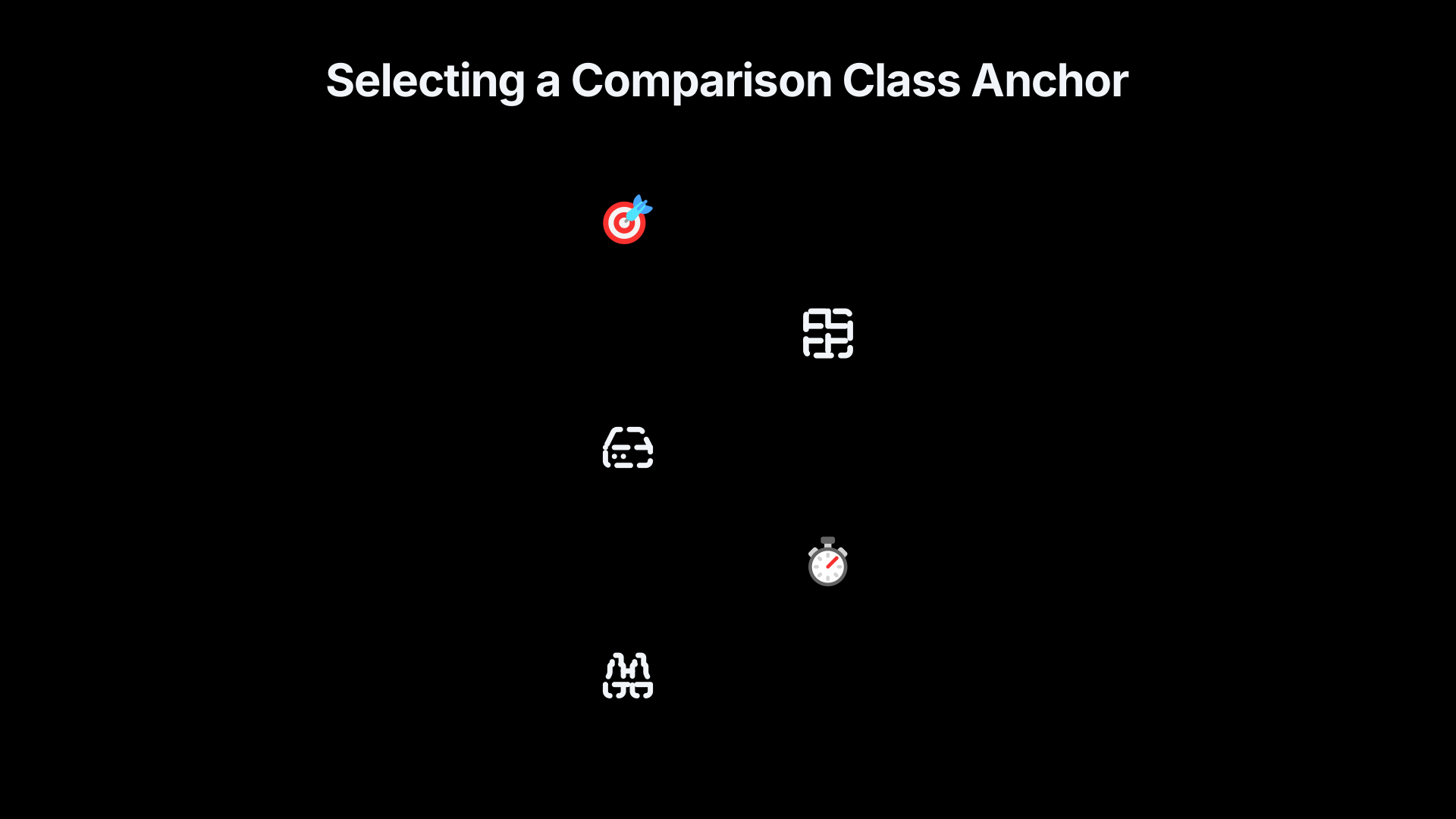
Finding an appropriate comparison class usually involves asking three questions:
- What outcome am I trying to predict?
- Which past cases were genuinely similar before their outcomes were known?
- How many such cases are available?
This approach reduces hindsight bias because similarity is defined using information available at the time of decision rather than by selecting examples that happened to produce the desired outcome.
Beware of comparison classes that are too broad or too narrow
An overly broad comparison class hides important differences.
For example, saying “most businesses fail” tells an entrepreneur little if their company belongs to a well-funded niche with very different survival rates.
An overly narrow comparison class creates another problem: the sample becomes too small to estimate reliable probabilities. Looking only at “companies founded by left-handed engineers in coastal cities during leap years” produces numbers that appear precise but are based on too little evidence.
The goal is not the most detailed comparison possible. It is the most informative comparison supported by enough evidence.
When the base rate should be adjusted
A base rate is a starting estimate, not a final verdict.[Wikipedia]WikipediaBase rate fallacyBase rate fallacyKahneman considers base rate neglect to be a specific form of extension neglect. Richard Nisbett has argued that some…
After establishing what usually happens, ask whether the current case contains evidence strong enough to justify moving away from that starting point.
Examples include:
- A patient belongs to a low-risk population but has highly reliable diagnostic evidence.
- A project resembles previous failures but now uses a proven technology that removes a major historical risk.
- An applicant has characteristics that previous successful employees rarely possessed but that objective evidence shows are strongly predictive of performance.
The adjustment should depend on the strength and reliability of the new evidence, not on how vivid or emotionally compelling it feels.
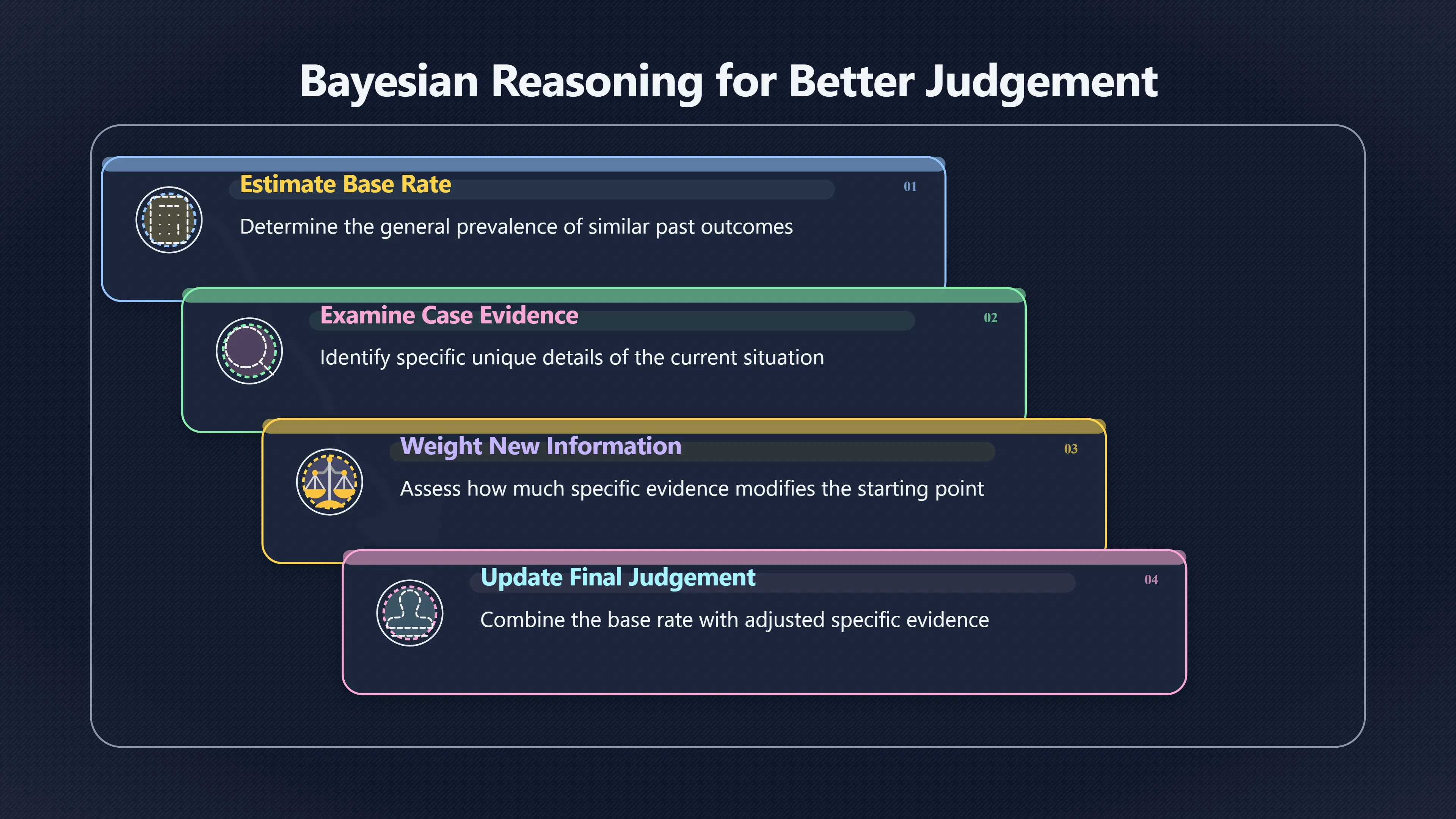
One useful mental sequence is:
- Estimate the base rate.[Wikipedia]WikipediaBase rate fallacyBase rate fallacyKahneman considers base rate neglect to be a specific form of extension neglect. Richard Nisbett has argued that some…
- Examine the case-specific evidence.
- Ask how much that evidence should change the initial estimate.
- Reach an updated judgement.
This mirrors the logic behind Bayesian reasoning, even if no formal calculations are performed. Rather than replacing the base rate with new information, the new information modifies it.[Cambridge University Press & Assessment]cambridge.orgInterestingly, in addition to…
Why memorable stories often defeat statistics
Human attention naturally favours concrete stories over abstract percentages.
A detailed biography can feel more informative than knowing that only a small fraction of similar people achieve a particular outcome. Yet many individually persuasive details have surprisingly little predictive value.
This happens because descriptive information often creates a strong sense of representativeness. If someone resembles our mental image of a successful entrepreneur, talented student or skilled detective, we instinctively raise our estimate of success even when success is objectively rare.
Stories remain valuable—they may contain genuine evidence—but they should be interpreted against the background of what normally happens rather than replacing it altogether. Research suggests that making base-rate information more explicit reduces this bias, especially when people are encouraged to integrate rather than ignore prior probabilities.[Cambridge University Press & Assessment]cambridge.orgInterestingly, in addition to…
A medical example: why prevalence matters
Medical testing provides one of the clearest demonstrations of why base rates matter.
Imagine a disease that is rare in the general population. Even a highly accurate screening test can produce many false positives simply because healthy people greatly outnumber people with the disease.
Without considering the disease’s prevalence, many people—including trained professionals in some studies—overestimate the probability that a positive test means the patient actually has the condition. The prevalence of the disease is part of the calculation, not an optional extra.[Cambridge University Press & Assessment]cambridge.orgIt also showed physicians interpretingCambridge University Press & AssessmentPhysicians neglect base rates, and it mattersby RM Hamm · 1996 · Cited by 23 — A recent study show…
Researchers have repeatedly found that understanding improves when probabilities are expressed as natural frequencies rather than abstract percentages.
Instead of saying:
- “The disease prevalence is 1%.”
It is often easier to reason with:
- “Out of every 1,000 people, about 10 have the disease.”
Presenting information this way makes the relationship between true positives, false positives and total tested people more transparent, improving Bayesian reasoning across medicine, education and other applied settings.[PubMed+2PMC]pubmed.ncbi.nlm.nih.govWhat are natural frequencies?What are natural frequencies? BMJ. 2011 Oct 17:343:d6386. doi: 10.1136/bmj.d6386. Author. Gerd Gigeren…
Common mistakes when using base rates
Starting with base rates does not mean blindly following averages.
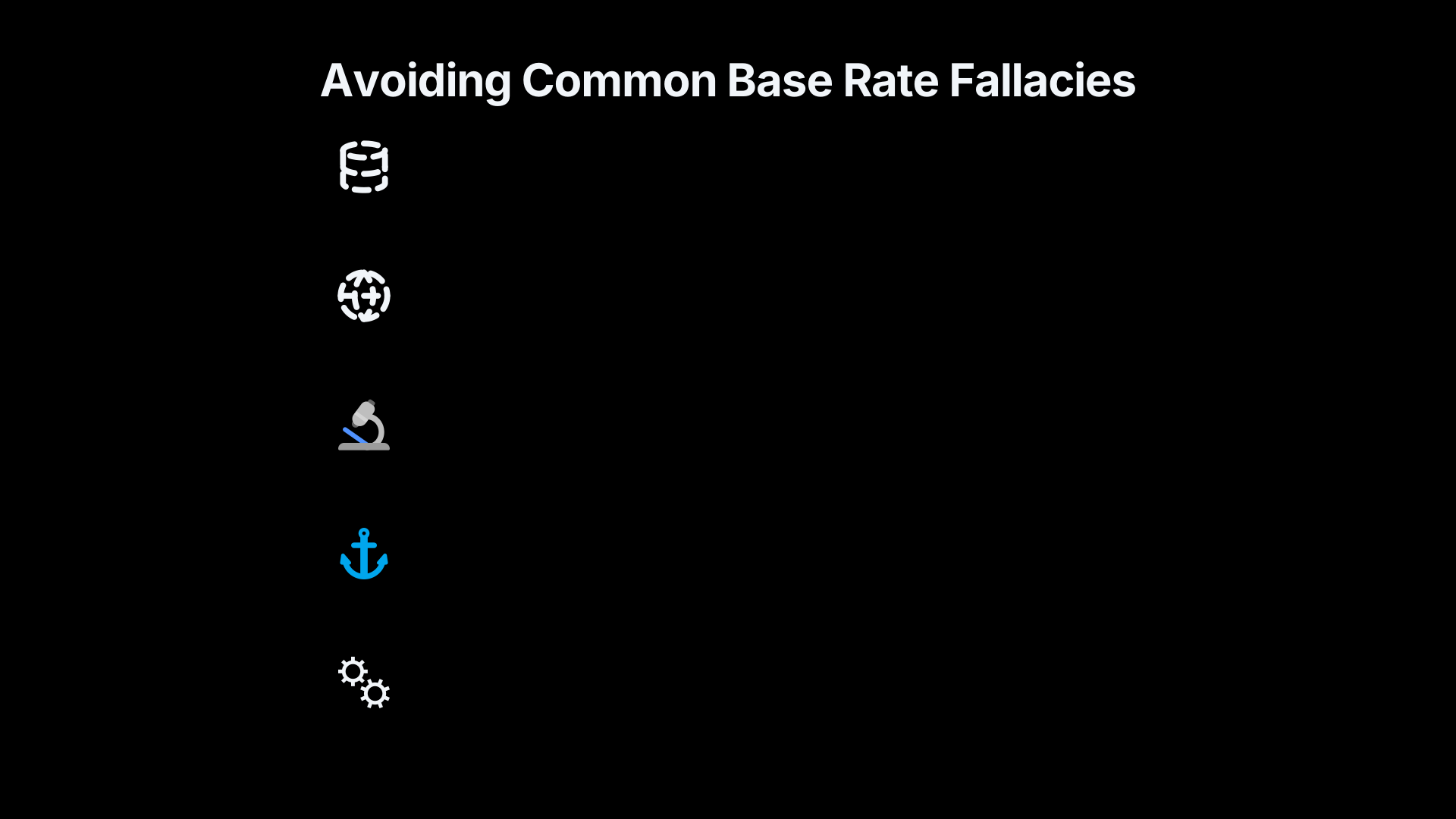
Several mistakes are common:
- Ignoring the base rate entirely. Exceptional details crowd out statistical reality.[Wikipedia]WikipediaBase rate fallacyBase rate fallacyKahneman considers base rate neglect to be a specific form of extension neglect. Richard Nisbett has argued that some…
- Using the wrong comparison class. The average for an irrelevant population adds little value.
- Treating the base rate as destiny. Individual evidence can justify substantial adjustment.
- Using outdated data. A changing environment may alter historical frequencies.
- Confusing frequency with causation. Base rates describe what usually happens, not necessarily why it happens.
Good judgement avoids both extremes: neither ignoring statistics nor assuming that every individual must conform to them.
A practical habit for everyday decisions
Before making an uncertain judgement, pause long enough to ask three questions:
- What usually happens in cases like this?
- What comparison group best matches the current situation?
- Which specific facts genuinely justify moving away from that starting estimate?
This sequence helps separate evidence from intuition. Rather than allowing the most memorable feature of a case to dominate the decision, it gives the ordinary pattern its proper place before evaluating whether the current case is truly unusual.
In probabilistic thinking, exceptional cases certainly exist. The challenge is recognising them for the right reasons, not simply because they tell the most compelling story.
eBay marketplace picks
Marketplace Samples
Example marketplace items related to this page. Use the search link to explore similar finds on eBay.


Endnotes
1.
Source: cambridge.org
Link:https://www.cambridge.org/core/journals/judgment-and-decision-making/article/base-rate-neglect-and-conservatism-in-probabilistic-reasoning-insights-from-eliciting-full-distributions/57619E3572DB3A6035101546DB147F7E
Source snippet
Interestingly, in addition to...
2.
Source: Wikipedia
Title: Base rate fallacy
Link:https://en.wikipedia.org/wiki/Base_rate_fallacy
Source snippet
Base rate fallacyKahneman considers base rate neglect to be a specific form of extension neglect. Richard Nisbett has argued that some...
3.
Source: pmc.ncbi.nlm.nih.gov
Title: PMCExperts use base rates in real-world sequential decisions
Link:https://pmc.ncbi.nlm.nih.gov/articles/PMC9038831/
Source snippet
use base rates in real-world sequential decisions - PMCby D Link · 2021 · Cited by 15 — We argue here that while naïve subjects demonstra...
4.
Source: pmc.ncbi.nlm.nih.gov
Link:https://pmc.ncbi.nlm.nih.gov/articles/PMC4604268/
Source snippet
frequencies improve Bayesian reasoning in simple...by U Hoffrage · 2015 · Cited by 139 — Representing statistical information in terms o...
5.
Source: cambridge.org
Title: It also showed physicians interpreting
Link:https://www.cambridge.org/core/journals/behavioral-and-brain-sciences/article/physicians-neglect-base-rates-and-it-matters/48984E851538FA30B5DE4D6D6CC35CA3
Source snippet
Cambridge University Press & AssessmentPhysicians neglect base rates, and it mattersby RM Hamm · 1996 · Cited by 23 — A recent study show...
6.
Source: Wikipedia
Title: Natural frequency (statistics)
Link:https://en.wikipedia.org/wiki/Natural_frequency_%28statistics%29
Source snippet
Natural frequency (statistics)People often neglect the base rate of people with breast cancer when given this information (base rate f...
7.
Source: pubmed.ncbi.nlm.nih.gov
Link:https://pubmed.ncbi.nlm.nih.gov/22006953/
Source snippet
What are natural frequencies?What are natural frequencies? BMJ. 2011 Oct 17:343:d6386. doi: 10.1136/bmj.d6386. Author. Gerd Gigeren...
8.
Source: pubmed.ncbi.nlm.nih.gov
Link:https://pubmed.ncbi.nlm.nih.gov/29448883/
Source snippet
on Pighin, Gonzalez, Savadori, and Girotto (2016)by M McDowell · 2018 · Cited by 28 — In each analysis, natural frequencies lead to more...
9.
Source: pubmed.ncbi.nlm.nih.gov
Link:https://pubmed.ncbi.nlm.nih.gov/11006907/
Source snippet
Early accounts assumed a general deficit in using statistical base rates...
10.
Source: frontiersin.org
Link:https://www.frontiersin.org/journals/psychology/articles/10.3389/fpsyg.2015.01473/full
Source snippet
Natural frequencies improve Bayesian reasoning in simple...by U Hoffrage · 2015 · Cited by 138 — Representing statistical information in...
Additional References
11.
Source: thesis.eur.nl
Link:https://thesis.eur.nl/pub/35423/Willem-van-Dijk-414364.pdf
Source snippet
Evaluation of Gigerenzer's Criticism on the Heuristics...by W VAN DIJK — The goal of this thesis is to study Gigerenzer's criticism on t...
12.
Source: researchgate.net
Link:https://www.researchgate.net/publication/364692195_Base_rate_neglect_and_conservatism_in_probabilistic_reasoning_Insights_from_eliciting_full_distributions
Source snippet
(PDF) Base rate neglect and conservatism in probabilistic...Previous research suggests that people tend to underweight both their prior...
13.
Source: simplypsychology.org
Link:https://www.simplypsychology.org/base-rate-fallacy.html
Source snippet
ome trait in a population (the base-rate...Read more...
14.
Source: jasoncollins.blog
Title: explaining base rate neglect
Link:https://www.jasoncollins.blog/posts/explaining-base-rate-neglect
Source snippet
12 Apr 2022 — In a seminar for a team from an investment manager I described how base rates are often neglected when people are grappling...
15.
Source: biorxiv.org
Link:https://www.biorxiv.org/content/10.1101/2021.03.11.434913v1.full
Source snippet
On the generality and cognitive basis of base-rate neglect12 Mar 2021 — Base rate neglect refers to people's apparent tendency to underwe...
16.
Source: projecteuclid.org
Link:https://projecteuclid.org/journals/statistical-science/volume-20/issue-3/How-to-Confuse-with-Statistics-or–The-Use-and/10.1214/088342305000000296.pdf
Source snippet
This article shows by various examples how consumers of statisti- cal information may be confused when this information is presented in t...
17.
Source: econtent.hogrefe.com
Title: 1618 3169.50.2.97
Link:https://econtent.hogrefe.com/doi/10.1026//1618-3169.50.2.97
Source snippet
Normative Judgments of Conditional ProbabilityIn this study, the focus is on the failure to incorporate base rates in conditional probabi...
18.
Source: journals.sagepub.com
Link:https://journals.sagepub.com/doi/10.1177/0272989X18754508
Source snippet
Frequencies Do Foster Public Understanding of...Feb 15, 2018 — They argue that they have “replicated the only study reporting that natur...
19.
Source: youtube.com
Title: The Representativeness Heuristic (Intro Psych Tutorial #93)
Link:https://www.youtube.com/watch?v=lhcE5EU-nII
Source snippet
The Base Rate Fallacy: Why 99% Accuracy Fails...
20.
Source: youtube.com
Title: Base rate fallacy: Easy explanation
Link:https://www.youtube.com/watch?v=9bIXEn8E74Q
Source snippet
What is Base Rate Fallacy? [Definition and Example] - Guide to Cognitive Biases...
Topic Tree