Within Humility
When Skepticism Turns Into a Trap
Cynicism can look smart, but it weakens analysis when distrust becomes automatic and evidence can no longer correct belief.
On this page
- Why cynicism feels intellectually safe
- How blanket distrust becomes unfalsifiable
- What humble skepticism asks instead
Page outline Jump by section
Introduction
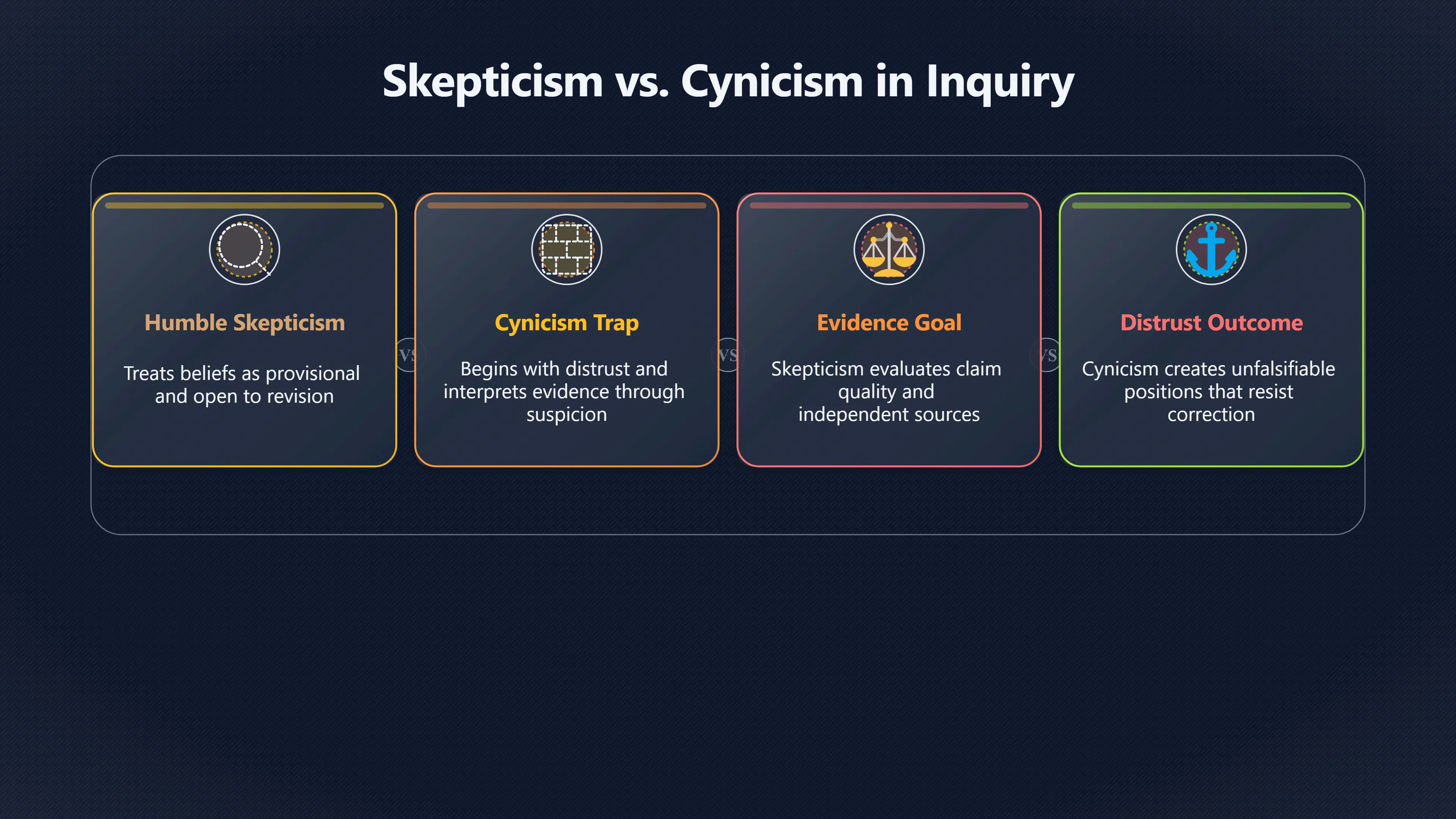
Intellectual humility depends on asking hard questions without assuming that every claim, institution or person is deceptive. That distinction separates humble skepticism from cynicism. Both can appear intellectually rigorous because both reject naïve acceptance, but they work very differently. Humble skepticism treats beliefs as provisional and lets stronger evidence replace weaker evidence. Cynicism begins from distrust and often interprets new information through that distrust, making it difficult for evidence to change its conclusions. Research on intellectual humility consistently associates humility with better evidence evaluation and a greater willingness to revise beliefs, whereas studies of cynicism suggest that chronic distrust can become a self-reinforcing pattern rather than a reliable path to truth.[PMC+2Advances.in]pmc.ncbi.nlm.nih.govPMCPredictors and consequences of intellectual humilityby T Porter · 2022 · Cited by 359 — Intellectual humility involves acknowledging the limitations of one's knowledge and that one's bel…
 Within the broader goal of improving analytical thinking, the key question is not whether to question claims, but how to question them. The most reliable thinking remains open to correction without becoming permanently suspicious.
Why Cynicism Feels Intellectually Safe
Cynicism offers a powerful psychological attraction because it appears to reduce the risk of being deceived. If you assume that politicians always lie, companies always manipulate, experts always protect their interests, or strangers always act selfishly, you will rarely be surprised by bad behaviour.
That defensive posture creates an illusion of intellectual sophistication. Many cultures reinforce the stereotype that the most intelligent observer is the one who sees hidden motives everywhere. Yet psychological research suggests that people commonly overestimate the connection between cynicism and intelligence. Large cross-national studies have found that although many people believe cynics are more competent and realistic, cynical individuals generally do not perform better on measures of cognitive ability, and often perform worse. This pattern has been called the “cynical genius illusion”.[PMC]pmc.ncbi.nlm.nih.govThe Cynical Genius Illusion: Exploring and Debunking Lay…by O Stavrova · 2018 · Cited by 74 — Cynicism refers to a negative apprais…
Part of cynicism’s appeal comes from its emotional payoff:
- It protects against disappointment.
- It provides simple explanations for complex events.
- It avoids the vulnerability involved in trusting others.
- It creates a sense of being harder to manipulate than everyone else.
These benefits are psychologically real even when the underlying beliefs are inaccurate. The emotional reward therefore helps explain why cynical worldviews can persist despite contradictory evidence.
How Blanket Distrust Becomes Unfalsifiable
Healthy reasoning requires beliefs that can be disproved. Cynicism often escapes this requirement.
Consider the claim:
“Every expert is serving hidden interests.”
No amount of honest behaviour by experts disproves this belief. Honest actions are reinterpreted as sophisticated deception, incomplete information, or strategic public relations. Every observation becomes further confirmation.
This creates an unfalsifiable position. Instead of evaluating evidence, cynicism changes the interpretation of evidence so that the conclusion never changes.
Several common reasoning patterns illustrate this trap:
- Selective confirmation. Evidence supporting distrust is remembered, while counterexamples are dismissed as exceptions.
- Motive substitution. Arguments are ignored in favour of presumed intentions.
- Moving standards of proof. Evidence sufficient to reject one claim suddenly becomes insufficient when it contradicts cynical expectations.
- Asymmetric updating. Negative evidence rapidly changes beliefs, whereas positive evidence is discounted.
These mechanisms make cynicism resistant to correction. The issue is not simply that cynical people distrust more often; it is that distrust itself becomes insulated from evidence.
Research distinguishing skepticism from cynicism repeatedly finds this difference. Skepticism focuses on evaluating the quality of claims, whereas cynicism assumes bad motives before evaluating the claims themselves.[ResearchGate+2International Journal of Communication]researchgate.netAsymmetric negative influence of cynicism and skepticismSkepticism is related to cognitive responses to the communication con…
What Humble Skepticism Asks Instead
Humble skepticism begins from uncertainty rather than certainty.
Instead of asking:
“Why should I assume they’re lying?”
it asks:
“What evidence would increase or decrease my confidence?”
This difference sounds subtle but changes the entire reasoning process.
A humble skeptic separates several questions that cynicism tends to merge:
- Is the evidence reliable?
- Are there independent sources?
- What incentives might bias the source?
- How strong is the evidence despite those incentives?
- What evidence would make me change my view?
The crucial feature is that every answer remains revisable.
Intellectual humility therefore does not require trusting everyone equally. It requires calibrating trust according to evidence rather than treating distrust as the default. Reviews of intellectual humility describe it as recognising the limits of one’s own knowledge while remaining responsive to stronger evidence, an orientation associated with better resistance to misinformation and more accurate evidence evaluation.[PMC+2Advances.in]pmc.ncbi.nlm.nih.govPMCPredictors and consequences of intellectual humilityby T Porter · 2022 · Cited by 359 — Intellectual humility involves acknowledging the limitations of one's knowledge and that one's bel…

Historical Contrast: Suspicion Versus Inquiry
The history of science illustrates why skepticism and cynicism should not be confused.[medium.com]medium.comScience and Skepticism vs Cynicism | by Tony TonevWhat does this have to do with cynicism? While a gullible person always believes, a cyn…
Scientific skepticism developed methods designed to expose error through replication, transparent evidence, peer criticism and continual testing. Scientists often assume that hypotheses may be wrong, but they do not assume that every researcher is acting dishonestly. Institutions include safeguards because bias exists, not because fraud is presumed everywhere.
The same distinction appears in journalism and historical scholarship. Responsible investigators scrutinise documents, compare independent witnesses and examine incentives without concluding beforehand that every source is fabricated. Evidence determines confidence rather than confirming a predetermined attitude.
Modern communication research similarly distinguishes constructive skepticism—which critically evaluates competence and evidence—from cynicism, which attributes malevolent motives as the default explanation.[International Journal of Communication]ijoc.orgby O Quiring · 2021 · Cited by 100 — These considerations resemble the distinction between skepticism and cynicism in previous research…
Why Cynicism Can Weaken Analysis
At first glance, cynicism appears demanding because it rejects easy answers. In practice, it often reduces analytical effort.
If every institution is corrupt, every statistic manipulated and every disagreement explained by hidden motives, there is little reason to compare competing evidence. Investigation stops once suspicion is established.
This can produce several analytical failures:
- Genuine expertise is ignored alongside genuine misinformation.
- Reliable evidence is treated as no more credible than weak evidence.
- Nuanced explanations are replaced with single-cause stories about corruption or self-interest.
- Unexpected facts become psychologically difficult to accept.
Ironically, research has also found that higher cynicism does not necessarily protect against false beliefs. Studies examining conspiracy theories, paranormal beliefs and other unsupported claims have reported that cynicism can positively predict endorsement of several kinds of unsubstantiated beliefs. Blanket distrust appears to weaken, rather than strengthen, discrimination between reliable and unreliable information.[Wiley Online Library]onlinelibrary.wiley.comWiley Online LibrarySkepticism, cynicism, and cognitive style predictors of the…by DA Bensley · 2022 · Cited by 41 — Unexpectedly, in…
Practical Questions That Keep Skepticism Humble
A useful way to prevent skepticism from becoming cynicism is to ask questions that expose your own assumptions as well as everyone else’s.
When evaluating an important claim, consider:
- What specific evidence supports this conclusion?
- What evidence would change my mind?
- Am I evaluating the argument or merely inferring motives?
- Am I applying the same standard of proof to views I agree with and disagree with?
- Have I mistaken confidence for certainty, or suspicion for insight?
These questions preserve intellectual caution while ensuring that evidence remains capable of correcting belief.

The Central Difference
Cynicism and humble skepticism both reject gullibility, but they diverge in their relationship with evidence.
Cynicism begins with distrust and asks evidence to justify that distrust. Humble skepticism begins with uncertainty and asks evidence to determine what level of trust is warranted.
That distinction matters because good analytical thinking is not measured by how often you reject claims. It is measured by whether your confidence—high or low—moves in proportion to the quality of the evidence. Intellectual humility protects that proportionality by keeping every conclusion, including your own suspicions, open to revision.
Amazon book picks
Further Reading
Books and field guides related to When Skepticism Turns Into a Trap. Use these as the next step if you want deeper reading beyond the article.
The Demon-Haunted World
Rating: 4.5/5 from 43 Google Books ratings
Promotes skeptical inquiry without cynical thinking.
eBay marketplace picks
Marketplace Samples
Example marketplace items related to this page. Use the search link to explore similar finds on eBay.




Endnotes
1.
Source: pmc.ncbi.nlm.nih.gov
Title: PMCPredictors and consequences of intellectual humility
Link:https://pmc.ncbi.nlm.nih.gov/articles/PMC9244574/
Source snippet
by T Porter · 2022 · Cited by 359 — Intellectual humility involves acknowledging the limitations of one's knowledge and that one's bel...
2.
Source: advances.in
Title: Intellectual humility and misinformation receptivity
Link:https://advances.in/psychology/10.56296/aip00026/
Source snippet
SM Bowes · 2024 · Cited by 14 — Research has found that IH is correlated with less belief in misinformation, greater intentions to engage...
3.
Source: pmc.ncbi.nlm.nih.gov
Link:https://pmc.ncbi.nlm.nih.gov/articles/PMC6328999/
Source snippet
The Cynical Genius Illusion: Exploring and Debunking Lay...by O Stavrova · 2018 · Cited by 74 — Cynicism refers to a negative apprais...
4.
Source: researchgate.net
Link:https://www.researchgate.net/publication/332181169_Asymmetric_negative_influence_of_cynicism_and_skepticism_a_study_of_preventative_communication
Source snippet
Asymmetric negative influence of cynicism and skepticismSkepticism is related to cognitive responses to the communication con...
5.
Source: onlinelibrary.wiley.com
Link:https://onlinelibrary.wiley.com/doi/abs/10.1002/acp.3900
Source snippet
Wiley Online LibrarySkepticism, cynicism, and cognitive style predictors of the...by DA Bensley · 2022 · Cited by 41 — Unexpectedly, in...
6.
Source: researchgate.net
Link:https://www.researchgate.net/publication/392986769_The_Role_of_Self-Efficacy_and_Intellectual_Humility_in_the_Relationship_Between_Perceived_Deepfake_Exposure_and_Media_Cynicism
Source snippet
(PDF) The Role of Self-Efficacy and Intellectual Humility in...23 Jul 2025 — In this study, we relate perceived deepfake exposure to med...
7.
Source: researchgate.net
Link:https://www.researchgate.net/publication/227315974_Expecting_the_Worst_Moderating_Effects_of_Social_Cynicism_on_the_Relationships_Between_Relationship_Conflict_and_Negative_Affective_Reactions
Source snippet
d hostility towards others and involves vilification of others' motives behind any...Read more...
8.
Source: ijoc.org
Link:https://ijoc.org/index.php/ijoc/article/download/16127/3514
Source snippet
by O Quiring · 2021 · Cited by 100 — These considerations resemble the distinction between skepticism and cynicism in previous research...
Additional References
9.
Source: beyondintractability.org
Link:https://www.beyondintractability.org/essay/distrust
Source snippet
DistrustAs noted earlier, distrust is associated with a lack of cooperation, lower satisfaction and commitment, and possibly even retribu...
10.
Source: medium.com
Link:https://medium.com/%40tonytonev/science-and-skepticism-vs-cynicism-4cb90709dffe
Source snippet
Science and Skepticism vs Cynicism | by Tony TonevWhat does this have to do with cynicism? While a gullible person always believes, a cyn...
11.
Source: ggsc.berkeley.edu
Link:https://ggsc.berkeley.edu/what_we_do/major_initiatives/intellectual_humility/introduction_intellectual_humility_research
Source snippet
Greater Good Science CenterExpanding Awareness of the Science of Intellectual HumilityBelow, we review three research papers that reveal...
12.
Source: researchportalplus.anu.edu.au
Link:https://researchportalplus.anu.edu.au/en/publications/intellectual-humility-predicts-trust-in-science-and-scientists-an/
Source snippet
humility predicts trust in science and scientists and...by HP Huynh · 2025 · Cited by 4 — We found that IH was associated with higher tr...
13.
Source: reachlink.com
Title: from ancient cynics to modern skeptics evolution of cynicism
Link:https://reachlink.com/advice/pessimism/from-ancient-cynics-to-modern-skeptics-evolution-of-cynicism/
Source snippet
From Ancient Cynics to Modern SkepticsNov 28, 2025 — Healthy skepticism involves critical thinking and reasonable doubt, while harmful cy...
14.
Source: skepticalinquirer.org
Link:https://skepticalinquirer.org/2020/09/intellectual-humility-a-guiding-principle-for-the-skeptical-movement/
Source snippet
approach to evidence that the skeptical movement may wish to embrace as a guiding credo...
15.
Source: facebook.com
Link:https://www.facebook.com/saltlaketribune/posts/by-practicing-humility-skepticism-and-curiosity-we-can-prioritize-trustworthy-in/1619864106806597/
Source snippet
rthy information over that which soothes our egos and protects our worldviews,”...
16.
Source: facebook.com
Title: Skepticism and cynicism are two different things
Link:https://www.facebook.com/sadhguru/posts/skepticism-and-cynicism-are-two-different-things-cynicism-means-you-made-assumpt/10159975149729146/
Source snippet
Difference between skepticism and cynicism: Skepticism is lack of faith in assumptions, while cynicism is a lack of faith in people. Toda...
17.
Source: ianchadwick.com
Title: skepticism too easily slides into cynicism
Link:https://ianchadwick.com/blog/skepticism-too-easily-slides-into-cynicism/
Source snippet
ScripturientOct 19, 2014 — It's an easy slide, however, from a healthy skepticism to a soul-destroying cynicism – using the modern sense...
18.
Source: facebook.com
Title: Cynicism is tempting in uncertain times
Link:https://www.facebook.com/NPR/posts/cynicism-is-tempting-in-uncertain-times-but-stanford-psychologist-jamil-zaki-say/983452053651794/
Source snippet
But Stanford...Cynicism is a philosophical and psychological attitude characterized by skepticism and a general distrust of the motives...
Topic Tree