Within Decision Stakes
When Is Acting the Better Analysis?
Reversible choices often improve faster through small experiments than through long private debate.
On this page
- How reversibility changes the decision standard
- Small trials that limit downside
- Review dates, stop loss rules, and exit ramps
Page outline Jump by section
Introduction
Many decisions feel more important than they really are because we imagine making them once and living with them forever. In practice, a large share of everyday choices are “two-way door” decisions: they can be reversed, adjusted, or abandoned before they cause lasting harm. The better question is often not “What is the perfect answer?” but “Can I test this safely?” When a choice is genuinely reversible, small experiments usually produce better information than extended private debate. Jeff Bezos popularised this distinction by arguing that organisations become slow when they apply heavyweight decision processes to choices that can easily be changed later.[Inc.com]inc.comAmazon Founder Jeff Bezos: This Is How Successful People…Dec 3, 2018 — Some decisions are consequential and irreversible or nearly irr…
 This does not mean acting carelessly. A reversible decision still deserves thought. The difference is that the standard shifts from seeking certainty to designing a test that limits downside while generating reliable feedback.
How reversibility changes the decision standard
A two-way door decision is not defined by being unimportant. It is defined by being recoverable. If you can reverse the choice quickly, cheaply, and without causing major harm to yourself or others, then the value of learning by doing often exceeds the value of collecting more information before acting.[The Uncertainty Project]theuncertaintyproject.orgThe Uncertainty ProjectDecision TypesType 2: Also known as two-way door decisions, these are reversible and have short-term consequences…
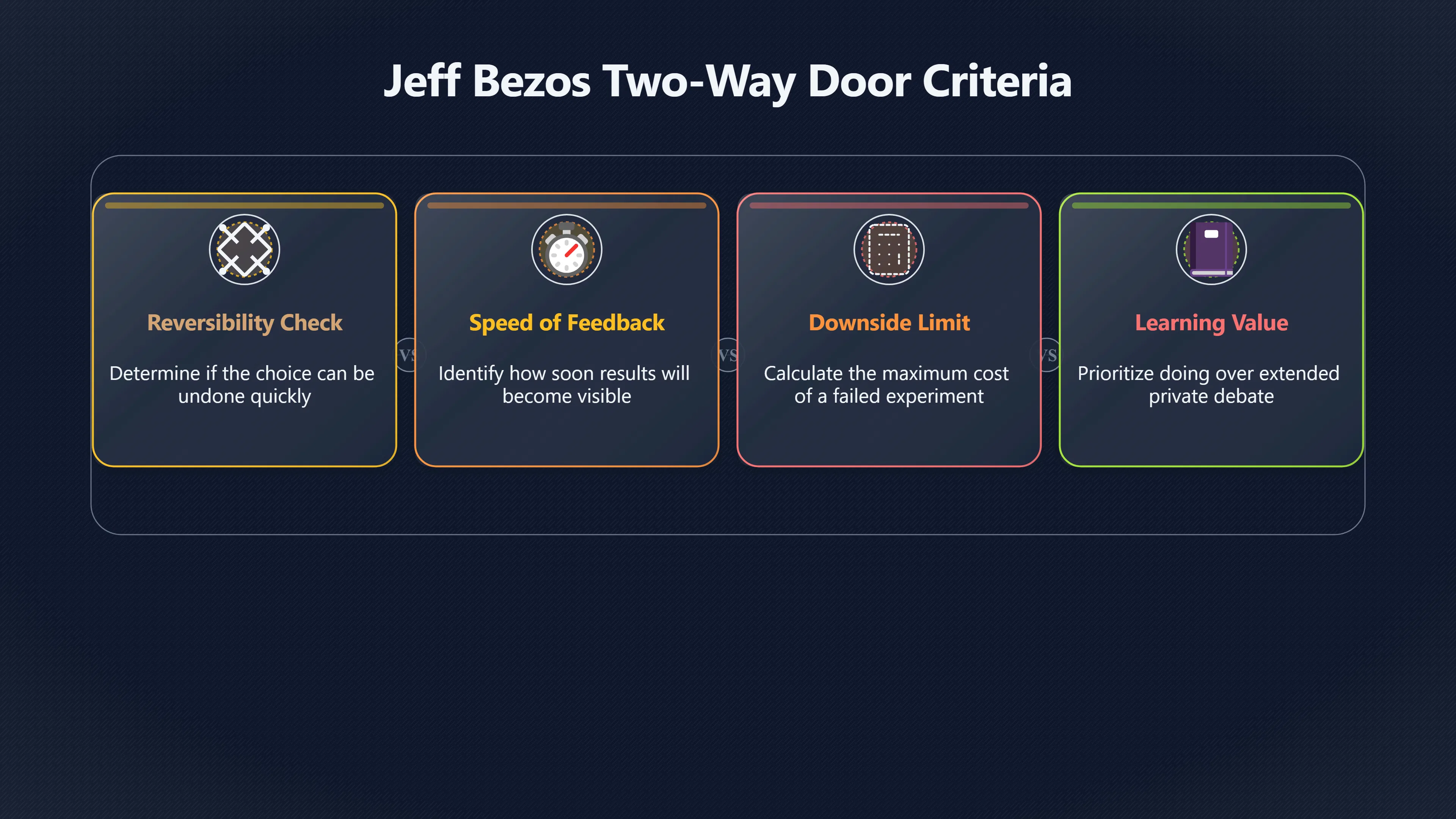
This changes what counts as “good analysis”. Instead of trying to predict every outcome in advance, the aim becomes to answer three practical questions:
- How easily can I undo this?
- How quickly will I know whether it is working?
- What is the maximum cost if the experiment fails?
If the answers are “easy”, “soon”, and “small”, then delaying for perfect confidence usually has diminishing returns. The experiment itself becomes part of the analysis rather than something that happens after analysis is complete. This is the mechanism that allows faster learning without increasing overall risk.[Leading Sapiens]leadingsapiens.comLeading Sapiens How Bezos ThinksThose decisions can use a light-weight process. For those, so what if you're wrong? Second, most…Read more…
Small trials that limit downside
The safest two-way door decisions are designed as experiments rather than commitments. Instead of asking whether an idea will work forever, ask whether it is worth testing for a limited period.
Common examples include:
- Trying a different study schedule for one week instead of redesigning an entire semester.
- Running a pilot meeting format before changing how a whole organisation collaborates.
- Testing a software tool with one team rather than migrating every department.
- Taking a short online course before committing to a long qualification.
- Renting or borrowing equipment before buying expensive versions.
Each example narrows the possible loss while preserving the opportunity to learn.
A useful way to structure these trials is to reduce one or more dimensions of exposure:
- Time: test for a week instead of indefinitely.
- Scale: involve one project instead of every project.
- Money: begin with a free trial or low-cost option.
- Commitment: avoid contracts that remove the ability to exit.
- Visibility: test privately before making a public commitment where appropriate.
These adjustments do not eliminate uncertainty. They make uncertainty affordable.
Why action often produces better evidence than reflection
People frequently overestimate how much additional thinking will improve a decision. Many questions cannot be answered by reasoning alone because the missing information only appears after action.
For example:
- You cannot know whether a productivity system suits you until you use it consistently.
- You cannot accurately judge whether a new workflow improves collaboration until people work with it.
- You cannot reliably predict whether an exercise routine fits your lifestyle without attempting it.
Behavioural research has long shown that people are poor at forecasting many future preferences and experiences. Direct experience often corrects assumptions that seemed convincing beforehand. Well-designed experiments therefore produce evidence that is both more relevant and more personalised than abstract speculation.
The key insight is that action is not the opposite of analysis. In reversible situations, action is often the fastest way to gather higher-quality evidence.
Review dates, stop-loss rules, and exit ramps
Two-way door decisions work best when the exit is planned before the experiment begins. Without predefined review points, temporary experiments easily become accidental long-term commitments.
Three simple safeguards improve almost every reversible test.
Set a review date
Choose a specific date before starting.
Instead of saying, “I’ll see how it goes,” decide:
- after one week,
- after ten customer conversations,
- after completing three practice sessions,
- after one monthly billing cycle.
A fixed review point prevents both premature abandonment and endless drift.
Define a stop-loss rule
Investors use stop-loss rules to limit losses before emotions take over. The same idea works in everyday decisions.
Examples include:
- stop if costs exceed a set budget;
- stop if the experiment consistently interferes with sleep or health;
- stop if agreed performance measures decline for several review periods.
Predetermined limits reduce the temptation to continue simply because time or effort has already been invested.
Build an exit ramp
A decision is more reversible when leaving has already been considered.
Examples include:
- keeping backups before changing software;
- choosing monthly subscriptions rather than long contracts;
- maintaining previous procedures until the replacement has proved itself;
- documenting changes so they can be reversed quickly.
The easier it is to return, the more confidently small experiments can be attempted.
Common mistakes when judging reversibility
People often misclassify decisions because they focus on one aspect of reversibility while ignoring others.
Frequent errors include:
- Ignoring hidden switching costs. A free trial may still require weeks of setup and retraining.
- Confusing embarrassment with irreversibility. Many decisions feel permanent only because changing your mind is uncomfortable.
- Overlooking effects on others. A decision that is reversible for one person may impose significant costs on colleagues, customers, or family.
- Waiting for complete certainty. By the time nearly all uncertainty has disappeared, the opportunity to learn quickly may already have been lost. Bezos has argued that many decisions can be made with roughly 70% of the information desired, provided organisations are good at recognising and correcting mistakes rapidly.[Leading Sapiens]leadingsapiens.comLeading Sapiens How Bezos ThinksThose decisions can use a light-weight process. For those, so what if you're wrong? Second, most…Read more…
Recognising these pitfalls helps preserve the central advantage of two-way door decisions: rapid learning with bounded risk.
Turning more decisions into safe experiments
Sometimes a choice appears irreversible only because it has been framed too broadly. Breaking it into smaller steps can transform a one-way commitment into a sequence of reversible tests.
Instead of deciding whether to “change careers”, someone might first shadow professionals, complete a short project, freelance part-time, or take evening training. Rather than deciding whether to “launch a business”, they might first interview potential customers, build a prototype, or test demand with a limited offering.
This approach does not remove uncertainty. It changes the structure of uncertainty. Each successful experiment increases confidence while each unsuccessful one limits the cost of being wrong.
The practical lesson is straightforward: when consequences are genuinely reversible, the highest-quality analysis often comes from carefully designed action rather than prolonged deliberation. The objective is not to eliminate mistakes but to make them small, informative, and easy to correct.
Amazon book picks
Further Reading
Books and field guides related to When Is Acting the Better Analysis?. Use these as the next step if you want deeper reading beyond the article.
The Lean Startup
Rating: 4.0/5 from 5 Google Books ratings
Centers on testing ideas through small, reversible experiments.
Thinking, Fast and Slow
Provides the cognitive background for deciding when action beats further analysis.
eBay marketplace picks
Marketplace Samples
Live-tested eBay searches with available results related to this page.

Top pick
critical thinking card game
Open a targeted eBay search for items related to this topic.
Browse eBay

Related search
when memorabilia
Open a targeted eBay search for items related to this topic.
Browse eBay
Endnotes
1.
Source: inc.com
Link:https://www.inc.com/jeff-haden/amazon-founder-jeff-bezos-this-is-how-successful-people-make-such-smart-decisions.html
Source snippet
Amazon Founder Jeff Bezos: This Is How Successful People...Dec 3, 2018 — Some decisions are consequential and irreversible or nearly irr...
2.
Source: theuncertaintyproject.org
Link:https://www.theuncertaintyproject.org/tools/decision-types
Source snippet
The Uncertainty ProjectDecision TypesType 2: Also known as two-way door decisions, these are reversible and have short-term consequences...
3.
Source: leadingsapiens.com
Title: Leading Sapiens How Bezos Thinks
Link:https://www.leadingsapiens.com/bezos-on-failure-decision-making-life/
Source snippet
Those decisions can use a light-weight process. For those, so what if you're wrong? Second, most...Read more...
Additional References
4.
Source: drjoshuaread.com
Link:https://drjoshuaread.com/category/tips-tricks/
Source snippet
Category: Tips & TricksWe can call these Type 1 decisions. But most decisions aren't like that – they are changeable, reversible – they'r...
5.
Source: linkedin.com
Link:https://www.linkedin.com/posts/colinbryar_when-bill-carr-and-i-approached-jeff-bezos-activity-7288265841781940224-3zv_
Source snippet
Colin Bryar's PostBezos says there are two kinds of decisions leaders make: [one-way doors]({{ 'one-way-doors/' | relative_url }}) and two-way doors. One-way door decisions are b...
6.
Source: fs.blog
Link:https://fs.blog/reversible-irreversible-decisions/
Source snippet
Farnam StreetReversible and Irreversible DecisionsSome decisions are consequential and irreversible or nearly irreversible – one-way door...
7.
Source: linkedin.com
Link:https://www.linkedin.com/posts/the-startup-archive_jeff-bezos-explains-the-difference-between-activity-7398045364764737536-np8f
Source snippet
Jeff Bezos on two-way and one-way door decisionsJeff Bezos explains the difference between 1-way door and 2-way door decisions In the sim...
8.
Source: goalsandprogress.com
Title: Decision Making Templates That Cut Choice Overloadirreversible choices
Link:https://goalsandprogress.com/decision-making-templates-tools/
Source snippet
Jeff Bezos popularized the distinction between “one-way door” and “two-way door” decisions in his 2016 Amazon shareholder letter [5]...
9.
Source: linkedin.com
Link:https://www.linkedin.com/posts/jasonyoong_jeff-bezos-explains-the-difference-between-activity-7244164615729733632-tDdM
Source snippet
The DOWNFALL of many companies is they have a one-size-fits-all decision making...Read more...
10.
Source: metaintro.com
Title: underrated leadership skill 2026 knowing when to slow down
Link:https://www.metaintro.com/blog/underrated-leadership-skill-2026-knowing-when-to-slow-down
Source snippet
The Most Underrated Leadership Skill in 2026Jeff Bezos famously categorized decisions as "one-way doors" (irreversible, high-stakes) and...
11.
Source: medium.com
Link:https://medium.com/illumination/jeff-bezos-method-of-decision-making-the-two-way-door-strategy-52513f389020
Source snippet
n you can easily crawl back from; and one-way door decision, a...Read more...
12.
Source: linkedin.com
Link:https://www.linkedin.com/posts/jasonaosborn_jeff-bezos-approach-to-decisions-activity-7402300746978840576-MMFk
Source snippet
ype 1 (One Way Door): Irreversible or nearly irreversible...Read more...
13.
Source: startupbell.net
Title: one way door and two way door decisions by jeff bezos
Link:https://www.startupbell.net/post/one-way-door-and-two-way-door-decisions-by-jeff-bezos
Source snippet
one-way door decision-making framework. We'll break down how it works, why it matters, and how to use it in...Read more...
Topic Tree