Within Job Offers
Is the Growth Promise Real?
A role that promises development is stronger when it produces visible skills, credible examples and a path to the next job.
On this page
- Separating learning opportunities from vague optimism
- Checking promotion paths and recent internal moves
- Judging marketable skills after the first year
Page outline Jump by section
Introduction
A job offer that promises rapid growth is valuable only if that growth becomes visible evidence that you can use in your next career move. Many employers advertise learning, mentorship and promotion opportunities, but the strongest opportunities leave a trail of proof: new responsibilities, measurable achievements, recognised skills, and a credible record of people progressing into more senior roles. Evaluating this evidence is one of the most effective ways to avoid being persuaded by optimistic language alone.
 When comparing offers, the key question is not, “Will I learn?” Almost every job involves some learning. Instead ask, “What concrete evidence will exist after my first year that makes me more valuable to future employers?” Framing the decision this way turns vague promises into testable claims.
Separating genuine learning opportunities from vague optimism
Growth claims vary enormously in quality. Statements such as “fast-paced environment”, “lots of exposure”, or “excellent career opportunities” sound attractive but often describe aspirations rather than outcomes. A stronger signal is when an employer can point to structured development, measurable skill building, and examples of employees who have advanced.
Look for evidence such as:
- A documented training programme with specific technical or professional skills.
- Regular feedback and development reviews rather than only annual appraisals.
- Opportunities to own increasingly complex projects.
- Formal mentoring or coaching.
- Access to recognised certifications or qualifications.
- Cross-functional work that broadens experience beyond a narrow job description.
Research consistently shows that learning is most effective when it is connected directly to career development rather than offered as isolated training. LinkedIn’s 2025 Workplace Learning Report found that organisations with mature career development programmes combine learning with leadership development, coaching and internal mobility, producing stronger promotion outcomes and higher engagement than organisations where learning exists without clear career pathways.[LinkedIn]business.linkedin.comworkplace learning report2025 Workplace Learning ReportUncover data, trends, and actionable advice to drive career growth, talent retention, and organizat…
By contrast, an employer whose development story depends almost entirely on enthusiasm, culture slogans or future intentions is asking candidates to trust promises that may never materialise.
How to test whether promotion paths are real
A promotion path becomes credible when it is visible in recent employee careers rather than described only during recruitment.
Useful questions include:
- How many people on this team were promoted during the past two years?
- Where did the previous person in this role move next?
- What distinguishes employees who are promoted quickly?
- Are vacancies usually filled internally or externally?
- How long do people typically stay at each level?
Recruiters may not have every answer, but organisations with genuine internal progression usually provide concrete examples instead of general assurances.
Public information can also help. Professional networking profiles often reveal whether employees regularly move into broader responsibilities inside the organisation or whether advancement mainly requires leaving the company. A pattern of internal moves across multiple employees is stronger evidence than a single success story.
LinkedIn’s Career Development Index illustrates why these indicators matter. The index incorporates measurable factors including internal career moves, leadership skill development and career-oriented job postings. Organisations scoring highly show higher promotion rates and stronger leadership pipelines than organisations with weaker career development practices.[LinkedIn]business.linkedin.comworkplace learning report2025 Workplace Learning ReportUncover data, trends, and actionable advice to drive career growth, talent retention, and organizat…
One important caution is survivorship bias. Employers naturally introduce candidates to employees whose careers progressed exceptionally well. Ask whether these examples represent the typical experience or the exceptional one.
Judge the manager as carefully as the company
Even excellent organisations vary dramatically between teams. Much of a person’s development depends on the immediate manager rather than the employer’s official policies.
Managers who genuinely accelerate careers often:
- Delegate meaningful responsibility early.
- Give detailed feedback instead of only praise.
- Explain business decisions rather than assigning isolated tasks.
- Encourage presentations, customer interaction or leadership opportunities.
- Help employees build visibility across the organisation.
The opposite pattern is equally informative. If interviewers cannot explain how junior staff develop new responsibilities, or describe growth only as “working hard”, the advertised learning may consist largely of accumulating workload rather than acquiring valuable capability.
LinkedIn’s research also highlights that managers are frequently the limiting factor. Many organisations recognise the importance of career development, but respondents identify lack of managerial time and support—not lack of executive interest—as one of the biggest barriers to employee growth.[LinkedIn]business.linkedin.comworkplace learning report2025 Workplace Learning ReportUncover data, trends, and actionable advice to drive career growth, talent retention, and organizat…
What should exist after your first year?
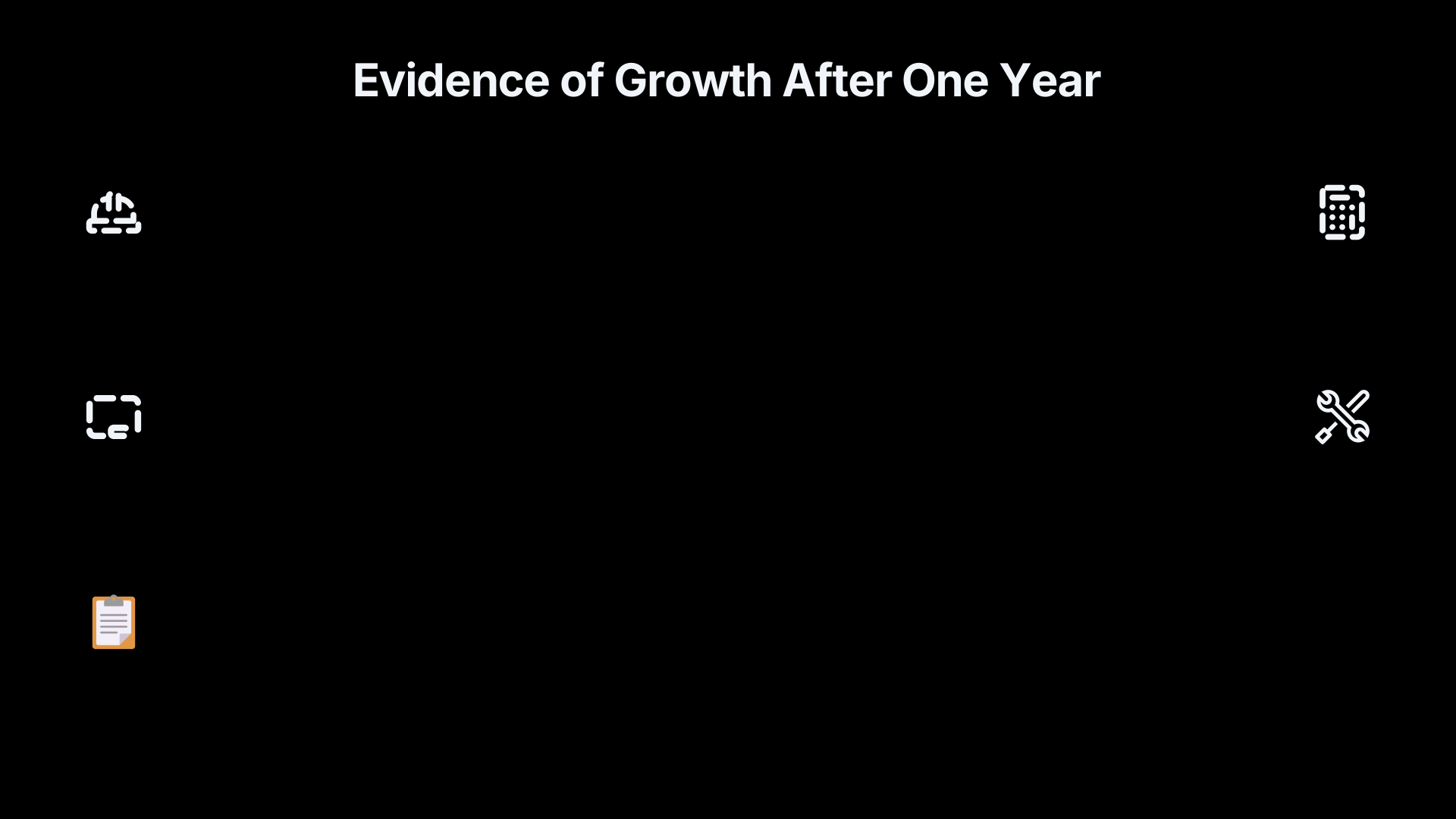
The strongest test of a growth promise is imagining your curriculum vitae after twelve months.
A productive first year should allow you to add evidence such as:
- Leading a significant project.
- Managing budgets, customers or stakeholders.
- Supervising colleagues or mentoring newer staff.
- Learning industry-standard tools or technologies.
- Delivering measurable business improvements.
- Completing recognised professional qualifications.
- Demonstrating increased decision-making authority.
Notice that each item describes observable evidence rather than effort. Future employers rarely reward someone simply because they worked hard. They reward demonstrated capability.
Recent labour-market research also suggests that richer skill portfolios—not merely longer experience—are associated with better labour-market outcomes. Workers who accumulate broader and more specific skills tend to be more likely to occupy higher-paid roles, reinforcing the importance of choosing work that visibly expands capabilities rather than only extending tenure.[arXiv]arxiv.orgMultidimensional Skills as a Measure of Human Capital: Evidence from LinkedIn ProfilesSeptember 27, 2024…
Skills that remain valuable outside the employer
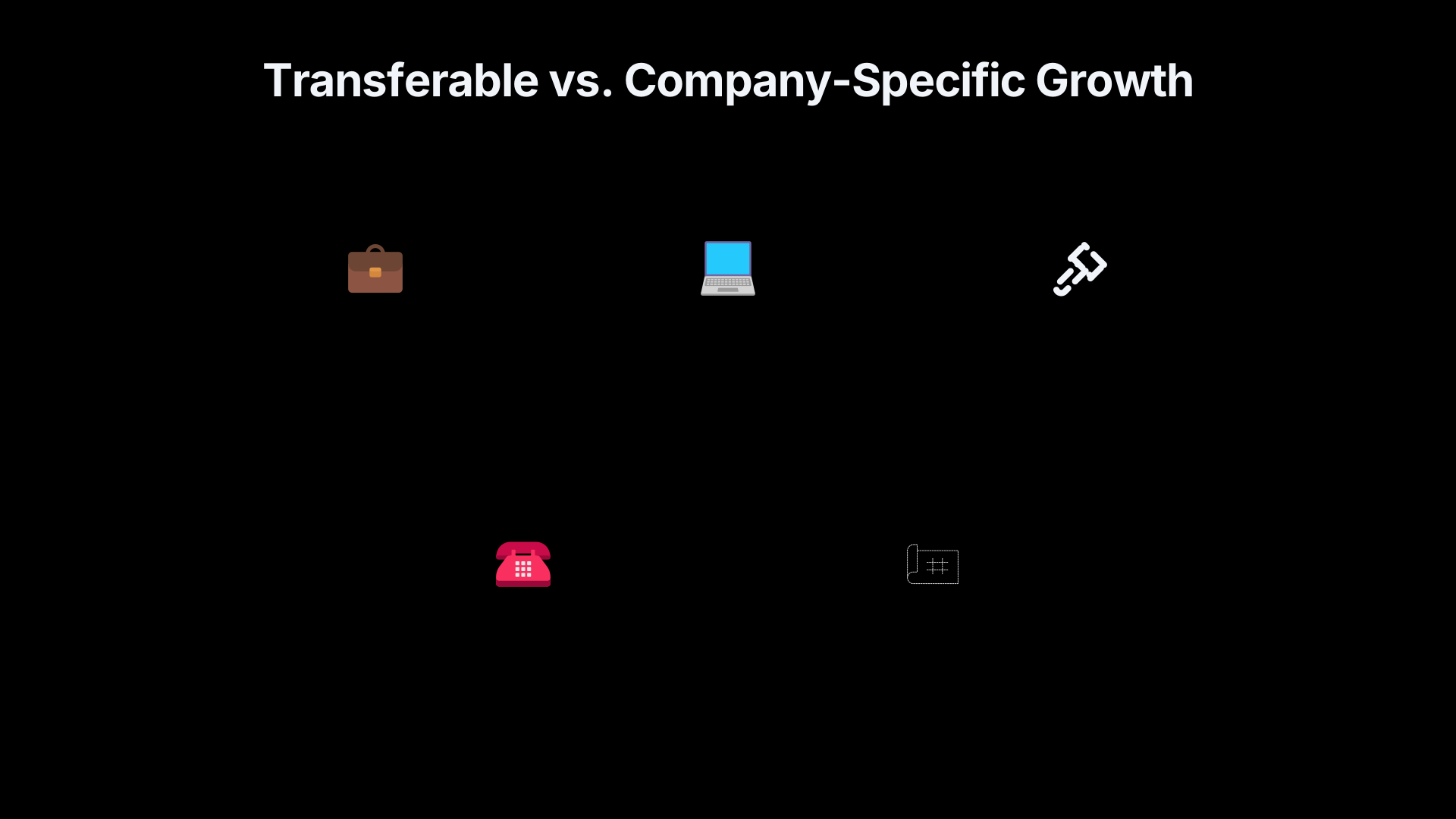
Some organisations develop highly specialised knowledge that is difficult to transfer elsewhere. Others provide experience recognised across an entire industry.
When assessing growth, distinguish between:
Strong evidence of transferable growthWeaker evidence of growthManaging people or projectsLearning only company-specific proceduresWidely recognised software or technical toolsProprietary internal systems onlyCommercial decision-makingRoutine administrative repetitionCustomer-facing responsibilityLimited visibility outside one teamCross-functional collaborationHighly isolated workIndustry-recognised certificationsInternal training with no external recognition
Transferable skills increase future options because they remain valuable even if circumstances change or the employer disappoints.
Warning signs that growth is mostly marketing
Certain patterns appear repeatedly when organisations overstate development opportunities.
Be cautious if:
- Every employee receives the same generic promise of “rapid progression”.
- Promotion criteria are unclear or constantly changing.
- Most senior positions are hired externally.
- Employees remain in identical roles for many years without expanded responsibilities.
- Development depends entirely on unpaid overtime or “proving commitment”.
- Interviewers struggle to describe recent examples of internal advancement.
- The role offers exposure without ownership, meaning you observe important work but rarely make decisions yourself.
These warning signs do not prove that growth is impossible, but they justify seeking stronger evidence before treating development as part of the offer’s value.

A practical evidence test before accepting an offer
A simple framework helps separate credible opportunities from optimistic recruiting language.
Ask whether the employer provides evidence across four areas:
- Visible progression: Can recent promotions or internal career moves be demonstrated?
- Skill accumulation: Will you acquire capabilities recognised across the wider market?
- Increasing responsibility: Will your authority expand, not just your workload?
- Future employability: Would your first year produce achievements that strengthen your position in the next job search?
The more confidently you can answer “yes” to each question using observable evidence rather than promises, the more credible the growth opportunity becomes.
This approach also improves analytical thinking. Instead of accepting optimistic forecasts, you evaluate competing job offers by examining evidence that can be verified today and translated into stronger career opportunities tomorrow.
Amazon book picks
Further Reading
Books and field guides related to Is the Growth Promise Real?. Use these as the next step if you want deeper reading beyond the article.
So Good They Can't Ignore You
Explains why valuable skills matter more than vague passion promises.
Designing Your Life
Helps evaluate long-term career growth using evidence rather than assumptions.
eBay marketplace picks
Marketplace Samples
Example marketplace items related to this page. Use the search link to explore similar finds on eBay.




Endnotes
1.
Source: business.linkedin.com
Title: workplace learning report
Link:https://business.linkedin.com/learn/resources/workplace-learning-report
Source snippet
2025 Workplace Learning ReportUncover data, trends, and actionable advice to drive career growth, talent retention, and organizat...
2.
Source: business.linkedin.com
Title: LinkedIn Workplace Learning Report 2025
Link:https://business.linkedin.com/content/dam/lem/business/en/learn/workplace-learning-report-2025/LinkedIn-Workplace-Learning-Report-2025.pdf
Source snippet
Learning Report 2025Learning combined with career development — leadership training, coaching, internal mobility, and more — accelerates...
3.
Source: business.linkedin.com
Title: united kingdom workplace learning report 2025
Link:https://business.linkedin.com/talent-solutions/united-kingdom-workplace-learning-report-2025
Source snippet
Kingdom Workplace Learning Report 2025Organisations scoring high on the Career Development Index... Our Future Leader Pathway for first...
4.
Source: arxiv.org
Link:https://arxiv.org/abs/2409.18638
Source snippet
Multidimensional Skills as a Measure of Human Capital: Evidence from LinkedIn ProfilesSeptember 27, 2024...
Published: September 27, 2024
5.
Source: learning.linkedin.com
Title: LinkedIn Workplace Learning Report 2024
Link:https://learning.linkedin.com/content/dam/me/business/en-us/amp/learning-solutions/images/wlr-2024/LinkedIn-Workplace-Learning-Report-2024.pdf
Source snippet
Learning Report 2024Analysis scores companies on a learning culture index, then assesses rate of retention, internal mobility, and promot...
6.
Source: linkedin.com
Title: Invest in your internal talent
Link:https://www.linkedin.com/learning/facilitate-employee-skill-development-and-career-mobility-as-a-manager/invest-in-your-internal-talent
Source snippet
Facilitate Employee Skill...5 Dec 2023 — Internal mobility, which is all about employees embracing new opportunities and growth right wh...
7.
Source: learning.linkedin.com
Title: workplace learning report uk 2024
Link:https://learning.linkedin.com/resources/workplace-learning-report-uk-2024
Source snippet
Learning Report | United KingdomThis report combines survey results, LinkedIn behavioural data, and wisdom from L&D pros in the UK and ar...
8.
Source: learning.linkedin.com
Title: workplace learning report au
Link:https://learning.linkedin.com/resources/workplace-learning-report-au
Source snippet
Learning Report | Australia & New ZealandFor more than a third of organisations globally, internal mobility is shared between two or more...
9.
Source: hrgrapevine.com
Link:https://www.hrgrapevine.com/us/content/article/2025-02-27-linkedin-report-highlights-business-imperative-of-continual-career-growth-learning
Source snippet
LinkedIn findings | What is 'continual career growth learning'27 Feb 2025 — According to the LinkedIn report, those career development ch...
Additional References
10.
Source: youtube.com
Title: 2 Ways to Know If You’ve Hit Your Career Ceiling | Big Think
Link:https://www.youtube.com/watch?v=sKNFglrW9Ic
Source snippet
The Truth About Career Progression | Richard Edge | TEDxPCL...
11.
Source: cipd.org
Link:https://www.cipd.org/uk/knowledge/reports/goodwork/
Source snippet
Good Work Index | Report9 Jun 2025 — The CIPD Good Work Index captures data on seven dimensions of 'good work' for use by people professi...
12.
Source: youtube.com
Title: How to Evaluate a Job Offer: [Red Flags]({{ ‘red-flags/’ | relative_url }}) & Negotiation Tips
Link:https://www.youtube.com/watch?v=AxheEL80srM
Source snippet
10 Signs You're Interviewing For A GREAT Company...
13.
Source: youtube.com
Title: 10 Signs You’re Interviewing For A GREAT Company!
Link:https://www.youtube.com/watch?v=HVK8030Zejw
Source snippet
2 Ways to Know If You've Hit Your Career Ceiling | Big Think...
14.
Source: youtube.com
Title: Job Progression vs Career Growth
Link:https://www.youtube.com/watch?v=myTDZet9iTI
Source snippet
How to Evaluate a Job Offer: Red Flags & Negotiation Tips...
15.
Source: youtube.com
Title: The Truth About Career Progression | Richard Edge | TEDx PCL
Link:https://www.youtube.com/watch?v=NX6qIbflNyY
Topic Tree